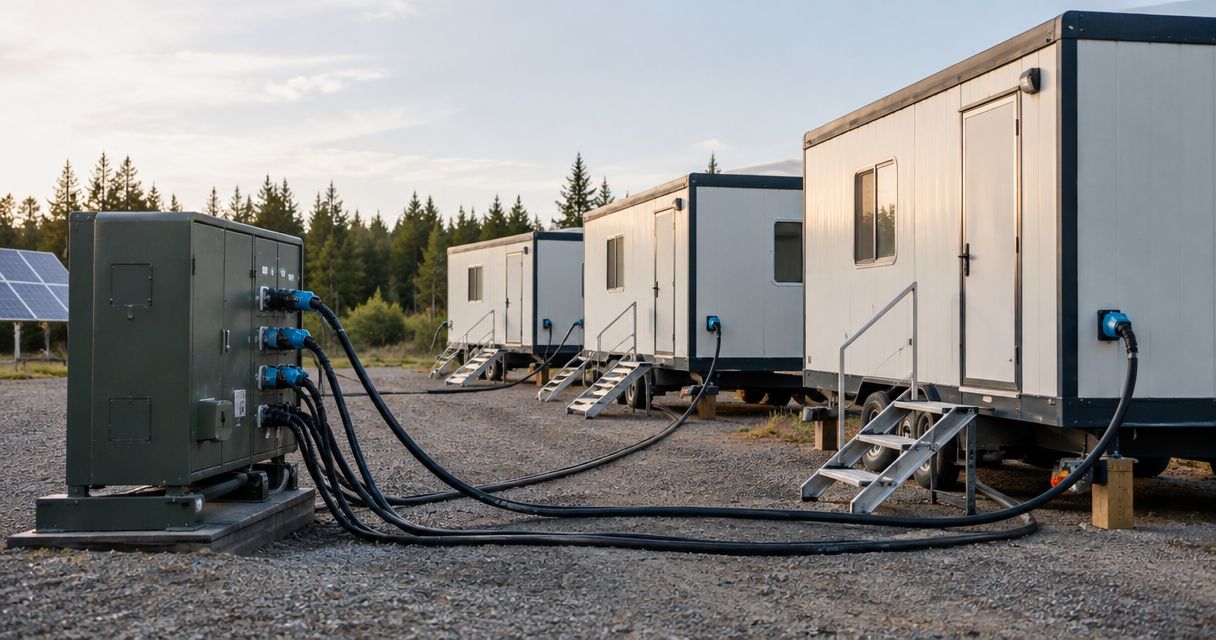
Yes. One electrical service can power multiple man camp trailers when the service has enough calculated capacity and each trailer has a properly designed feeder, protection, and disconnecting arrangement. Trailer count alone does not establish capacity; a licensed electrician must inspect the site and confirm the design with the utility and electrical authority before connections are made.
- Man camp electrical service multiple trailers: yes, with verified capacity, proper distribution, and approval for the installation.
- Eagle Electric provides oilfield electrical contracting for Bakken operators; request a site inspection before adding trailer loads.
- Size the system around heating, cooking, water heating, and shared facilities—not trailer count alone.
- A shared service needs separate trailer feeders and a plan for isolating faults and performing maintenance.
Why this matters
A camp can have empty breaker spaces and still lack the electrical capacity for another occupied trailer. Electric heat, water heaters, kitchen equipment, and laundry loads all affect the calculation. Physical space in a panel is not proof of usable power.
For a 2026 camp expansion, settle the electrical design before placing trailers or committing to occupancy. The guide to electrical panel upgrades for man camps covers the related panel work. Approve the load and distribution plan before treating another trailer connection as a simple hookup.
Can one electrical service power multiple man camp trailers?
Yes. A shared utility service can supply distribution equipment that feeds individual trailers. Each feeder must match the connected equipment, installation conditions, and applicable electrical requirements. The utility must also confirm that its supply can support the proposed camp demand.
There is no safe universal answer such as a fixed number of trailers per service. Sleeping quarters with fuel-fired heat present a different electrical load from trailers with electric space heating, electric water heating, and cooking equipment.
These are the main arrangements to discuss with your electrician and utility:
| Arrangement | Best for | Main advantage | Main limitation |
|---|---|---|---|
| Shared service with individual trailer feeders | A grouped camp with an approved central distribution layout | Centralizes incoming power and distribution | A service-level outage affects every connected trailer |
| Separate utility services | Sites where separate connections suit the utility plan and operating needs | Separates service-level shutdowns | Requires utility approval and separate service infrastructure |
| Shared service with selected backup loads | Camps that need defined loads maintained during utility outages | Limits backup demand to designated equipment | Requires transfer equipment and a clear load-selection plan |
A shared service is suitable only when the entire supply path supports the calculated camp load. That path includes the utility supply, service equipment, distribution equipment, feeders, and trailer connections. Upgrading just the visible panel does not establish that the rest of the system is adequate.
Shared service: separate feeders, not improvised connections
A central distribution arrangement gives each trailer a designed supply path. It also gives the electrician a way to protect and isolate that feeder. Do not connect trailers through improvised cords, adapters, or another trailer's general-purpose receptacles.
A sound distribution plan identifies:
- The incoming service and its verified rating.
- The distribution equipment supplying each trailer.
- The feeder route and destination for every connection.
- The required overcurrent protection and disconnects.
- Grounding and bonding arrangements for the installation.
- Labels that identify the trailer and equipment served.
A fault in one trailer should not require guesswork about which circuit supplies it. Clear feeder identification matters during repairs, trailer moves, and emergency isolation. It also helps keep maintenance work from shutting down unrelated camp facilities unnecessarily.
Separate services: useful when the site plan supports them
Separate utility services are an alternative, not an automatic requirement for multiple trailers. The utility and electrical authority determine what service arrangements are acceptable for the property and its buildings or structures.
The benefit is separation at the service level. Work on one service does not inherently require shutting down another service. The trade-off is additional service infrastructure and coordination; separate meters alone do not establish that every downstream connection is correct.
Choose the arrangement after reviewing the camp layout and operating needs. Do not order equipment on the assumption that the utility will approve the preferred connection method.
Why electrical capacity varies between man camps
The right service design depends on the actual camp, not a trailer-count rule. For a 2026 project, give the electrician current equipment information and the planned operating layout. An old drawing is not enough when equipment or occupancy has changed.
- Heating equipment. Electric resistance heat adds substantial demand. Fuel-fired systems still need electrical power for controls, fans, and associated equipment.
- Water heating and cooking. Electric water heaters, ranges, and kitchen appliances change the load calculation. Record their nameplate ratings rather than estimating from trailer size.
- Shared facilities. Laundry, kitchens, pumps, exterior lighting, and support buildings draw power beyond the sleeping trailers.
- Voltage and phase. The supply must match the equipment. Similar-looking connections do not establish electrical compatibility.
- Feeder distance and routing. Long runs require a voltage-drop evaluation. Burial, exposure, traffic, and physical protection affect the wiring design.
- Future expansion. Additional trailers need a documented capacity check. Spare breaker positions do not reserve power for future buildings.
What must be checked before connecting another trailer?
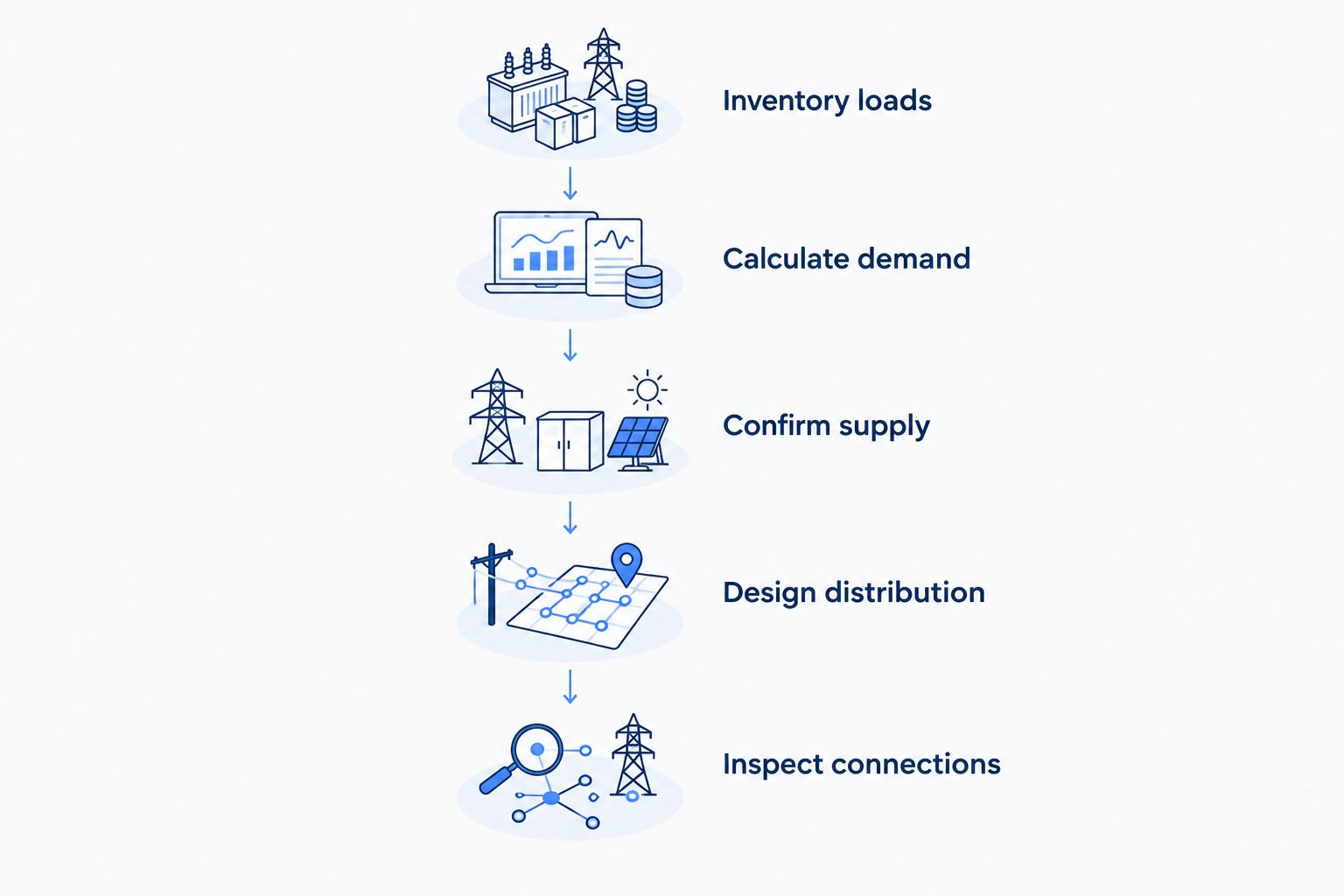
Use this sequence for a new camp or an expansion. These are planning and inspection steps for a licensed electrician—not instructions for opening equipment or making live connections.
- Inventory loads. Identify every trailer and shared facility. Collect equipment nameplate information, including heating, cooling, cooking, and water heating.
- Calculate demand. Have the electrician apply the load-calculation rules appropriate to the installation. Do not simply total breaker handles or assume every trailer draws the same current.
- Confirm supply. Check utility capacity, available voltage and phase, and service-equipment ratings. Confirm the requirements for the proposed installation with the electrical authority.
- Design distribution. Establish feeder sizes, protection, disconnects, routes, grounding, bonding, and equipment ratings. Include the actual distances between supply equipment and trailers.
- Inspect connections. Complete required inspections and testing before occupancy or energization, as applicable. Update the circuit directory and site records to match the finished installation.
The sequence matters. Buying a larger panel before confirming the utility supply can leave you with new equipment and the same capacity problem. Moving trailers before settling feeder routes can also create avoidable conflicts with access roads and other site work.
Does a 200-amp service tell you how many trailers it can supply?
A 200-amp service rating does not establish a trailer count. Current rating is only part of the picture. Voltage, phase, calculated demand, equipment ratings, and feeder conditions also matter.
For example, 120/240-volt single-phase and 120/208-volt three-phase systems have different electrical characteristics. A trailer designed for one supply arrangement must not be assumed compatible with the other. Have the electrician verify the trailer documentation and installed equipment.
Likewise, a 200-amp label on a replacement panel does not prove that the utility connection or service conductors support that rating. Check the whole supply path, not just the label on the panel door.
For your 2026 planning documents, record the verified service characteristics alongside the calculated camp demand. Keep those records with the distribution drawings so the next trailer addition starts with facts.
What safety details matter at each trailer?
Each trailer connection needs more than enough amperage. The electrician must check protection, disconnecting means, grounding, bonding, equipment condition, and suitability for the environment. Temporary occupancy does not remove electrical safety requirements.
Pay particular attention to damaged connectors, exposed wiring, loose equipment, water intrusion, and feeder routes crossed by vehicles. Do not open enclosures to investigate these conditions yourself. Keep people clear of damaged electrical equipment and have a licensed electrician assess it.
Grounding and bonding need specific attention across separate structures. A ground rod is not a substitute for a required equipment grounding conductor. The arrangement must follow the rules that apply to the actual installation.
An oilfield location also needs a review of any nearby classified areas. Do not assume every camp area is hazardous, or that ordinary equipment is acceptable everywhere. The oilfield electrical code compliance guide addresses the broader site-compliance questions.
Can backup power support the same trailers?
Backup power can serve a shared camp distribution system when the generator, transfer equipment, and connected loads are designed together. The utility service rating does not establish the generator capacity required. Starting loads and the equipment selected for backup affect that design.
Decide what must remain powered before selecting equipment. Heating controls, water systems, lighting, and refrigeration need to be identified by their actual loads—not grouped under an undefined request to keep the camp running.
A selected-load backup plan limits what receives generator power. Its limitation is equally clear: equipment outside that plan will not be supported. Transfer equipment must prevent an improper connection between utility and generator sources; never improvise a backfeed connection.
What should you send with a quote request?
Send a camp layout, trailer equipment information, the proposed occupancy plan, and any existing electrical drawings. Include planned additions and shared facilities. Photos of accessible exterior labels can help, but they do not replace an on-site inspection.
For a 2026 expansion, distinguish existing equipment from proposed equipment. Identify which trailers are moving, which loads are changing, and whether backup power is part of the scope. Ask for a clear written quote that identifies the work included and the approvals required.
Eagle Electric provides oilfield electrical contracting for Bakken operators who need licensed electrical work. Request a same-business-day response to your quote request and a clear written quote. An on-site inspection establishes what the camp connection requires; a response to an inquiry is not a promise of same-day completion.
Request a camp electrical quote
Ask Eagle Electric for a same-business-day response and a clear written scope for your camp connection.
FAQ
Can one meter supply several man camp trailers?
One meter can serve a shared electrical distribution arrangement when the utility and electrical authority approve it. The meter does not establish capacity; the service and each trailer feeder still need proper design and protection.
How many trailers can a 200-amp service handle?
A 200-amp service does not correspond to a fixed number of trailers. A licensed electrician must calculate demand from the actual equipment and verify voltage, phase, service capacity, and feeder requirements.
Does every man camp trailer need its own utility service?
Every trailer does not automatically need a separate utility service. A shared service with individual feeders is an option when the installation meets utility requirements and applicable electrical rules.
Can I connect another trailer if the panel has spare breakers?
Spare breaker positions do not prove that the service has capacity for another trailer. Have a licensed electrician check the added demand, feeder requirements, and existing equipment before connecting it.
Can I run power to a trailer through another trailer?
Do not improvise a trailer supply through another trailer's general-purpose receptacles or adapters. Have a licensed electrician design and approve the distribution arrangement for the site.
Will one electrical fault shut down the whole camp?
A service-level failure can interrupt every trailer supplied by that service. Proper feeder protection and a reviewed distribution design help isolate faults, but sharing a service does not provide independent utility supplies.
What should a man camp electrical quote include?
A man camp electrical quote should identify the proposed distribution work, trailer connections, equipment, and approval responsibilities. Ask for a clear written scope based on an on-site inspection and the planned camp loads.
One last thing
The next trailer is not always the load that causes trouble. A replacement electric water heater, added laundry equipment, or changed heating system can alter demand without changing the trailer count.
For your 2026 camp records, track equipment changes as well as trailer additions. Require a load review before approving either. That keeps the electrical plan tied to what the camp actually uses.