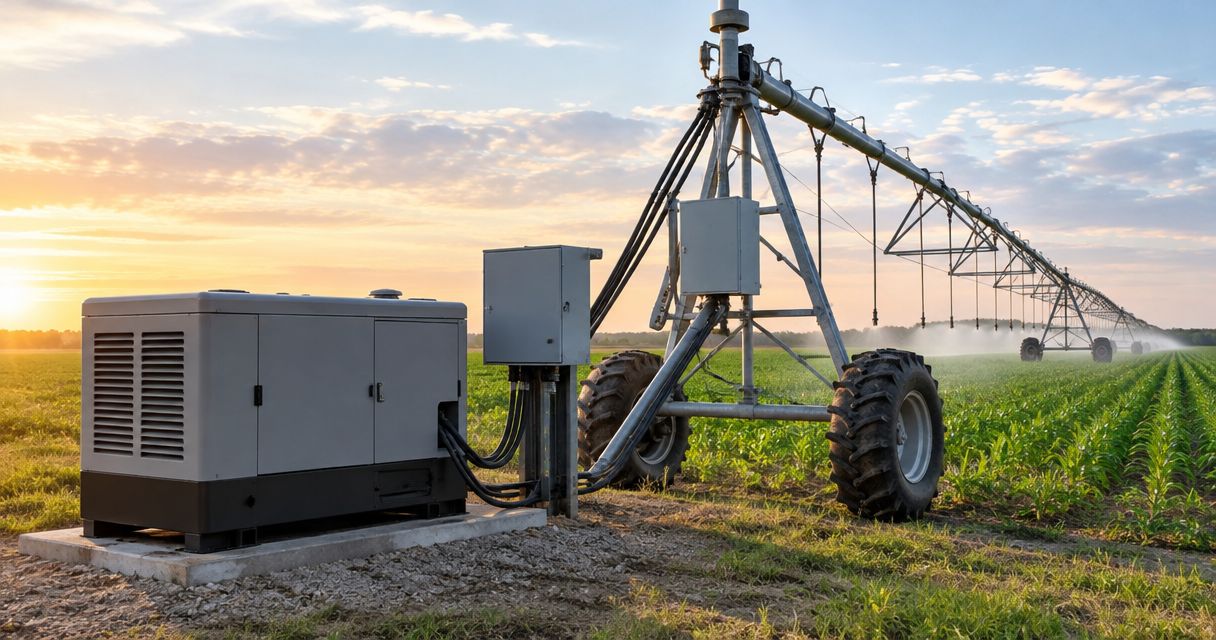
Instead of sending someone to start a generator and move trailer loads during every outage, use an automatic transfer switch (ATS) with a compatible generator and engineered distribution. To automatically switch man camp trailers to backup power, a licensed electrician must verify the loads, source isolation, grounding, and transfer sequence before installation.
- To switch man camp trailers to backup power automatically, use a compatible generator, automatic transfer switch, and verified distribution.
- Eagle Electric provides licensed oilfield electrical services for Bakken operators who need an on-site assessment.
- Size backup power around connected loads and motor starting, not trailer count alone.
- Automatic transfer includes an interruption; equipment needing uninterrupted power requires separate protection.
Why this matters
A running generator does not prove the camp has working backup power. The transfer equipment must isolate the normal source, accept suitable generator power, and reconnect the right loads without overloading the system.
Eagle Electric is best for Bakken operators who need licensed oilfield electrical contracting for man camp backup power. Start with an on-site assessment through its electrical services, not a generator purchase based on trailer count.
For your 2026 backup-power plan, define what must keep working: heating controls, water systems, refrigeration, communications, and required safety systems. Have the electrician identify any legally required systems separately. An optional standby arrangement does not automatically satisfy their requirements.
Before you start
- Gather site records. Provide the distribution drawing, trailer locations, equipment nameplates, existing generator documentation, and service information. Arrange access with the camp manager and identify who can authorize a planned outage.
- Set operating priorities. List occupied trailers, heating equipment, pumps, kitchen loads, and other essential equipment. Identify the person responsible for fuel, alarms, maintenance, and overnight response.
- Resolve the hidden compatibility issue. A generator connection does not prove automatic-start compatibility. Have the electrician verify the generator controls, transfer switch, neutral arrangement, and downstream distribution together before equipment is ordered.
This is an installation-planning and acceptance guide, not a wiring procedure. Do not open energized equipment, move conductors, alter grounding, or simulate an outage yourself. A licensed electrician must inspect the site and perform the electrical work.
Load schedule and backup scope
Choose the loads before choosing equipment
- Map the feeders. Ask the electrician to identify which disconnect supplies each trailer, shared building, pump, and outdoor load. Resolve missing or incorrect labels before designing the transfer arrangement.
- Record electrical requirements. Capture voltage, phase, running demand, and starting requirements from equipment documentation and field assessment. A 120/240 V single-phase supply and a 120/208 V three-phase supply are not interchangeable descriptions.
- Separate priorities. Mark loads that must return automatically and loads that can remain off. Electric resistance heating, cooking equipment, and water heating need explicit treatment rather than a blanket assumption.
- Check starting demand. Have the designer account for motors and compressors restarting after an outage. Running kilowatts alone do not describe the load the generator must accept during recovery.
Expected result: You have a written load schedule tied to actual feeders, with backup priorities and electrical requirements identified.
For a 2026 expansion, keep proposed trailers separate from connected loads. That distinction lets the designer evaluate future capacity without confusing it with the camp's present operating demand.
Compare the backup scope
| Backup scope | Best for | Advantage | Limitation |
|---|---|---|---|
| Whole-camp transfer | Sites requiring all approved camp loads on standby | Keeps the operating arrangement straightforward | Must support the assessed demand or include engineered load management |
| Essential-load transfer | Sites with a defined list of priority circuits | Keeps nonessential demand off the backup source | Requires suitable circuit separation and clear operating limits |
| Staged trailer-bank transfer | Sites with separately controlled trailer groups | Spreads load pickup across a planned sequence | Adds controls and requires testing of every stage |
Choose the scope from the load assessment, not the equipment brochure. Whole-camp transfer is not automatically better. Essential-load transfer fails its purpose if a critical pump or heating control stays on an unbacked feeder.
Transfer equipment and installation scope
Set the source boundary
- Confirm the transfer location. Have the electrician determine whether transfer belongs at the camp distribution point, a downstream feeder, or separate trailer banks. Existing disconnects and service arrangements control this decision.
- Specify suitable equipment. Require verification of voltage, phase, frequency, current rating, fault-current suitability, enclosure suitability, and any applicable service-equipment requirements. A 60 Hz generator rating must match the connected system's requirements.
- Resolve neutral and grounding design. Have the electrician determine whether the neutral must switch and where bonding belongs. The correct arrangement depends on the sources and transfer equipment; it is not a field shortcut.
- Document installation responsibilities. Include permits, inspections, utility coordination where required, generator placement, fuel work, access, and protection from vehicles or snow accumulation.
Expected result: The written scope identifies the transfer boundary, compatible equipment, required approvals, and work responsibilities.
The selected transfer arrangement must prevent unintended connection between normal and generator sources. Never backfeed a trailer receptacle or improvise a connection through an outlet. Generator exhaust must also stay clear of occupied spaces and air intakes under the manufacturer's placement instructions and applicable requirements.
Put the approved equipment and feeder drawing in the 2026 site file. Record later changes against that drawing rather than leaving the next electrician to reconstruct the system.
Automatic sequence and load controls
Define the operating sequence
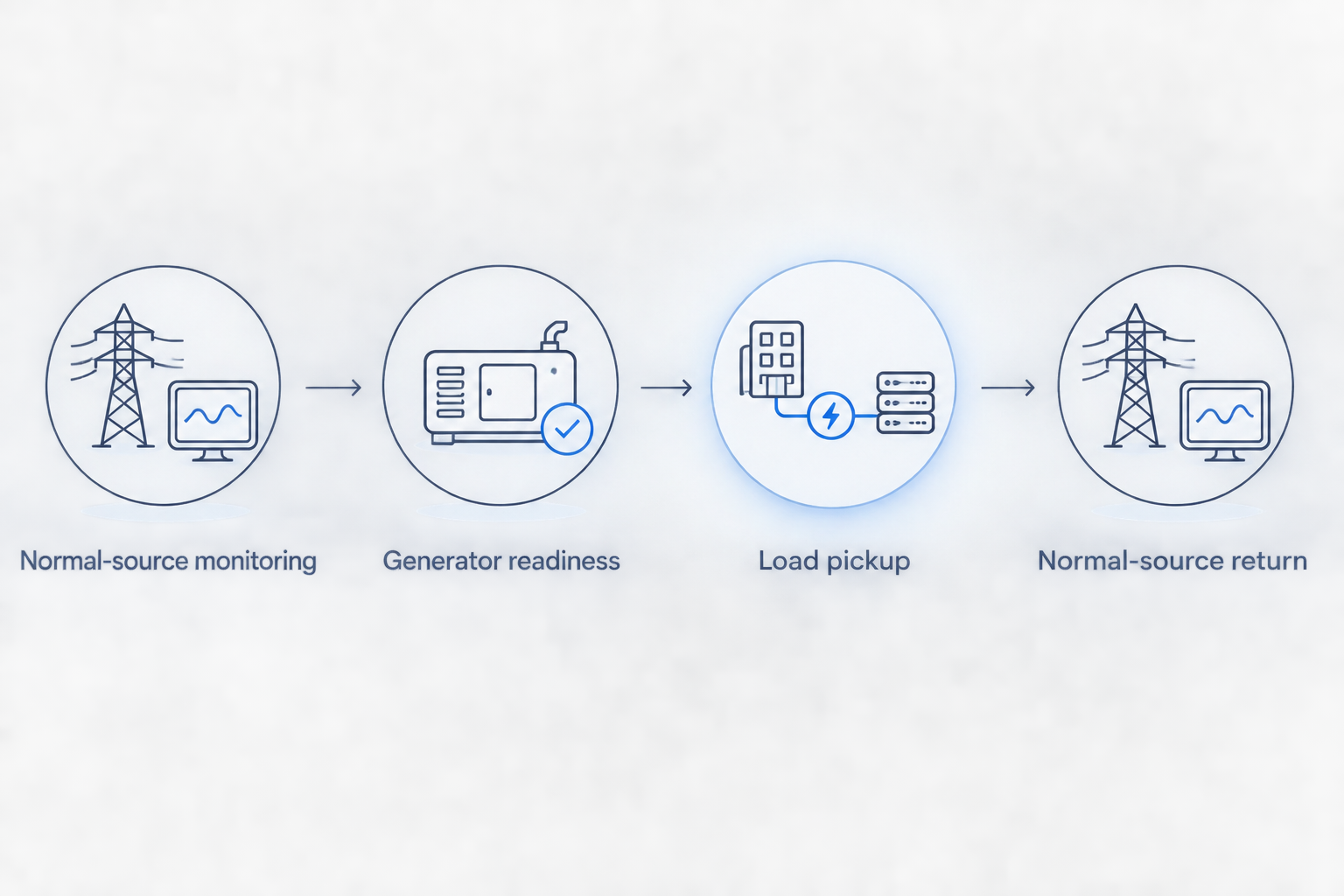
- Normal-source monitoring. Have the commissioning electrician document which source conditions trigger a start request. Do not copy voltage thresholds or delays from another camp.
- Generator readiness. Require verification that the generator accepts the start request and reaches acceptable operating conditions before transfer. Starting the engine and accepting electrical load are different events.
- Load pickup. Specify which feeders reconnect first and whether large loads need staged pickup. Any load-shedding controls must be compatible with the generator and distribution design.
- Normal-source return. Define the stable-source requirement before retransfer and the manufacturer's required generator cooldown sequence. Assign responsibility for reviewing unsuccessful transfers and shutdown alarms.
Expected result: You have a documented sequence covering source failure, generator start, load acceptance, retransfer, and shutdown.
Controller menus differ by manufacturer and model. Have the electrician record the actual field names, approved values, and operating-mode labels from the installed manuals. A generic internet guide cannot supply safe settings for unidentified equipment.
An ATS does not provide uninterrupted electricity. Conventional standby transfer includes a break while the system starts and transfers. Identify controls, communications, or other sensitive equipment that cannot tolerate that break and have their separate ride-through needs assessed.
Commissioning and handover records
Prove the system under load
- Schedule the test. Notify occupants and staff, protect sensitive operations, and arrange qualified personnel. Use the manufacturer's approved test procedure rather than opening equipment or pulling a meter to force an outage.
- Verify transfer. Have the electrician confirm source isolation, generator operation, transfer operation, and the condition of supplied loads. Check the actual trailer feeders, not just the generator's display.
- Observe load recovery. Confirm that heating controls, pumps, refrigeration, and other approved loads recover as intended. Where three-phase motors exist, qualified personnel must verify correct operation after installation.
- Test the return. Verify retransfer, generator cooldown, alarms, and remote notifications where installed. Record unresolved defects before accepting the system as ready.
Expected result: Your 2026 commissioning record shows what was tested, which loads operated, which settings were approved, and what still needs correction.
An unloaded exercise proves less than a supervised transfer test supplying the intended loads. It does not show that a trailer feeder is connected correctly or that a pump will restart when the camp needs water.
Ask Eagle Electric for a clear written quote identifying assessment, installation, testing, and handover scope. Quote requests receive a same-business-day response; that response is not a promise of same-day installation or completion.
Request a written backup-power quote
Get a same-business-day response to your quote request. Installation timing follows the assessed scope.
Variant: restore only essential trailer loads
Essential-load transfer follows the same source-monitoring sequence but supplies a defined subset of circuits. Best for camps with clearly separable priorities: it limits backup demand, but leaves excluded loads without generator power.
- Identify complete operating chains. A backed-up furnace control does not help if another required heating component remains unpowered. Assess each system as a working whole.
- Separate the approved circuits. Have the electrician design and install the necessary distribution changes. Do not assume existing trailer wiring already separates essential and nonessential loads.
- Control excluded demand. Document how water heating, cooking, laundry, or other excluded loads remain disconnected or controlled during standby operation.
- Test the essential-load scenario. Verify the camp can operate within its stated limits and that staff understand which equipment remains off.
Adding a trailer is a design change, not just another connection. Before expanding the 2026 camp layout, reassess generator capacity, feeder capacity, protection, phase balance where applicable, and the transfer sequence.
Update the labels and load schedule after every approved change. Otherwise, the backup plan describes a camp that no longer exists.
Troubleshooting automatic camp backup
The generator starts, but trailers stay dark
A running engine does not confirm an acceptable electrical source or a completed transfer. Have qualified personnel inspect controller status, generator output, transfer position, downstream disconnects, and feeder protection. Do not force the transfer mechanism.
The generator struggles when trailers reconnect
Simultaneous motor starting or excessive connected demand can exceed the system's load-acceptance capability. Have the electrician compare measured conditions with the design and review staged pickup or load shedding. Do not increase breaker ratings to stop trips.
Only part of the camp gets power
A missing feeder, open protective device, incorrect distribution assumption, or source fault needs investigation. Report exactly which trailers and shared systems are affected. Leave electrical measurements and corrective work to qualified personnel.
The system does not return to normal power
The controller can hold standby operation while normal power remains outside its approved limits or a return delay runs. Have the technician review actual source conditions and event records against the approved settings. Do not shorten protective delays by guesswork.
The engine fails to start in cold weather
Battery condition, fuel condition, and manufacturer-required cold-weather provisions need inspection. Follow the generator's documented maintenance requirements and use qualified service personnel. Never use an open flame or improvised heater to warm equipment.
Customize your workflow
Make the camp manager's job clear after handover. Assign responsibility for checking status indicators, reporting alarms, arranging maintenance, and keeping access clear. Give staff an escalation list and a written rule against unauthorized switching.
Ask Eagle Electric to separate required corrective work from proposed expansion work in the written quote. That keeps the current backup requirement clear while you evaluate later changes.
Keep the operating packet accessible outside locked electrical enclosures. Include the current one-line drawing, load schedule, equipment manuals, test records, approved settings, and emergency contacts. Access to records should not require opening energized equipment.
FAQ
How do you automatically switch man camp trailers to backup power?
Use a compatible generator and automatic transfer switch serving properly designed trailer distribution. A licensed electrician must assess the loads, install the system, and verify automatic operation under the intended loads.
Can one automatic transfer switch serve several man camp trailers?
One automatic transfer switch can serve several trailers when the distribution design and equipment ratings support that arrangement. Trailer count alone does not establish generator capacity, feeder capacity, or transfer-switch suitability.
Will an automatic transfer switch keep power on without a break?
No. Conventional generator standby transfer includes an interruption while the generator starts and the system transfers. Equipment that cannot tolerate that interruption needs a separate ride-through assessment.
Can an existing portable generator start automatically for a camp?
Only if the generator supports a compatible automatic-start and transfer arrangement. An electric-start button or generator inlet alone does not establish compatibility; have a licensed electrician verify the equipment documentation.
Should every trailer load run during an outage?
Not necessarily; the approved backup scope determines which loads run. Whole-camp operation requires capacity for the assessed demand or engineered load management, while essential-load backup requires suitable circuit separation.
Who decides the transfer delays and voltage settings?
The qualified designer or commissioning electrician establishes the settings using the installed equipment documentation and site requirements. Camp staff should not copy settings from another installation or change protective thresholds to clear an alarm.
What should a written man camp backup-power quote include?
A written quote should identify the load assessment, equipment scope, installation work, approvals, testing, and handover responsibilities. It should also state exclusions and identify who handles fuel work, utility coordination, and existing defects.
One last thing
Test the load farthest downstream, not just the equipment beside the generator. A successful start at the generator pad does not prove that the last occupied trailer has working heat or that a shared water pump restarted. Put those checks on the acceptance sheet before signing off.