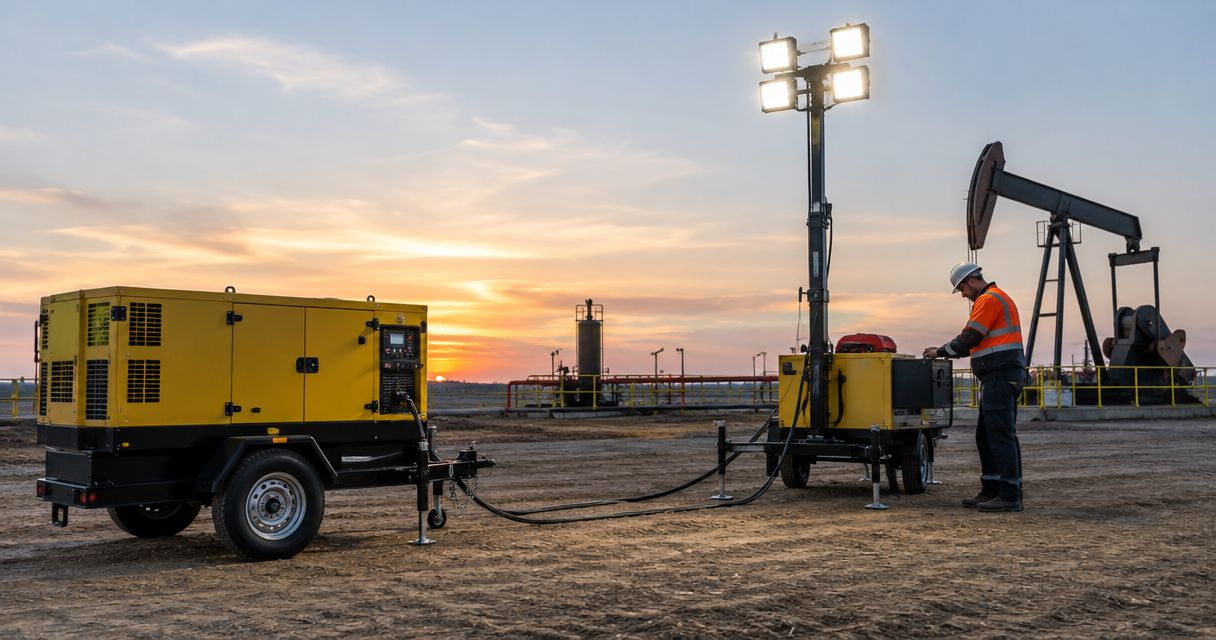
Instead of improvising a generator hookup every time a light tower moves, use a documented connection plan that matches the tower’s input, generator output, and oilfield location classification. Have a licensed electrician approve the setup before authorized personnel connect equipment under the manufacturer’s instructions and site procedures.
- To connect light towers to generator power oilfield crews must confirm electrical ratings, location classification, and approved connections.
- Eagle-Elc provides oilfield electrical contracting for Bakken operators who need a licensed contractor.
- A matching plug does not prove voltage, grounding, or hazardous-location compatibility.
- Use an approved distribution plan for multiple towers; never improvise adapters or defeat protective devices.
Why this matters
A light tower can accept the wrong supply through an improvised adapter and still appear ready to run. The risks include equipment damage, shock, fire, and ignition where flammable gas or vapor is present. Getting light onto the work area is not proof that the connection is safe.
Eagle-Elc is best for Bakken operators who need a licensed contractor for oilfield electrical work. The company’s electrical services include oilfield contracting for operators across the region.
For your 2026 temporary-power plan, treat each tower relocation as a setup change. A different cable route, generator, or classified-area boundary can invalidate the previous arrangement. This guide covers planning, inspection, and controlled startup—not field wiring instructions.
Before you start
- Gather the equipment records. Obtain the generator manual, tower manual, readable nameplates, connector information, and site electrical drawings. Confirm that the tower accepts external power; an onboard generator does not establish that capability.
- Arrange qualified oversight. Identify the licensed electrician, authorized equipment operator, and person responsible for site safety. Have the site’s hazardous-area classification and applicable work authorization ready before equipment arrives.
- Resolve the hidden gotcha: grounding and bonding. Generator neutral configuration, distribution equipment, and protective devices must work together. A grounding rod is not a universal fix, and a plug that fits does not establish a correct grounding arrangement. Leave that determination to the electrician.
If labels are missing, manuals conflict, or the classified-area boundary is unclear, stop the hookup. An on-site inspection is needed before anyone selects adapters, changes connections, or energizes the tower.
Equipment and site configuration
Confirm the supply requirements
- Identify the tower input. Record the required voltage, frequency, phase, current, and connection method from the tower nameplate and manual. Distinguish the external supply inlet from accessory receptacles and any power-export connection.
- Match the generator output. Have the electrician verify the actual output configuration against the tower requirements. A 120 V input is not interchangeable with a 240 V supply. If the tower requires 60 Hz, confirm that requirement against the generator documentation.
- Account for the whole load. Include every tower and other connected equipment. Use the manufacturer’s operating and starting requirements, not lamp wattage alone, when checking generator capacity and circuit loading.
- Check the operating location. Have the site safety lead and electrician confirm where the generator, tower, distribution equipment, and connectors can be placed. Equipment suitability must match the location classification and environmental exposure.
Expected result: You have a written equipment match and approved placement plan. No one is relying on connector appearance, rental-yard familiarity, or a previous job’s setup.
Choose the connection arrangement
The simplest arrangement is not automatically the correct one. Use the tower manual, generator documentation, and site requirements to choose between a direct connection and temporary distribution.
| Arrangement | Best for | Practical advantage | Limitation |
|---|---|---|---|
| Direct connection | A tower with a compatible, manufacturer-approved generator connection | Fewer connection points to inspect | Still requires verified ratings, protection, grounding, and cable selection |
| Temporary distribution | Multiple towers or separated lighting areas | Provides a defined way to supply and protect individual circuits | Adds distribution equipment, connectors, inspection points, and load-planning work |
Use a direct connection only when the complete arrangement is approved. Temporary distribution is the better fit when the site layout requires separate protected circuits, but it is not permission to add towers without checking capacity.
Cable route and protection configuration
Prepare the distribution path
- Have the electrician select the cable assembly. Selection must account for current, length, voltage drop, temperature, physical exposure, and connector ratings. Do not choose a cable by jacket thickness or connector shape.
- Plan the route. Keep cables clear of vehicle paths, sharp edges, hot surfaces, standing water, and moving equipment. Where crossings cannot be avoided, use protection approved for the traffic and site conditions.
- Inspect accessible parts while de-energized. Look for damaged jackets, exposed conductors, loose connector bodies, missing covers, contamination, and signs of overheating. Remove damaged assemblies from service rather than covering defects with tape.
- Confirm circuit protection. Have the electrician verify overcurrent protection and any required ground-fault circuit-interrupter protection. Verify the grounding and bonding arrangement for the complete system. Never bypass a protective device to keep lights running.
Expected result: The approved route protects the cable, the connections suit the environment, and each circuit has the protection required for its application.
For a 2026 setup record, document the route and equipment identifiers before startup. Photographs help the next shift recognize changes, but photographs do not replace electrical verification.
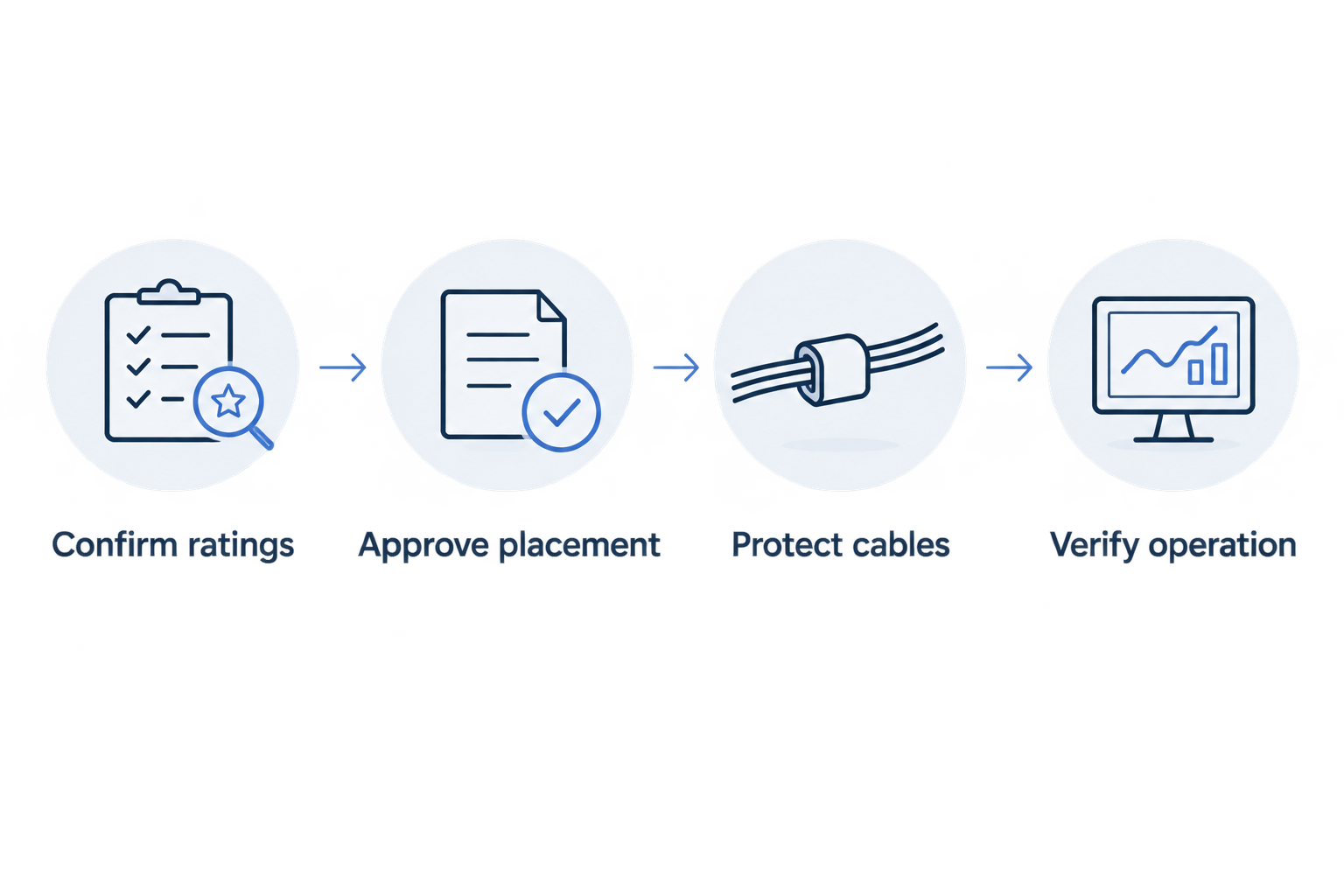
The sequence matters. A sound cable does not correct the wrong supply, and the correct supply does not make ordinary equipment suitable for a classified location. Keep both checks in the same work plan.
For the wider site requirements, use the guide to electrical code compliance for oilfield sites. Have the electrician and authority having jurisdiction resolve which requirements apply to the actual installation.
Connection and startup configuration
Complete the controlled connection
- Establish the safe work condition. Have authorized personnel follow the site’s shutdown, isolation, and lockout/tagout procedures where applicable. A qualified person must verify the required de-energized condition before connection work begins. A stopped engine alone does not prove isolation from every source.
- Make only approved connections. Have authorized personnel connect compatible, inspected cord assemblies under the equipment instructions. Hardwired terminations, distribution changes, and grounding or bonding modifications belong to qualified electrical personnel. Do not improvise adapters or use male-to-male cords.
- Restore covers and clear the area. Confirm that connectors are properly secured and protected as designed. Check that personnel, tools, and loose materials are clear before the authorized operator begins startup.
- Start under the manufacturer’s sequence. Follow the generator and tower manuals for startup, stabilization, and load application. Do not copy a control sequence from another model. Switch names and operating sequences differ between equipment.
- Verify operation under load. Have the electrician verify supply conditions using appropriate instruments and safe work practices. Watch for protective-device operation, unstable lighting, abnormal sound, odor, or visible damage. Stop operation if an unsafe condition appears.
Expected result: The tower operates on a verified supply without unresolved faults, and the operator knows the normal shutdown and emergency response procedures.
Record the approved startup sequence in the 2026 shift handover. Keep it with the actual equipment identification so a replacement generator does not silently inherit the wrong instructions.
Request an oilfield electrical quote
Get a same-business-day response to your quote request and a clear written quote for the proposed work.
Eagle-Elc provides oilfield electrical contracting across the Bakken region. Include tower and generator nameplates, the proposed layout, and known site restrictions with your request. A quote response is not a promise of same-day job completion; the connection plan still needs the right site information.
Variant: supply multiple towers from one generator
A shared generator can serve multiple towers only when the equipment ratings, distribution design, and operating loads support that arrangement. More receptacles do not establish more usable capacity.
- Build a load schedule. List each tower and every other connected load. Have the electrician check operating demand, starting behavior, circuit limits, and phase loading where applicable.
- Assign approved circuits. Identify which distribution circuit serves each tower. Do not daisy-chain towers unless their manufacturer expressly permits that configuration within stated limits.
- Set the startup sequence. Follow equipment instructions and the approved load plan rather than switching every load on together. Assign responsibility for adding or removing equipment.
- Recheck after changes. Treat an added tower, longer cable, or replacement generator as a change requiring review. Update the circuit identification and handover record.
Expected result: Each tower has an identified supply path, and the operator knows which loads the arrangement is approved to carry.
The trade-off is shared dependence. A generator fault can darken every tower it supplies. Have the site safety lead plan independent lighting where loss of illumination would compromise safe shutdown or escape.
Troubleshooting
The generator runs, but the tower stays dark
Check the documented operating sequence and accessible status indications without opening electrical enclosures. Confirm that the tower is designed for external power and that the correct input is being used. Have the electrician investigate missing supply, incorrect configuration, or equipment faults; do not probe live connectors yourself.
A breaker or GFCI trips
Stop and investigate instead of repeatedly resetting it. Overload, damaged insulation, wet connectors, equipment faults, or an unsuitable grounding arrangement can cause protective devices to operate. Have the electrician identify the cause. Do not install a larger breaker, remove a ground connection, or defeat GFCI protection.
Lights flicker or the generator struggles
Remove the affected setup from operation using the approved shutdown procedure. Have qualified personnel check the load schedule, generator condition, supply quality, connections, and voltage drop. Adding cable length or another load can change an arrangement that previously worked.
A connector smells hot or shows discoloration
Stop using the affected circuit and keep personnel clear. Have authorized personnel isolate it before inspection. A qualified person must assess the connector, cable, and connected equipment; a connection that still passes power is not necessarily safe.
The tower moves into a different work area
Recheck the location classification, cable route, equipment placement, and lighting coverage before restarting. A move near production equipment or a potential release point needs site-specific review. Ordinary outdoor equipment is not automatically hazardous-location equipment.
Customize your workflow
Build a repeatable package for your 2026 lighting deployments: equipment identification, approved connection arrangement, load schedule, routing sketch, inspection record, and shutdown instructions. Keep the package short enough for the operator to use at the generator.
Make reassessment triggers explicit. Require review when a generator changes, a tower moves, cable length changes, another load is added, or site conditions change. Do not let a familiar-looking replacement bypass the checks.
Eagle-Elc oilfield electrical services cover the contractor role for Bakken operators. Your site lead still controls work authorization, equipment access, and operating restrictions. Put those responsibilities in writing before the hookup starts.
FAQ
Can I connect a light tower directly to a generator?
Yes, when the tower accepts external power and the complete connection arrangement meets the equipment instructions and site requirements. A licensed electrician must verify electrical compatibility, protection, grounding, and location suitability before use.
Can one generator power several oilfield light towers?
Yes, if its usable output and the approved distribution system support the complete load. Have an electrician check circuit limits, starting requirements, cable selection, and phase loading where applicable.
Does a matching plug mean the light tower is compatible?
No. Connector fit does not establish correct voltage, frequency, phase, grounding, or hazardous-location suitability. Verify the nameplates, manuals, and complete connection arrangement.
Do generator-powered light towers always need a grounding rod?
No, a grounding rod is not a universal requirement or a universal solution. The electrician must determine the grounding and bonding requirements for the generator, connected equipment, distribution arrangement, and applicable rules.
Can I use an ordinary light tower near oilfield production equipment?
Only if the equipment is suitable for the actual location classification and operating conditions. Have the site safety lead and electrician confirm placement; ordinary weather resistance does not establish hazardous-location suitability.
Why does the GFCI trip when I connect a tower?
A trip requires investigation, not a bypass. Damaged insulation, moisture, equipment faults, or an unsuitable system arrangement can be involved; have qualified electrical personnel find and correct the cause.
What should a 2026 light-tower connection record include?
Include equipment identification, verified supply requirements, the approved load and routing plan, inspection results, and startup and shutdown instructions. Update the record whenever equipment, placement, or connected loads change.
One last thing
Record what must not be connected, not just what can be connected. An unused receptacle invites someone to add another load. Mark the approved circuit use and leave clear instructions for getting changes reviewed before the next shift plugs anything in.