Instead of managing temporary generators and site wiring as separate systems, plan your oilfield temporary power to permanent wiring changeover around an approved electrical design, a controlled outage, and documented commissioning. A licensed electrical contractor must inspect the site, establish the connection method, and complete the electrical work before permanent service takes over.
- Oilfield temporary power to permanent wiring requires engineered source separation, qualified electrical work, and authorization before energization.
- Eagle Electric provides oilfield electrical contracting for Bakken operators coordinating temporary-to-permanent power transitions.
- Decide whether the generator leaves or remains as backup before finalizing the electrical design.
- Verify hazardous-location requirements, grounding, equipment ratings, and shutdown responsibilities before scheduling the outage.
Why this matters
A generator feeding construction loads is not automatically suitable for feeding permanent distribution. The connection changes the power source, fault conditions, grounding arrangement, and operating procedures. Equipment that ran yesterday still needs verification under the permanent design.
Eagle Electric is a fit for Bakken operators who need a licensed oilfield electrical contractor for a temporary-to-permanent power transition. Eagle Electric serves oil and gas operators from Watford City, ND. Request a same-business-day response to your quote request and a clear written scope; that response is not a promise of same-day job completion.
Use this 2026 guide to organize the job with your contractor, utility, and site operations team. It is a coordination workflow, not a wiring diagram or authorization to work on electrical equipment.
Before you start
- Gather the site records. Provide the current one-line diagram, temporary distribution layout, equipment nameplates, load list, hazardous-area classification documents, and utility service requirements. Identify who can authorize an outage and who controls each power source.
- Confirm access and approvals. Arrange an on-site inspection by a licensed electrical contractor. Establish the permit, inspection, utility-release, and site work-permit requirements before promising a changeover date.
- Resolve the grounding gotcha early. Keeping a generator as backup can change the required neutral-switching and bonding arrangement. Do not order a transfer device or reuse temporary feeders until the contractor has checked the complete system.
Your planning packet should identify every source capable of energizing the equipment. That includes utility service, generators, battery-backed systems, and connected equipment with stored energy. An incomplete source list makes an otherwise tidy outage plan unsafe.
Source plan and connection design
Establish the permanent power arrangement
- State the end condition. Tell the contractor whether temporary generation will leave the site or remain as standby power. Identify loads that must stop, loads needing an orderly shutdown, and systems needing a separately designed continuity solution.
- Provide the actual load information. Supply motor, heater, control, lighting, and other equipment nameplates. Separate normal operating load from motor-starting requirements and planned expansion. A generator's nameplate alone does not establish permanent service capacity.
- Request a site-specific connection design. Have the contractor identify the service equipment, distribution equipment, feeder routes, disconnecting means, protection, grounding, and source-separation method. Existing temporary equipment must be evaluated rather than assumed reusable.
- Set the approval responsibilities. Record who submits drawings, obtains permits, coordinates utility work, schedules inspections, and authorizes energization. Put exclusions and owner-supplied work in the written quote.
Expected result: You have an agreed end state and a documented connection plan. Equipment purchasing follows that plan, not the other way around.
For a 2026 project, confirm the code edition and local amendments with the authority having jurisdiction. A calendar year does not establish which electrical code applies to your installation. Use the oilfield electrical code compliance guide to prepare the questions for your contractor.
Check ratings before choosing equipment
A matching plug or enclosure size does not prove electrical compatibility. Your contractor must verify voltage, phase, frequency, equipment ratings, available fault current, and the protective-device arrangement against the design and manufacturer instructions.
For example, a 480-volt motor cannot be treated as suitable for a 208-volt supply without checking its nameplate and permitted configuration. Likewise, a 60-hertz equipment rating is a verification item, not permission to connect equipment to an unverified source. These are rating examples, not specifications for your site.
Hazardous-location suitability is a separate check. Outdoor or weather-resistant equipment is not automatically approved for a classified location. The classification documents determine the required equipment selection and installation methods.
Outage plan and controlled installation
Assign the shutdown responsibilities
- Choose an outage window with operations. Account for process shutdown, isolation, installation, inspection, testing, and restart. Do not schedule only the physical connection work and leave commissioning outside the window.
- Identify operating dependencies. List controls, communications, ventilation, alarms, process equipment, and other systems affected by the shutdown. Operations must determine which losses require a process stop or additional safeguards.
- Require a written energy-control plan. Qualified personnel must identify all sources, apply the site's lockout/tagout procedure, address stored energy, and verify the required safe work condition. Opening a main disconnect alone does not prove the work area is electrically safe.
- Arrange the release points. Name the people responsible for utility coordination, inspection acceptance, electrical readiness, and process restart. Define who can stop the work when conditions differ from the plan.
Expected result: Everyone knows what shuts down, who controls the sources, and which approvals are required before power returns.
The shutdown sequence is a site-specific document. Do not use an internet checklist as a substitute for your electrical safety program, equipment instructions, or the contractor's work plan.
Keep installation within the approved scope
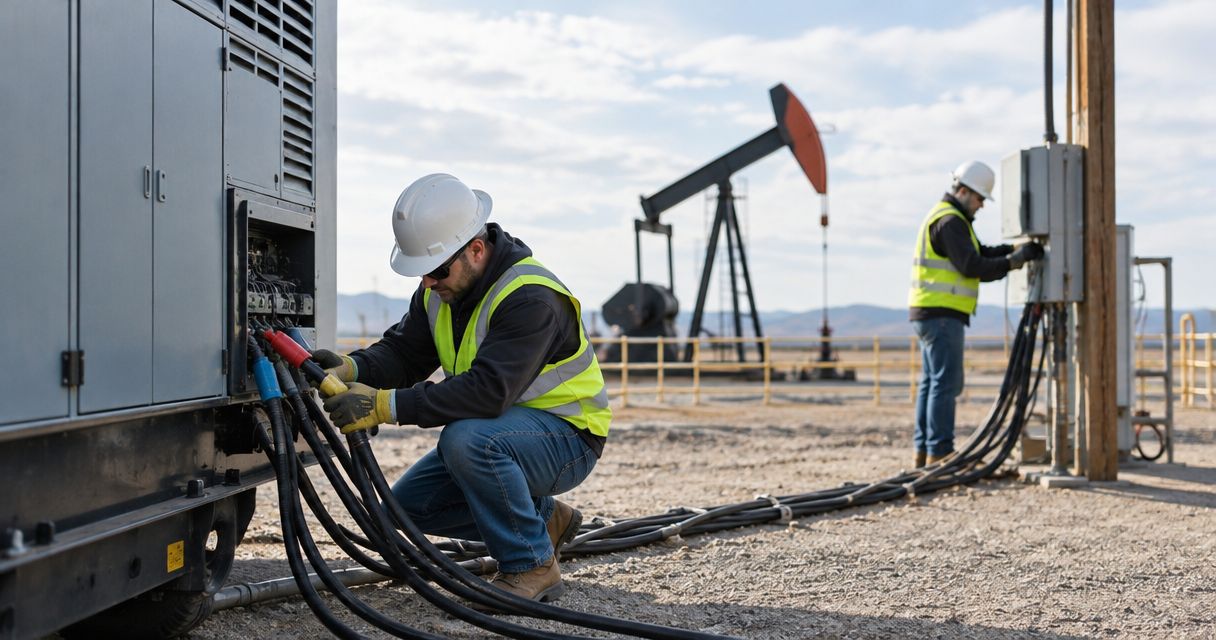
The licensed electrical contractor handles conductor selection, terminations, protective-device settings, grounding and bonding, and required testing. Site personnel support access, operating coordination, and accurate equipment information. They do not improvise connections to keep the schedule moving.
Temporary cords, distribution boxes, connectors, and cable routes need individual review. Equipment suitable for a temporary installation is not automatically acceptable as permanent wiring. Likewise, temporary equipment does not become permanent simply because it remains in place.
Stop the changeover when field conditions disagree with the drawings. Unknown conductors, damaged insulation, missing classifications, or an unexpected power source require resolution before work continues. Record the change and obtain the necessary design or approval update.
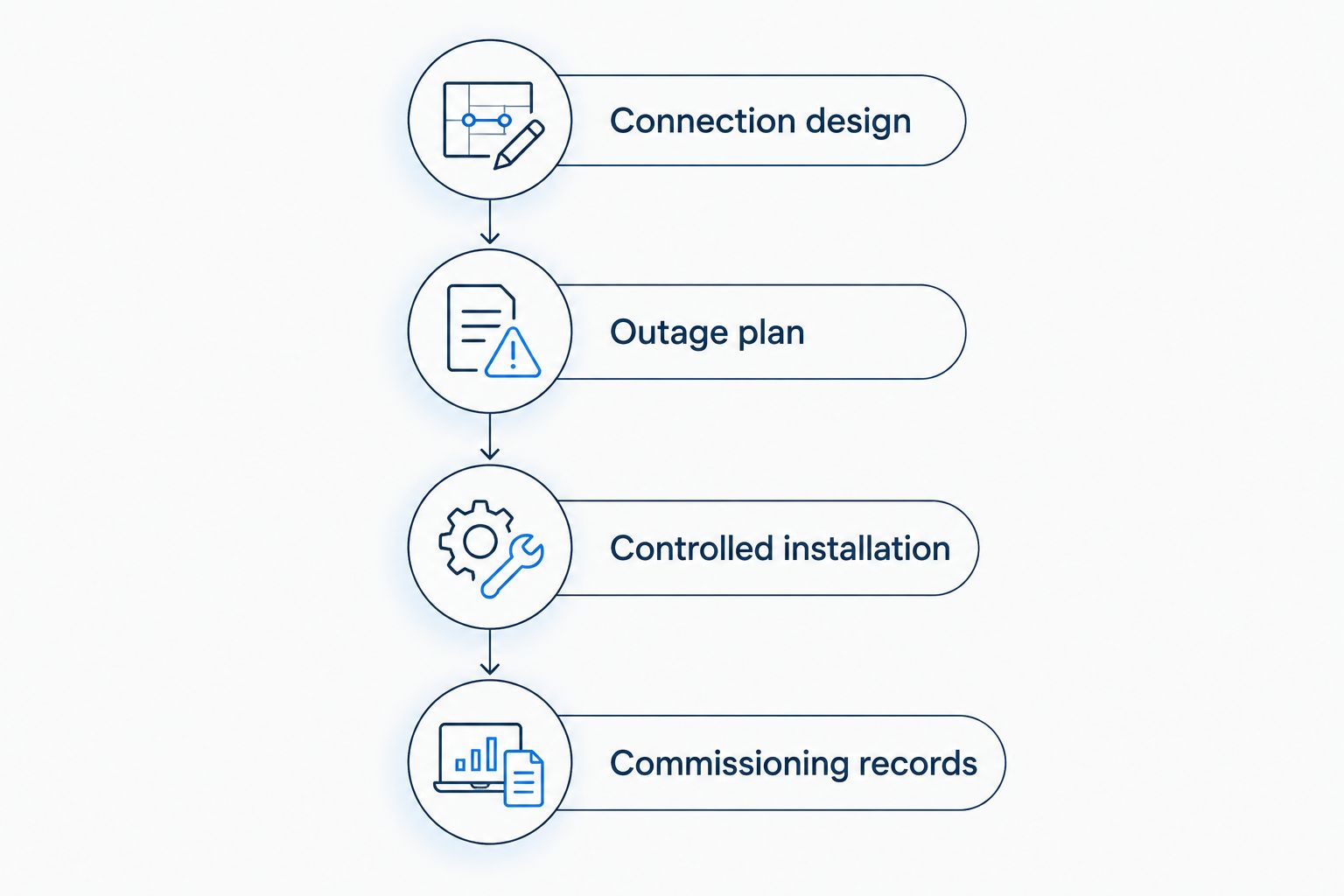
Commissioning records and operational handover
Establish acceptance before energization
- Request the contractor's inspection and test records. The required checks depend on the equipment and installation. They can include insulation condition, grounding continuity, termination verification, protective settings, and source-transfer operation where applicable.
- Confirm external releases. Obtain the required inspection acceptance and utility authorization. A completed installation and an authorized energization are separate milestones.
- Coordinate the controlled restart. Have qualified personnel perform energization and electrical checks under the approved procedure. Operations should release connected processes only after the required electrical and process conditions are confirmed.
- Collect the handover documents. Obtain updated drawings, circuit identification, equipment instructions, test reports, inspection records, and the approved operating procedure. Record any remaining work with a named owner.
Expected result: Permanent power is accepted, the site has an operating procedure, and the records match the installed system.
For your 2026 handover file, record the actual inspection and commissioning dates. Keep those records accessible to maintenance staff rather than leaving them only in a construction email thread.
Separate electrical acceptance from process performance
An energized panel does not prove every connected process is ready. Motor rotation, control behavior, alarms, and equipment restart requirements need verification by the appropriate qualified personnel. Operations must follow equipment-specific restart procedures.
Do not accept “the lights are on” as the handover standard. The useful deliverable is an installation with documented checks, clear source identification, and a known response when power fails.
Second workflow: keep the generator as permanent backup
Keeping temporary generation on site creates a different project. The generator, fuel arrangement, location, connection equipment, controls, and operating procedure must be evaluated for the intended standby installation. A temporary connection is not a permanent backup design.
| Arrangement | Best for | Advantage | Limitation |
|---|---|---|---|
| Permanent service only | Sites removing temporary generation after acceptance | Removes the temporary source from routine operation | Does not provide generator backup after removal |
| Permanent service with generator backup | Sites requiring a designed alternate power source | Retains a planned response to utility outages | Adds transfer equipment, controls, maintenance, and operating requirements |
Neither arrangement wins without the site's operating requirements. Choose permanent service only when generator backup is outside the approved scope; choose retained backup only with a complete alternate-source design.
For the retained-backup workflow, have the contractor resolve source isolation, transfer operation, neutral treatment, load selection, generator suitability, and the testing procedure before installation. Any parallel operation requires a specifically designed and authorized system; do not assume a transfer arrangement permits it.
Include the backup system in your 2026 maintenance plan. Assign responsibility for inspections, exercising, fuel management, and records according to equipment instructions and site requirements. Automatic transfer does not remove the need for maintenance or a documented operating procedure.
Request an oilfield electrical quote
Get a same-business-day response and a clear written scope. Job completion depends on the approved work.
Troubleshooting
The utility is ready, but the site cannot energize
Check the release chain. Utility readiness does not replace required inspection acceptance, completed site work, or operating authorization. Have the project lead identify the missing approval and assign responsibility before changing the outage date.
A motor runs incorrectly after the changeover
Stop the affected equipment and call the contractor. Incorrect phase sequence, voltage problems, or equipment-specific control issues require qualified diagnosis. Do not keep restarting the motor or swap conductors yourself.
Protective devices trip when loads restart
Leave the protection in service and investigate the cause. Starting demand, faults, wiring errors, or incorrect settings require evaluation. Never increase a breaker rating or bypass protection to force a restart.
Controls reset when a large load starts
Have the contractor investigate the supply and control circuits. Voltage disturbance, connection problems, and unsuitable distribution arrangements are possible causes to test, not conclusions to assume. Record which equipment starts and which controls reset so the investigation has a clear sequence.
The retained generator will not transfer correctly
Use the approved operating procedure and qualified service personnel. Transfer controls, source sensing, interlocks, and grounding arrangements require coordinated diagnosis. Do not defeat an interlock or manually bridge sources.
Customize your workflow
Build the work package around what the site actually operates. A drilling location, production facility, and temporary support compound do not share an identical load list or shutdown plan. Identify the real operating dependencies before requesting a final scope.
Ask Eagle Electric to separate the quote into defined work: site assessment, design responsibilities, installation, inspection coordination, commissioning, and handover. Clear written exclusions matter as much as included work. Confirm who handles utility-owned equipment and process controls.
Keep future additions separate from today's approved capacity. New motors, heating loads, buildings, or backup requirements need review before connection. An unused breaker space is not proof of spare system capacity.
FAQ
Can I connect an oilfield generator directly to permanent site wiring?
Not through an improvised connection. A licensed electrical contractor must evaluate the site and provide an approved connection arrangement that addresses source separation, protection, grounding, and equipment suitability.
Do I need a transfer switch when temporary power becomes permanent?
The required source-selection equipment depends on whether alternate power sources remain connected or available to the installation. Have the contractor establish the arrangement from the complete system design rather than assuming every changeover uses the same switch.
Can temporary oilfield cables stay as permanent wiring?
Only equipment and wiring methods accepted for the permanent installation can remain. Your contractor must evaluate ratings, condition, routing, protection, environmental exposure, and applicable installation requirements.
Does permanent utility service eliminate hazardous-location requirements?
No. Hazardous-location requirements follow the site's classification and installation conditions, not whether electricity comes from a generator or utility service.
Can the site stay running during the power changeover?
Do not assume uninterrupted operation. Continuity requires a specifically designed solution and an approved operating plan; otherwise, coordinate a controlled outage and process shutdown.
Who should coordinate oilfield temporary power to permanent wiring in the Bakken?
Use a licensed electrical contractor with an agreed site-specific scope. Eagle Electric provides oilfield electrical contracting across the Bakken region; coordinate utility, inspection, and operations responsibilities in the written work package.
What should I send with an electrical quote request?
Send the site location, load list, equipment nameplates, available drawings, classification documents, and desired end condition. State whether the generator will leave or remain as backup, and identify your outage constraints.
One last thing
The most useful final check is whether the drawings match the equipment in front of you. A correct installation with an outdated one-line diagram leaves the next crew working from the wrong source information. Make updated records a condition of the 2026 handover, not an optional follow-up.