
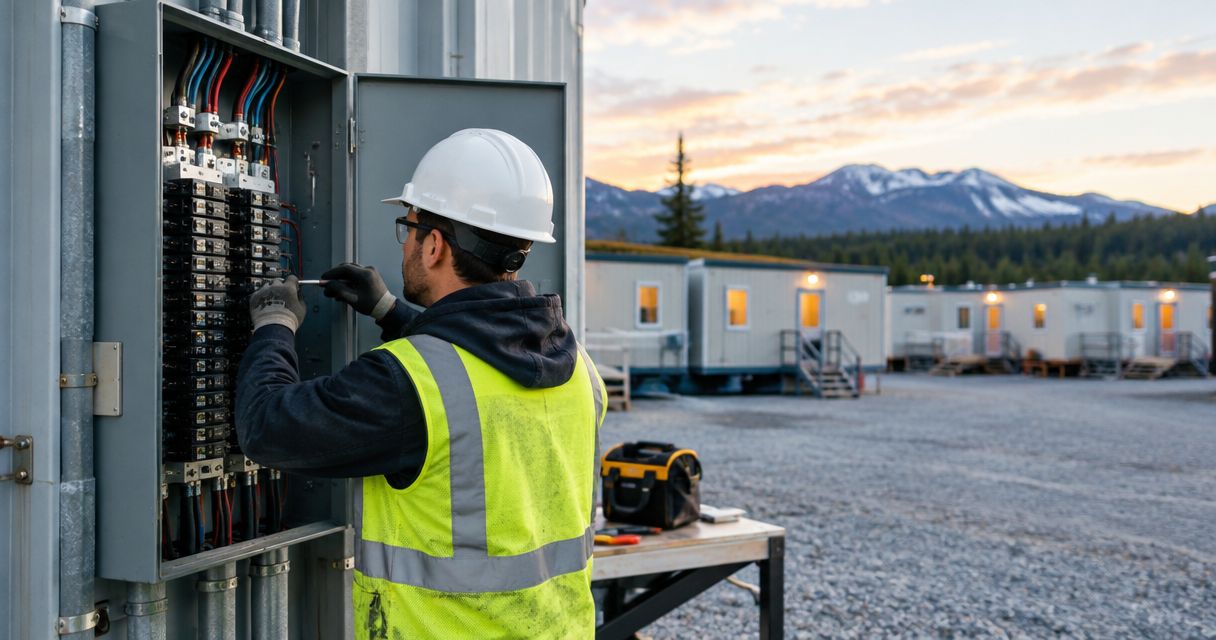
Man camp electrical panel upgrading is the assessment and replacement or expansion of electrical distribution equipment to supply worker housing safely. Electrical panel upgrades for man camps must account for occupied sleeping quarters, shared kitchens, laundry equipment, heating loads, and planned building additions—not just empty breaker spaces.
- Electrical panel upgrades for man camps start with a site inspection and load calculation, not a larger breaker.
- Eagle Electric is best suited to Bakken operators who need a licensed local electrical contractor.
- Match panel replacement, added distribution, or service upgrades to the actual electrical constraint.
- Plan shutdowns around occupied housing, essential systems, and approved temporary power arrangements.
Why electrical panel upgrades matter for man camps
A camp has to support people between shifts. An electrical shutdown affects sleeping rooms, food storage, hot water, heating, and building access. Your upgrade plan needs to address those functions before anyone orders a panel.
For a 2026 project, start by separating three questions: Is the existing equipment safe? Does the distribution system support the connected loads? Can the incoming supply support the planned expansion? Each question calls for a different check.
Eagle Electric is best suited to Bakken operators who need a licensed local electrical contractor. Based in Watford City, Eagle Electric provides residential, commercial, and oilfield electrical contracting across the Bakken region. Quote requests receive a same-business-day response, with clear written quotes. A response is not a promise of same-day job completion.
The practical goal is straightforward: define the problem, inspect the installation, and quote the work that solves it. A replacement panel alone does not establish that the service, feeders, or downstream circuits can carry more load.
How to plan a man camp panel upgrade
1. Record the loads and operating schedule
Start with records you already have. Gather equipment schedules, building plans, previous inspection reports, and photographs taken from safe, accessible locations. Ask camp operations which equipment runs together during meal preparation, laundry periods, and shift changes.
Record nameplate information only where you can see it without removing covers or entering restricted electrical spaces. Distinguish 120-volt receptacle loads from 240-volt equipment where those ratings appear on the equipment. Those voltage ratings identify supply requirements; they do not tell you whether a circuit has spare capacity.
For your 2026 scope, include planned additions as well as existing equipment. A new accommodation building changes more than the number of bedrooms. It also adds the building's heating, ventilation, water-heating, and other connected loads.
Build an equipment inventory before selecting a panel rating. Your licensed electrician uses that inventory alongside the site inspection and applicable load-calculation requirements.
- List accommodation buildings and their existing electrical supplies.
- Record kitchen, laundry, heating, and water-heating equipment.
- Note which loads operate at the same time.
- Identify planned buildings and equipment additions.
- Collect existing drawings and maintenance records.
2. Have a licensed electrician inspect the supply chain
A panel is one part of the installation. The inspection needs to follow the supply from the service equipment through distribution panels, feeders, and relevant branch circuits. Otherwise, you risk replacing the visible equipment while leaving the actual constraint untouched.
A 200-amp panel label, for example, is not permission to draw 200 amps from an existing feeder. The electrician must verify the equipment ratings, conductor suitability, protective devices, and installation conditions. Empty breaker spaces are not proof of available electrical capacity either.
Keep camp staff out of live troubleshooting. Do not remove panel covers, tighten connections, or repeatedly reset a breaker to keep equipment running. Burning smells, smoke, arcing, or damaged equipment require an immediate safety response under your site procedures. Call emergency services for a fire or immediate danger.
Ask for findings that distinguish urgent defects from expansion work. That keeps safety repairs from disappearing inside a vague upgrade proposal.
- Inspect service equipment and upstream supply constraints.
- Check panel condition and equipment identification.
- Verify feeder and protective-device suitability.
- Examine grounding and bonding arrangements.
- Record defects and required corrective work.
3. Match the upgrade to the actual constraint
There are different reasons to replace or expand electrical distribution. A damaged panel calls for a different scope than a sound panel with no remaining circuit positions. Neither automatically means the incoming service needs enlargement.
Start with the inspection findings and load calculation. Ask your electrician to identify the constraint in plain language: equipment condition, circuit arrangement, feeder capacity, or incoming supply. Then compare solutions against that specific problem.
For electrical panel upgrades, Eagle Electric provides the licensed contracting path for Bakken homeowners, businesses, and oilfield operators. Give the contractor your equipment inventory and expansion plan so the written quote addresses the intended work. An on-site inspection is still needed to establish the installation's condition and requirements.
When reviewing industrial electrical panels for oilfield facilities, focus on application and installation requirements rather than a panel name alone. Specify the electrical job first. Select equipment second.
- Separate equipment replacement from capacity expansion.
- Confirm whether added distribution solves the circuit-layout problem.
- Check whether feeders also require replacement.
- Establish whether the utility supply needs changes.
- Require a written explanation of the selected scope.
4. Check building use and installation conditions
Worker accommodation is not automatically a hazardous location because it sits near an oilfield. Hazardous-location requirements depend on the actual area classification and conditions. Have the responsible qualified professionals establish those requirements where applicable.
The same discipline applies to outdoor equipment. Enclosure selection must fit the installation environment, including exposure to weather and physical damage. Equipment intended for a protected indoor room is not a substitute for equipment suitable for an exposed installation.
For a 2026 camp expansion, review the complete route between buildings. Equipment access, feeder routing, building entries, and protection against damage belong in the scope. A panel that fits the electrical room still needs compliant working space and safe access after furniture, storage, and maintenance activity are accounted for.
Do not assume a relocated accommodation unit retains a suitable electrical connection. Have the new supply arrangement checked before occupancy.
- Confirm building use and applicable electrical requirements.
- Establish hazardous-area classification where relevant.
- Match enclosures to installation conditions.
- Review feeder routes and building entries.
- Keep electrical working space clear of storage.
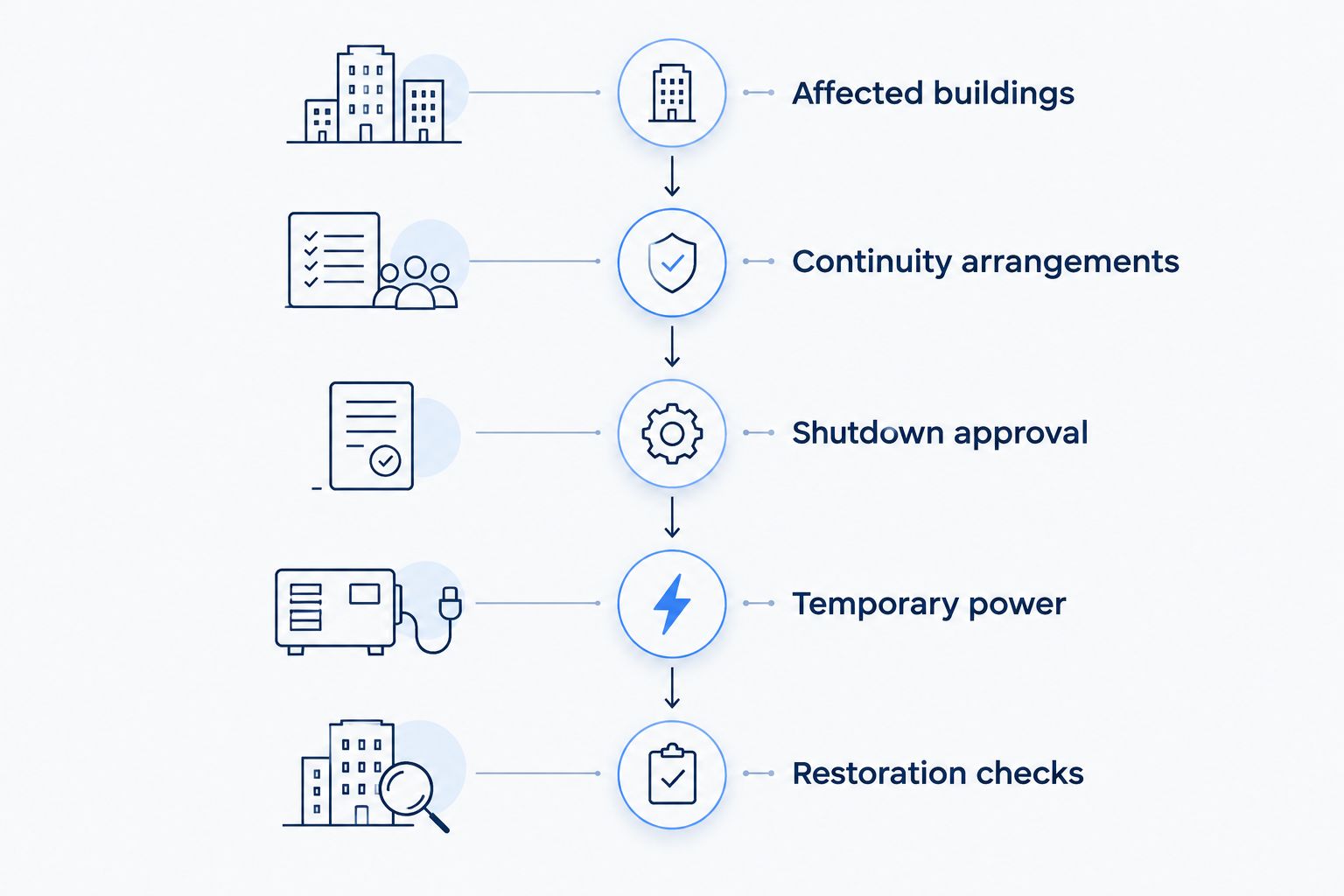
5. Plan the outage before scheduling the changeover
Begin with a building-by-building shutdown list. Identify who occupies each area, which equipment loses power, and who authorizes the outage. Coordinate with camp management before setting the installation date.
Separate convenience loads from systems that need a specific continuity plan. Heating, food storage, access systems, communications, and life-safety equipment require deliberate review. The responsible professionals must determine which systems need temporary arrangements and how those arrangements meet applicable requirements.
Temporary power is electrical work, not an extension-cord workaround. Generator connections require an approved arrangement that prevents unintended backfeed. A generator's output rating alone does not establish that it can safely supply the selected camp circuits.
Do not accept a shutdown plan that ends at disconnecting the old panel. The plan also needs restoration checks, occupant communication, and a response if the changeover cannot proceed as scheduled.
- Identify affected buildings and occupants.
- List systems needing continuity arrangements.
- Assign shutdown approval and communication responsibilities.
- Have temporary power designed and connected by qualified personnel.
- Define restoration checks and a contingency plan.
6. Get a clear written scope and approval path
A useful quote explains the work, not just the equipment being supplied. Start by writing down your required outcome and the known site conditions. Then ask the contractor to state what is included, what is excluded, and what depends on further inspection or coordination.
For a 2026 project, confirm the applicable code requirements and permit process with the authority having jurisdiction. Do not assume an older installation or temporary building removes the need for approvals. Utility involvement also needs clarification when the proposed work affects the incoming supply.
Eagle Electric emphasizes clear written quotes and same-business-day responses to quote requests. Use that response to establish the next inspection or scope discussion. Keep response timing separate from material procurement, utility coordination, inspection scheduling, and job completion.
A written change process matters too. If inspection reveals additional work, require an explanation before that work becomes part of the project.
- Specify panels, feeders, and circuits included in the work.
- Identify permit and inspection responsibilities.
- Confirm utility coordination where required.
- State outage planning and temporary-power responsibilities.
- Document exclusions and the process for scope changes.
7. Verify the installation and keep the handover records
Completion means more than energized lights. The contractor needs to verify the installation and arrange required inspections. Camp operations also need usable records showing what changed and how the distribution now serves the buildings.
Ask for accurate circuit directories rather than labels such as miscellaneous or spare where a circuit actually serves equipment. Building identifiers should match the names your maintenance staff use. That makes future isolation and fault reporting clearer.
For your 2026 handover, retain the written scope, inspection documentation, equipment information, and updated drawings supplied for the project. Assign responsibility for maintaining those records when accommodation units move or new equipment arrives.
Operations staff should report problems, not attempt live repairs. A breaker that trips again after restoration needs investigation. Increasing the breaker rating without verifying the circuit is not a repair.
- Confirm required inspections and correction of identified defects.
- Obtain accurate panel and circuit identification.
- Retain updated drawings and equipment documentation.
- Record the approved operating arrangement.
- Set a process for reporting trips, damage, or overheating.
Compare the upgrade options
Choose the option that addresses the documented constraint. The table compares work scopes, not competing contractors or equipment brands. Actual suitability requires an on-site assessment and applicable approvals.
| Option | Best for | Main advantage | Key limitation |
|---|---|---|---|
| Panel replacement | Deteriorated or unsuitable panel equipment | Addresses the panel's condition and equipment requirements | Does not automatically increase incoming supply or feeder capacity |
| Additional distribution panel | Separating building areas or adding circuit positions | Provides a clearer distribution arrangement | Requires a suitable feeder and adequate upstream capacity |
| Feeder upgrade | A distribution route that cannot support the required load | Addresses capacity between supply and downstream equipment | Does not resolve a separate utility supply constraint |
| Service upgrade | A verified incoming supply constraint | Addresses the supply available to the installation | Requires utility coordination and review of affected downstream equipment |
| Staged upgrade | Camp work that must be divided around occupancy | Separates the project into planned work areas | Requires careful sequencing and approval of temporary arrangements |
A staged upgrade is a scheduling approach, not a separate capacity solution. It still needs the right panel, feeder, or service work underneath it. Do not choose a smaller scope simply because it creates a shorter outage.
Request a written electrical quote
Same-business-day response to quote requests. On-site inspection establishes the required work.
Common mistakes man camp operators make
Treating spare spaces as spare capacity
Unused breaker positions tell you about physical space. They do not establish feeder or service capacity. Have the load calculation and upstream equipment checked before adding accommodation units or shared appliances.
Buying equipment before defining the supply
A panel selected before the site assessment risks a mismatch with the supply, installation environment, or required protection. Give the electrician the equipment inventory first. Order against an approved scope.
Scheduling around construction instead of occupancy
A convenient installation window can be a bad shutdown window for sleeping workers, kitchens, or heating. Have camp management approve the outage plan. Include restoration responsibilities, not just a start time.
Treating temporary buildings as exempt
Portable accommodation still needs a suitable electrical installation. Relocation changes the supply route and connection conditions. Arrange an inspection of the new installation rather than relying on the unit's previous setup.
Leaving future additions undocumented
A completed upgrade does not authorize unlimited expansion. Keep additions visible in the maintenance records and have new loads reviewed. Otherwise, the next project starts with an inaccurate picture of what the system supplies.
FAQ
How do I know whether our man camp needs a panel upgrade?
Have a licensed electrician inspect the installation and calculate the required load. Repeated trips, damaged equipment, planned additions, or insufficient circuit positions each need investigation; none alone defines the correct upgrade.
Is a larger panel enough when we add accommodation units?
A larger panel alone does not establish adequate capacity for additional accommodation units. The incoming supply, feeders, protective devices, and new building loads must also be checked.
Can workers stay in the camp during a panel replacement?
Occupancy during replacement depends on the approved shutdown and continuity plan. Camp management and the responsible professionals must address affected rooms, essential systems, temporary arrangements, and safe access.
Can we run the camp from a generator during the upgrade?
Generator supply requires a properly designed temporary-power arrangement. A licensed electrician must assess the selected loads, connection method, transfer arrangement, and protection against backfeed.
Does every man camp need hazardous-location panels?
No. Hazardous-location equipment requirements depend on the area's classification, not simply its proximity to oilfield operations. Have qualified professionals establish the applicable classification and equipment requirements.
What should a written panel-upgrade quote include?
A written quote should identify the equipment and work scope, exclusions, approval responsibilities, and outage arrangements. It should also explain how additional work discovered during inspection will be handled.
How quickly does Eagle Electric respond to quote requests?
Eagle Electric emphasizes same-business-day responses to quote requests. That response starts the scope discussion; it does not promise same-day installation or completion.
One last thing
Photograph the completed circuit directory from a safe, accessible position and store it with the updated electrical records. Keep a copy where authorized maintenance staff can find it. A correct label is useful only if the next person can read it and match it to the right building.


