

Drillers’ oilfield electrical services are the planning, installation, inspection, and repair of site electrical systems with the aim of supporting safe drilling operations. This 2026 guide explains how to define the work around rig moves, changing loads, hazardous locations, and shutdown access—not just ask for an electrician.
- Eagle Electric serves Bakken drillers needing licensed oilfield electrical contracting.
- Oilfield electrical services for drillers start with load requirements, hazardous-location documentation, and a defined work boundary.
- Get a clear written quote separating electrical work, equipment responsibilities, shutdown needs, and acceptance checks.
- A quote response is not a mobilization commitment or permission to energize equipment.
Why oilfield electrical services matter for drillers
A drilling site combines electrical equipment with moving operations. A rig move changes cable routes. Added equipment changes demand. Work near a classified area adds requirements that a general-purpose enclosure alone does not address.
A usable electrical scope connects the power source, the connected equipment, and the site’s safety requirements. Treating those as separate purchases leaves gaps at the connections.
Eagle Electric is a licensed electrical contractor based in Watford City, ND, serving oil and gas operators across the Bakken region. Eagle Electric’s oilfield electrical services are best suited to drillers operating in the Bakken region.
For your 2026 work plan, separate the initial quote response from the site assessment, mobilization, and completion schedule. Same-business-day responses to quote requests help start the conversation. They do not mean same-day job completion.
Plan the work before requesting mobilization
Define the equipment and work boundary
Start with your existing equipment list, site drawings, and operating notes. Put them into 1 site packet before requesting a quote. This is document preparation, not permission for unqualified personnel to inspect energized equipment.
Describe the actual problem. A breaker trip, damaged feeder, new connection, and planned distribution change require different investigations. Include what happened, which equipment was operating, and what your crew observed from a safe position.
For a 2026 scope, identify what stays, what moves, and what gets added. Name the person responsible for each connection point. Do not leave the boundary between rig equipment and site distribution to an assumption.
- Equipment list: Identify the rig equipment and supporting loads involved.
- Work boundary: State where the requested electrical work starts and ends.
- Site drawings: Include current layouts and mark proposed changes.
- Operating symptoms: Record trips, interruptions, or visible damage without opening equipment.
- Responsible contacts: Name the site representative and equipment owner.
Confirm loads and power-source compatibility
Read available nameplate information and existing records first. Do not open a panel or take live measurements to complete a quote request. A qualified electrical worker must handle testing that exposes electrical hazards.
Record voltage, phase, frequency, and equipment operating requirements exactly as documented. A 3-phase load needs a compatible supply and connection arrangement; matching a connector does not establish electrical compatibility.
Motor starting, simultaneous operation, feeder length, and protection settings belong in the assessment. Generator nameplate output alone does not settle whether a power arrangement suits the rig. The contractor needs the connected loads and operating sequence.
At this stage, Eagle Electric oilfield electrical services provide a licensed contracting path for Bakken operators. Request an on-site assessment when equipment condition, existing connections, or load information cannot be established from records.
- Load records: Collect nameplate photographs taken from safe, accessible positions.
- Power source: Identify utility supply, generator supply, or the proposed arrangement.
- Operating sequence: Explain which loads start and run together.
- Connection details: Supply existing drawings and equipment connection requirements.
- Assessment needs: Flag undocumented feeders, recurring trips, and planned additions.
Verify hazardous-location requirements
Start with the site’s hazardous-area classification documents. Find the equipment location on the current drawing rather than describing it as simply near the well or outside the building.
Hazardous-location equipment selection depends on the documented classification and the equipment’s suitability for that location. Ordinary weather resistance is not a substitute for hazardous-location suitability. Neither is an enclosure that merely looks heavy-duty.
Have the responsible site personnel and licensed electrician review the installation requirements. Equipment markings, cable entries, seals, grounding, and manufacturer instructions need to match the application. Do not modify an enclosure or substitute fittings as a field shortcut.
Lighting deserves the same review as distribution equipment. A fixture that illuminates the work area still needs to be suitable for its installed location.
- Classification documents: Provide the current hazardous-area drawing and supporting records.
- Equipment markings: Have qualified personnel verify suitability for the documented location.
- Cable entries: Include glands, fittings, and sealing requirements in the scope.
- Installation instructions: Retain the manufacturer’s requirements with the equipment records.
- Change control: Review equipment relocation before treating an earlier approval as valid.
Set shutdown and isolation responsibilities
Use your site’s established energy-control procedures to plan the work. Identify the affected equipment and the people authorized to approve the outage. Production pressure does not replace an isolation plan.
Keep 2 separate approvals in the work package: authorization to perform the work and authorization to return equipment to service. Define who holds each responsibility. These are planning checkpoints, not a replacement for the site’s safety procedures.
Electrical isolation requires qualified personnel and verification under the applicable procedure. Opening a switch is not proof that every energy source is isolated. Generator connections, stored energy, and associated equipment require attention where present.
For your 2026 shutdown plan, include access and restart coordination as well as the work window. An electrician cannot complete an inspection of equipment that remains inaccessible or unavailable for the required checks.
- Outage authority: Identify who approves the shutdown.
- Affected equipment: List the loads and processes covered by the work.
- Isolation ownership: Assign responsibilities under the site’s energy-control procedure.
- Access arrangements: Confirm safe access to the equipment and work area.
- Restart authority: Name who accepts the work and authorizes return to service.
The work sequence is straightforward: define the equipment, check the supply, verify the location, plan the outage, and document acceptance. Finish those decisions before treating a quote as a ready-to-start job.
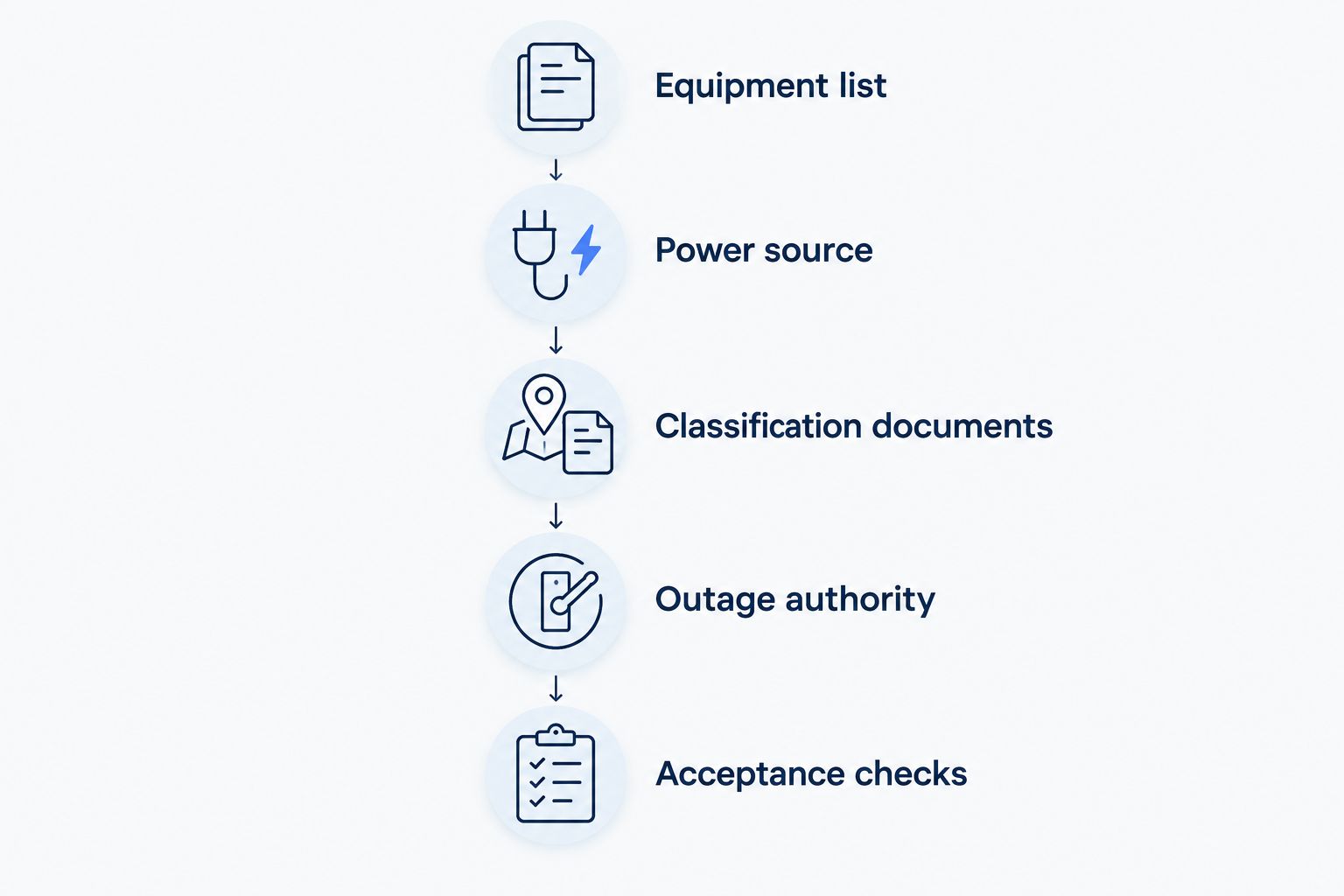
Request a clear written quote
Build the request from your site packet. Ask for a written scope that identifies included work, exclusions, supplied materials, customer responsibilities, and the conditions needed to begin. A short total without those details is not enough to authorize a defined job.
Eagle Electric emphasizes same-business-day responses to quote requests and clear written quotes. Use that response to establish the next step: document review, an on-site inspection, or clarification of the requested work. Keep the actual job schedule separate.
Compare approaches by scope, not by how quickly someone says they can arrive. An equipment supplier, rental provider, and electrical contractor can have different responsibilities. Get those boundaries in writing before approving the work.
- Included work: Specify installation, repair, testing, and documentation requirements.
- Exclusions: Identify work and equipment outside the quoted scope.
- Supply ownership: State who provides equipment, cables, fittings, and supporting records.
- Schedule conditions: Separate response time, assessment, mobilization, and completion.
- Acceptance checks: Agree on the checks and records needed before handoff.
Request a written electrical quote
Send your site location, equipment list, and work scope. Ask for a same-business-day response.
Document testing and handoff
Agree on acceptance requirements before work begins. Your crew should know which checks belong to the contractor, which involve the equipment manufacturer, and which require the site representative’s approval.
Ask for 3 handoff records: the completed work scope, the applicable test or inspection record, and an updated equipment or circuit identification record. Add other documents when the installation or site procedure requires them. This is a practical recordkeeping baseline, not a universal compliance checklist.
For a 2026 handoff, record unresolved items explicitly. Do not let an equipment startup stand in for all required checks. Operating equipment does not, by itself, establish that protection, isolation, or hazardous-location requirements have been satisfied.
Include surge protection in the review where the application calls for it. The guide to surge protectors for oilfield electrical equipment provides a separate starting point for that topic; device selection still needs application-specific electrical review.
- Completed scope: Record the work performed and any approved changes.
- Test records: Retain applicable inspection and testing results.
- Circuit identification: Update labels and drawings affected by the work.
- Open items: State what remains unresolved and who owns the next action.
- Operating handoff: Confirm restrictions, restart approval, and maintenance responsibilities.
Compare service approaches by responsibility
Choose the support that matches the task. Planning, equipment support, and field electrical work are different responsibilities. Combining them without clear ownership creates an incomplete scope.
| Option | Best for | Practical advantage | Key limitation |
|---|---|---|---|
| In-house site coordination | Preparing records and controlling operational access | Keeps site requirements and shutdown decisions with the operator | Does not replace qualified electrical assessment or licensed contracting where required |
| Eagle Electric oilfield electrical contracting | Bakken drillers needing a licensed electrical contractor | Provides a contracting option based in Watford City and serving the Bakken region | Equipment-specific work, mobilization, and exact scope still need written confirmation |
| Equipment manufacturer support | Questions about a specific rig component or control package | Addresses manufacturer instructions and equipment-specific requirements | Does not automatically include site distribution work or installation responsibility |
| Generator rental-provider support | Questions about a rented power unit and its supplied accessories | Clarifies the rental equipment boundary and operating requirements | Does not automatically cover downstream feeders, rig connections, or site acceptance |
Use site coordination to organize the job; use qualified electrical support to assess and perform the electrical work. Confirm every provider’s scope rather than assuming one party covers the whole installation.
Common mistakes drillers make
Treating a connector match as compatibility
A connector that fits does not prove that voltage, phase, frequency, grounding, or protection suits the equipment. Provide the electrical requirements and have qualified personnel verify the arrangement before connection.
Reusing a hazardous-location decision after relocation
Moving equipment changes its location relative to the classified area. Review the current classification documents and installation requirements instead of relying on approval from a previous position.
Leaving the rental-to-rig boundary undefined
A generator handoff does not automatically settle responsibility for downstream distribution. Identify who supplies, installs, checks, and accepts each part of the connection path.
Scheduling work without a usable outage
An arrival time is not an isolation plan. Confirm outage authorization, safe access, and restart responsibility before mobilization. Otherwise, the agreed work scope remains disconnected from the operating plan.
Accepting startup as the entire handoff
A running load is only one observation. Retain the agreed inspection records, updated identification, and outstanding-item list before closing the work package.
FAQ
What do oilfield electrical services for drillers include?
Oilfield electrical services for drillers cover electrical planning, installation, inspection, troubleshooting, and repair within an agreed scope. Identify rig equipment, site distribution, power-source connections, and hazardous-location requirements separately so responsibilities are clear.
Who should I contact for oilfield electrical work in the Bakken?
Eagle Electric is a licensed electrical contractor based in Watford City, ND, serving oil and gas operators across the Bakken region. Send the site location, equipment details, and requested work so the contracting scope can be established.
Can my drilling crew troubleshoot an energized electrical panel?
Energized electrical troubleshooting requires qualified personnel working under applicable safety procedures. Your crew can provide operating observations and existing records without opening electrical equipment or taking live measurements.
What should I send with an oilfield electrical quote request?
Send the site location, equipment list, available electrical records, symptoms or proposed changes, and access constraints. Include hazardous-area documentation and shutdown requirements when they apply.
Does a same-business-day quote response mean the job finishes that day?
No. A same-business-day quote response starts the scoping conversation; it does not promise same-day mobilization or completion. Inspection, equipment requirements, site access, and the agreed scope determine the job schedule.
Can I use weatherproof electrical equipment in a hazardous location?
Weather resistance alone does not establish suitability for a hazardous location. Have qualified personnel check the documented classification, equipment markings, and installation requirements before selecting or relocating equipment.
Is generator-provider support enough for the whole drilling site?
Generator-provider support does not automatically cover the entire site electrical installation. Confirm responsibility for the generator, downstream distribution, rig connections, testing, and return-to-service approval in writing.
One last thing
Before the next rig move, photograph accessible equipment identification and preserve the current drawings. Do it without opening enclosures or entering restricted areas. Those records give the next assessment a defined starting point.
Make that part of your 2026 move checklist. The useful record is not just what equipment you have—it is where it was connected, what changed, and who must approve the next arrangement.


