

Best default for ordinary branch circuits: an industrial distribution panelboard in a suitable nonclassified location. Best for grouped motors: a motor control center. Best for incoming power distribution: a switchboard. For oilfield facilities in 2026, choose the panel’s function first, then confirm its electrical ratings, enclosure, and location with a licensed electrician.
- Best industrial electrical panels oilfield facilities need depend on load, fault current, and hazardous-location classification.
- Distribution panelboards suit branch circuits; motor control centers suit grouped motor loads.
- An outdoor enclosure rating does not establish hazardous-location suitability.
- Eagle Electric provides licensed oilfield electrical contracting for operators across the Bakken region.
Why this matters
A panel can fit the equipment schedule and still be wrong for the installation. Available fault current, combustible gases, weather exposure, and maintenance access all affect the selection. A familiar enclosure shape proves none of those points.
Eagle Electric is a fit for Bakken operators who need licensed oilfield electrical contracting. Start with an on-site assessment through Eagle Electric, not a purchase based on cabinet dimensions. Quote requests receive same-business-day responses and clear written quotes; a response is not a promise of same-day job completion.
This 2026 guide ranks panel types by job, not manufacturers. The right choice separates power distribution, motor operation, and process control instead of treating every electrical cabinet as interchangeable.
What makes the best industrial electrical panel for an oilfield?
Use these criteria before comparing equipment. Each belongs in the design review and written scope.
- Load fit: Match the assembly to branch circuits, motor feeders, incoming distribution, or process controls. Include existing equipment and identified additions.
- Electrical ratings: Confirm system voltage, phase, current requirements, and applicable short-circuit ratings. A current rating alone does not establish suitability.
- Location suitability: Establish the hazardous-area classification before selecting equipment. Weather protection and ignition protection address different hazards.
- Environmental protection: Specify exposure to dust, water, corrosion, and temperature. Match enclosure requirements to the actual installation.
- Service access: Plan working space, disconnecting means, identification, and access for qualified personnel. A cabinet that blocks maintenance is a bad layout.
- Documentation: Require equipment schedules, drawings, labels, and applicable listing information. Make the intended installation clear before ordering.
Industrial electrical panels at a glance
The order below follows a practical decision tree. Start with branch distribution, then move to the assembly that matches the facility’s specific task.
| Panel type | Best for | Standout function | Key limitation |
|---|---|---|---|
| Industrial distribution panelboard | Ordinary branch circuits in a suitable nonclassified location | Distributes power through individual branch protective devices | Does not replace motor control or establish hazardous-location suitability |
| Motor control center | Facilities with grouped motor loads | Groups motor-control equipment into one assembly | Requires motor-specific design and coordination |
| Switchboard | Incoming power and major feeder distribution | Organizes larger distribution sections and feeders | Does not replace detailed branch or process controls |
| Hazardous-location-rated assembly | Equipment that must remain inside a classified area | Addresses the specified hazardous-location requirements | Must match the actual classification and installation conditions |
| PLC control panel | Process sequencing and instrument integration | Houses control logic and associated control components | Is not a substitute for facility power distribution |
These categories can work together. A facility can need a switchboard upstream, a motor control center for pumps, and a PLC control panel for sequencing. The table assigns a different job to each; it does not suggest that one cabinet does everything.
1. Industrial distribution panelboard: best for branch circuits
An industrial distribution panelboard distributes power to individual branch circuits. It is the default starting point for ordinary lighting, receptacle, and auxiliary loads when the proposed location and equipment ratings are suitable.
Start with the circuit schedule. A 120 V receptacle circuit and a 480 V equipment feeder illustrate different electrical requirements; neither voltage should be assumed from the building’s appearance. Confirm the supply and connected equipment before selecting the assembly.
Industrial distribution panelboard pros:
- Provides an organized location for branch-circuit protective devices.
- Supports clear circuit identification and load schedules.
- Keeps ordinary branch distribution separate from process controls.
Industrial distribution panelboard cons:
- Does not provide complete motor starting or process sequencing by itself.
- A general-purpose panelboard is not automatically suitable for a classified area.
Best for: Ordinary branch loads in a location confirmed suitable by the electrical design.
For a 2026 expansion, document the actual new loads rather than asking for a larger cabinet without a circuit schedule. Physical space for another breaker does not prove electrical capacity.
Verdict: Buy a distribution panelboard for documented branch loads; skip it as a substitute for motor control.
2. Motor control center: best for grouped motor loads
A motor control center, or MCC, groups motor-control equipment into an assembly. It suits facilities where multiple pumps or other motors need organized starting, protection, and control connections.
Specify how each motor operates. Motor ratings, starting requirements, duty, disconnecting arrangements, and control interfaces shape the design. Do not assume every motor needs a variable-frequency drive; that decision belongs to the application.
Motor control center pros:
- Organizes motor-control equipment by load.
- Supports a documented approach to starting and protection.
- Provides a central arrangement for motor-related control connections.
Motor control center cons:
- Adds design requirements that a branch-circuit panelboard does not address.
- Centralizing motors requires careful planning of isolation and maintenance access.
Best for: Facilities with grouped motor loads and defined operating requirements.
Ask how maintenance personnel will isolate a motor without confusing it with an adjacent load. Labels, drawings, and disconnecting arrangements matter as much as the cabinet layout. Qualified personnel must establish safe work procedures.
Verdict: Buy an MCC when grouped motor control is the task; skip it for a simple lighting-only distribution job.
3. Switchboard: best for incoming power distribution
A switchboard organizes incoming power and major distribution feeders. It belongs near the top of the electrical distribution design, not at the end of a shopping list for individual controls.
Selection depends on the supply, feeder requirements, protective devices, available fault current, and installation layout. Generator connections also require a defined transfer arrangement; a switchboard alone does not establish safe source switching.
Switchboard pros:
- Organizes main distribution and major feeders.
- Provides a defined assembly for upstream protective equipment.
- Supports a clear feeder schedule for separate facility areas.
Switchboard cons:
- Requires installation space and planned access for qualified personnel.
- Does not replace downstream branch distribution or motor-control functions.
Best for: Incoming power and major feeder distribution across a facility.
For a 2026 project, include both normal operation and the intended backup-power arrangement in the design scope. Do not leave source switching to an improvised field connection. Establish what remains energized during an outage before equipment selection.
Verdict: Buy a switchboard for main distribution; hold the order until supply and feeder requirements are confirmed.
4. Hazardous-location-rated assembly: best inside classified areas
A hazardous-location-rated assembly addresses equipment installed where the documented classification requires specific protection. It is not one universal panel style. The assembly and installation must suit the classification, substances involved, temperature requirements, and applicable protection method.
An outdoor enclosure rating does not establish hazardous-location suitability. Protection against rain or dust does not, by itself, address ignition hazards from combustible gases. Where the design permits, placing ordinary electrical equipment outside a classified area changes the selection problem, but that location must be confirmed.
Hazardous-location-rated assembly pros:
- Addresses the protection requirements of a documented classified location.
- Makes location suitability an explicit equipment-selection requirement.
- Supports inspection against specified ratings and installation details.
Hazardous-location-rated assembly cons:
- Cannot be selected correctly from a generic outdoor-equipment description.
- Requires attention to entries, seals, components, and permitted installation methods.
Best for: Necessary electrical equipment inside a formally classified area.
Do not move or replace equipment based on a photograph of its enclosure. A licensed electrician needs the classification documentation and installation details. Changes to entries or components require review, not guesswork.
Verdict: Buy only after classification review; hold any assembly offered without matching documentation.
5. PLC control panel: best for process sequencing
A programmable logic controller, or PLC, control panel houses control logic and associated components. It connects process commands, instrument signals, and equipment interfaces according to the control design.
Control voltage and power-distribution voltage are separate questions. A 24 V DC control circuit, for example, does not establish the voltage or protection requirements of the motor it commands. Document both sides of the interface.
PLC control panel pros:
- Organizes control logic and instrument connections.
- Supports documented operating sequences and equipment interfaces.
- Separates process-control functions from general branch distribution.
PLC control panel cons:
- Does not replace power distribution or motor protective equipment.
- Requires drawings, programming documentation, and a defined support plan.
Best for: Process sequencing, instrumentation, and coordinated equipment commands.
Define what happens when a signal fails or power returns. Safety-related functions require their own engineering assessment; do not assume ordinary control logic satisfies them. Operators also need drawings that match the installed equipment.
Verdict: Buy a PLC control panel for a defined control sequence; skip it as a stand-alone answer to facility power needs.
How these panel types are ranked
The ranking uses load fit, electrical ratings, location suitability, environmental protection, service access, and documentation. Distribution panelboards lead because they address ordinary branch distribution. The remaining choices own distinct jobs rather than competing for the same slot.
This is a function-based selection guide, not a manufacturer performance ranking. Final suitability comes from the project design, equipment documentation, and inspection of the proposed installation.
What to put in the written quote
A useful 2026 quote describes the work, not just a cabinet. Give Eagle Electric the equipment schedule, proposed location, existing drawings, and known operating constraints. Arrange an on-site inspection where existing conditions need confirmation.
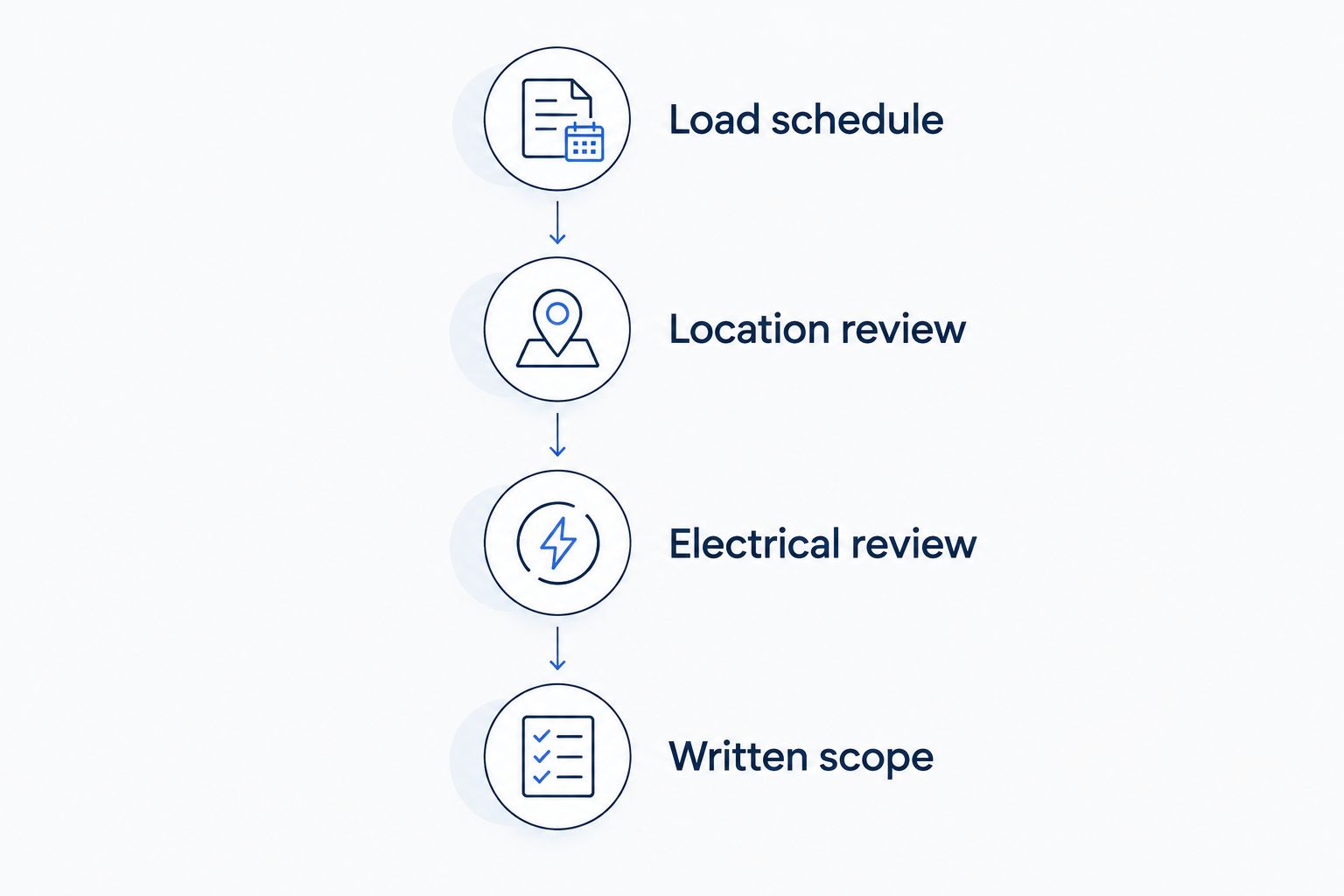
Use this sequence to keep the scope clear:
- Load schedule: Identify connected equipment, motor information, operating requirements, and planned additions.
- Location review: Confirm classified boundaries, environmental exposure, working space, and equipment access.
- Electrical review: Establish supply characteristics, available fault current, protection requirements, and existing capacity.
- Written scope: Identify equipment, installation work, exclusions, outage requirements, and documentation.
These steps separate equipment selection from installation assumptions. They also give you a basis for checking whether the finished work matches the agreed scope.
Ask who handles required permits, inspections, utility coordination, and final drawings. Put those responsibilities in writing. A same-business-day quote response starts the conversation; it does not settle installation timing or shutdown requirements.
Request an oilfield electrical quote
Get a same-business-day response and a clear written quote. Confirm site conditions before equipment selection.
Which industrial electrical panel should you choose?
Choose a distribution panelboard for ordinary branch circuits in a suitable nonclassified location. Choose an MCC for grouped motors, a switchboard for main distribution, and a PLC control panel for process sequencing. Use an appropriately rated assembly wherever the documented hazardous-location requirements demand it.
For an undecided Bakken operator, the next move is an inspection and written scope from Eagle Electric, not a manufacturer shortlist. In 2026, the selection still starts with the same practical questions: what does the equipment feed, where will it sit, and how will qualified personnel service it safely?
FAQ
What's the best industrial electrical panel for an oilfield facility?
The best panel depends on its job and installation location. A distribution panelboard suits ordinary branch circuits, an MCC suits grouped motors, and a switchboard suits main distribution. A licensed electrician must confirm ratings and location suitability.
Is a motor control center better than a panelboard?
A motor control center is better for grouped motor-control duties, not for every electrical load. A panelboard distributes branch circuits; an MCC organizes motor-control equipment. Choose by function rather than cabinet appearance.
Does an outdoor electrical panel work in a hazardous location?
An outdoor rating alone does not establish hazardous-location suitability. Equipment must match the documented classification and applicable installation requirements. Have a licensed electrician review the location before selection.
Can a PLC panel power all the equipment at an oilfield site?
A PLC control panel is not a substitute for facility power distribution. It handles control logic and associated interfaces. Motors and other loads still need suitable distribution, protection, and disconnecting arrangements.
What should I send with an oilfield panel quote request?
Send the equipment schedule, proposed location, existing drawings, and known operating constraints. Include hazardous-area documentation when applicable. An on-site inspection establishes existing conditions that documents alone do not resolve.
Should I replace a breaker with a larger one when equipment trips?
Do not increase a breaker rating to stop tripping without a licensed electrician's assessment. The electrician must check the load, conductors, protective device, and equipment requirements. Repeated trips require diagnosis, not a larger breaker by default.
Does a same-business-day quote response mean same-day installation?
No, a same-business-day response does not promise same-day job completion. Eagle Electric emphasizes prompt quote responses and clear written quotes. Installation timing depends on the agreed scope and site requirements.
One last thing
Spare breaker positions are not proof of spare capacity. Before adding a pump, heater, or other load, have a licensed electrician assess the supply, conductors, protective equipment, and existing demand. An empty slot answers a space question, not an electrical one.


