

Best overall: coordinated service-entrance surge protection. Best retrofit: distribution-panel protection. Best for sensitive controls: signal-line protection paired with power-side protection. This 2026 guide ranks protection arrangements for oilfield equipment—not competing brands—because voltage, grounding, installation location, and hazardous-area requirements determine what belongs on your site.
- The best surge protectors oilfield equipment needs must match its power system, installation location, and hazardous-area requirements.
- Service-entrance protection is the first choice for incoming power; equipment-panel protection adds coverage near sensitive loads.
- Signal-line protection addresses exposed control wiring that a power-panel surge protective device does not protect.
- Eagle-Elc provides oilfield electrical contracting; request an on-site assessment and a clear written quote.
Why this matters
A pump motor, variable-frequency drive, and control system do not present the same protection problem. A surge protective device, or SPD, limits transient overvoltage. It does not repair loose connections, correct sustained overvoltage, or provide backup power.
Eagle-Elc is best for Bakken operators who need licensed oilfield electrical contracting rather than a plug-in surge strip. Start with an assessment through Eagle-Elc before specifying equipment. The company serves oil and gas operators across the Bakken region from Watford City, North Dakota.
For a 2026 project, describe the failure first. A controller reboot, damaged input module, and tripped drive call for different investigations. Treating every electrical problem as a surge leads to the wrong purchase.
What makes the best oilfield surge protection
Judge the protection arrangement before judging a device's headline ratings. These criteria belong in the written specification:
- System compatibility: Match nominal voltage, phase arrangement, grounding configuration, and maximum continuous operating voltage. A device marked for one system is not automatically suitable for another.
- Installation location: Specify service entrance, distribution panel, equipment panel, power outlet, or signal circuit. The location determines which device types belong there.
- Safety ratings: Check the applicable listing, short-circuit current rating, required overcurrent protection, and manufacturer's instructions. Have the electrician verify compatibility with available fault current.
- Connection quality: Keep SPD connecting conductors short and direct as instructed. Extra conductor length adds impedance and affects installed protection.
- Environmental suitability: Match temperature, moisture, corrosion exposure, enclosure requirements, and any hazardous-location classification. A weather-resistant enclosure alone does not establish HazLoc suitability.
- Maintenance visibility: Specify how staff will identify failed protection, inspect status indicators, and arrange replacement. A device that has reached end of life must not remain unnoticed.
The electrician also needs the system diagram. Nominal values such as 480 volts AC, 120 volts AC, and 24 volts DC describe different circuits; they are not interchangeable SPD specifications. Verify the actual circuit and the manufacturer's permitted application before selecting anything.
Oilfield surge protection at a glance
These ranked options occupy distinct jobs. Several belong in the same installation, so the table is a placement guide—not a claim that one device replaces every other device.
| Rank and option | Best for | Standout function | Key limitation |
|---|---|---|---|
| 1. Service-entrance SPD | Incoming power protection | Addresses transients at the electrical service | Does not protect every downstream signal path |
| 2. Distribution-panel SPD | Existing facility retrofits | Adds protection at a downstream distribution point | Placement and connecting conductors affect performance |
| 3. Equipment-panel SPD | Drives and local control assemblies | Places power protection near the equipment supply | Must match the local circuit and equipment instructions |
| 4. Signal-line SPD | Instrumentation and communications | Protects specified low-voltage signal paths | Incorrect selection can interfere with the signal |
| 5. Point-of-use SPD | Suitable plug-connected support equipment | Adds local protection at a receptacle-fed load | Not a substitute for industrial power-system protection |
1. Service-entrance SPD: best for incoming power protection
A service-entrance SPD addresses transient overvoltage where power enters the installation. It gives the protection plan a starting point, but downstream equipment and external signal cables still need separate consideration.
UL 1449 distinguishes installation types. A Type 1 SPD is intended for permitted installations on either side of the service overcurrent device, subject to its listing and instructions. That classification does not give anyone permission to work on energized service equipment.
Service-entrance SPD pros:
- Establishes protection at the incoming electrical supply.
- Addresses incoming power conductors rather than one plug-connected load.
- Provides a foundation for coordinated downstream protection.
Service-entrance SPD cons:
- Does not cover separate communications or instrumentation circuits.
- Requires careful verification of service configuration and installation requirements.
Best for: Operators specifying protection at the electrical service during a new installation or an assessed upgrade.
Have a licensed electrician confirm the connection arrangement, grounding, bonding, and available fault current. Service equipment access requires a planned work procedure, not an improvised connection.
Verdict: Buy a properly specified service-entrance SPD as the incoming-power layer—not as the entire protection plan.
2. Distribution-panel SPD: best for existing facility retrofits
A distribution-panel SPD adds protection downstream of the service. It suits a retrofit when the assessment identifies a distribution point serving vulnerable loads and confirms a permitted installation method.
A Type 2 SPD installs on the load side of the service overcurrent device under its listing and instructions. Check panel suitability, the connection method, required disconnecting means, and any specified breaker or fuse protection. An open breaker position alone does not prove the installation is suitable.
Distribution-panel SPD pros:
- Adds protection at an existing downstream distribution point.
- Supports a staged retrofit without treating every load separately.
- Provides a location for inspection when equipment status remains accessible.
Distribution-panel SPD cons:
- Does not eliminate transients generated or entering farther downstream.
- Poor routing or excessive connecting-conductor length weakens installed performance.
Best for: Existing facilities adding protection to a defined group of circuits.
For a 2026 retrofit, ask for the proposed location and connection arrangement in the quote. Do not accept a generic device description with no explanation of which panel it protects.
Verdict: Buy a distribution-panel SPD when the site assessment identifies that panel as a useful protection point.
3. Equipment-panel SPD: best for drives and local controls
An equipment-panel SPD places power-side protection near a specific assembly. This arrangement matters when a remote panel supplies a drive cabinet, pump controller, or other sensitive equipment.
It is a placement choice, not a separate universal listing category. The electrician must select a permitted SPD type and verify the equipment manufacturer's instructions. Power-side protection also leaves control and communications connections as separate assessment items.
Equipment-panel SPD pros:
- Places protection close to the equipment supply connection.
- Addresses a specific load rather than relying only on service protection.
- Supports a local inspection and maintenance plan.
Equipment-panel SPD cons:
- Does not correct motor, drive, grounding, or wiring faults.
- Requires equipment-specific review of voltage, connection points, and enclosure conditions.
Best for: Sensitive drives and control assemblies with an identified need for local power-side protection.
Keep the device on the correct side of the equipment's circuitry. Never place a general-purpose SPD on a variable-frequency drive output unless the drive and protection manufacturers explicitly permit that application. The output waveform is not the same as the incoming utility supply.
Verdict: Buy equipment-panel protection after confirming the permitted supply-side application; skip improvised drive-output installations.
4. Signal-line SPD: best for instrumentation and communications
A signal-line SPD protects a specified control or communications circuit. It belongs in the assessment when external wiring connects instruments, remote equipment, or separate structures to sensitive electronics.
Choose it for the actual signal, not just the connector shape. Operating voltage, bandwidth, impedance, conductor arrangement, and grounding requirements all matter. Power-panel protection does not protect these separate paths by default.
Signal-line SPD pros:
- Addresses surge paths outside the equipment's power supply.
- Targets exposed instrumentation and communications wiring.
- Complements power-side protection at control assemblies.
Signal-line SPD cons:
- The wrong device can interfere with normal signal operation.
- Hazardous-area and intrinsically safe circuits require additional application review.
Best for: Instrumentation and communications circuits with exposed conductors or connections between structures.
Do not add a protector to an intrinsically safe loop without checking the system documentation and permitted component arrangement. Intrinsic safety is a system requirement. A device's individual marking does not settle every installation question.
For a 2026 controls upgrade, include signal protection in the electrical review before selecting hardware. Otherwise, the incoming power receives attention while another surge path remains untreated.
Verdict: Buy signal-line protection matched to the actual circuit; skip generic protectors selected only by connector type.
5. Point-of-use SPD: best for suitable support equipment
A point-of-use SPD provides local protection for an appropriate receptacle-fed load. Think of non-process support equipment in a suitable environment—not a universal fix for motors, drives, or field instrumentation.
UL 1449 includes Type 3 SPDs for point-of-utilization applications with specific installation requirements. Follow the product instructions and coordinate the device with upstream protection. Do not assume every power strip provides surge protection.
Point-of-use SPD pros:
- Adds local protection for suitable plug-connected equipment.
- Offers accessible status indication when the selected device provides it.
- Supports a layered arrangement for office or support-space loads.
Point-of-use SPD cons:
- Does not replace service, distribution, or equipment-panel protection.
- Ordinary indoor devices do not establish suitability for wet, corrosive, or classified locations.
Best for: Appropriate receptacle-fed support equipment in a suitable, unclassified environment.
Check both the device and the load. A damaged receptacle, missing grounding connection, or overloaded circuit needs repair—not another adapter.
Verdict: Buy point-of-use protection for its narrow support-equipment role; skip household strips as process-equipment protection.
How the ranking works
The ranking follows protection location and use case. Service-entrance protection comes first for incoming power; distribution and equipment-panel protection address downstream power; signal-line protection covers a different electrical path; point-of-use protection serves suitable plug-connected loads.
It does not rank competing manufacturers or claim bench-test results. The best device is the one that fits the verified circuit and installation—not the one with the largest isolated rating.
What your electrician needs before the quote
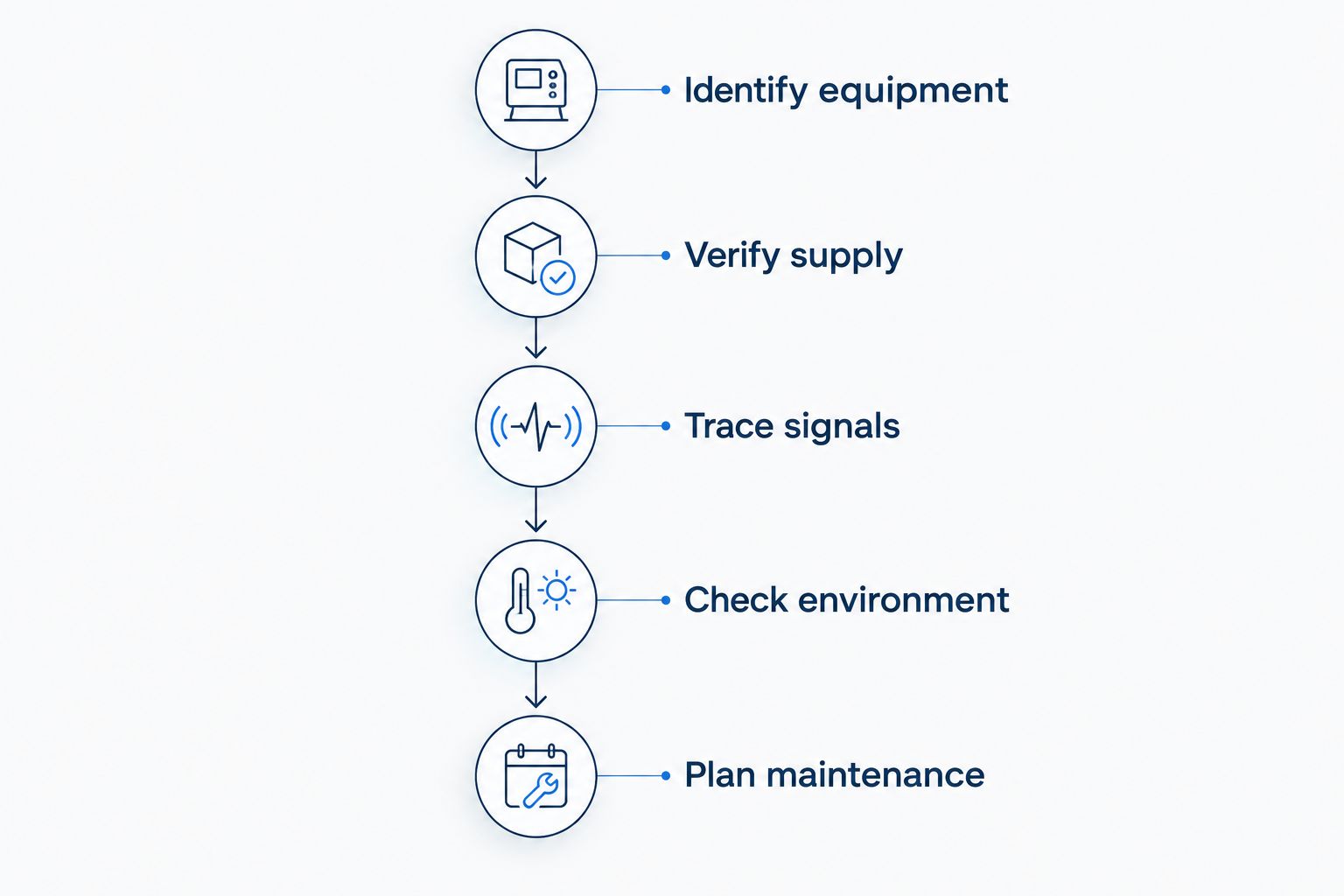
Use this sequence for a 2026 scope. Keep the information practical and do not open energized equipment to gather it.
- Identify equipment. List affected pumps, drives, controllers, instruments, and support loads. Describe what failed or stopped working.
- Verify supply. Provide existing drawings and accessible nameplate information. The electrician verifies circuit voltage, grounding configuration, and fault-current requirements.
- Trace signals. Identify external control and communications connections. Include wiring between separate structures.
- Check environment. Confirm weather exposure, enclosure needs, and documented hazardous-area classifications.
- Plan maintenance. Decide who checks protection status and how a failed device gets replaced.
The written scope should identify protection locations, installation requirements, shutdown needs, and acceptance checks. Separate known work from items that require inspection. Clear boundaries prevent a device-only quote from being mistaken for a complete electrical correction.
Eagle-Elc's oilfield electrical contracting starts with the job you need assessed. Expect a same-business-day response to a quote request and a clear written quote. A response is not a promise of same-day installation or completion.
Request an oilfield electrical quote
Describe the equipment, failures, and site conditions. Ask for a clear written scope.
Which surge protection should you choose?
Start with a coordinated power-and-signal assessment. For an undecided operator, service-entrance protection is the default incoming-power recommendation, followed by downstream and signal protection where the assessed installation calls for them.
Do not buy a device to diagnose a recurring fault. Burning smells, damaged insulation, repeated trips, or unexplained equipment failures require a licensed electrician. Keep personnel away from unsafe equipment and follow the site's isolation procedures.
FAQ
What's the best surge protection for oilfield equipment?
The best arrangement matches the verified power system and protects the relevant power and signal paths. Start with service-entrance assessment, then evaluate distribution panels, equipment panels, and exposed control wiring.
Is a Type 1 SPD better than a Type 2 SPD?
Type 1 and Type 2 describe permitted installation applications, not a simple quality ranking. Type 1 devices can serve permitted service-side locations; Type 2 devices install on the load side of the service overcurrent device.
Can a surge protector stop a variable-frequency drive from tripping?
An SPD does not correct every cause of a drive trip. Have a licensed electrician diagnose the fault and follow the drive manufacturer's instructions before specifying protection.
Do control cables need separate surge protection?
Control cables need a separate assessment because a power-panel SPD does not protect their signal paths. Any selected protector must match the signal characteristics and installation requirements.
Can I install a regular surge strip in a hazardous location?
Do not install an ordinary surge strip in a classified location unless its approvals and application explicitly permit that use. Have the electrician verify the area's classification and the complete installation requirements.
Does surge protection replace a generator or UPS?
No. Surge protection limits transient overvoltage; a generator or UPS addresses power continuity for suitable loads. These functions require separate selection and planning.
Who should assess oilfield surge protection in the Bakken?
Eagle-Elc provides licensed oilfield electrical contracting across the Bakken region. Request an on-site assessment and a written scope covering the equipment, supply, signal wiring, and site conditions.
One last thing
A correctly selected SPD can still deliver disappointing protection if its connecting conductors are poorly routed. Ask the electrician to specify the connection arrangement, not just the catalog number. For your 2026 maintenance plan, make protection status and replacement responsibility visible to the people operating the site.


