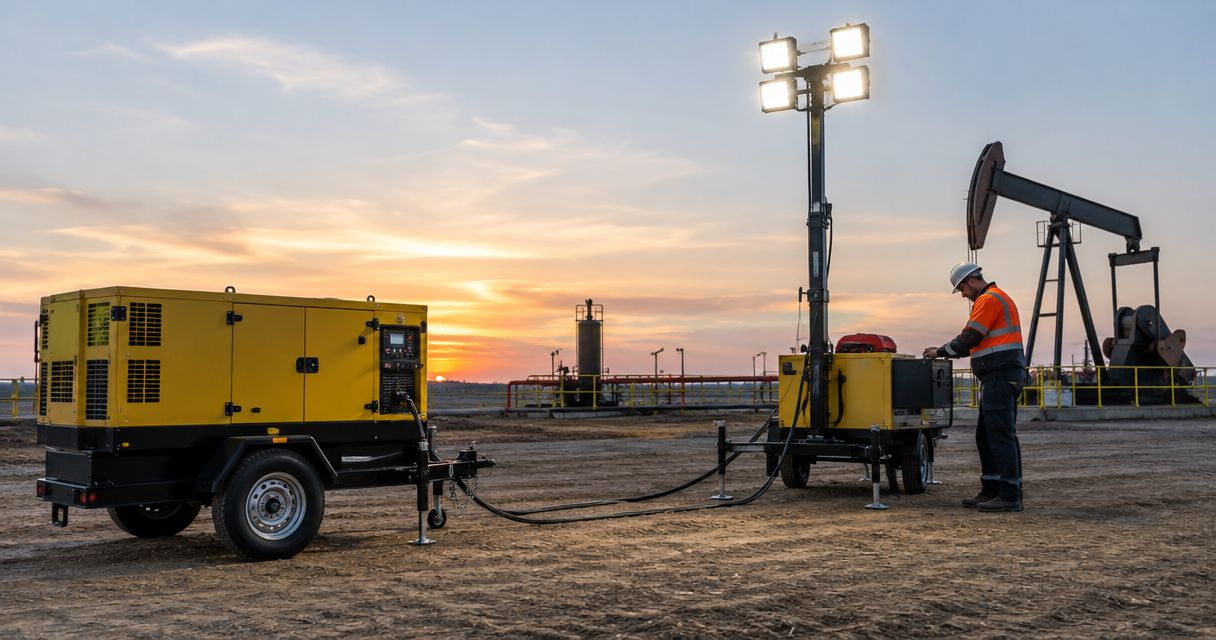
Best overall: a location-rated LED area luminaire for general site lighting. Best for equipment faces: a location-rated floodlight. Best for walkways: a location-rated linear luminaire. The best hazardous location lighting oil and gas operators can specify in 2026 starts with the documented area classification—not a fixture brand or a brighter beam.
- The best hazardous location lighting oil and gas facilities need matches the documented classification before brightness or fixture shape.
- Location-rated LED area luminaires are the default for general lighting; floodlights serve equipment faces and targeted work areas.
- Eagle-elc provides licensed oilfield electrical contracting for Bakken operators; request a clear written scope before ordering fixtures.
- HazLoc lighting selection requires the correct gas group, temperature code, ambient rating, and installation method.
Why this matters
A weatherproof light is not automatically suitable for a classified location. Neither is an industrial LED fixture with a heavy housing. The approval has to cover the actual hazardous location and the installation conditions.
Eagle-elc provides licensed oilfield electrical contracting for Bakken operators. Based in Watford City, ND, Eagle-elc serves oil and gas operators across the region. The practical starting point is an on-site assessment and a clear written quote, not a catalog order based on appearance.
This 2026 guide ranks fixture types by their job. It does not compare manufacturers or treat every oilfield location as the same hazard. Your documented classification decides which products qualify; the lighting task decides which qualifying fixture fits.
What makes the best hazardous location lighting?
Use these criteria before comparing fixture shapes:
- Location approval: Match the documented Class and Division, or Zone designation, plus the applicable gas or vapor group. Confirm the exact model's listing and markings.
- Temperature suitability: Check the temperature code and approved ambient range against the site's substances and operating conditions.
- Useful light: Evaluate illumination on the walking surface, equipment face, or inspection point. Glare and shadows matter alongside brightness.
- Physical protection: Match exposure to water, dust, corrosion, vibration, and impact. Environmental ratings do not replace hazardous-location approval.
- Installation fit: Review the supply, mounting, wiring method, entries, and any required seals. The whole installation must comply.
- Maintenance access: Choose an arrangement that supports safe inspection and service under the facility's isolation procedures.
Reject a fixture that fails the classification check, even if its beam pattern is perfect. A lighting layout cannot compensate for the wrong approval.
Hazardous location lighting at a glance
These are application categories, not interchangeable certifications. Every option below still needs the correct hazardous-location approval for its intended position.
| Ranked option | Best for | Standout feature | Key limitation |
|---|---|---|---|
| Location-rated LED area luminaire | General site lighting | Broad illumination across a defined area | Poor placement creates glare and leaves equipment shadows |
| Location-rated LED floodlight | Equipment faces and targeted work areas | Aimable light directed at a specific task | Narrow coverage does not replace a complete site layout |
| Location-rated linear LED luminaire | Walkways and sheltered process routes | Distributed light along a path | Obstructions and mounting geometry interrupt coverage |
| Location-rated task light | Close inspection and maintenance | Light placed near the inspection point | Portable use still requires appropriate approval and procedures |
| Location-rated emergency luminaire | Required emergency illumination | Lighting designed for loss of normal supply | Requires suitable power arrangements, inspection, and testing |
For a broader lighting layout, the guide to LED lighting solutions for oilfield job sites covers the surrounding application. Hazardous-location approval remains a separate gate; general job-site suitability is not enough.
1. LED area luminaire: best for general site lighting
A location-rated LED area luminaire is the default choice for broad, fixed illumination. It supports circulation and general visibility around equipment when its distribution and mounting position match the site layout.
Do not select it by wattage alone. Ask for a lighting layout that shows the intended illuminated surfaces and accounts for structures, tanks, pipework, and glare toward approaching workers.
LED area luminaire pros:
- Covers a general area rather than one narrow inspection point.
- Supports a consistent fixed-lighting layout.
- Offers distribution choices that can suit different mounting positions.
LED area luminaire cons:
- Equipment and structures can block the light.
- Elevated mounting can complicate safe maintenance access.
- Excessive brightness or poor aiming creates glare.
Best for: General circulation and broad outdoor work areas within the fixture's approved conditions.
For a 2026 replacement project, retain the existing pole or mounting position only after checking its condition and the new fixture's suitability. A fitting mounting bracket does not prove an acceptable installation.
Verdict: Buy for general lighting only after classification, layout, and mounting approval.
2. LED floodlight: best for equipment faces
A location-rated floodlight directs light toward a defined target. It fits tasks such as illuminating an equipment face or a work area that a general overhead fixture leaves in shadow.
The beam must reach the task without shining into the worker's eyes. Check the view from the actual working position, not just from the mounting location.
LED floodlight pros:
- Directs illumination toward a specific surface.
- Supports targeted coverage where general lighting falls short.
- Allows beam placement around physical obstructions.
LED floodlight cons:
- Concentrated light can create harsh shadows.
- Incorrect aiming produces glare.
- One bright target can leave the surrounding route inadequately lit.
Best for: Equipment faces and clearly defined outdoor work zones.
A floodlight is a supplement when the task needs focused illumination. It is not a shortcut for designing the entire facility's lighting. Document the aiming position so later maintenance does not change the intended coverage.
Verdict: Buy for a defined target; skip as the sole answer to site-wide lighting.
3. Linear LED luminaire: best for walkways
A location-rated linear luminaire distributes light along a route or elongated work surface. It fits walkways and sheltered process areas where repeated fixtures can provide useful continuity.
Check the mounting height, spacing, and obstructions together. Pipework, cable trays, and structural members can interrupt the light even when the fixtures themselves are correctly approved.
Linear LED luminaire pros:
- Suits elongated routes and work surfaces.
- Supports repeated placement along a walkway.
- Distributes light rather than concentrating it on one target.
Linear LED luminaire cons:
- Nearby structures can create persistent shadows.
- Sheltered mounting does not eliminate corrosion or moisture exposure.
- Tight locations can make inspection and replacement difficult.
Best for: Walkways, sheltered routes, and elongated work areas.
During a 2026 retrofit, inspect the existing wiring and mounting arrangement before replacing fixtures in place. Do not assume that the old installation's condition or documentation meets the new project's requirements.
Verdict: Buy for route lighting after checking continuity, exposure, and service access.
4. Task light: best for close inspection
A location-rated task light brings illumination close to an inspection point. It addresses detail work where overhead light is blocked or the worker's own position casts a shadow.
Portable does not mean unrestricted. The light, its power arrangement, and its use must suit the classified location and the facility's work procedures.
Task light pros:
- Illuminates details that general lighting misses.
- Supports inspection from a useful working angle.
- Addresses temporary tasks without changing the permanent layout.
Task light cons:
- Cords or placement can obstruct access.
- Handling exposes the light to impact and damage.
- An ordinary flashlight or work light is not a substitute for required approval.
Best for: Close inspection and maintenance under an approved work procedure.
Check the exact portable light's markings before taking it into the area. Follow the manufacturer's charging and battery instructions, including any restrictions on charging or battery replacement in classified locations.
Verdict: Buy for approved inspection tasks; skip unapproved portable substitutes.
5. Emergency luminaire: best for emergency illumination
A location-rated emergency luminaire serves required illumination when normal lighting loses power. Its suitability depends on the location, the emergency-lighting design, and the applicable requirements.
A normal fixture connected to an unspecified backup source is not a complete emergency-lighting plan. Confirm the required coverage, power arrangement, testing method, and maintenance responsibilities with the design team.
Emergency luminaire pros:
- Addresses illumination during loss of normal supply.
- Supports a defined emergency-lighting design.
- Makes inspection and testing part of the specified system.
Emergency luminaire cons:
- Backup components introduce additional maintenance requirements.
- Batteries and equipment must suit their approved ambient conditions.
- Emergency coverage does not replace normal task lighting.
Best for: Locations where the approved design requires emergency illumination.
For 2026 projects, include testing and handover documentation in the written scope. Do not leave the facility team to work out the testing procedure after installation.
Verdict: Buy where the approved emergency-lighting design requires it.
Read the marking before the lumen figure
Class I locations involve flammable gases or vapors. Division and Zone systems describe hazardous-location conditions differently; their labels are not interchangeable shorthand. The facility's documented classification must guide selection.
Temperature codes are another separate check. Under the North American temperature-code system used in NEC hazardous-location provisions, T1 corresponds to 450 °C, T3 to 200 °C, and T4 to 135 °C maximum equipment surface temperatures under the applicable rating conditions. These are classification limits, not recommended operating temperatures or blanket fixture selections.
A lower permitted surface temperature does not make a fixture universally suitable. You still need the correct gas group, location approval, ambient range, and installation details. Review the manufacturer's certification documentation and the code edition adopted for the project in 2026.
Do not infer suitability from an explosionproof label alone. Other approved protection methods exist, and the exact marking must match the application.
Turn the shortlist into an installation scope
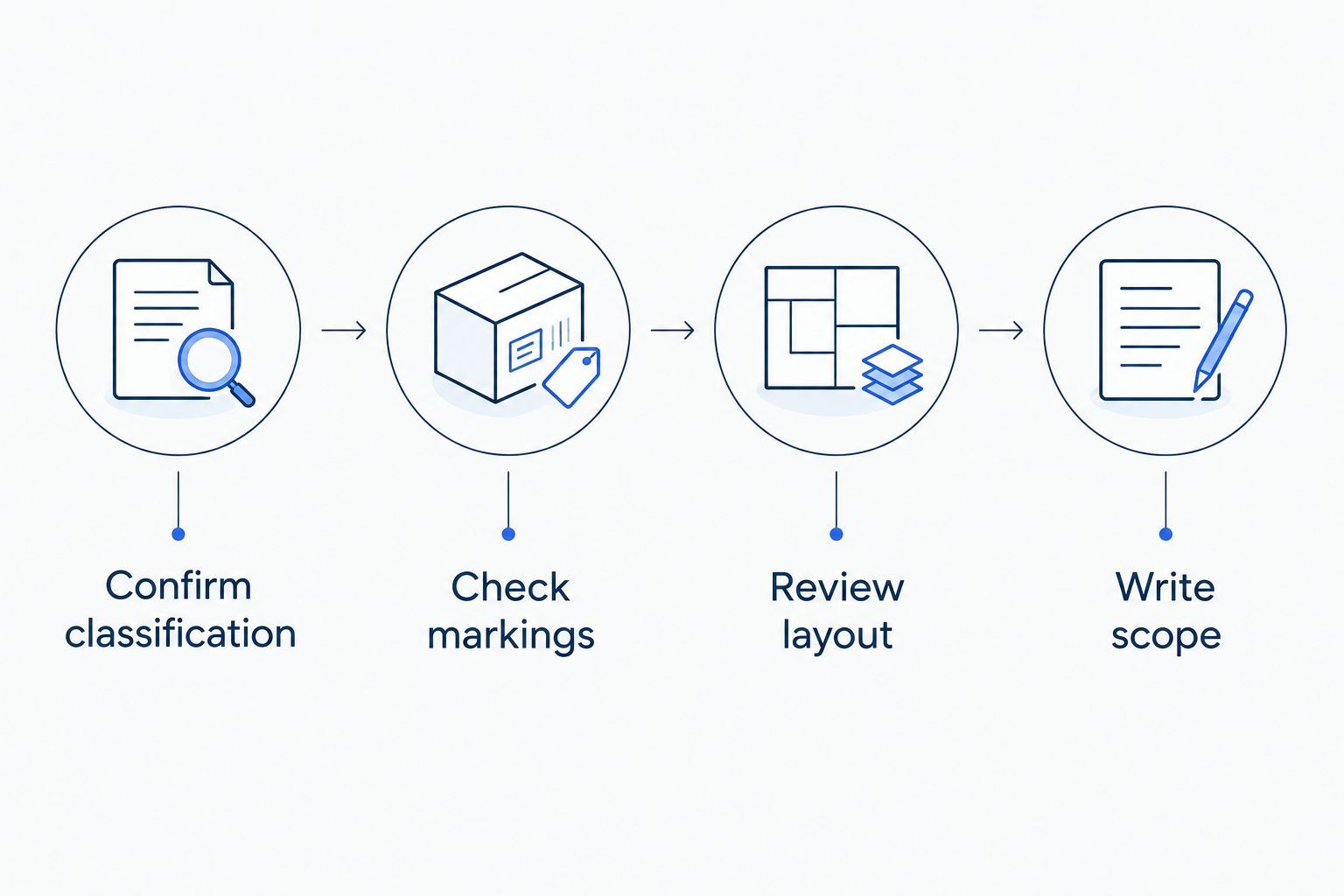
Use this sequence with the facility's responsible technical team and a licensed electrician. It is a procurement checklist, not a DIY installation procedure.
Confirm classification
Obtain the area-classification documents and identify each proposed fixture position. Resolve unclear boundaries before purchasing equipment. An on-site inspection alone does not replace the engineering basis for classification.
Check markings
Record the exact fixture model, approval, gas group, temperature code, and ambient rating. Match the supply and manufacturer's installation instructions. Similar-looking models can carry different approvals.
Review layout
Identify walking routes, task surfaces, glare points, and maintenance access. Choose area, flood, linear, task, or emergency lighting according to the job—not because one type is already on the shelf.
Write scope
List fixtures, mounting work, wiring work, required inspections, and handover documents. Identify who handles permits and any required classification or design work. State exclusions clearly.
Eagle-elc responds to quote requests the same business day. Request a clear written quote covering the inspection, proposed work, and exclusions. A same-business-day response is not a promise of same-day job completion.
Request a written electrical quote
Describe the facility, lighting task, and available classification documents.
How these lighting types were ranked
The ranking uses application fit: broad coverage first, then targeted equipment lighting, walkway lighting, close inspection, and emergency illumination. Classification, temperature suitability, physical exposure, installation fit, and service access remain pass-or-fail checks for every option.
This is not a product test or a manufacturer leaderboard. Emergency lighting ranks last by application sequence, not by safety importance. Its required provision is not optional.
Which hazardous location lighting should you choose?
Start with a location-rated LED area luminaire for general illumination. Add floodlights for defined equipment faces, linear fixtures for routes, and approved task lights for inspection. Specify emergency illumination through the facility's required design.
For Bakken operators, Eagle-elc is the local licensed electrical contracting option described here—not a lighting manufacturer. Use the contractor discussion to turn your classification documents and operating needs into a written installation scope.
Choose the approved fixture that lights the task correctly. Reject any option that fails either requirement.
FAQ
What's the best hazardous location lighting for an oil and gas facility?
A location-rated LED area luminaire is the default for general illumination, provided its approval matches the documented location. Use floodlights, linear luminaires, task lights, or emergency luminaires for their distinct applications.
Is a weatherproof LED light safe in a hazardous location?
Weatherproofing alone does not establish hazardous-location suitability. The exact fixture needs the appropriate approval, gas group, temperature code, and ambient rating for its installation position.
Are Class I Division 1 and Division 2 lights interchangeable?
Do not assume Class I Division 1 and Division 2 lights are interchangeable. Check the exact listing, markings, installation instructions, and documented area classification with the responsible technical team.
Does an explosionproof label mean a light works everywhere?
No. An explosionproof label does not establish suitability for every gas group, temperature condition, or classified location. Review the complete approval and installation requirements.
Can I use a portable work light around oilfield equipment?
Use a portable work light only when its approval and the facility's procedures permit it in that location. Check the light, power arrangement, condition, and manufacturer restrictions before use.
Do hazardous locations need emergency lighting?
Required emergency illumination depends on the facility's applicable requirements and approved design. Any emergency equipment placed in a classified location must also be suitable for that location.
What should I send an electrician before requesting a lighting quote?
Send the facility location, lighting problem, proposed work areas, and available classification documents. Include existing fixture information and access restrictions so the electrician can define the inspection and written scope.
One last thing
An identical housing does not mean an identical approval. Before accepting a replacement, compare the exact model and nameplate against the approved specification. Keep that record with the facility's electrical documentation; it makes the next replacement a controlled decision instead of a guess.