
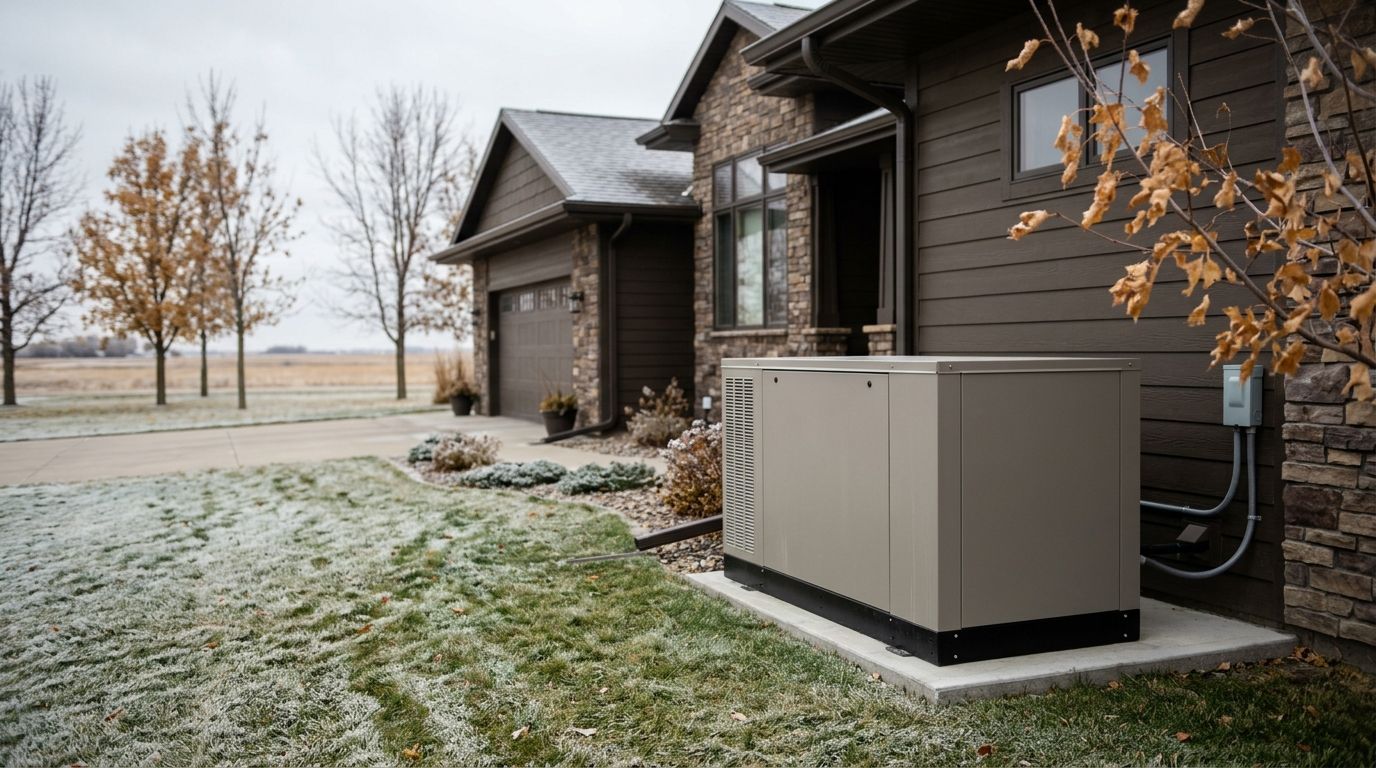
A whole-home standby generator is worth it in North Dakota when losing power also means losing essential heat, water, or sump-pump protection—especially when nobody is home to start backup equipment. It is harder to justify when you only need occasional power for lights and a refrigerator. The tradeoff is permanent installation, fuel planning, and maintenance; automatic backup still needs attention.
- A whole-home standby generator is worth it in North Dakota when essential circuits need unattended backup power.
- Automatic transfer protects selected loads without someone carrying equipment outside during an outage.
- Choose backup capacity from an electrical load calculation, not the phrase whole home.
- Eagle Electric provides licensed residential electrical contracting for Bakken homeowners who need an on-site assessment.
Why this matters
A gas furnace still needs electricity for its controls and blower. A private well needs power to move water. Losing either changes an outage from an inconvenience into a household problem.
Eagle Electric is a fit for Bakken homeowners who need licensed residential electrical contracting. Start with an on-site assessment, not a generator size picked from an advertisement. Eagle Electric is based in Watford City and serves homeowners across the Bakken region.
For your 2026 backup-power plan, identify what must keep working first. Then decide whether automatic operation solves a problem you actually have.
Is a whole-home standby generator worth it in ND?
Yes, when unattended operation and essential household loads matter more than simply having an emergency outlet. A permanently installed standby system can start automatically and transfer connected circuits after utility power fails. That benefit depends on proper equipment selection, installation, fuel supply, and maintenance.
Compare the operating burden as well as the coverage. These are different ways to handle an outage, not interchangeable purchases.
| Backup approach | Best for | Main advantage | Main limitation |
|---|---|---|---|
| Whole-home standby system | Homeowners seeking automatic backup across household circuits | Automatic starting and transfer with properly selected equipment | Requires permanent installation, fuel planning, and maintenance; capacity still has limits |
| Essential-circuit standby system | Homes prioritizing heat, water, refrigeration, and selected outlets | Automatic backup focused on critical loads | Circuits outside the backup plan remain unavailable |
| Portable generator | Households with someone available to operate equipment safely | Provides temporary backup without a permanently installed engine | Requires outdoor placement, manual handling, and safe connection arrangements |
| Battery backup | Selected loads with a defined energy requirement | No combustion exhaust at the battery equipment | Available energy and output limit what runs and for how long |
Do not assume a standby generator runs every appliance simultaneously. The final design determines whether large loads operate together, wait their turn, or stay off during an outage.
Whole-home standby: best for unattended household backup
Whole-home standby makes sense when you want automatic operation and broad circuit coverage. It is particularly relevant if you travel, leave the house unoccupied, or cannot safely handle portable equipment during bad weather.
The advantage is reduced dependence on someone being present. The limitation is that automatic operation does not remove equipment limits or maintenance duties. A fault, interrupted fuel supply, blocked airflow, or neglected service can prevent reliable operation.
Ask the electrician to identify exactly what the proposed system powers. “Whole home” should lead to a written load plan, not an assumption that everything runs at once.
Recommendation: choose whole-home standby when automatic coverage across household circuits solves a clear need.
Essential-circuit standby: best for protecting necessities
Essential-circuit standby concentrates backup power on the equipment you cannot comfortably lose. Your list might include furnace controls, a well pump, a sump pump, refrigeration, and selected lighting.
This approach keeps the discussion tied to household function. Its drawback is deliberate exclusion: equipment outside the selected circuits does not receive backup power unless the design specifically includes it.
Before approving a 2026 installation scope, ask which outlets remain live. A working refrigerator circuit does not mean every kitchen receptacle has power.
Recommendation: choose essential-circuit standby when necessities matter more than unrestricted appliance use.
Portable backup: best for attended, limited needs
A portable generator is a practical option when someone can deploy it safely and manage the connected loads. It is less suitable when the central requirement is automatic operation while the house is empty.
Safe placement is nonnegotiable. CDC portable-generator guidance calls for outdoor operation at least 20 feet from doors, windows, and vents, with exhaust directed away from the home. An open garage door does not make indoor operation safe.
Do not apply that portable-generator distance as a universal standby-installation rule. Permanently installed equipment needs manufacturer-specified clearances and compliance with applicable requirements.
Never feed a house through a wall receptacle. Building connections require suitable transfer equipment installed by a licensed electrician; the guide to portable-generator transfer connections explains the connection issue in more detail.
Recommendation: choose portable backup only when safe setup and hands-on operation fit your household.
Why the value of standby backup varies
The value comes from the outage consequences you avoid and the operating burden you remove. Use these factors to judge your own house rather than a statewide assumption.
- Outage history. Record the interruptions your property actually experiences. Include what stopped working, not just when the lights went out.
- Heating dependence. Identify the electrical equipment your heating system needs. Backup electricity does not replace its heating fuel.
- Water dependence. A private well and an electrically powered sump pump create different backup needs from a home without those loads.
- Household availability. Automatic starting matters more when nobody can safely deploy temporary equipment.
- Fuel supply. Confirm the available fuel, delivery arrangements where applicable, and whether the supply supports generator demand.
- Service commitment. Scheduled maintenance and attention to faults remain part of owning a standby system.
For a 2026 decision, your own outage record is more useful than an unsupported claim about how often every North Dakota home loses power. A short interruption can still matter if it stops equipment your household depends on.
What should a licensed electrician check before you decide?
An on-site inspection connects your wish list to the actual electrical system. Photographs and appliance labels help prepare for the visit, but they do not replace inspecting service equipment, connection points, and installation conditions.
Use this sequence to keep the assessment focused:
- Critical loads. List the equipment that must operate during an outage. Separate necessities from convenience loads.
- Load calculation. Have the electrician evaluate running demand and motor-starting requirements. Pumps and compressors need attention beyond their normal running load.
- Transfer equipment. Confirm how the system separates generator power from utility power and which circuits it supplies.
- Fuel supply. Have the appropriate qualified trade verify fuel-system requirements and available supply.
- Installation site. Check equipment clearances, exhaust direction, snow exposure, access, and applicable local requirements.
- Operating plan. Establish maintenance responsibilities, fault reporting, and safe shutdown instructions.
A proper assessment follows the house, not a generic equipment package. Keep the load list and operating plan with your installation documents so everyone knows what the backup system is intended to do.
A panel rating is not a generator size
A 200-amp electrical service describes the service equipment's rating. It does not tell you the generator capacity your household needs or prove that every connected appliance can run together.
Likewise, 120/240-volt service describes voltage, not available backup power. Generator selection requires the load calculation, appropriate voltage, starting requirements, and a plan for equipment that cannot operate simultaneously.
Do not open an energized panel to collect information. Give the electrician accessible labels and appliance details, and leave internal inspection to the licensed professional.
Cold-weather planning belongs in the design
Ask how the proposed equipment handles the installation site's winter conditions. Follow the manufacturer's requirements for starting provisions, fuel delivery, service intervals, and any specified cold-weather accessories.
Placement also affects access. The installer needs to account for snow accumulation and maintenance access without blocking required clearances or directing exhaust toward openings. Never build an improvised enclosure around operating equipment.
What should your written quote include?
A clear 2026 quote should describe the work, the boundaries, and the responsibilities. A model number alone is not enough to compare an installation with your actual backup needs.
Ask for these items in writing:
- Coverage: The circuits or loads included, plus any exclusions or automatic load management.
- Electrical work: Transfer equipment, wiring, connection arrangements, and any identified panel work.
- Site work: Equipment support, placement, access, and responsibility for associated work.
- Fuel work: Who checks the supply and completes required fuel connections.
- Approvals: Who handles applicable permits, inspections, and utility coordination.
- Handover: Startup checks, operating instructions, maintenance requirements, and fault procedures.
Eagle Electric emphasizes same-business-day responses to quote requests and clear written quotes. A response is not a promise of same-day installation. Scheduling depends on the defined work and the arrangements needed to complete it safely.
Request a written electrical quote
Get a same-business-day response to your quote request. Installation scheduling is separate.
Does a standby generator protect my home when I am away?
A properly configured standby system can start and transfer connected loads without you being home. That is its main advantage over equipment requiring manual setup. It does not guarantee uninterrupted power or eliminate equipment faults.
Ask what happens if the generator fails to start and how you will learn about it. Remote monitoring, where supported, is an alerting tool—not proof that every appliance is running or the house needs no further attention.
Can a generator keep my furnace and well pump running?
A generator can power a furnace's electrical components and a well pump when the system is designed for those loads. The electrician must account for starting demand, connected circuits, and other equipment operating at the same time.
Do not select equipment from the furnace or pump description alone. Bring the actual equipment information to the assessment, and confirm any fuel-dependent heating requirements separately.
FAQ
Is a whole-home standby generator worth it in North Dakota?
A whole-home standby generator is worth it when automatic backup protects essential household functions and manual setup is not dependable for your situation. It is less compelling when limited temporary power meets your needs safely.
Will a whole-home generator run everything at once?
A whole-home generator does not necessarily run every appliance at once. The load calculation, generator output, and load-management design determine which equipment operates together.
Do I need a licensed electrician to install standby backup?
Yes. A licensed electrician needs to assess the electrical system and install suitable transfer equipment and connections. Fuel work and applicable approvals also need the appropriate qualified parties.
Can I put a portable generator in my garage with the door open?
No. Never operate a portable generator in a garage, even with the door open. CDC guidance calls for outdoor operation at least 20 feet from doors, windows, and vents, with exhaust directed away from the home.
Does standby backup provide power without any interruption?
No. A standby generator generally needs time to detect utility failure, start, and transfer the connected load. Equipment requiring uninterrupted power needs a separate assessment of suitable backup arrangements.
Does a standby generator still need maintenance if I rarely use it?
Yes. Follow the manufacturer's maintenance and exercise requirements even when utility outages are uncommon. Check reported faults and keep required access and airflow clear.
What should I prepare before requesting a generator quote?
Prepare a list of essential equipment, your observed outage history, and accessible appliance information. Request an on-site assessment and a written scope identifying connected loads, exclusions, fuel work, and installation responsibilities.
One last thing
Write down what is allowed to stay off. That list often clarifies the decision faster than listing every appliance you own. If the oven, clothes dryer, and other large loads can wait, make that explicit before equipment selection.
Your 2026 backup plan should protect the household functions you actually need. Automatic operation matters. So does knowing exactly what happens when the utility goes down.


