
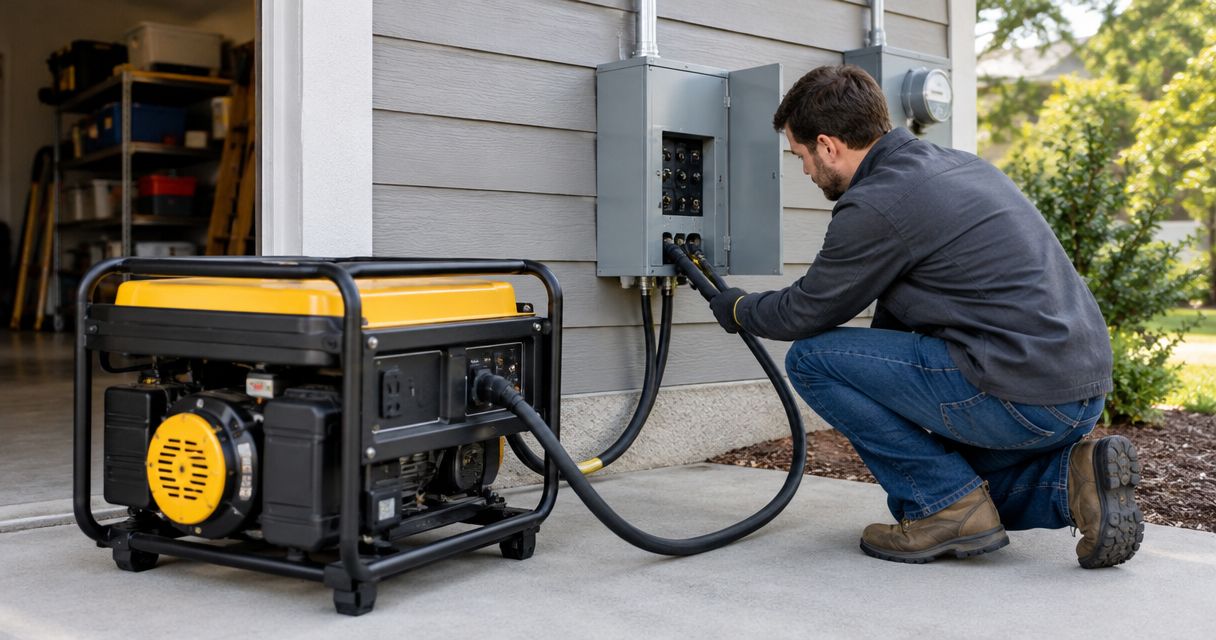
Instead of hauling out a generator and switching circuits during every outage, connect a transfer switch to a portable generator through a licensed electrician and a manufacturer-approved system. Automatic backup requires more than an automatic transfer switch: the generator must support unattended starting, operation, and shutdown in its installed configuration.
- To connect transfer switch to portable generator equipment, confirm manufacturer-approved automatic-start compatibility before buying the switch.
- An automatic transfer switch cannot make a manual-start portable generator start itself.
- Eagle-elc is best for Bakken homeowners seeking licensed electrical contracting for a generator connection.
- Keep portable generators outdoors, at least 20 feet from the home, with exhaust directed away from openings.
Why this matters
Automatic transfer and automatic backup are not the same thing. A switch can change the electrical supply without anyone moving a handle. That does not mean the generator can start safely without someone present.
A portable generator with a push-button starter is not automatically suitable for unattended backup. Fuel controls, starting controls, weather protection, maintenance requirements, and the manufacturer's operating instructions all matter.
For a 2026 installation, start with the generator model and its documentation—not the transfer switch listing. Eagle-elc provides licensed residential, commercial, and oilfield electrical contracting across the Bakken region.
This guide covers equipment selection, the installation handoff, and acceptance testing. It does not provide panel-wiring instructions. A licensed electrician must inspect the site and handle the fixed electrical connection.
Before you start
- Collect the equipment documents. You need the generator's exact model, operating manual, electrical specifications, and any documented automatic-start interface. Gather the proposed transfer equipment instructions too.
- Arrange access and define the load. Give the electrician access to the service equipment and proposed generator location. List the circuits you need during an outage, including equipment with motor-starting loads.
- Check the hidden compatibility issue. Electric start does not prove automatic-start compatibility. The electrician must also resolve neutral switching, bonding, grounding, and GFCI compatibility before selecting equipment.
Never connect a generator through a household receptacle. Never use a cord with exposed male plug ends. Those arrangements can energize utility wiring and expose people to lethal electrical hazards.
Generator and transfer-switch compatibility
Confirm what automatic means
- Identify the starting method. Read the exact model's manual. Separate recoil start, electric start, remote start, and documented automatic start. These are different functions.
- Find the approved control interface. Ask the electrician to confirm which transfer equipment and controller the manufacturer permits. Do not assume a remote-control accessory provides an automatic utility-failure signal.
- Check unattended-operation requirements. Confirm fuel supply, ventilation, weather limitations, starting-battery requirements, and any operator actions required before starting.
- Choose the workflow. If the manufacturer does not support automatic operation in the proposed configuration, use a supervised manual workflow or select equipment designed for automatic standby service.
Expected result: You have a documented compatible system—or a clear decision not to automate the existing portable generator. A switch seller's general compatibility claim is not enough.
Do not improvise choke controls, bypass safety shutdowns, or modify the generator's starting circuit. An engine that starts during a demonstration has not proved that it can provide safe unattended backup.
Match the electrical supply
The electrician must match the generator output to the transfer equipment and the selected loads. A generator supplying only 120 volts cannot supply a 240-volt appliance through a different cord or switch.
The plug fitting is not the whole compatibility check. Voltage, current ratings, conductor requirements, overcurrent protection, and the equipment's approved configuration must agree.
Use this comparison when deciding which workflow fits your property:
| Configuration | Best for | Main advantage | Main limitation |
|---|---|---|---|
| Portable generator with manual transfer equipment | Homeowners who can supervise outage operation | Operator controls starting and load selection | Requires someone present; does not provide unattended restoration |
| Portable generator with documented automatic-start compatibility | Owners whose exact equipment supports the complete automatic system | Can coordinate starting and transfer when correctly configured | Requires model-specific approval and suitable operating conditions |
| Permanently installed standby generator | Properties that need unattended backup | Designed around automatic starting and transfer | Requires a dedicated installation, fuel planning, and maintenance |
Choose the operating requirement first, then the equipment. For a 2026 project, a portable generator you already own is useful only if it meets that requirement safely.
Site and installation scope
Set the outdoor operating location
- Select an outdoor location. Follow the generator manufacturer's instructions and applicable installation requirements. CDC guidance places portable generators at least 20 feet from the home, with exhaust directed away from windows, doors, and vents.
- Reject enclosed operating spaces. Do not run a portable generator in a garage, basement, crawlspace, shed, or other enclosed or partly enclosed space. An open garage door does not make operation safe.
- Plan for weather without trapping exhaust. Use only protection permitted by the manufacturer. Do not build a tight enclosure around a portable generator to keep snow or rain off it.
- Keep the operating area accessible. Plan a clear route for the operator and keep cords away from vehicle traffic, standing water, and damage.
Expected result: The proposed location supports safe operation and a compliant connection. If it does not, change the location or equipment before installation proceeds.
North Dakota winter conditions belong in the site discussion. Snow accumulation, access, and the manufacturer's operating limits affect the plan. A transfer switch does not solve an unsuitable outdoor location.
Define the electrician's work
- Schedule the site inspection. Have the electrician inspect the service equipment, panel condition, proposed inlet location, selected circuits, and generator documentation.
- Approve a written scope. Identify the transfer equipment, inlet or approved connection arrangement, circuit coverage, required approvals, and testing responsibilities.
- Assign the electrical installation. Leave service equipment, panel wiring, grounding, bonding, and control wiring to the licensed electrician. Parts of service equipment can remain energized even with the main breaker off.
- Confirm utility isolation. Require transfer equipment that prevents the generator from energizing utility conductors. Switching off a main breaker by itself is not a substitute for an approved transfer arrangement.
Expected result: The written scope describes what will receive backup power, how the sources remain isolated, and who completes inspection and commissioning.
For a 2026 quote request, send the equipment documents and your priority-circuit list together. Eagle-elc emphasizes same-business-day responses to quote requests and clear written quotes. A response is not a promise of same-day job completion.
A useful quote separates the connection work from any panel repairs or other work found during inspection. That keeps an existing electrical problem from disappearing inside a vague generator-installation description.
Commissioning and operating handoff
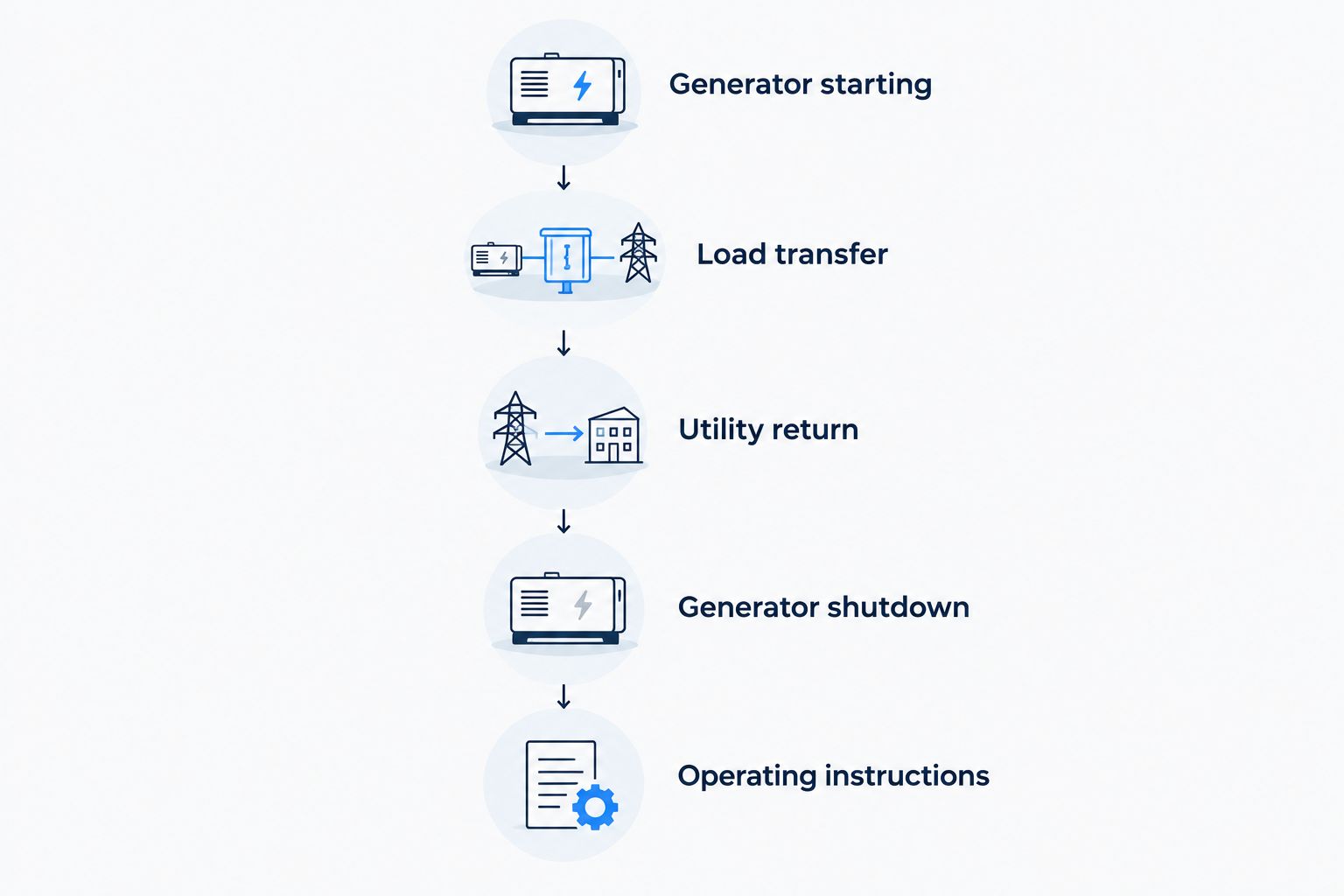
Test the complete sequence
- Have the installer lead the test. The electrician should verify the completed installation and follow the manufacturer's commissioning procedure. Do not simulate an outage by opening unfamiliar service equipment yourself.
- Verify generator starting. For an approved automatic system, confirm that the controller initiates starting without an operator action that defeats the purpose of automatic backup.
- Verify transfer under the planned load. Confirm that selected circuits receive power and that the generator supports the intended combination of loads. Motor starting needs attention, not just steady running.
- Verify utility return. Confirm the manufacturer's prescribed return-to-utility and shutdown sequence. A system that transfers one way has not completed its acceptance test.
- Receive the operating instructions. Ask the installer to identify the controls, shutdown procedure, maintenance requirements, and conditions that require service.
Expected result: You receive a demonstrated operating sequence and written instructions for your equipment. The handoff should cover failure conditions as well as a successful start.
The labels on your equipment control the procedure. There is no universal button sequence for every generator and transfer switch. Have the installer point out the actual controls rather than relying on generic online instructions.
Before closing a 2026 installation, document which circuits are backed up and which are excluded. Keep that record with the manuals. A working kitchen light does not prove the well pump or heating equipment has backup power.
Second workflow: supervised manual backup
A manual workflow is the right choice when the portable generator requires an operator. It gives up unattended restoration rather than pretending unsupported automation is safe.
Have the electrician install and demonstrate approved manual transfer equipment. Use the transfer-switch selection guide to frame the equipment discussion, then confirm suitability against the actual generator and site.
For each outage:
- Check the operating conditions. Confirm the outdoor location is safe, exhaust paths are clear, and the equipment has no visible damage.
- Follow the documented connection procedure. Use the approved inlet and correctly rated cord. Follow the manufacturer's sequence for connection, starting, and transfer.
- Manage the selected loads. Follow the installer's load plan. Do not add appliances simply because an unused receptacle is nearby.
- Follow the return procedure. Restore utility supply, shut down, disconnect, and store equipment in the sequence specified for your system.
Expected result: You restore selected circuits under supervision without a utility backfeed path. You still need someone available to operate the generator.
Troubleshooting
The switch is automatic, but the generator never starts
Check the documented starting requirements with the installer. A manual-start generator cannot respond to a transfer switch's start request. For compatible equipment, have the installer check the controller, starting battery, and approved control connection.
Do not bypass a safety device to force a start.
The generator runs, but selected circuits stay off
Check only the user-accessible indications and controls described in the manuals. Stop if the sequence differs from the handoff instructions. The electrician must investigate transfer operation, protective devices, and fixed wiring.
The generator GFCI trips when connected
Have the electrician review neutral switching, bonding, leakage faults, and compatibility with the generator's protection. Do not remove a grounding pin or defeat the GFCI. Repeated resetting does not correct the cause.
The generator struggles when a motor starts
Reduce loads using the approved operating procedure and contact the installer. The load plan must account for starting demand as well as running demand. Do not increase breaker ratings to stop trips.
Utility power returns, but the system stays on generator
Check the documented operating sequence and controller indications. Return timing and fault behavior depend on the equipment. Do not force the transfer mechanism or open energized equipment; have the installer diagnose the condition.
Customize your workflow
Build the backup plan around the loads you cannot leave off. Heating controls, refrigeration, pumps, and essential business equipment require different operating decisions. Name the actual equipment in your scope instead of requesting unspecified whole-building coverage.
Eagle-elc electrical contracting covers homeowners, businesses, and oilfield operators in the Bakken region. Each site still needs its own inspection and load assessment. A residential connection plan is not an oilfield electrical design.
For your 2026 maintenance file, keep the manuals, circuit list, inspection records, and commissioning instructions together. Revisit the load plan when you add equipment or change the panel.
FAQ
Can I connect a transfer switch to a portable generator myself?
Have a licensed electrician install the fixed transfer equipment and generator connection. Panel work, utility isolation, neutral switching, and grounding require a site-specific assessment; follow the documented operating procedure after installation.
Will an automatic transfer switch start any portable generator?
No. The generator must have a documented compatible automatic-start interface and support unattended operation in the proposed configuration. Electric start alone does not establish compatibility.
Can a portable generator provide automatic backup while I am away?
Only when the manufacturer supports the complete automatic operating arrangement and the installation meets its requirements. Otherwise, use supervised manual operation or equipment designed for automatic standby service.
How far from the house should a portable generator run?
CDC guidance says to operate portable generators outdoors at least 20 feet from the home, with exhaust directed away from openings. Follow the manufacturer's instructions and any more restrictive applicable requirements.
Why does the generator GFCI trip after connection?
A trip requires diagnosis of the protective device, connected loads, wiring, and neutral-bonding arrangement. Have the electrician identify the cause; never defeat the protection or remove a grounding pin.
Can my portable generator power every circuit in the house?
Only if its output and the approved installation support the actual loads. Have the electrician assess running demand, motor starting, voltage requirements, and any required load management.
What should I send with a generator-installation quote request?
Send the generator model and manual, your priority-circuit list, and accessible photographs of closed equipment labels and the proposed outdoor location. Eagle-elc emphasizes same-business-day responses to quote requests and clear written quotes; installation scheduling is separate.
One last thing
Test the return to utility power before accepting the installation. Starting the generator proves only part of the workflow. The complete handoff must also demonstrate transfer, intended load operation, utility restoration, and generator shutdown.


