
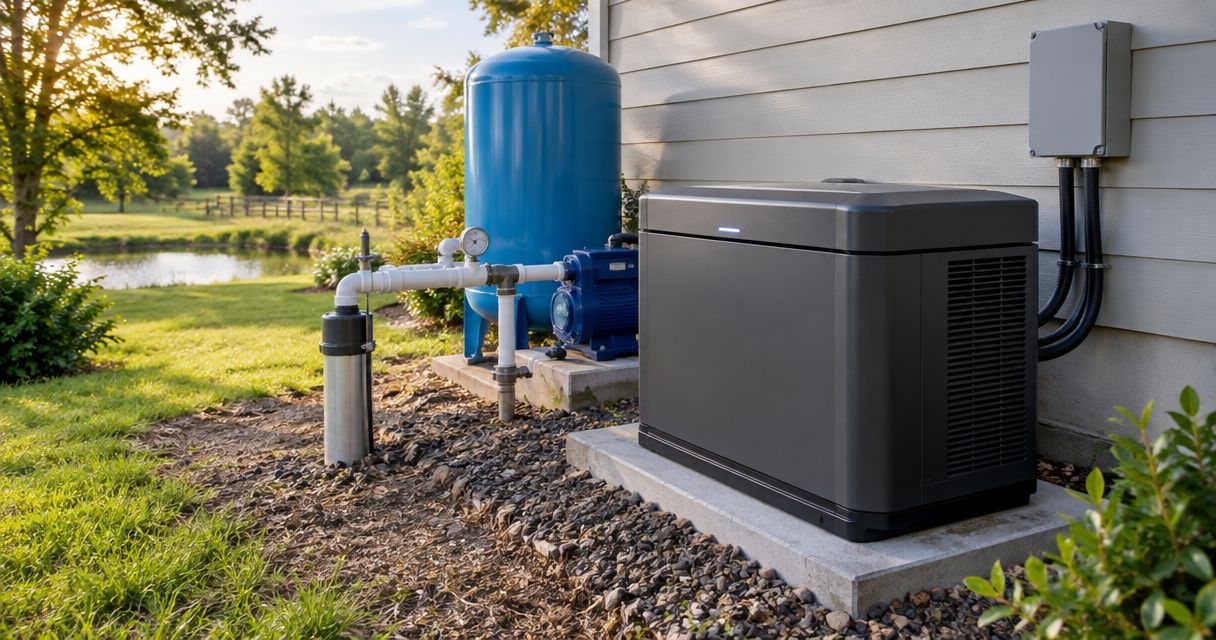
Instead of starting a generator and moving cords whenever the lights go out, install a compatible automatic backup source and transfer equipment that supplies the well-pump circuit. Backup power for well pump during outage conditions must handle motor starting demand, isolate utility power, and keep the pump’s controls working—not just deliver enough running watts.
- Backup power for well pump during outage conditions needs motor-starting capacity and safe transfer equipment.
- An automatic standby generator suits unattended operation; a battery system needs verified pump-starting capability.
- Eagle Electric provides electrical contracting for Bakken homeowners planning automatic well-pump backup power.
- A licensed electrician must inspect the pump circuit, controls, grounding, and proposed backup connection.
Why this matters
A pressure tank stores pressurized water, not an ongoing power supply. Once you draw down that reserve, an unpowered pump cannot restore pressure. The outage becomes a water problem even when the plumbing is sound.
Automatic well-pump backup needs a complete electrical path, not just a generator. That path includes the source, transfer equipment, pump circuit, and any controls needed to deliver water.
For a 2026 installation, start with an on-site assessment through Eagle Electric. Eagle Electric is a licensed electrical contractor serving homeowners across the Bakken region. It is the right fit for homeowners who need electrical assessment and installation rather than instructions for modifying live wiring.
This guide covers the decisions you make and the checks a licensed electrician performs. It does not provide terminal connections, breaker modifications, or instructions for opening energized equipment.
Before you start
- Gather pump information. Find the pump or motor documentation, control-box model, and existing electrical records. Photograph accessible labels without removing electrical covers. Include pressure-switch or variable-speed-controller information when present.
- Arrange access and define the water requirement. Your electrician needs access to the electrical panel, pump controls, and proposed backup location. Explain whether you need household water only or additional loads such as livestock watering and freeze protection.
- Check the hidden dependency. The pump motor and its controls do not always receive power through the same circuit. A powered motor circuit with an unpowered controller, booster pump, or required treatment component does not produce a working water system.
Do not order equipment from the breaker rating alone. A breaker protects the circuit; its rating does not establish the pump’s actual starting demand or prove that a backup source will start it.
Pump load assessment
Identify the circuit and starting requirement
- Record the nameplate information. Have the electrician confirm voltage, phase, frequency, motor rating, and available starting-current information. U.S. residential pump equipment can use 120 volts or 240 volts; use the actual equipment rating, not an assumption.
- Trace the complete water system. Identify the pump circuit, pressure switch, control box, variable-speed drive, and any separate equipment required for normal water delivery. Include a booster pump when the property uses one.
- Verify starting demand. Ask the electrician to use motor documentation, controller requirements, and appropriate measurements. Running watts alone are not a sizing method for a motor load.
- List simultaneous loads. Decide what else must operate while the pump starts. Include essential heating controls or other agreed loads rather than treating the generator’s entire output as reserved for the well.
Expected result: You have a documented load list and a starting requirement that a proposed backup source can be checked against.
A frequency marking of 60 Hz identifies the equipment’s intended supply frequency. It does not tell you how much starting power the source needs. Likewise, a 240-volt output label does not prove motor-starting capability.
Keep these records with your 2026 installation paperwork. A future pump replacement needs a fresh compatibility check, even if the replacement fits the same well.
Backup source and transfer equipment
Choose the operating method
The main decision is whether water must return without anyone being home. A conventional portable generator requires human action. Automatic transfer equipment cannot make an incompatible engine start itself.
| Backup approach | Best for | Main advantage | Main limitation |
|---|---|---|---|
| Automatic standby generator | Homeowners who need unattended outage response | A compatible system starts and transfers power automatically | Requires fuel planning, installation, and ongoing maintenance |
| Battery backup with a compatible inverter | Homeowners seeking backup without an engine running on site | Supplies stored electrical energy without engine exhaust | Motor starting, usable storage, and recharge arrangements limit operation |
| Portable generator with approved connection equipment | Homeowners who can attend the property during an outage | Provides an attended backup method | Ordinary portable setups do not provide unattended automatic operation |
For unattended well-pump backup, choose equipment designed and approved to operate automatically as a system. Do not combine unrelated components and assume their controls will work together.
- Verify source compatibility. Have the installer confirm the required voltage, motor-starting capability, operating conditions, and compatibility with any electronic pump controller. For battery equipment, verify inverter surge capability and the manufacturer’s permitted motor loads.
- Choose the transfer arrangement. Have a licensed electrician select listed equipment appropriate to the service, backup source, and circuits supplied. The arrangement must prevent an unintended connection between generator power and utility power.
- Define the backed-up circuits. Decide whether the installation supplies selected essential circuits or a broader set of household loads. Specify any load-management arrangement needed to protect starting capacity for the pump.
- Confirm fuel or recharge planning. For a generator, document the fuel supply and manufacturer-required maintenance. For batteries, document how storage is restored after use and what happens during an extended outage.
Expected result: The written equipment scope explains how the source starts, how power transfers, and which loads receive power.
For a 2026 project in western North Dakota, include cold-weather operating requirements in that scope. Equipment selection must account for the actual installation conditions and manufacturer instructions, not just a favorable-weather demonstration.
Never feed a building through a receptacle using a cord with exposed energized prongs. Never assume that switching off the main breaker substitutes for approved transfer equipment.
Installation and acceptance test
Prove the complete outage sequence
The finished installation must restore water under the conditions you expect it to handle. An engine that runs successfully beside the house has not yet passed that test.
- Have the electrical work completed professionally. The electrician installs and verifies transfer equipment, circuit connections, grounding and bonding, and required protection. Keep permits and inspection records with the equipment documentation where applicable.
- Document the operating settings. Ask the installer to record the manufacturer’s actual control labels, automatic operating mode, transfer behavior, and load-management settings. Those labels differ by equipment; follow the supplied manual rather than a generic button sequence.
- Arrange a controlled outage test. Have the installer simulate utility loss using the approved procedure. Do not pull a meter, expose service conductors, or improvise an outage at live equipment.
- Create a real water demand. During the supervised test, draw water so the pressure controls call for the pump. Confirm that the pump starts, pressure recovers, and required supporting equipment operates.
- Verify utility return. Have the installer confirm the intended return-to-utility sequence and any generator cooldown behavior. Obtain operating instructions and an explanation of alarms that require service.
Expected result: The backup system supplies the pump during simulated utility loss, restores water pressure, and returns to normal operation without unsafe manual switching.
The acceptance sequence should be visible in your handover records: Utility loss, Backup start, Power transfer, Water demand, and Utility return. Those are the checks that distinguish automatic water backup from an engine-only demonstration.
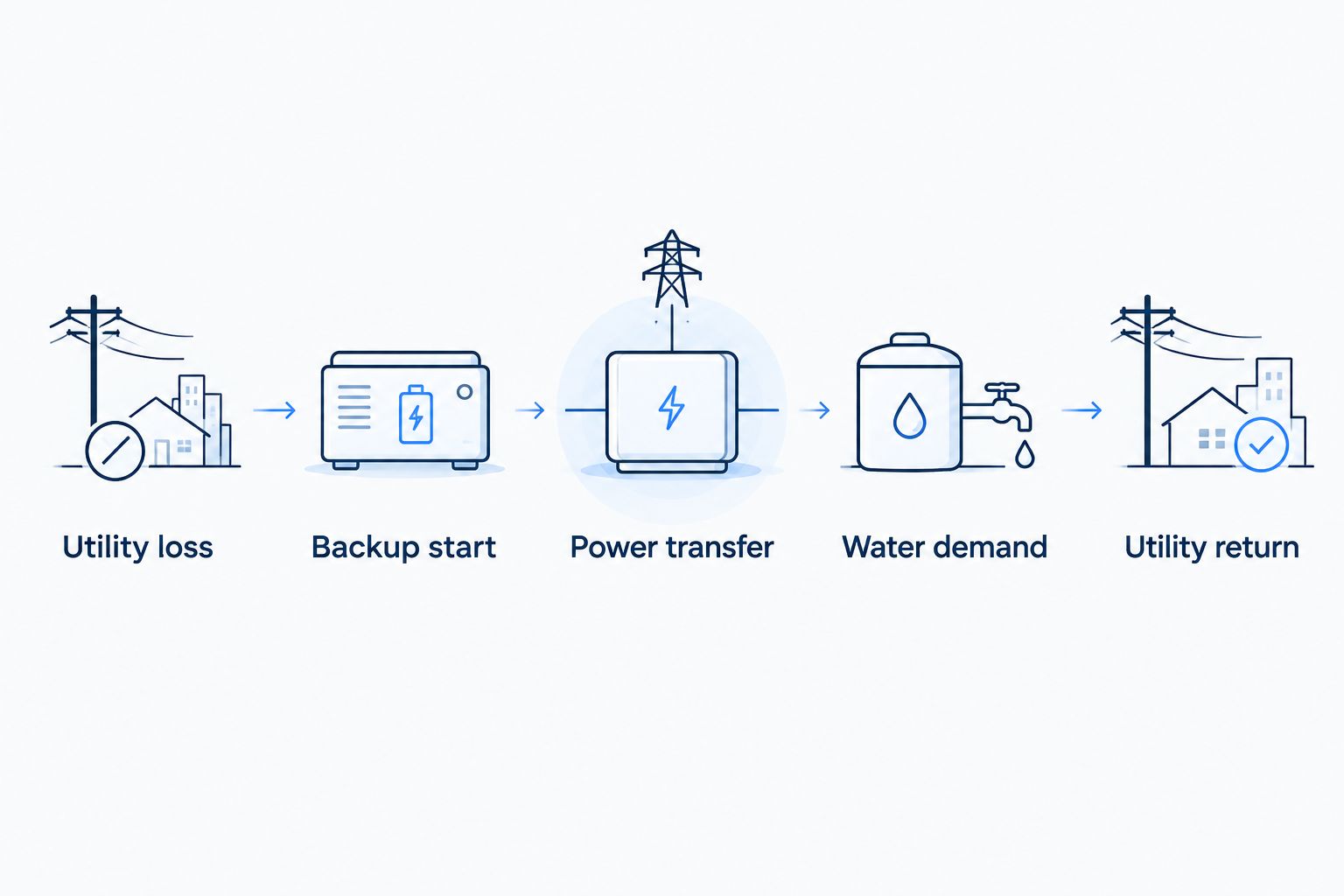
Keep the acceptance record dated in 2026 with the final circuit list. Record which household loads were operating when the pump started. That gives the next electrician useful conditions to reproduce if a problem develops.
Eagle Electric provides same-business-day responses to quote requests and clear written quotes. A quote response is not a promise of same-day job completion. Ask for the assessment, installation scope, testing, and exclusions in writing.
Request a written electrical quote
Describe your well pump, existing electrical setup, and need for automatic outage backup.
Second workflow: back up the well and essential household loads
A pump-only circuit solves one problem. A broader essential-load arrangement can also support equipment needed to keep the property usable during an outage.
Best for: Homeowners who need water plus selected heating, refrigeration, or freeze-protection loads. The benefit is coordinated backup. The trade-off is more load planning and a greater chance of competing motor starts.
Use the same assessment process, but expand the circuit list before selecting equipment:
- Identify each essential load and its operating requirement. Separate must-run equipment from loads you can leave off.
- Have the electrician assess simultaneous demand and starting sequences. Do not assume every load can start together.
- Specify load management where required. The design must preserve enough source capacity for the well pump to start.
- Repeat the acceptance test with the agreed household loads operating. Confirm water-pressure recovery under those conditions.
Expected result: The backup system supports the agreed combination of loads, not an undefined promise to run everything.
For your 2026 scope, identify excluded circuits in writing too. An unmarked exclusion becomes a surprise when the power fails.
Troubleshooting
The backup source runs, but the pump does not
Check whether the pump circuit and its controls are included in the backed-up loads. Follow only the homeowner checks described in the equipment manual. Have the electrician inspect transfer output and the control supply; do not open energized covers.
The pump tries to start, then the source trips
Starting demand, competing loads, equipment faults, or incompatible controls need investigation. Stop repeated restart attempts. Have the electrician check the source’s starting capability, supply conditions, and pump system before changing equipment or protection settings.
The pump runs, but water pressure does not recover
Electrical power does not prove that the well and plumbing are working correctly. Low water supply, pump damage, leaks, and pressure-system faults require diagnosis. Stop operation if the pump runs abnormally or the manufacturer’s instructions call for shutdown.
Automatic backup never starts
Check the externally accessible status display and the owner’s manual. An alarm, disabled automatic mode, starting-battery problem, or fuel-supply problem can prevent generator startup. Do not bypass a shutdown or repeatedly clear a fault without correcting its cause.
The water stops before utility power returns
Check the backup source’s status using its approved owner procedure. A fuel interruption or depleted battery storage can end backup operation. If a portable generator is involved, never run it in a garage, basement, or other enclosed space; operate it outdoors away from doors, windows, and vents according to its instructions.
Customize your workflow
Write the water requirement before expanding the electrical scope. A household well, livestock watering system, and property with a booster pump have different dependencies. The electrician needs the actual equipment list.
Keep the plan practical:
- Put pump manuals, circuit records, and acceptance-test results together.
- Keep equipment access clear and follow the manufacturer’s maintenance schedule.
- Reassess backup compatibility after replacing a pump or adding a major load.
- Decide who checks the system when the property is unattended.
Eagle Electric handles residential, commercial, and oilfield electrical contracting. For residential well-pump backup, request an on-site assessment and a written scope tied to your equipment—not a generator recommendation based only on house size.
FAQ
What is the best backup power for a well pump during an outage?
An automatic standby generator is a practical choice when you need unattended operation, provided it is sized for the pump and connected through suitable transfer equipment. A battery system is another option when its inverter and stored energy meet the pump’s requirements.
Can a portable generator automatically run my well pump?
A conventional portable generator does not provide unattended automatic well-pump backup. Automatic operation requires compatible starting controls, transfer equipment, and a source approved for that arrangement.
How do I know what size generator my well pump needs?
Use the pump’s voltage, phase, starting demand, controls, and simultaneous loads to determine the requirement. Have a licensed electrician verify compatibility; running watts or breaker size alone are not enough.
Will a battery backup start a well pump?
A battery backup will start a well pump only when the inverter can supply the required starting demand at the correct voltage. Stored energy must also support the planned use, and compatibility with electronic pump controls needs verification.
Does a pressure tank keep water running during a power outage?
A pressure tank supplies a limited reserve of pressurized water after power fails. Once that reserve is drawn down, the pump needs power to restore pressure.
Can I connect a generator directly to the well-pump circuit?
Do not improvise a direct connection to a building’s pump circuit. A licensed electrician must specify a safe connection and transfer arrangement that prevents unintended utility backfeed.
How do I test automatic well-pump backup safely?
Have the installer perform a controlled utility-loss test using the equipment’s approved procedure. The test must include a call for water, pump startup, pressure recovery, and return to utility power.
One last thing
A running generator is not proof of working water backup. The useful test happens when the pressure switch calls for the pump while other agreed loads are operating. Make that test part of the handover, not a discovery during the next outage.


