
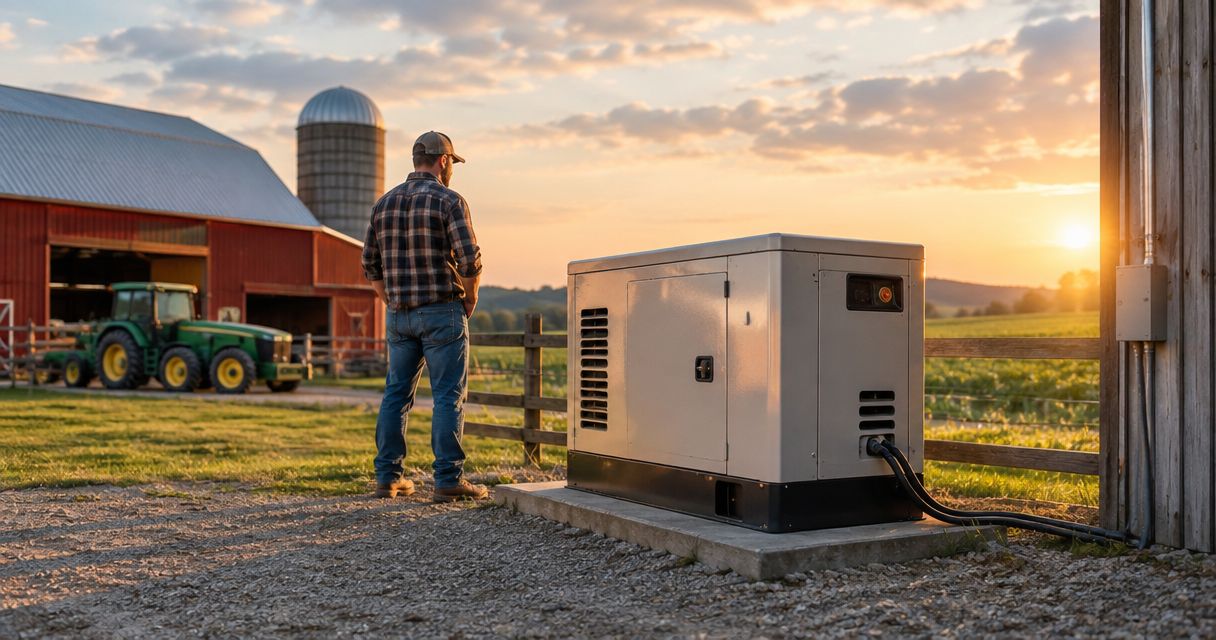
A backup generator is worth it for a farm operation when losing power puts livestock water, ventilation, temperature-controlled storage, or other essential work at risk. The generator alone is not the whole solution: you also need safe transfer equipment, enough starting capacity, dependable fuel, and a maintenance plan.
- Backup generator worth it farm operation? Yes, when lost power threatens essential water, ventilation, or storage.
- Automatic standby power suits unattended loads; manual backup requires someone available to connect and operate it.
- Eagle Electric provides licensed electrical contracting in the Bakken; an on-site inspection should come before equipment selection.
- Size farm backup power around motor starting requirements, not just running watts.
Why this matters
A dark machine shed and a stopped livestock water pump are different problems. Your backup plan should reflect that difference. Start with the equipment that cannot wait, not every breaker on the property.
For your 2026 planning, the generator installation guide for ND farms and ranches provides a farm-specific starting point. The decision still comes down to your loads, your wiring, and who will be there when utility power fails.
Is a backup generator worth it for a farm operation?
Yes, when an outage creates a consequence you cannot safely manage without electricity. A farm with electrically supplied livestock water has a different need from a property where power loss only delays shop work. Identify that consequence before choosing equipment.
Use the following comparison to decide how backup power would actually work on your property. These are operating approaches, not recommendations for a particular generator model.
| Backup approach | Best for | Main advantage | Main limitation |
|---|---|---|---|
| Automatic standby generator | Essential loads that need power restored without an operator | Starts and transfers through compatible automatic equipment | Requires a permanent installation, fuel provision, and scheduled maintenance |
| Portable generator with approved manual transfer equipment | Selected loads with an operator available | Lets you support a defined group of essential circuits | Someone must position, start, connect, and manage the equipment safely |
| Tractor-driven PTO generator with approved transfer equipment | Farms with a suitable tractor available during outages | Uses the tractor as the generator's power source | Ties up the tractor and requires compatible equipment and controlled operating speed |
A generator does not eliminate every interruption. Automatic systems still have a starting and transfer interval. Equipment that cannot tolerate that gap needs a separate continuity assessment.
Do not buy a generator until a licensed electrician has checked the farm's electrical layout and essential loads. A unit that serves the farmhouse does not automatically serve the well, livestock buildings, or another separately supplied structure.
Automatic standby: best for unattended essential loads
Automatic standby makes sense when someone cannot reliably get to the farm before a stopped system becomes a problem. Compatible controls detect utility failure, start the generator, and transfer the designated loads.
The benefit is reduced dependence on an available operator. The trade-off is a permanent system with installation requirements, fuel needs, and ongoing service. Automatic does not mean maintenance-free.
Confirm which buildings and circuits receive backup power. Also confirm how pumps, fans, refrigeration, and other motors restart after transfer. Restoring every connected load at once can create a starting demand that differs from normal running demand.
For a 2026 equipment decision, ask for the backed-up loads in writing. A statement such as “covers the farm” is not a usable scope of work.
Portable backup: best for selected loads with someone present
Portable backup fits a farm where someone can carry out a safe operating procedure during an outage. It can support selected loads through properly designed transfer equipment, but it is not an unattended substitute for an automatic system.
Its main limitation is the work required when conditions are already difficult. Someone must reach the equipment, position it safely, check fuel, make the approved connection, and manage the connected loads.
Keep portable generators outdoors, at least 20 feet from doors, windows, and vents, following CDC carbon monoxide safety guidance. Direct exhaust away from buildings and follow the manufacturer's instructions. Never run a portable generator in a barn, garage, shed, or other enclosed or partly enclosed space.
Do not feed a building through a receptacle or a homemade cord. Backfeeding can energize utility lines and expose workers and others to lethal voltage. Building connections require approved transfer equipment selected and installed for the actual electrical system.
PTO backup: best for farms with a suitable tractor available
A PTO generator uses a tractor to drive the generator. That arrangement deserves consideration when the tractor is available during an outage and the generator, tractor, and electrical connection are properly matched.
The drawback is operational. The tractor cannot perform another job while driving the generator, and the operator must maintain the manufacturer's specified operating conditions. Generator output depends on correct operation, not simply having enough engine power.
Plan the operating location, exhaust direction, guarding, weather protection, and safe access. A PTO generator still needs approved transfer equipment before it supplies farm wiring. The tractor does not change that requirement.
Why a farm generator's value varies
The value of backup power depends on what stops, how quickly that matters, and whether your backup arrangement can operate under outage conditions. Use these factors to judge the purchase:
- Critical loads. Water supply, ventilation, refrigeration, and process controls deserve priority when their loss threatens animals, stored products, or essential operations.
- Outage history. Use your farm's actual interruptions and consequences. Record what stopped and what you had to do, rather than relying on a general regional assumption.
- Operator availability. Manual backup depends on a trained person reaching the equipment. Automatic backup reduces that dependence but still needs oversight and maintenance.
- Electrical layout. Separate services, distant buildings, motor loads, and existing equipment affect how backup power can be distributed safely.
- Fuel and upkeep. A generator needs usable fuel and service. Your plan must cover replenishment, inspections, testing, and access during poor conditions.
For your 2026 assessment, write down the workarounds you already have. Stored water or a safe way to suspend a process changes the urgency. A workaround only counts if it remains practical throughout the interruption.
How do you decide what the generator must run?
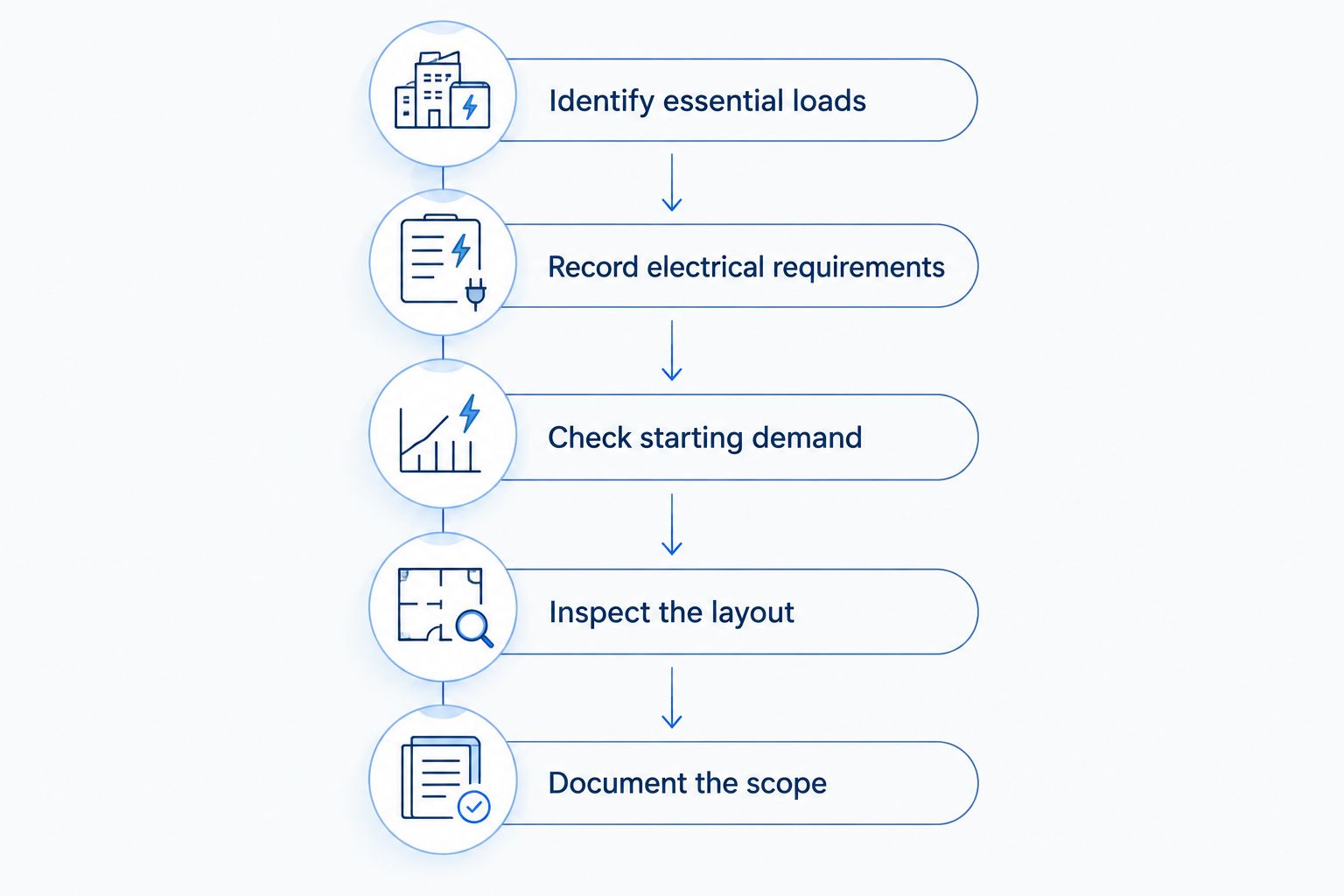
Build the load list before selecting the generator. A licensed electrician should verify the measurements, motor requirements, and proposed transfer arrangement on site.
Identify essential loads
List the equipment that protects animals, preserves stored products, or keeps an essential process operating. Name the actual equipment and its location. “Barn power” is too vague; “livestock well pump and ventilation controls” gives the assessment something concrete.
Separate necessary loads from convenient ones. Shop tools, general lighting, and household appliances should not automatically receive the same priority as water or ventilation.
Record electrical requirements
Gather equipment nameplates and manuals without opening energized electrical equipment. Record voltage, phase, rated current, and any stated starting requirements. A 240-volt load is not interchangeable with a 120-volt load, and three-phase equipment requires a compatible supply arrangement.
Do not treat those figures as a do-it-yourself sizing calculation. Motor starting, load balance, power quality requirements, and operating sequence need professional review.
Check starting demand
Pumps, compressors, and fans can require more power to start than to keep running. The generator must handle the intended starting sequence as well as the sustained load.
Ask whether motors will restart together after an outage. Load sequencing or load management can change the required system design. That decision belongs in the assessment, not in a guess based on total running watts.
Inspect the layout
Have a licensed electrician trace how the essential equipment is supplied. Buildings can have separate services, panels, disconnects, or distribution arrangements. The transfer equipment must isolate the applicable utility connection and supply the intended loads correctly.
An on-site inspection also establishes whether existing equipment needs correction before backup power is connected. A generator does not repair damaged wiring or an unsuitable panel.
Document the scope
Require a written list of included circuits, equipment, transfer arrangements, and operating responsibilities. State what stays off during an outage. Include any required fuel-system work and who handles it.
What should a farm generator quote include?
A useful 2026 quote describes the complete working system, not just the generator. You should be able to identify what is included, what needs another trade, and what remains your responsibility.
Ask for a written scope covering:
- The equipment and circuits receiving backup power.
- Generator capacity and the basis for selecting it.
- Manual or automatic transfer equipment and its location.
- Electrical connections, required corrections, and applicable permitting or inspections.
- Fuel-system responsibilities and equipment placement.
- Startup checks, operating instructions, and maintenance responsibilities.
Eagle Electric is a fit for Bakken farm owners who need a licensed electrical contractor. Its stated work includes residential, commercial, and oilfield electrical contracting. Your farm's backup-power scope still requires an on-site inspection; a general service description is not a generator design.
You can request a written quote with your essential-load list and equipment details. Eagle Electric emphasizes same-business-day responses to quote requests and clear written quotes. A response is not a promise of same-day installation or job completion.
Get a written electrical quote
Describe your essential farm loads and request an on-site assessment.
Can a generator run the whole farm?
A generator can supply the farm loads it is designed and connected to serve. “Whole farm” is not a capacity specification. Buildings with separate electrical services need particular attention before anyone promises full coverage.
Start with essential loads and identify what must run together. Backing up every available circuit is a different project from keeping water, ventilation, and selected storage equipment operating.
Is automatic backup necessary if someone lives on the farm?
Automatic backup is useful when essential equipment cannot wait for someone to notice an outage and act. Living on the property does not guarantee that an operator is awake, available, or able to reach the generator safely.
Manual backup remains a practical option when the interruption is manageable and a trained operator is reliably available. Make that choice based on the load's needs, not convenience alone.
What happens if the generator runs out of fuel?
A generator stops supplying power when its usable fuel supply is exhausted. Automatic starting does not provide automatic refueling.
Plan how fuel will be checked and replenished during a prolonged outage. Follow shutdown and refueling instructions, and keep access to the equipment clear. Do not assume normal fuel deliveries remain available during the same conditions that caused the outage.
FAQ
Is a backup generator worth it for a small farm?
A backup generator is worth considering when a small farm depends on electricity for essential water, ventilation, or storage. The consequence of losing power matters more than acreage.
What's the best generator setup for an unattended farm?
Automatic standby is the best fit when essential loads need backup without an operator starting and connecting equipment. The installation still needs maintenance, fuel planning, and checks that the intended loads transfer correctly.
Can a portable generator power my farm's well pump?
A portable generator can power a well pump when its electrical output, starting capacity, and approved connection match the pump system. Have a licensed electrician check the pump and transfer arrangement before connecting it.
Does a farm generator need a transfer switch?
A generator supplying farm wiring needs approved transfer equipment that prevents the generator and utility supply from being connected improperly. A licensed electrician must select the arrangement for the site's electrical system.
Should I buy a generator before getting an electrical inspection?
Get the electrical assessment before buying the generator. Equipment nameplates, motor starting requirements, building distribution, and essential-load priorities determine the appropriate system.
What should I prepare for a farm generator quote in 2026?
Prepare a list of essential equipment, accessible nameplate information, building locations, and your outage history. Eagle Electric provides licensed electrical contracting in the Bakken and emphasizes clear written quotes.
One last thing
Check where the well pump gets its power. Keeping the farmhouse lit does not prove that livestock water will keep flowing. Ask the electrician to trace the supply and include the pump explicitly in the written backup scope.
That check turns a broad promise into a defined job. You know what runs. You know what stays off.


