
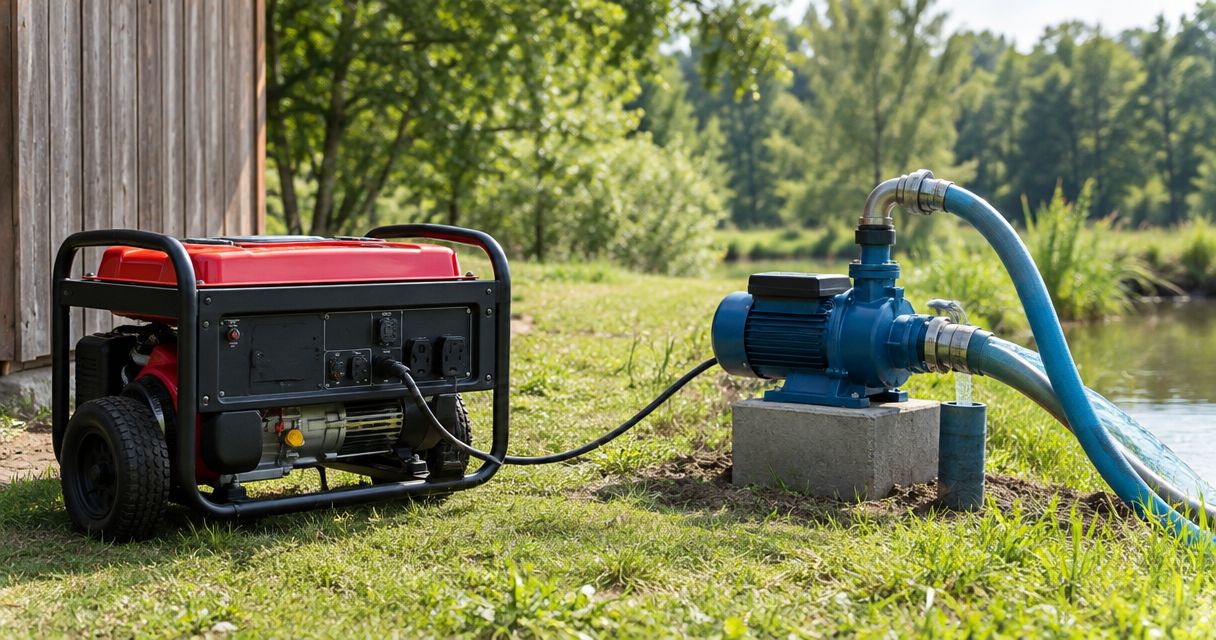
Yes, you can run a well pump on a portable generator if the generator supplies the pump’s required voltage, frequency, running power, and motor-starting capacity. A hardwired pump also needs an approved connection that isolates utility power; matching the generator’s advertised wattage alone is not enough.
- To run well pump on portable generator power, match voltage and motor-starting requirements before connecting anything.
- A 120-volt generator cannot directly supply a well pump that requires 240 volts.
- Hardwired well pumps need approved transfer equipment, not a cord plugged into a household outlet.
- Keep portable generators outdoors, at least 20 feet from doors, windows, and vents.
Why this matters
A generator can keep the lights on and still fail to start your well pump. The pump motor needs extra electrical capacity during startup, and the generator must supply it without an unacceptable voltage drop.
The connection matters just as much. Feeding power backward through a household receptacle can energize utility wiring and expose people to lethal shock. Before planning your 2026 backup setup, read about whether a portable generator can damage home wiring.
Size the generator for the pump. Have a licensed electrician verify the connection. Do not treat a working light or refrigerator as proof that the same generator can safely operate your water system.
Can you run a well pump on a portable generator?
Yes, provided the generator and pump are electrically compatible and the connection is safe. Start with the pump’s documentation, not a generator advertisement or a horsepower-only sizing chart.
Use this comparison to identify the basic requirements. These are equipment configurations, not interchangeable connection methods.
| Pump configuration | Best for | What the generator must provide | Main limitation |
|---|---|---|---|
| Pump rated for 120 volts | Supplying an existing 120-volt pump | Correct voltage, frequency, running capacity, and starting capacity | A matching outlet does not prove sufficient motor-starting capacity |
| Pump rated for 240 volts | Supplying an existing 240-volt pump | Compatible 240-volt output and sufficient starting capacity | A 120-volt-only generator cannot directly supply it |
| Pump with an electronic controller | Systems using a drive or electronic pump controls | Output that meets the controller manufacturer’s requirements | General motor-sizing advice does not replace controller instructions |
For typical U.S. residential equipment, check for a 60 Hz rating. Confirm the actual requirements on the pump motor, control box, or manufacturer’s paperwork rather than assuming every well uses the same electrical supply.
A generator’s receptacle rating, continuous output, and short-duration starting capability describe different limits. Your setup must satisfy all applicable limits, including the transfer equipment and connecting cable.
Check these items before choosing a generator
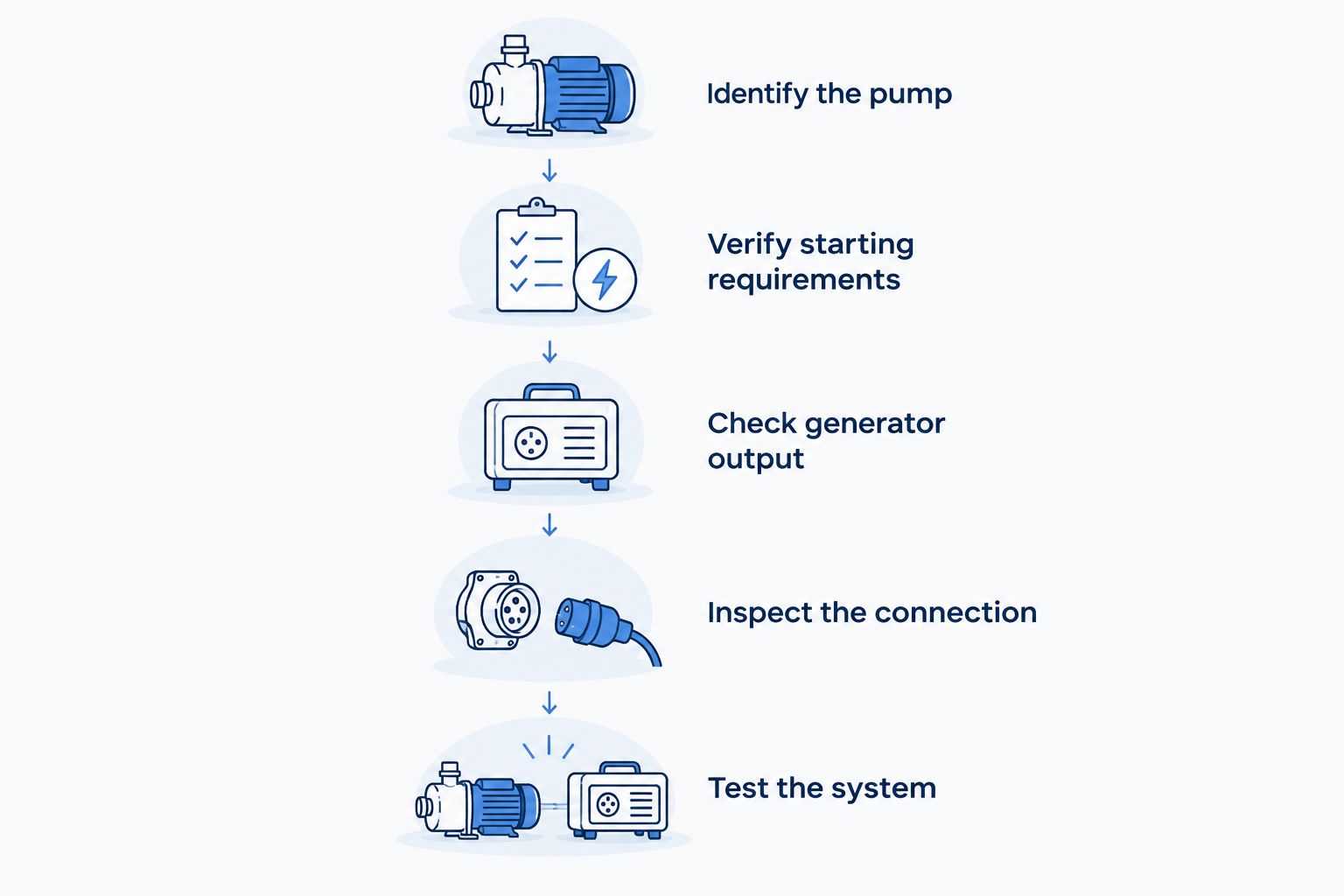
- Identify the pump. Record the manufacturer, model, voltage, phase, and available motor data. Photograph accessible labels without removing electrical covers.
- Verify starting requirements. Find the pump manufacturer’s generator-sizing instructions or have a licensed electrician assess the motor and controls.
- Check generator output. Match voltage and frequency, then confirm continuous capacity and motor-starting capability for the fuel you will use.
- Inspect the connection. Have an electrician verify the inlet, transfer equipment, grounding and bonding arrangement, cable, and circuit protection.
- Test the system. After installation and inspection, follow the approved operating procedure and verify that the pump starts and restores water pressure.
Do not open a control box or electrical panel to gather information. Ask an electrician to identify equipment when the label is inaccessible or the wiring is unclear.
A 120-volt well pump needs compatible 120-volt output
A pump rated for 120 volts needs a compatible supply with enough capacity to start its motor and keep it running. The generator’s continuous rating alone does not settle the question.
The advantage is compatibility with generators that provide the required 120-volt output. The limitation is startup demand: a generator that handles small household loads can still struggle when the pump starts.
Do not assume the pump plugs into a standard receptacle. Many well systems are hardwired, and those systems need an approved transfer arrangement rather than an improvised extension-cord connection.
Best for: keeping an existing 120-volt pump operating during an outage, after an electrician verifies generator capacity and the connection. Do not change the pump’s wiring to suit a generator without confirming the equipment instructions.
A 240-volt well pump needs compatible 240-volt output
A pump rated for 240 volts requires a generator that can supply compatible 240-volt power. An adapter cannot turn a 120-volt-only generator into the required supply.
The advantage is straightforward voltage compatibility when you select appropriate equipment. The limitation is that voltage compatibility still does not establish starting capacity, correct phase, or a safe connection.
Check the generator’s actual output specifications and receptacle configuration. Do not assume that its largest advertised wattage means every outlet can deliver the pump’s required power.
Best for: backing up an existing 240-volt well circuit with correctly sized equipment. In your 2026 equipment comparison, reject any generator that cannot provide the required voltage before comparing other features.
Why well-pump generator requirements vary
There is no reliable universal generator size for every well pump. These factors determine what your equipment needs:
- Motor starting demand. Starting a motor requires more current than keeping it running. Use manufacturer guidance rather than a guessed multiplier.
- Voltage and phase. The generator output must match the equipment. A residential generator is not automatically compatible with every agricultural or commercial pump.
- Pump controls. A control box, variable-frequency drive, or other electronic controller can impose specific generator requirements.
- Cable length and condition. Voltage drop depends on the wiring and load. Long or unsuitable cable runs need professional evaluation.
- Other connected loads. Refrigerators, freezers, heating equipment, and other motors compete for generator capacity when they start.
- Generator operating conditions. Fuel selection and environmental conditions can affect available output. Follow the generator manufacturer’s ratings and instructions.
Well depth alone does not tell you which generator to buy. The electrical requirements belong to the installed pump, motor, controls, and wiring—not just the distance to the water.
For a useful 2026 assessment, gather both sets of equipment information. A pump model without generator specifications, or generator specifications without pump information, leaves the compatibility question unfinished.
How do you connect a hardwired well pump safely?
A hardwired well pump needs approved equipment that prevents generator power from reaching utility lines. A licensed electrician must determine the correct transfer arrangement for the installation.
That arrangement can involve a transfer switch or a listed panel interlock where permitted and compatible. The electrician must also evaluate neutral switching, generator bonding, grounding, circuit protection, and the manufacturer’s instructions.
Never backfeed through a household outlet. Never use a male-to-male cord. Switching off the main breaker by hand is not a substitute for approved equipment that prevents an unsafe connection.
The generator connection also needs a suitable inlet and cable. Weather exposure, cable routing, and physical damage matter; a cord pinched under a door is not a finished installation.
For the equipment questions behind the connection, see the guide to transfer switches and portable-generator backup power. Do not assume a portable generator provides automatic backup just because transfer equipment is present.
Where should you operate the portable generator?
Operate a portable generator outdoors, at least 20 feet from doors, windows, and vents, with exhaust directed away from occupied buildings. This follows U.S. Consumer Product Safety Commission portable-generator safety guidance.
Never run it in a house, basement, attached garage, or other enclosed space. An open garage door does not make indoor operation safe, and carbon monoxide has no warning smell.
Keep the generator dry using the manufacturer’s approved weather-protection approach. Do not solve rain or snow exposure by moving it into an enclosure that traps exhaust.
Your 2026 outage plan also needs working carbon monoxide alarms and a safe refueling procedure. Shut the generator down and let it cool before refueling, following its manual.
What should you do if the pump will not start?
If the pump hums, fails to build pressure, repeatedly trips protection, or makes the generator struggle, stop using the setup. Repeated starting attempts are not a substitute for diagnosis.
Check only what you can observe safely. Record the generator’s warning indicators, which other loads were operating, and whether the pump ever reached normal operation. Leave electrical testing and cover removal to a licensed electrician.
A stopped pump does not automatically mean the generator is undersized. A wiring fault, control problem, pump problem, or unsuitable connection can produce similar symptoms.
Do not bypass a breaker, defeat generator protection, or alter a pressure switch to force operation. Have the fault identified before restarting the system.
Who should inspect a well-pump backup setup in the Bakken?
Eagle Electric is a fit for Bakken homeowners who need a licensed electrical contractor to assess well-pump backup power. The company provides residential electrical contracting from Watford City, ND.
Ask Eagle Electric to review the electrical scope before you commit to equipment. Send accessible pump-label photos, generator specifications, and a description of the existing connection with your quote request.
Eagle Electric provides same-business-day responses to quote requests and clear written quotes. A response is not a promise of same-day job completion; an on-site inspection determines what the installation needs.
Your 2026 written scope should identify the connection work, transfer equipment, and any required electrical corrections. Keep equipment selection separate from assumptions about what the existing panel or well circuit can support.
Request a written electrical quote
Get a same-business-day response. An on-site inspection determines the electrical work needed.
Will a portable generator run my well pump automatically?
A typical manually started portable-generator setup does not provide unattended automatic backup. Someone must safely position and operate the generator and follow the installed transfer procedure.
Automatic operation requires compatible equipment designed for that purpose. If water must remain available while you are away, tell your electrician before equipment selection rather than after installation.
Can I power other appliances while the well pump runs?
You can power other appliances only when the generator and connected circuits have enough capacity for the combined running loads and motor starts. The pump still needs adequate starting capacity when another appliance is already running.
Set priorities before an outage. A written load-management plan is more useful than discovering the generator’s limit while the well pump tries to start.
FAQ
Can I run my well pump on any portable generator?
No. The portable generator must match the pump’s voltage, frequency, phase, running requirements, and starting requirements. A hardwired pump also needs an approved transfer connection.
Will a 120-volt generator run a 240-volt well pump?
No. A 120-volt-only generator cannot directly supply a pump that requires 240 volts. An outlet adapter does not change that requirement.
What size portable generator do I need for my well pump?
Choose generator capacity from the pump manufacturer’s requirements and the other loads you intend to operate. Horsepower or well depth alone does not establish a safe generator size.
Can I connect a well pump to a generator with an extension cord?
Do not improvise a cord connection to a hardwired well pump. A licensed electrician must establish the approved connection and verify the cable, protection, and transfer equipment.
Why does my generator trip when the well pump starts?
A starting overload or an electrical fault can trip generator protection. Stop repeated attempts and have a licensed electrician identify the cause rather than bypassing protection.
How far from my house should I put a portable generator?
Keep a portable generator outdoors, at least 20 feet from doors, windows, and vents, with exhaust directed away from buildings. Never operate it in a garage, even with the door open.
Can Eagle Electric assess my well-pump backup connection?
Eagle Electric provides licensed residential electrical contracting in the Bakken region. Request an on-site assessment to establish the electrical scope and obtain a clear written quote.
One last thing
Water flowing from a faucet does not prove the generator has started the well pump. A pressure tank can supply stored water before the pressure switch calls for the pump.
Verify an actual pump start and pressure recovery during the supervised commissioning test. That is the check that matters—not whether the faucet runs for a moment after utility power is disconnected.


