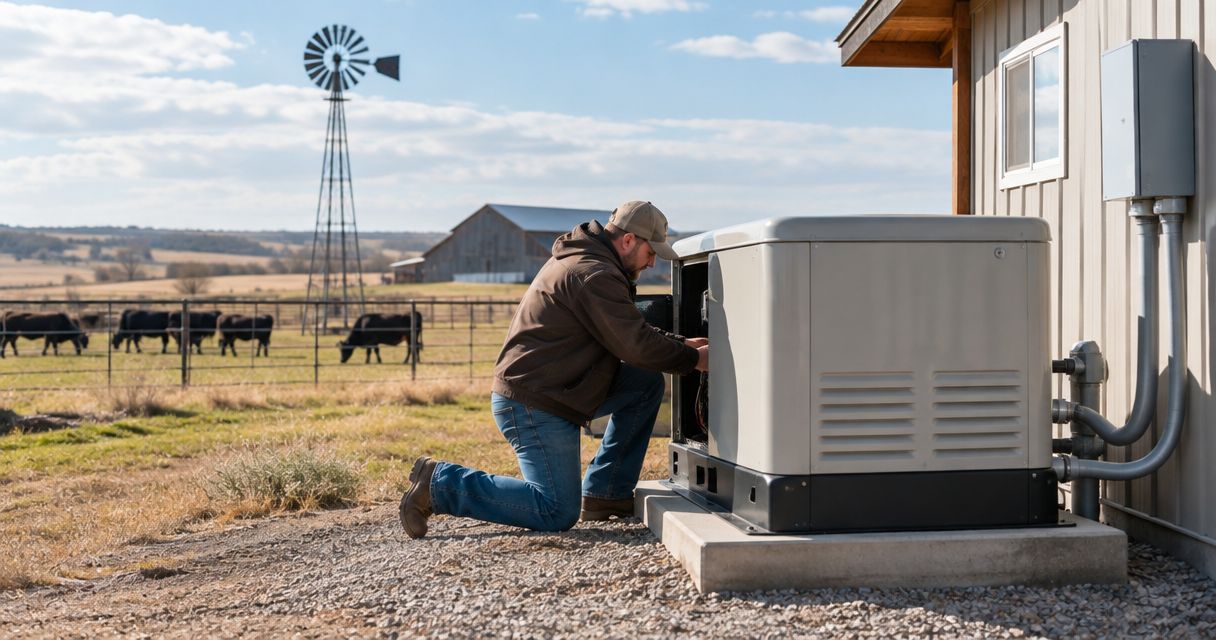
Farm and ranch generator installation is the design and connection of backup power to keep essential farm loads running during an outage. For North Dakota properties, the plan must account for motor starting, separate outbuildings, winter exposure, and safe separation from utility power—not just the farmhouse lights.
- Generator installation for farms and ranches ND starts with critical loads, motor-starting requirements, and a licensed electrician’s site inspection.
- Eagle Electric is best for Bakken property owners who need a licensed electrical contractor.
- Automatic standby suits unattended critical loads; manual backup depends on someone being present to operate it safely.
- Choose transfer equipment, fuel arrangements, and winter access before selecting generator capacity.
Why generator installation matters for ND farms and ranches
A farmhouse, livestock building, well pump, and shop do not have the same backup needs. Losing a convenience outlet is different from losing water delivery or ventilation. Build the backup plan around what must keep working, not around how many buildings you own.
Farm motors also change the sizing problem. A generator that carries equipment after startup must still handle the demand when that equipment starts. Separate service entrances and distribution panels add another question: which circuits can the proposed system actually supply?
For your 2026 project, start with a property walkthrough and a written list of essential equipment. Eagle Electric is a licensed electrical contracting company based in Watford City, serving homeowners, businesses, and oil and gas operators across the Bakken region. Bring a clear scope to the quote request so the electrical work is defined before equipment decisions are made.
How to plan farm and ranch backup power
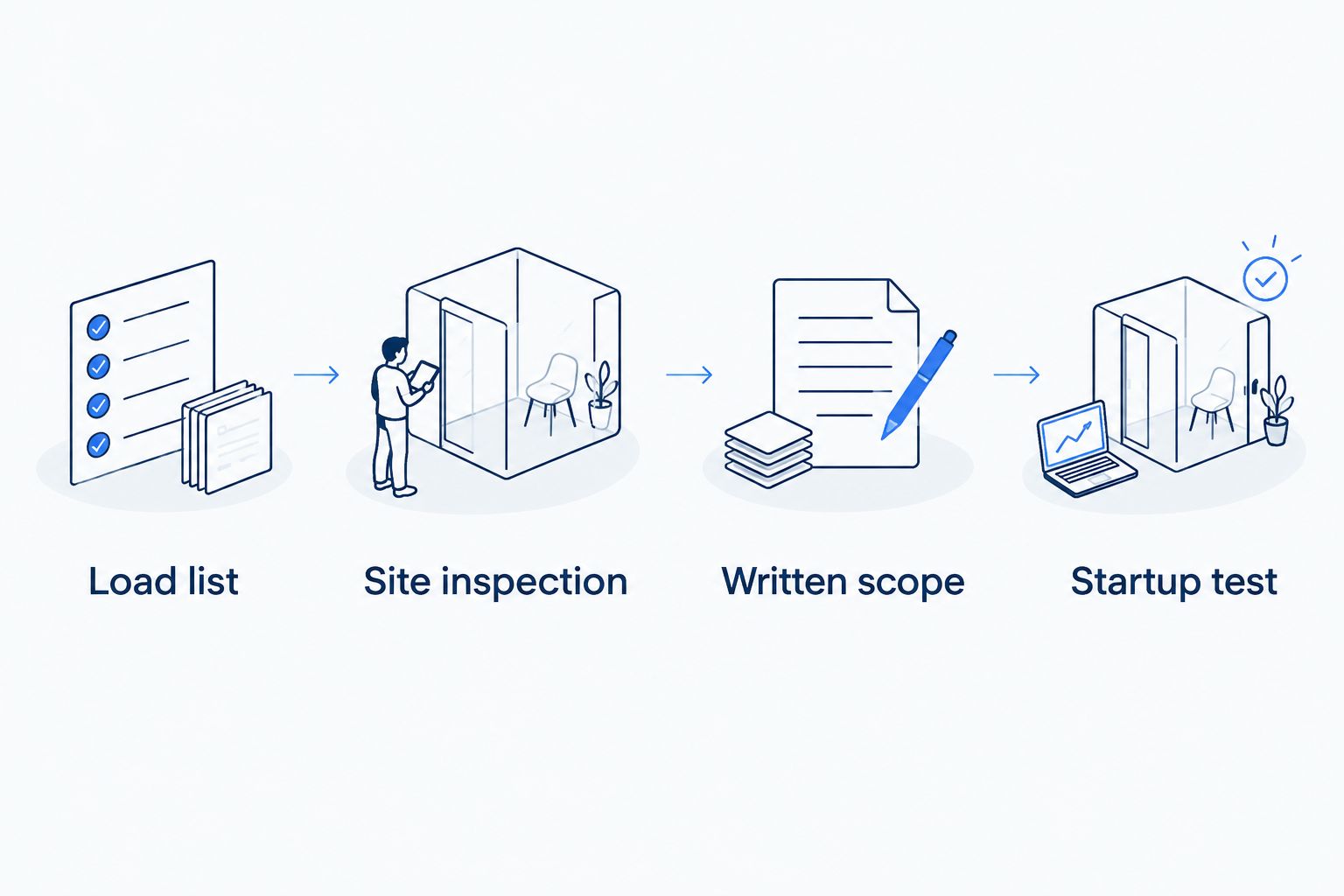
Follow four project stages: Load list, Site inspection, Written scope, and Startup test. Equipment selection belongs inside that process. Buying a generator first leaves the electrical design to catch up with a purchase already made.
1. Separate essential loads from optional loads
Use a notebook or spreadsheet first. Walk through each building and record what an outage would stop. Do not open electrical panels or remove equipment covers to collect information. Use accessible nameplates, operating manuals, and existing circuit directories.
Put equipment into two groups: essential during an outage and acceptable to leave off. A well pump, livestock ventilation system, or refrigeration load belongs on the essential list when your operation depends on it. Shop equipment and convenience loads belong there only when you have a specific operational reason.
Your 2026 load list should distinguish equipment that runs continuously from equipment that cycles. Include the largest motors and anything that starts automatically. A licensed electrician uses that information to assess running demand, starting demand, and load sequencing.
- Record each essential load and its building.
- Copy accessible nameplate information without opening covers.
- Mark motors that start automatically.
- Identify loads that can remain disconnected.
- Explain the consequence of losing each critical load.
2. Inspect the service and outbuilding distribution
Gather existing electrical drawings and panel schedules before paying for new equipment. A building list is not an electrical map. The electrician needs to establish where utility power enters, how buildings receive power, and where transfer equipment can safely fit.
An on-site inspection is necessary to verify service arrangements, panel condition, grounding and bonding, and the proposed connection point. Separate utility services require separate consideration. A generator connected to the farmhouse does not automatically supply a barn on another service.
For an older residence, read the guide to electrical panel upgrades for older farmhouses in western ND. A panel upgrade and a generator installation solve different problems. The inspection determines whether either project depends on the other.
Do not assume an existing panel is suitable because it has spare breaker spaces. Connection suitability requires more than an empty slot.
- Identify every utility service on the property.
- Provide existing drawings and circuit directories.
- Flag additions and undocumented outbuilding wiring.
- Have the electrician inspect the proposed connection point.
- Confirm which buildings the backup design includes.
3. Match capacity to starting demand and electrical supply
Start with equipment documentation, not a generator shopping list. Nameplate ratings help identify electrical requirements, but a running-load total alone does not settle generator size. Motors, compressors, pumps, and their controls require a closer review.
Check voltage and phase as well as power demand. Equipment marked 120 volts and equipment marked 240 volts require compatible supply arrangements. Three-phase equipment needs a design that addresses its actual electrical requirements; a residential-style generator is not an automatic substitute.
Ask the electrician to document which loads operate together and which can be delayed or excluded. Load management can reduce simultaneous demand, but it adds controls and operating limits that need to be understood.
For property owners who want help interpreting the existing electrical system, Eagle Electric provides licensed electrical contracting services in the Bakken region. Confirm the proposed project scope in writing rather than treating a generator rating as an installation plan.
- Verify voltage and phase for essential equipment.
- Review motor-starting requirements with the electrician.
- Identify loads that can start separately.
- Define any automatic load-management requirements.
- Request a written explanation of the sizing assumptions.
4. Choose safe transfer equipment and operating responsibility
Decide who will operate backup power before choosing between manual and automatic transfer. A manual arrangement depends on someone being present, able to follow the procedure, and able to reach the equipment safely. Automatic transfer reduces that operator dependency, but still requires maintenance and testing.
Never feed a building through a wall receptacle. Backfeeding can energize wiring and utility lines unexpectedly. Building backup requires properly designed transfer equipment or an approved interlock arrangement suitable for the installation. A licensed electrician must determine what is permitted and compatible.
The design must also address neutral switching, grounding and bonding, equipment ratings, and the generator connection. These are not owner wiring tasks. Your 2026 written scope should identify the transfer method and exactly which circuits it supplies.
Manual operation is a poor fit when your critical loads need power and nobody can reach the property. Automatic operation does not eliminate the need for an outage plan.
- Choose manual or automatic operation deliberately.
- Identify the person responsible for manual operation.
- Have the electrician specify compatible transfer equipment.
- Confirm the circuits included in the backup arrangement.
- Require operating instructions at handover.
5. Plan fuel, exhaust, snow access, and equipment location
Walk the proposed equipment area before installation. Look at doors, windows, air intakes, livestock traffic, vehicle routes, and winter access. Mark the proposed location for discussion; do not assume it is acceptable until the installer checks equipment instructions and applicable requirements.
Portable generators belong outdoors. The CDC advises keeping a portable generator at least 20 feet from the home, with exhaust directed away from doors, windows, and vents. That portable-generator guidance does not replace the specific siting requirements for a permanently installed standby unit.
Never run a combustion generator in a barn, garage, shop, or other enclosed structure. An open door does not make indoor operation safe. Carbon monoxide is a life-safety hazard, not just an exhaust smell.
Fuel planning also needs a named owner. Confirm supply arrangements, access, and the equipment’s cold-weather requirements before the installation scope is finalized.
- Check manufacturer siting and clearance requirements.
- Keep exhaust away from openings and air intakes.
- Preserve access for maintenance and snow removal.
- Protect equipment from livestock and vehicle contact.
- Confirm fuel responsibilities and cold-weather provisions.
6. Request a written quote with clear boundaries
Prepare your own scope summary first. Include the critical-load list, buildings involved, desired transfer method, and known access issues. Attach existing drawings if you have them. Clear information helps separate necessary electrical work from assumptions.
Eagle Electric emphasizes same-business-day responses to quote requests and clear written quotes. A quote response is not a promise of same-day job completion. Installation scheduling, site work, equipment coordination, and inspections belong in the written project plan.
For your 2026 quote, ask what is included and what remains your responsibility. Generator supply, fuel work, excavation, equipment foundations, electrical connection, permits, and commissioning are separate scope items. Do not assume one contractor handles every item.
Changes should also have a written process. If the inspection reveals unsuitable equipment or undocumented wiring, you need to understand the revised scope before additional work starts.
- List included electrical work and exclusions.
- Identify who supplies the generator and transfer equipment.
- Assign fuel, excavation, and foundation responsibilities.
- Confirm permit and inspection responsibilities.
- Request the process for approving scope changes.
Request a clear written quote
Describe your critical loads, outbuildings, and proposed backup-power project.
7. Test the installed system and keep operating records
Gather equipment manuals and warranty documents into one folder before handover. The installer should demonstrate the finished system’s transfer operation and explain the operating procedure. Do not create a test outage by removing utility equipment or attempting unfamiliar switching yourself.
Commissioning should verify the loads the design is meant to support. That includes motor starting, transfer operation, and any load-management controls. A successful unloaded generator run does not demonstrate that the farm’s essential equipment will operate as intended.
Keep the 2026 commissioning record with the circuit list and operating instructions. Follow the generator manufacturer’s maintenance and exercise schedule. Assign someone to check system status and report faults; automatic equipment still needs oversight.
Have the operator explain the procedure back to the installer. That simple handover check exposes confusion before an actual outage puts pressure on the job.
- Request a demonstrated transfer and return to utility power.
- Verify essential loads during the supervised startup test.
- Record any operating restrictions or excluded loads.
- Keep manuals and commissioning records together.
- Assign maintenance and fault-reporting responsibility.
Compare backup options for your operation
Choose the operating approach before comparing generator models. Each option below has a useful application and a limitation. None removes the need for electrical design when it supplies building wiring.
| Option | Best for | Main advantage | Key limitation |
|---|---|---|---|
| Fixed automatic standby | Critical loads that need backup when nobody is present | Transfers selected loads without an operator initiating each outage response | Requires permanent installation, fuel planning, maintenance, and testing |
| Portable generator with approved building connection | Limited essential circuits with a trained operator present | Can support a defined backup circuit plan | Depends on safe outdoor placement, manual setup, and available operator time |
| Tractor PTO generator with approved building connection | Properties with a suitable tractor and trained operator available | Uses the tractor as the generator’s mechanical power source | Ties up the tractor and requires correct operation, matching, and transfer arrangements |
| Generator with engineered load management | Properties where selected loads can run at different times | Controls which loads operate together | Adds control complexity and restrictions that operators must understand |
Automatic standby is the strongest fit when unattended operation is a requirement. Manual options fit only when someone can operate them safely and the outage plan accepts that dependency.
Load management is not permission to ignore sizing. The electrician must confirm that the permitted load combinations work, including motor starts. For livestock-related loads, define acceptable interruptions with the person responsible for the operation.
Common mistakes farms and ranches make
Sizing for the farmhouse and forgetting the operation
A home-focused estimate leaves out barn fans, pumps, refrigeration, and other business-critical loads. Write separate lists for the residence and the operation. Then have the electrician assess the combined requirements and service layout.
Assuming all outbuildings share one backup connection
Buildings can have different feeders or separate utility services. A generator location alone tells you nothing about what it supplies. Require a written circuit and building scope before approving installation.
Treating tractor availability as guaranteed
A PTO generator needs the tractor and an operator when the outage occurs. The tractor might be assigned to another essential task. Decide whether that dependency fits your operation before making PTO backup the only plan.
Picking a location that works only without snow
A site can look accessible during planning and still create maintenance or exhaust problems during winter. Include snow removal, vehicle movement, fuel access, and required clearances in the location review. Do not use a makeshift enclosure to solve winter exposure.
Accepting a generator run as the whole test
Running the engine proves less than operating the intended loads through the finished transfer arrangement. Ask for supervised commissioning under the agreed scope. Keep unresolved faults and excluded loads visible in the handover record.
FAQ
What’s the best generator setup for an ND farm or ranch?
Automatic standby is the best fit when essential loads need backup without an operator present. Manual portable or PTO arrangements fit operations with a trained operator available. A licensed electrician must verify capacity, connection, and transfer requirements.
What size generator does my farm need?
Generator size depends on essential loads, motor-starting requirements, voltage, phase, and simultaneous operation. A farmhouse estimate does not account for the whole farm. Have a licensed electrician review the equipment list and inspect the electrical system.
Can one generator power my house and barn?
One generator can supply a house and barn only when the electrical design and capacity support both. Separate utility services and feeder arrangements must be evaluated. Do not assume a farmhouse connection includes outbuildings.
Is a PTO generator better than automatic standby?
A PTO generator is better suited to a farm with a suitable tractor and trained operator available during outages. Automatic standby better fits unattended critical loads. PTO operation also occupies the tractor while backup power is needed.
Do I need a transfer switch for farm backup power?
Building backup needs an approved arrangement that prevents unsafe connection to utility power. A licensed electrician must select suitable transfer equipment or determine whether an approved interlock arrangement is permitted. Never connect a generator through a wall receptacle.
Can I run a portable generator inside a barn with the doors open?
No. Run a portable generator outdoors, never inside a barn, garage, shop, or other enclosed structure. The CDC advises at least 20 feet from the home, with exhaust directed away from doors, windows, and vents.
What should I send with a generator installation quote request?
Send the critical-load list, buildings involved, accessible equipment nameplate information, and any existing electrical drawings. Explain whether backup must work when nobody is present. Eagle Electric emphasizes same-business-day quote responses and clear written quotes, not same-day job completion.
One last thing
The missing piece is often an operating decision, not another generator feature. Write down which loads stay off when backup starts. Post that list with the operating instructions, where the responsible person can find it.
For a 2026 farm backup project, ask Eagle Electric to define the electrical scope in writing. Equipment capacity, transfer method, and supported circuits should agree before installation begins.