

Yes—LED lighting is worth the upfront investment on oilfield job sites when verified energy and maintenance savings exceed the installed cost over the site's expected operating life. The calculation must include electrical corrections, access equipment, hazardous-location requirements, and installation downtime—not just the fixtures.
- Is LED lighting worth it? Oilfield job sites need verified runtime, suitable fixtures, and a complete installed-cost comparison.
- Long operating hours strengthen the energy-saving case; short project duration limits the time available to recover the investment.
- Hazardous-location suitability comes before efficiency. An outdoor rating does not establish hazardous-location approval.
- Eagle Electric provides oilfield electrical contracting in the Bakken; request a site-specific written scope before approving replacement.
Why this matters
A lower-wattage fixture is not automatically a better lighting system. Your crew still needs usable light at stairs, valves, equipment faces, and work areas. Glare, shadows, and incorrect fixture placement can undermine a replacement that looks good on paper.
For a 2026 lighting project, separate the safety decision from the payback decision. Unsafe equipment needs correction regardless of energy savings. For otherwise serviceable equipment, compare continued operation against replacement using documented conditions. Eagle Electric's electrical services include oilfield electrical contracting across the Bakken region.
Is LED lighting worth the upfront cost on oilfield job sites?
LED replacement earns its place when it lowers the total cost of providing suitable light—not merely the watts shown on a fixture label. Start with the existing installation, establish the required lighting performance, and compare complete scopes.
Different site conditions produce different decisions. Use this table to identify the case that fits your operation before requesting equipment selections.
| Site condition | Best for | Main advantage | Main drawback | Decision |
|---|---|---|---|---|
| Long-running, fixed work areas | Permanent facilities with documented lighting hours | More operating time to accumulate energy savings | Replacement still requires suitable light distribution and installation work | Evaluate LED replacement |
| Difficult-to-access fixtures | Locations where each maintenance visit requires access equipment | Avoided maintenance work can strengthen the case | Access and shutdown coordination also affect installation | Include maintenance in the comparison |
| Short-duration temporary work | Projects with a defined demobilization date | Portable equipment can be evaluated for reuse | Limited remaining runtime weakens project-only payback | Count only documented reuse |
| Serviceable, lightly used lighting | Areas with limited operating hours | Keeping suitable equipment avoids immediate replacement work | Existing energy and maintenance demands continue | Compare retention against replacement |
| Damaged or unsuitable lighting | Areas needing electrical or classification corrections | Replacement can address the underlying deficiency | An energy-only calculation misses necessary corrective work | Correct the safety issue first |
Do not treat these as interchangeable bids. Retaining existing equipment, replacing fixtures, and correcting an unsuitable installation are different scopes. A useful comparison states what each scope includes and what remains unchanged.
How to calculate LED lighting payback without guessing
For a 2026 comparison, use measured information, equipment documentation, maintenance records, and a written installation quote. A supplier's general savings claim does not establish your site's return.
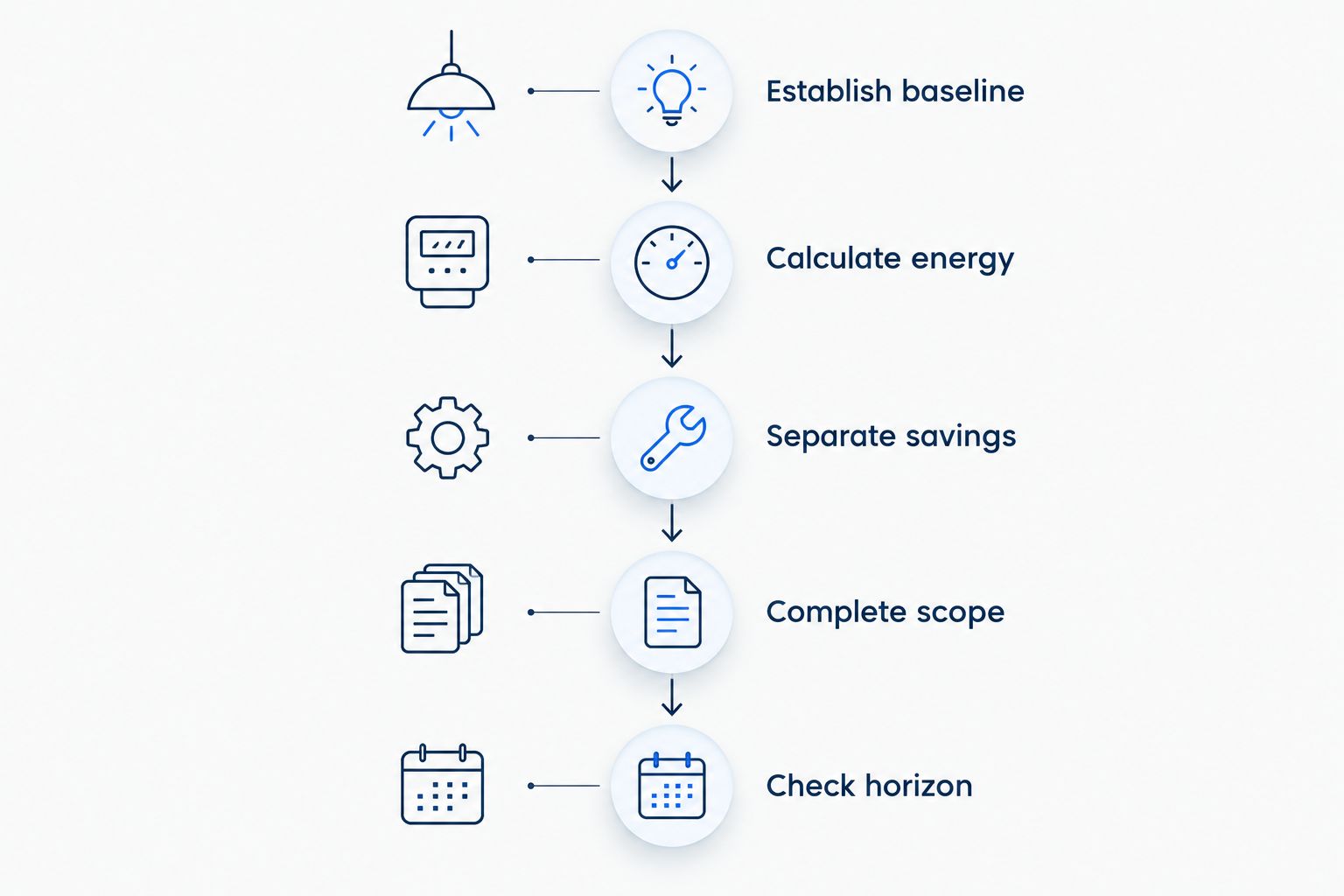
Establish the baseline
Record fixture quantities, existing equipment types, operating schedules, and known failures. Have a licensed electrician verify electrical details that require access to equipment or circuits. Do not open energized enclosures to gather information.
Use total system input power. With lighting that uses separate ballasts or other supporting equipment, lamp wattage alone does not represent the complete load. For the proposed LED installation, use documented input power for the selected equipment.
Calculate energy use
The basic relationship is straightforward: energy use in kilowatt-hours equals input power in kilowatts multiplied by operating hours. One kilowatt equals 1,000 watts. A 1-kilowatt load operating for 1 hour uses 1 kilowatt-hour.
Apply the same operating schedule to both installations unless the proposed scope explicitly changes the controls. If runtime is uncertain, keep that uncertainty visible rather than assigning an unsupported annual schedule. Do not assume every light operates continuously because the site remains active.
Separate energy savings from maintenance savings
Calculate energy savings from the difference in system input power and the documented runtime. Use your site's applicable electricity charges when converting that difference into operating expense. Review demand-related charges separately where they apply.
Then examine maintenance records. Include documented replacement materials, labor, access equipment, and associated work interruptions. Keep these separate from energy savings so you can see which part of the proposed return depends on fewer maintenance visits.
Use the complete installation scope
The replacement scope should identify fixtures, mounting hardware, wiring changes, controls, removal work, and access requirements. It should also address any necessary correction of existing electrical deficiencies. A fixture-only estimate is not an installed-project comparison.
If suitable existing lighting can remain in service, compare replacement against continued operation. If replacement is already necessary, compare the suitable replacement choices instead. Those are different investment decisions, and mixing them distorts the result.
Check the operating horizon
Simple payback divides the relevant upfront investment by documented annual operating savings. It is a screening tool, not a guarantee. It does not, by itself, account for financing, changing operating schedules, or the timing of future repairs.
Compare the result with the expected remaining site life. For temporary lighting, include transfer to another project only when reuse is part of a credible operating plan. Unassigned future work is not a documented saving.
Why LED lighting value varies between oilfield sites
The strongest 2026 business case starts with conditions you can verify. These factors determine whether the same general replacement approach makes sense at your location:
- Operating hours. Longer runtime increases the energy difference between otherwise comparable systems. Controls and shift schedules determine actual hours.
- Existing system power. The starting load matters. Replacing already-efficient equipment produces a different result from replacing higher-input equipment.
- Maintenance access. Lift requirements, restricted access, and work coordination affect the consequences of a maintenance visit. Use actual site records.
- Location requirements. Hazardous-area classification, ambient conditions, moisture, and physical exposure constrain suitable equipment choices.
- Lighting performance. Beam distribution, mounting height, obstructions, and glare determine whether the installation serves the task. More light is not automatically better light.
- Remaining project life. A permanent installation has a different operating horizon from a temporary work area. Count future use only when it is documented.
No single factor settles the decision. Long runtime does not make an unsuitable fixture acceptable, and a suitable fixture does not establish a financial return without the rest of the calculation.
What must a licensed electrician check before replacement?
The fixture must suit the location before its efficiency matters. Oilfield sites contain different environments; do not assume every area has the same classification or exposure.
For hazardous locations, the equipment's listing and markings must match the actual application. The review includes the applicable classification, gas or vapor group, temperature limitations, and installation conditions. An outdoor or weather-resistant designation alone does not establish hazardous-location suitability.
The electrical review must also address supply voltage, circuit condition, grounding and bonding, mounting, wiring methods, and controls. A fixture that physically fits an existing mount is not proof of electrical compatibility. Existing damage needs investigation, not concealment behind new equipment.
Cold-weather suitability needs product-specific documentation. Check the listed operating range and installation instructions for the actual fixture and associated components. Do not assume the word LED establishes suitability for every Bakken winter condition.
Keep field verification in qualified hands. Site staff can share operating schedules, maintenance records, and safely obtained photographs. A licensed electrician should inspect the installation before the final equipment selection and written scope are approved.
Does a lamp-only retrofit make sense?
A lamp-only retrofit needs its own compatibility review. Keeping an existing housing does not automatically preserve the suitability of the assembled equipment, particularly where a hazardous-location listing is involved. Follow the applicable listing conditions and manufacturer instructions.
A complete fixture replacement also has trade-offs. It creates an opportunity to select the required optics, mounting arrangement, and environmental suitability, but it adds removal and installation work. Neither approach wins merely because it involves fewer visible parts.
For a 2026 proposal, ask the contractor to identify the replacement method explicitly. The scope should state what remains, what changes, and how the completed installation meets the application's requirements.
Will lower wattage still provide enough light?
Lower wattage describes electrical input, not the light reaching your work surface. Fixture output, distribution, mounting position, and surrounding obstructions determine what your crew can see. Compare the proposed layout against the tasks performed there.
Request a lighting layout or other documented performance review appropriate to the project. Identify stairs, walking routes, equipment controls, inspection points, and places where vehicles or structures block light. Check glare from normal operator and driver positions.
Avoid using a brighter-looking fixture as the acceptance test. A bright source can still leave critical areas in shadow. Specify the required performance and how it will be checked after installation.
What should the written quote include?
Eagle Electric is a fit for Bakken operators who need licensed oilfield electrical contracting. The lighting decision still requires an on-site review; a general article cannot establish your site's classification, circuit condition, or payback.
Ask for a written quote that identifies the following:
- The work areas, existing equipment, and replacement boundaries.
- The proposed equipment and documentation supporting its suitability.
- Mounting, wiring, control changes, and necessary corrective work.
- Access requirements, isolation arrangements, and operational coordination.
- The method for checking the completed lighting installation.
- Assumptions, exclusions, and responsibility for work outside the stated scope.
Eagle Electric emphasizes same-business-day responses to quote requests and clear written quotes. A response is not a promise of same-day installation or completion. Equipment selection, site access, and the work scope still need confirmation.
Use the quote request to describe the location, operating schedule, maintenance problem, and intended project duration. Send equipment information only when you can obtain it safely without opening electrical enclosures or entering restricted areas.
Request a written lighting scope
Describe your site, operating hours, and lighting problems. Ask for an on-site review.
FAQ
Is LED lighting worth it for oilfield job sites in 2026?
LED lighting is worth the investment when documented energy and maintenance savings justify the complete installed scope within the site's expected operating life. Suitable lighting performance and hazardous-location requirements come first.
Can I replace an oilfield floodlight with any outdoor LED fixture?
No. An outdoor rating does not establish hazardous-location suitability. A licensed electrician must verify the application's requirements and the proposed equipment's listing, markings, and installation conditions.
Will LED lighting reduce our generator's fuel use?
Lower lighting input power reduces the electrical load, but that alone does not establish a specific fuel saving. Generator characteristics, other connected loads, and operating conditions determine the fuel-use result.
Is LED lighting worth replacing on a short oilfield project?
Short project duration limits the operating time available to recover the investment. Include future reuse only when the equipment's suitability and the transfer plan are documented.
Does LED lighting eliminate maintenance on oilfield sites?
No. LED fixtures still require inspection and maintenance, and drivers or other components can fail. Build the comparison from equipment documentation and site records rather than assuming maintenance disappears.
Can Eagle Electric assess oilfield lighting in the Bakken?
Eagle Electric provides licensed oilfield electrical contracting across the Bakken region. Request an on-site review and a clear written scope to establish the work required at your location.
One last thing
Before approving a 2026 replacement, write down the acceptance test. State which work areas must be illuminated, how glare and shadows will be reviewed, and what documentation must be handed over. Include controls and normal operating conditions.
That step keeps the job focused on usable light instead of a box count. Approve the completed lighting result—not just the fixture purchase.


