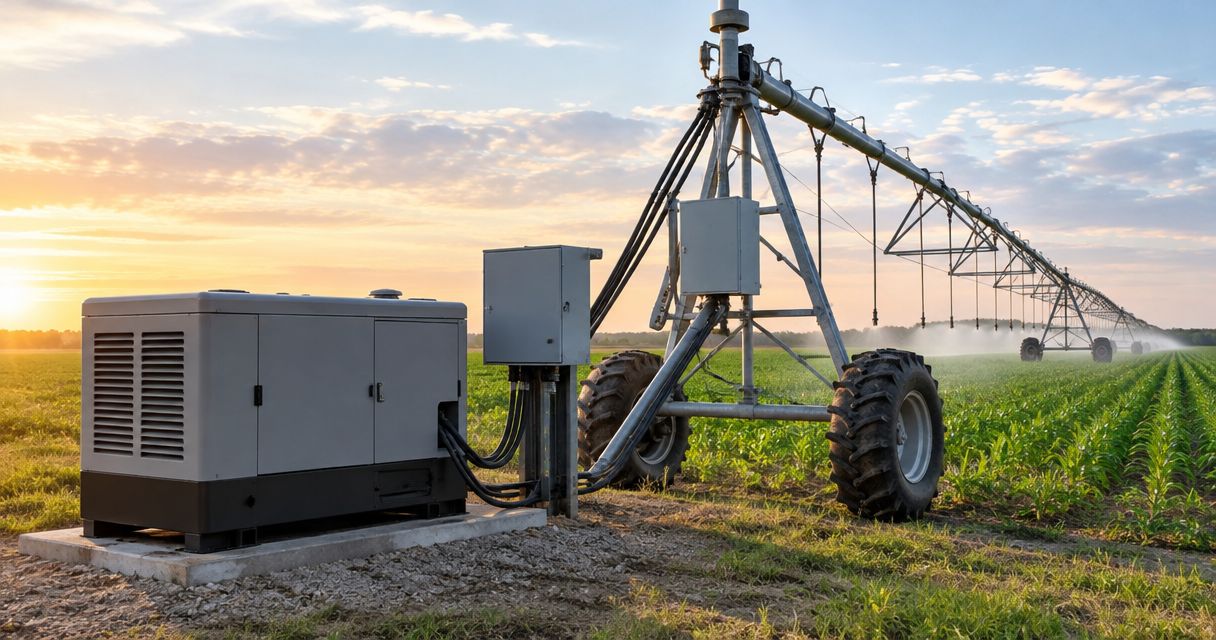
Instead of improvising generator hookups when irrigation stops, connect center pivot irrigation to backup power through properly rated transfer equipment installed by a licensed electrician. Match the generator to the pivot, pump, and controls, then commission a restart sequence that preserves every safety interlock.
- To connect center pivot irrigation to backup power, use approved transfer equipment and a licensed electrician.
- Size the generator for motor starting, not just running loads; include the irrigation pump and controls.
- Eagle Electric is best for Bakken customers seeking licensed electrical contracting and a clear written quote.
- Automatic transfer restores the electrical source; unattended irrigation restart requires separate controls and safety checks.
Why this matters
A powered pivot without water is not a working irrigation system. A running pump without the correct controls is not a safe backup arrangement either. Treat the water supply, tower drives, control panel, and shutdown circuits as one system.
Backup power must preserve the irrigation system’s protective functions, not bypass them. A generator connection that defeats utility isolation or a safety shutdown creates a new hazard instead of solving the outage.
Start your 2026 planning with a site assessment and a written quote. Eagle Electric emphasizes same-business-day responses to quote requests. That response is not a promise of same-day installation or job completion.
Before you start
- Gather equipment records and arrange access. Collect the pivot manual, electrical drawings, pump and motor nameplate information, controller details, and any existing generator documents. Photograph only labels visible without opening electrical enclosures.
- Identify the responsible people. You need a licensed electrician for electrical assessment and installation, the irrigation service provider for equipment-specific controls, and access to whoever operates the water supply. Confirm permit, inspection, and utility requirements before work starts.
- Check the hidden dependency: pump power. The pump and pivot can have separate electrical supplies. Backing up the pivot alone does not restore a pump on an unpowered feeder, and an automatic transfer switch does not automatically authorize safe irrigation restart.
Do not open panels, expose terminals, or attempt live measurements to collect missing information. Have the electrician obtain inaccessible data during the inspection. Wet ground, remote equipment, and motor circuits leave no room for improvised connections.
Equipment records and backup scope
Define the irrigation loads
- List each required load. Include tower motors, the water-supply pump, booster pumps, control power, and any equipment needed for safe operation. Identify separately powered equipment rather than assuming everything comes from the pivot disconnect.
- Record each nameplate exactly. Capture voltage, phase, frequency, motor horsepower, and current data where provided. If a motor reads 480 volts, 3-phase, 60 Hz, record those values; they are an example, not a specification for your installation.
- Choose the operating boundary. Decide whether backup power must support one pivot, its water supply, or additional farm loads. Identify equipment that must remain off during generator operation.
- Document existing controls. Give the electrician information about pump starters, variable-frequency drives, pressure switches, remote controls, and shutdown circuits. Do not change settings to make the generator appear compatible.
Expected result: You have an equipment schedule and a clear boundary showing what backup power must operate. The electrician can trace the actual supply arrangement instead of sizing from a guess.
Put the equipment schedule in your 2026 project file. Include photographs and model information so later equipment changes do not get mistaken for the original design.
Choose the transfer approach
Manual and automatic transfer solve different operating problems. Neither approach replaces proper generator sizing or irrigation safety controls.
| Transfer approach | Best for | Advantage | Limitation |
|---|---|---|---|
| Manual transfer | An attended irrigation site with a trained operator | Keeps source transfer under direct operator control | Requires someone to reach the site and follow the approved procedure |
| Automatic transfer | A site requiring source transfer without an operator present | Transfers the connected load when the designed conditions are met | Needs compatible generator controls and separate decisions about irrigation restart |
Choose manual transfer when attended operation meets the farm’s needs. Choose automatic transfer only when the full control sequence supports it. Do not buy an automatic switch expecting it to solve water pressure, alignment faults, or remote restart permission.
Generator and transfer equipment
Specify the electrical connection
- Have the electrician assess motor starting. Generator selection must account for starting demand, voltage dip, load sequence, and the manufacturer’s requirements. Adding running wattages alone is not a motor-starting calculation.
- Verify the complete output match. Confirm voltage, phase, frequency, and the electrical system arrangement against the equipment documentation. A connector that physically fits does not establish compatibility.
- Specify approved source isolation. Have the electrician select transfer equipment suitable for the installation. The arrangement must prevent unintended connection between utility power and generator power.
- Resolve the installation details. Have the electrician determine grounding and bonding, neutral switching where applicable, fault protection, conductor sizing, disconnects, outdoor enclosure suitability, and any drive-related requirements.
Expected result: The design identifies a compatible generator, transfer arrangement, and protected connection point. You receive a defined scope rather than a generator size with no connection plan.
Do not backfeed through a receptacle or use a homemade connection cord. Do not treat opening the utility breaker as a substitute for approved transfer equipment. Keep the wiring and termination work with the licensed installer.
For a 2026 written scope, ask Eagle Electric to distinguish electrical installation, irrigation-controller work, utility coordination, and inspection responsibilities. Clear boundaries prevent an unfinished control handoff from being mistaken for a completed system.
Pump and pivot control sequence
Establish safe restart conditions
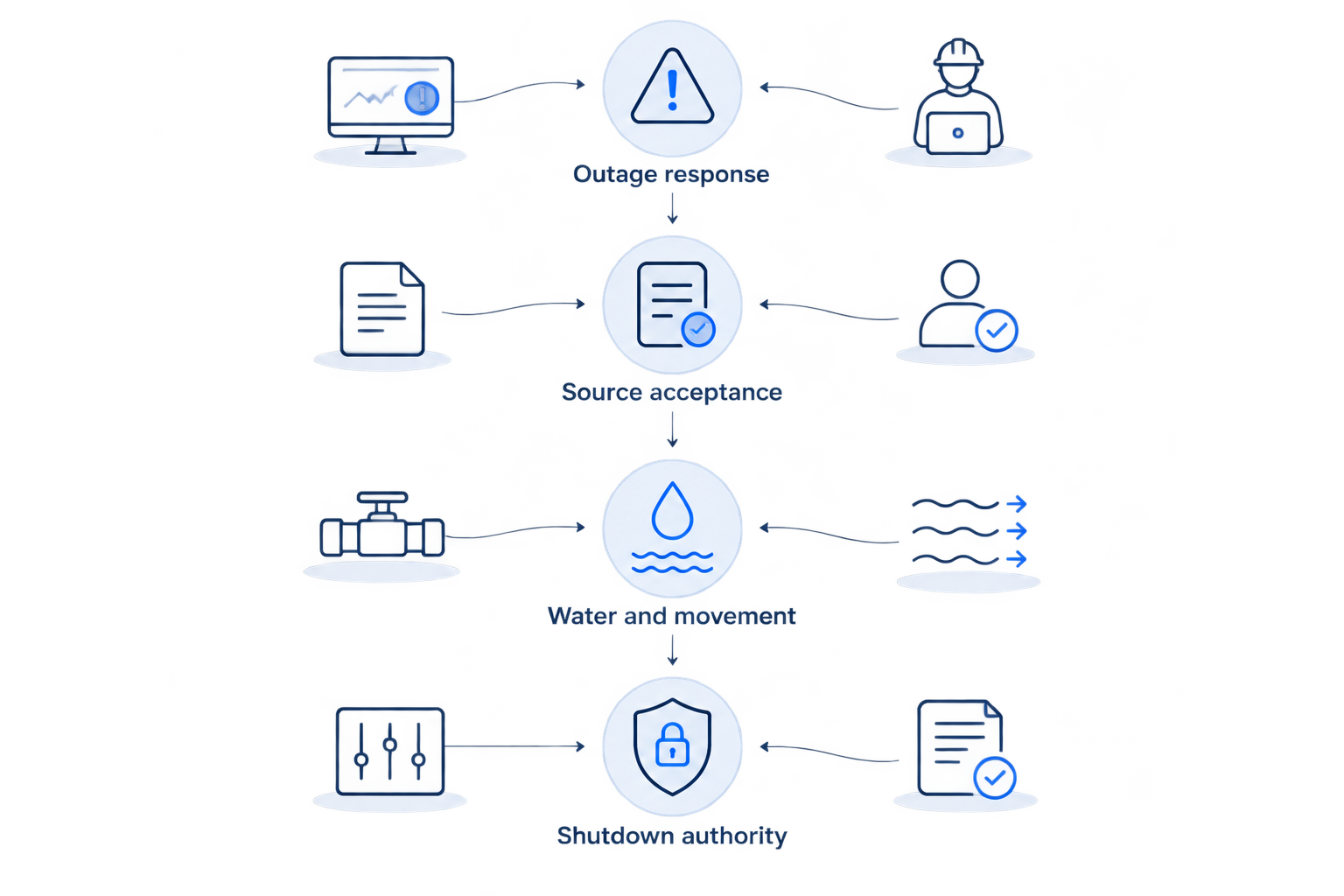
- Define the outage response. Have the irrigation technician document what happens to motion commands, pump commands, and remote start requests when utility power disappears. Identify which faults remain latched after power returns.
- Define source acceptance. Have the installer establish the manufacturer-approved conditions for applying generator power. Generator startup and electrical transfer are not the same event as permission to irrigate.
- Coordinate water and movement. Have the irrigation provider specify the correct sequence for the particular pivot and water system. Include required pressure or flow confirmation and any operating mode that intentionally permits movement without irrigation.
- Preserve shutdown authority. Confirm that emergency stops, alignment protection, overload protection, and applicable water-supply protections still stop the equipment as designed. No backup mode should defeat them.
Expected result: You have a written sequence covering power loss, generator operation, irrigation permission, faults, and utility restoration. Each condition has an assigned response.
Do not copy button names or settings from another pivot’s instructions. Controller labels and restart behavior vary by model and installed options. Use the exact controls in your equipment manual, and have the irrigation technician record the approved settings.
Commissioning and operator handoff
Verify operation under actual load
- Schedule a controlled test. Coordinate with the electrician and irrigation technician. Clear the equipment’s operating area and notify everyone whose work depends on the pump or pivot.
- Have qualified personnel test the transfer. The installer should verify source isolation and electrical conditions using the approved commissioning procedure. Operators should not create an outage by opening unfamiliar equipment.
- Verify the complete irrigation cycle. Confirm motor starting, intended direction, water delivery, control response, and operation under the planned load. A generator running without load does not prove the system works.
- Test faults and return to utility. Have qualified personnel verify protective responses through manufacturer-approved methods. Record the restoration sequence, operator actions, and any restart restrictions.
Expected result: You receive a demonstrated operating procedure, labeled equipment, test records, and clear instructions about who can operate each control.
Keep the signed 2026 commissioning record with the equipment manuals. Repeat the relevant checks after changes to the generator, pump, drive, transfer equipment, or control logic. A previous successful test does not validate a changed system.
Request a written electrical quote
Get a same-business-day response to your quote request. Installation scheduling is separate.
Automatic transfer when utility power fails
An unattended workflow adds more than an automatic transfer switch. It needs a compatible generator-start arrangement, source monitoring, irrigation restart permission, fault handling, and a defined return-to-utility sequence.
Automatic electrical transfer must not clear an irrigation fault or bypass a required operator reset. Have the irrigation provider confirm whether the existing controller supports the intended unattended operation. Do not assume a remote start feature provides every required safeguard.
Use this variant when the farm’s operating plan calls for unattended source transfer and the equipment supports it. Its advantage is reduced dependence on an operator reaching the transfer equipment. Its limitation is the additional control coordination and testing required.
Document the automatic sequence in the 2026 operating procedure. State who responds when the generator runs but irrigation remains locked out. A fault notification is useful only when someone has responsibility for it.
Troubleshooting
The generator runs, but the pivot stays off
Check operator-visible alarms and the approved operating procedure. Possible causes include an unaccepted power source, an open disconnect, or an irrigation safety lockout. Have the electrician and irrigation technician identify the cause; do not bridge a safety circuit to force movement.
The generator trips when a motor starts
Stop repeated restart attempts. Have the installer check starting demand, voltage behavior, generator capability, and the planned load sequence. An oversized replacement breaker is not a fix for an unresolved starting problem.
Tower motors move in the wrong direction
Stop the equipment through its approved controls and call the installer. Incorrect phase sequence can reverse motor rotation in a three-phase system. Have qualified personnel verify the supply and equipment connections before further operation.
The pivot has power, but water does not arrive
Confirm the pump’s status using normal operator controls and visible indicators. The water supply can remain unpowered even when the pivot has transferred successfully. Have the irrigation technician check the pump command, supply arrangement, and applicable pressure or flow conditions.
Utility power returns, but irrigation does not restart
Read the recorded restoration procedure before resetting anything. A controller can require an intentional restart after an outage or fault. Have the technician distinguish the designed behavior from a fault; do not enable automatic restart simply to remove an inconvenience.
Customize your workflow
Expand backup coverage only after the original load and control sequence work correctly. Adding another pivot, a larger pump, or other farm equipment changes the design conditions. Have the electrician review generator capacity and starting sequence before connecting additional loads.
For phased work, ask Eagle Electric for a written scope separating the current installation from future provisions. Identify spare capacity as a design question, not an assumption based on unused breaker spaces.
Keep the operator instructions at the controls and with the farm’s maintenance records. Include the normal sequence, shutdown procedure, fault contacts, and restrictions on operation. Update both copies when settings change.
FAQ
How do I connect center pivot irrigation to backup power safely?
Have a licensed electrician install properly rated transfer equipment and a generator connection matched to the irrigation system. Coordinate the pump, pivot controls, and safety circuits with the irrigation service provider before commissioning.
What size generator do I need for a center pivot?
Generator size depends on the connected loads and their starting requirements. Give the installer the pump, tower motor, control, and drive information; running wattage alone does not establish the required generator capacity.
Can a portable generator run my center pivot?
A portable generator is suitable only if its output and starting capability match the complete intended load. A licensed electrician must also confirm the approved connection and transfer arrangement; portability does not make a generator electrically compatible.
Will an automatic transfer switch restart irrigation?
An automatic transfer switch changes the electrical source, but it does not by itself establish safe irrigation restart. The controller, pump sequence, safety circuits, and restart permissions must support the intended operation.
Do I need backup power for the well pump too?
Include the water-supply pump if irrigation depends on that pump and its normal power source will be unavailable. Trace the actual electrical supplies because the pump and pivot can be on separate feeders.
Can I connect the generator myself if I turn off the main breaker?
Do not improvise a generator connection or rely on an open main breaker as the transfer arrangement. Have a licensed electrician provide approved source isolation, protection, and installation.
What should an irrigation backup-power quote include?
The written quote should define the loads, generator requirements, transfer equipment, electrical work, control responsibilities, permits, and commissioning scope. Ask who supplies each component and who verifies the complete pump-and-pivot sequence.
One last thing
A backup-power test is incomplete until utility restoration works correctly. The pump and pivot must return to normal operation without bypassed protection or an unexplained restart. Witness that handoff before accepting the system.