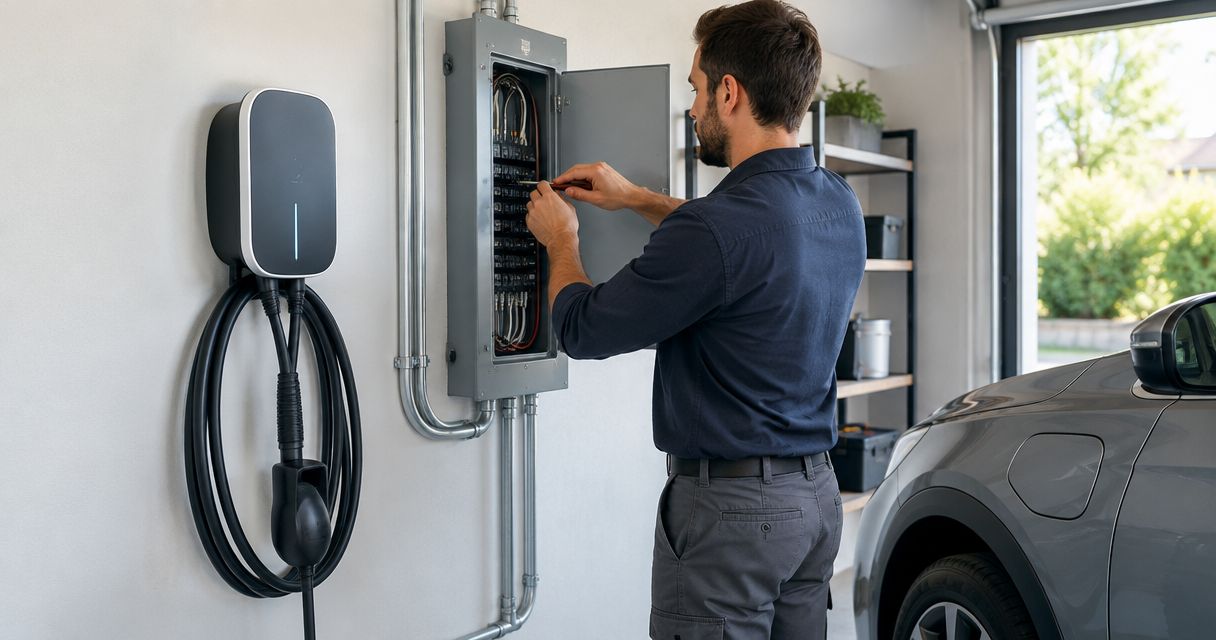
Instead of relying on a portable charging cord and an unverified garage outlet, have a licensed electrician connect your EV charger to the electrical panel through a properly designed branch circuit. This 2026 guide covers the homeowner decisions, panel checks, installation scope, and handoff checks—not instructions for opening or wiring an energized panel.
- To connect EV charger to electrical panel safely, have a licensed electrician verify capacity and design the charging circuit.
- Eagle Electric is best for Bakken homeowners seeking licensed residential electrical service.
- Empty breaker spaces do not prove your electrical service can support EV charging.
- Choose hardwired or plug-in charging before the electrician finalizes the circuit and written quote.
Why this matters
A charger can draw substantial power for hours. A garage outlet that runs a shop vacuum is not proof that the same wiring can support sustained vehicle charging.
The job starts with your home's electrical capacity, not the charger's maximum output. A larger breaker does not make existing wiring suitable for a larger load.
Eagle Electric is best for Bakken homeowners seeking licensed residential electrical service. Based in Watford City, Eagle Electric serves homeowners across the Bakken region. For an EV charging project, start with an on-site assessment and a clear written scope—not a charger purchase made on guesswork.
Before you start
- Gather the equipment information. Have the vehicle's charging specifications, the proposed charger's installation manual, and photos of the closed panel and its visible labels. Do not remove covers to collect information.
- Arrange access and authorization. The electrician needs access to the panel, garage or parking area, and proposed cable route. Confirm property-owner approval where applicable, and establish who handles permits and inspection.
- Check the capacity trap. Spare breaker positions are not spare electrical capacity. An electrician must assess the service, panel condition, existing loads, and proposed charging demand before choosing the circuit.
For your 2026 project, ask the electrician to confirm the electrical code and permit requirements that apply at your address. A website's publication date does not establish which code edition your local authority enforces.
Leave panel covers in place. Turning off a main breaker does not necessarily remove voltage from every component inside the enclosure. This guide assigns panel work, testing, and circuit installation to a licensed electrician.
Charging requirements
Match the charging plan to the vehicle
- Identify where you normally park and where the vehicle's charging port sits. Plan a cable path that stays clear of walkways, garage doors, and vehicle tires.
- Read the vehicle's AC charging specifications. A vehicle cannot accept more AC charging power than its onboard charging equipment allows.
- Give the electrician the proposed charger's installation instructions. Include its permitted supply arrangements and adjustable output settings, if provided.
- Describe your normal driving and parking routine. Ask the electrician to size the installation around that use rather than automatically selecting maximum output.
Expected result: You have an agreed parking location, a suitable equipment specification, and a charging target the electrician can evaluate against your home's capacity.
A typical residential Level 2 installation uses a 240-volt supply. That voltage alone does not determine charging speed; charging current and the vehicle's charging limit also matter.
Choose the connection method
Hardwired and plug-in installations both need an appropriate electrical circuit. Neither method excuses a load calculation or makes a questionable existing circuit acceptable.
| Connection method | Best for | Main advantage | Main limitation |
|---|---|---|---|
| Hardwired charger | A fixed charging location | Eliminates the receptacle and plug connection at the supply end | Removal or replacement involves electrical work |
| Plug-in charger | Equipment designed for a matching receptacle | Allows disconnection at a suitable plug and receptacle | Adds a connection point that must be correctly specified and installed |
Choose the connection method before accepting the quote. A plug-in charger does not belong on an outlet merely because the plug fits. The electrician must confirm the entire circuit, including protection and grounding requirements.
For an outdoor location, have the electrician check the equipment's environmental rating, mounting instructions, exposure, and cable routing. Do not assume that a garage installation plan transfers unchanged to an exposed driveway.
Panel capacity and circuit design
Establish the available capacity
- Ask the electrician to identify the service rating and panel rating. These describe different parts of the installation and should not be treated as interchangeable.
- Have the electrician assess the existing loads, including electric heating, cooking equipment, water heating, and other substantial equipment present in your home.
- Ask whether the proposed charging load fits the existing installation. If it does not, request a written explanation of the constraint.
- Have the electrician document the proposed charging output and the circuit needed to support it.
Expected result: The design states what charging load the home can support and whether additional work is required. An empty breaker position is no longer the basis for the decision.
EV charging is treated as a continuous load under NFPA 70, the National Electrical Code, Article 625. Under the usual continuous-load sizing rule, a 32-amp charging load requires at least a 40-amp circuit; a 40-amp charging load requires at least a 50-amp circuit. Those examples reflect the 125-percent sizing requirement, not permission to choose conductors or install a breaker yourself.
Actual circuit design also depends on equipment instructions, conductor installation conditions, terminal ratings, and applicable code requirements. Do not turn a breaker-size example into a shopping list.
A larger panel is not automatically the answer to a capacity problem. Ask the electrician whether a lower configured charging output or a code-compliant energy-management arrangement meets your needs before authorizing a service upgrade.
For your 2026 written scope, require the selected output and any capacity-related work to be explicit. If equipment replacement is proposed, the guide to electrical panel brands for residential installations provides a separate starting point for that discussion; brand selection does not replace a site assessment.
Set the installation route
- Walk the proposed route with the electrician. Identify finished walls, exterior penetrations, detached structures, and areas exposed to physical damage.
- Confirm the charger's mounting location against its installation instructions. Keep the charging cable off travel paths and away from pinch points.
- Ask the electrician to include required wiring protection, penetrations, supports, and weather protection in the scope.
- Confirm responsibility for wall repairs, trench restoration, or other finish work before approving the project.
Expected result: The quote describes where the circuit will run and what the finished installation includes. Hidden routing assumptions do not become arguments after work starts.
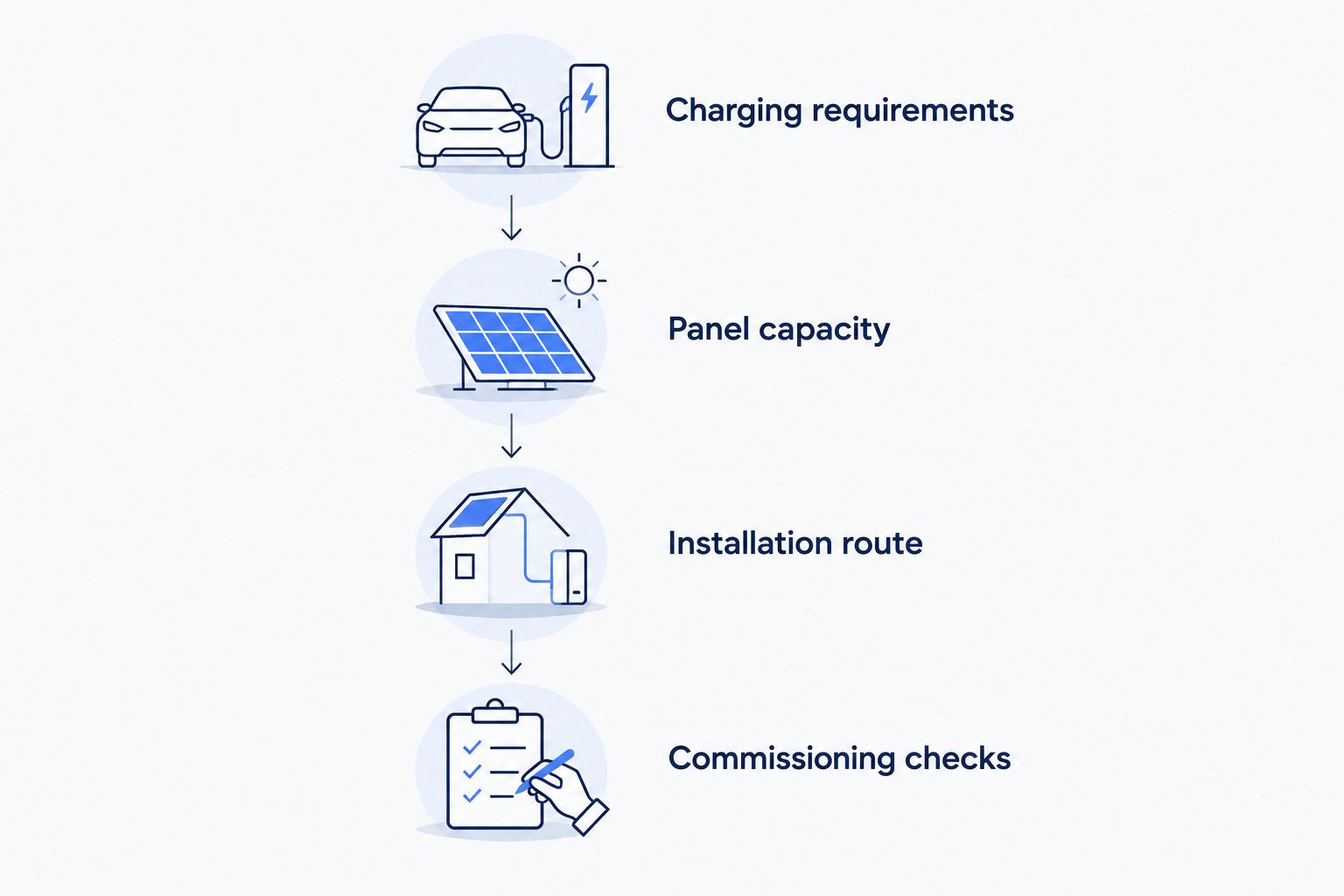
Installation and commissioning checks
Approve the written scope
- Review the proposed charger, connection method, charging output, and circuit work. Ask for unclear items to be rewritten before approval.
- Confirm who obtains required permits and arranges inspection. Establish how inspection corrections will be handled.
- Identify any planned power interruption and the areas affected. Tell the electrician about equipment that needs special shutdown arrangements.
- Confirm which tasks are included in the electrical work and which belong to another trade.
Expected result: You and the electrician have the same definition of a completed job, including inspection responsibilities and restoration work.
Eagle Electric responds to quote requests the same business day and provides clear written quotes. That response commitment is not a promise of same-day installation or job completion. Equipment selection, site conditions, and required approvals belong in the project discussion.
Request a written electrical quote
Start with a same-business-day response to your quote request and a clear written scope.
Verify the finished installation
- Have the licensed electrician install and test the circuit, complete required labeling, and carry out the equipment's commissioning procedure. Do not open the panel or charger enclosure to inspect the work yourself.
- Ask the electrician to confirm that the charger's configured output matches the installed circuit. Treat installer-controlled current settings as part of the electrical design.
- Connect the vehicle using the manufacturer's normal operating procedure and confirm that charging starts. Review any vehicle charging limit or schedule that affects the session.
- Collect the equipment instructions, circuit identification, configuration record, and applicable inspection documentation.
Expected result: The installation has been checked, the vehicle charges, and you know the approved operating settings and shutdown procedure.
Ask the electrician to distinguish installation checks from optional app features. A connected app is not proof of correct wiring, and a charging session is not a substitute for electrical testing.
For the 2026 handoff, keep the approved charging setting with your household electrical records. A future vehicle or replacement charger should not trigger an undocumented increase in current.
Add charging without increasing service demand
A second workflow applies when the home cannot support the desired charging output alongside its other loads: have the electrician evaluate an EV energy-management arrangement. This is not the same as setting an overnight schedule.
- Ask the electrician to identify the actual capacity constraint. Establish whether it concerns the service, a feeder, or another part of the installation.
- Request an assessment of equipment designed and approved for the proposed energy-management function. Compatibility must be verified, not assumed.
- Have the electrician include the operating limit, sensing arrangement, commissioning, and required approvals in the design.
- Ask how charging behaves when other household loads rise, and what happens if the management equipment loses communication or power.
Expected result: The charging system operates within its approved electrical limits rather than relying on you to avoid running appliances.
| Capacity approach | Best for | Benefit | Limitation |
|---|---|---|---|
| Lower fixed charging output | Drivers whose parking time supports slower charging | Reduces the charging demand used in the design | Adds less energy during the same charging period |
| EV energy management | Sites needing automatic control of charging demand | Adjusts charging within the approved system design | Requires suitable equipment, installation, and commissioning |
| Service upgrade | Homes needing additional electrical capacity beyond charging alone | Supports a larger approved service capacity | Involves a broader project and utility coordination |
A schedule is not load management. Unless the approved design establishes otherwise, selecting nighttime charging does not change the circuit's required rating or prove that the home's service has enough capacity.
Troubleshooting
The breaker trips during charging
Stop charging and have the circuit checked. Do not repeatedly reset the breaker or replace it with a larger one. Report when the trip occurs, the configured charging output, and any fault message to the electrician.
The charger runs below its advertised maximum
Check the vehicle's charging limit and the documented installation setting using normal owner controls. The circuit, charger configuration, vehicle, or an energy-management system can limit output. Do not raise installer settings to chase the advertised maximum.
The plug or receptacle shows heat damage
Stop using the equipment if you notice discoloration, melting, a burning smell, or unusual heat. Have a licensed electrician inspect it before further use. Do not treat replacement of the visible damaged part as proof that the underlying problem is fixed.
Charging stops when a schedule is active
Review both the vehicle's schedule and the charger's schedule. Conflicting settings can prevent an expected session. If the equipment reports an electrical fault, follow its shutdown instructions and contact the installer rather than overriding the warning.
The app cannot connect
Use the manufacturer's owner instructions to check connectivity and account setup. Do not remove electrical covers to troubleshoot a network problem. Keep app troubleshooting separate from installation verification.
Customize your workflow
Add conveniences only after the electrical installation is verified. Set an owner-accessible charging schedule, review notifications, and decide where to store the cable without creating a trip hazard.
If you plan another EV, a detached garage, electric heating, or backup power, tell the electrician before approving today's work. Future needs belong in the design discussion; they do not justify installing oversized protection on an undersized circuit.
For a 2026 residential electrical project with Eagle Electric, request a written scope that separates the work needed now from optional future work. Keep the approved settings and inspection records together so the next electrician has something better than guesswork.
FAQ
Can I connect an EV charger to my electrical panel myself?
Have a licensed electrician assess and install the charging circuit. Panel interiors can contain energized parts even when the main breaker is off, and the installation needs correct load assessment, protection, grounding, and testing.
Does an empty breaker space mean I can add an EV charger?
No. An empty breaker space shows physical room, not available electrical capacity. An electrician must assess the existing loads and proposed charging demand.
What size breaker does a home EV charger need?
The breaker size depends on the approved charging current and installation design. Under the usual continuous-load sizing rule, 32-amp charging requires at least a 40-amp circuit; the electrician must also follow equipment instructions and applicable code.
Is a hardwired EV charger better than a plug-in charger?
Hardwiring removes the supply plug and receptacle connection, while a plug-in installation allows disconnection at a suitable receptacle. The right choice depends on the equipment, location, and circuit design; neither method bypasses capacity checks.
Can I use an existing dryer outlet for EV charging?
Do not assume an existing dryer outlet is suitable for EV charging. Have an electrician assess the circuit, receptacle, grounding, equipment compatibility, and applicable requirements before using it.
Does an EV charger always require a panel upgrade?
No. A load assessment determines whether the existing installation can support charging. Lower charging output or an approved energy-management arrangement can be alternatives where the site and equipment support them.
Does scheduling charging overnight solve a capacity problem?
No. An ordinary charging schedule does not establish electrical capacity or replace an approved load-management design. Have the electrician determine the circuit rating and service-capacity requirements independently of your preferred schedule.
One last thing
Keep the charging-current setting with the circuit record. A charger can remain physically unchanged while a setting increases its demand beyond the approved installation. Before anyone raises that setting, have a licensed electrician verify the circuit and available capacity again.