Best overall for visible breaker-trip identification: Square D QO. Best for a straightforward conventional installation: Eaton BR. Best for a matching Siemens replacement: Siemens. Best for circuit monitoring: Leviton. This 2026 guide compares residential panel choices by breaker compatibility, useful features, and the work your home actually needs.
- Best electrical panel brands residential buyers should compare: Square D, Eaton, Siemens, and Leviton; choose by installation requirements.
- Square D QO stands out for its visible trip indicator, not a promise of better protection in every installation.
- Eaton BR suits conventional installations; Siemens suits replacements where the selected equipment matches the existing system.
- Leviton suits circuit-monitoring plans, but monitoring depends on the selected breakers and supporting equipment.
- Eagle-Elc residential electrical services start with the home’s requirements, not a panel logo.
Why this matters
A panel with spare breaker spaces can still lack capacity for another large load. A breaker that fits into a slot can still be wrong for that panel. Those are installation questions, not brand contests.
For a Bakken home, start with the service, connected loads, and condition of the existing equipment. Eagle-Elc is a licensed electrical contractor based in Watford City, serving homeowners across the region. Eagle-Elc residential electrical services are best for Bakken homeowners who need a licensed contractor to assess a panel installation.
The right 2026 purchase is a compatible panel with the required protection and room for your documented plans. A familiar logo does not replace an on-site inspection.
What makes the best residential electrical panel
Use these criteria before comparing manufacturers. They decide whether a panel belongs in your house.
- Service and load fit: The electrician must check the service rating and calculate the loads. Panel capacity alone does not establish available capacity.
- Listed breaker compatibility: Use breakers identified for the panel, or specifically classified for that application. Physical fit is not approval.
- Required protection: The design must accommodate required ground-fault circuit-interrupter protection, or GFCI, and arc-fault circuit-interrupter protection, or AFCI.
- Usable circuit spaces: Count full-size spaces and planned circuits. Do not assume every position accepts tandem breakers.
- Installation conditions: Indoor or outdoor location, conductor routing, working clearance, and grounding arrangements affect the selection.
- Useful features: Trip indicators, plug-on-neutral connections, and monitoring have different purposes. Buy features that solve a real problem.
A typical U.S. house uses a 120/240-volt split-phase service. Existing service ratings can include 100 amps or 200 amps, but neither rating tells you how much additional equipment the house can support. The load calculation does that.
Residential panel brands at a glance
These are use-case picks, not claims that one manufacturer makes every competing installation unsafe. Select the exact panel and breaker family before approving the work.
| Panel option | Best for | Standout feature | Key limitation |
|---|---|---|---|
| Square D QO | Visible breaker-trip identification | Visi-Trip indicator on QO breakers | QO and Homeline are different breaker families |
| Eaton BR | Straightforward conventional installations | Conventional load-center and breaker system | BR and CH breakers are not interchangeable |
| Siemens | Matching a Siemens replacement installation | Plug-on-neutral designs within the product range | Compatibility depends on the exact panel and breaker |
| Leviton Load Center | Circuit-monitoring plans | Smart-breaker monitoring options | Monitoring requires the appropriate equipment |
For an undecided homeowner, compare Square D QO and Eaton BR first. Then let the inspection, required breakers, and written installation scope settle the choice.
1. Square D QO: best residential panel for visible trip identification
Square D QO is a residential load-center and breaker family. Its QO breakers include the Visi-Trip indicator, which helps identify a tripped breaker. That feature makes a specific problem easier to see; it does not tell you what caused the trip.
If you have ever stared at a row of breaker handles after losing power to a room, the distinction matters. A visible trip indication helps with identification. Repeated tripping still needs diagnosis.
Square D QO pros:
- Visi-Trip gives a separate visual indication of a tripped breaker.
- A defined panel-and-breaker family keeps compatibility central to the selection.
- QO protection options support designs that require AFCI or GFCI breakers, subject to the selected equipment.
Square D QO cons:
- Square D Homeline breakers are not substitutes for QO breakers.
- A trip indicator does not identify an overload, damaged conductor, or faulty appliance.
- A QO panel does not remove the need to calculate loads or inspect the service.
Best for: Homeowners who value clear breaker-trip identification in a conventional residential panel.
Verdict: Buy when QO fits the installation and the written scope identifies the correct breakers. Do not choose it solely because another house uses Square D.
2. Eaton BR: best residential panel for a straightforward installation
Eaton BR is a conventional residential load-center and breaker family. It is a useful candidate when your priority is a clearly specified panel installation rather than connected monitoring. The electrician still needs to select the enclosure, rating, circuit spaces, and protective breakers.
For a 2026 replacement, ask for the exact Eaton BR model in the quote. The manufacturer name alone leaves too much undefined.
Eaton BR pros:
- A conventional panel system suits projects without a circuit-monitoring requirement.
- BR offers breaker options for required protective functions, subject to the selected panel.
- Specifying the BR family makes the intended breaker system clear.
Eaton BR cons:
- Eaton BR and Eaton CH are different systems; their breakers are not interchangeable.
- A conventional BR installation does not itself provide app-based circuit monitoring.
- Space count and permitted tandem positions depend on the exact panel label.
Best for: Homeowners who want a conventional installation with a clear equipment schedule and no monitoring requirement.
Verdict: Buy when the selected BR equipment meets the load, space, and protection requirements. Skip any quote that lists only an Eaton panel without identifying the model and breaker scope.
3. Siemens: best residential panel for a matching replacement
Siemens makes residential load centers, including plug-on-neutral designs. A compatible plug-on-neutral breaker connects to the panel’s neutral system without the usual neutral pigtail. That is an installation feature, not a reason to replace a sound panel by itself.
Siemens belongs on your shortlist when an electrician is evaluating an existing Siemens installation. Matching the manufacturer is only the starting point. The exact equipment determines what can remain and what must change.
Siemens pros:
- Plug-on-neutral designs provide a defined connection system for compatible breakers.
- Residential breaker options include protective functions needed for applicable circuits.
- A replacement assessment can compare the existing Siemens equipment with the proposed system directly.
Siemens cons:
- The Siemens name does not establish compatibility between every panel and breaker.
- Plug-on-neutral breakers require a compatible panel design.
- Existing breakers should not be reused without checking their listing, condition, and suitability.
Best for: Homeowners replacing Siemens equipment who want the electrician to assess compatible replacement choices.
Verdict: Hold until the existing panel label, breaker types, and conductor condition are checked. Then buy the specified system, not a visually similar substitute.
4. Leviton: best residential panel for circuit-monitoring plans
The Leviton Load Center supports smart-breaker options for circuit monitoring. A monitoring installation requires the appropriate breakers and supporting equipment. A basic panel purchase is not the same thing as a complete connected system.
This is the distinct use case: you want information about individual circuits, not just a place to terminate them. Decide what you want to monitor before the electrician specifies the equipment.
Leviton pros:
- Smart-breaker options support circuit-level energy information.
- The panel and compatible breakers form a defined equipment system.
- Monitoring requirements can be included in the installation scope from the start.
Leviton cons:
- Monitoring features depend on the selected breakers and supporting equipment.
- Connected features add setup requirements beyond a conventional panel installation.
- Monitoring does not increase service capacity or replace required electrical protection.
Best for: Homeowners with a specific circuit-monitoring goal and a complete equipment plan.
Verdict: Buy when the quote names the monitoring components and setup work. Skip if you only need a conventional replacement and will not use the connected features.
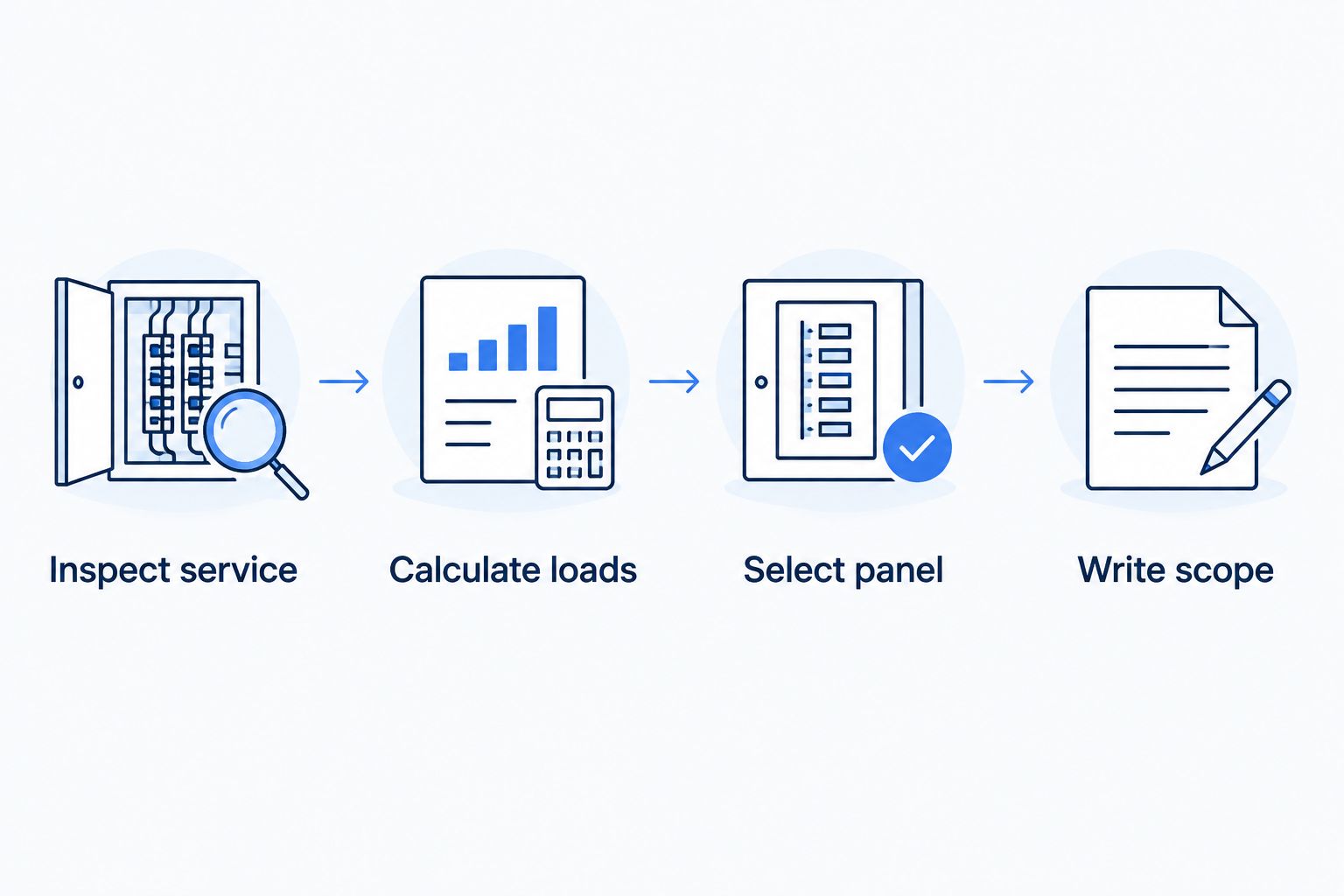
Before approving a panel replacement
A useful 2026 quote starts with an inspection, not a product brochure. Give the electrician your planned additions: an electric vehicle charger, electric heating, shop equipment, or a standby generator. Each changes the design questions.
Inspect service
Have a licensed electrician inspect the existing panel, service equipment, conductor condition, grounding, and installation location. Do not remove the panel cover yourself. Parts of the equipment can remain energized even when the main breaker is off.
Calculate loads
The electrician must calculate the existing and proposed loads. Replacing a 100-amp panel with a 200-amp panel does not automatically create a 200-amp service. The service conductors, meter equipment, utility requirements, and other components must support the change.
Select panel
Choose the exact panel, breaker family, required protection, and usable spaces. Document future circuits rather than asking vaguely for room to grow. Generator plans also need a suitable transfer arrangement; an ordinary panel is not automatically generator-ready.
Write scope
Get the equipment and work in writing. The scope should identify permits, utility coordination when required, circuit labeling, inspection responsibilities, and any excluded repairs. Separate the quote response from the construction schedule.
Eagle-Elc emphasizes same-business-day responses to quote requests and clear written quotes. That is a response commitment, not a promise to finish the electrical work the same day.
Request a written panel quote
Describe your existing panel and planned loads. Ask for a clear equipment and installation scope.
How the panel choices are ranked
This ranking separates practical uses: trip identification, conventional installation, matching replacement, and circuit monitoring. It is not a laboratory reliability ranking or a claim that one brand protects every home better than another.
Manufacturer documentation establishes features and compatibility. The panel label, applicable electrical requirements, and on-site assessment establish whether the selected equipment belongs in your house.
For a 2026 project, give the installer’s equipment schedule more weight than a broad brand recommendation. A precise quote is more useful than a long list of logos.
Which residential panel should you choose?
Start with Square D QO if visible trip identification matters. Start with Eaton BR if you want a conventional installation without monitoring. Those are useful defaults, not instructions to replace serviceable equipment.
Choose Siemens when the existing installation makes a matching replacement worth evaluating. Choose Leviton when circuit monitoring is a stated requirement and the quote includes the equipment needed to deliver it.
The final choice belongs in a written scope covering the complete installation. If two suitable panels meet the same requirements, compare the included work. Breaker protection, service repairs, labeling, and inspection responsibilities matter more than the badge on the door.
FAQ
What’s the best electrical panel brand for a house in 2026?
Square D QO is the default pick here for visible trip identification, while Eaton BR suits a conventional installation without monitoring. The final choice depends on the home’s service, calculated loads, required protection, and exact equipment compatibility.
Is Square D QO better than Eaton BR?
Square D QO has a distinct trip-identification advantage through its Visi-Trip indicator; that does not make it better for every installation. Eaton BR remains a candidate when the specified equipment meets the home’s requirements.
Can I put a different brand of breaker in my panel?
Use only breakers identified for the panel or specifically classified for that application. A breaker fitting into the slot does not establish electrical compatibility; have a licensed electrician check the panel label and breaker documentation.
Do I need a 200-amp panel for an electric vehicle charger?
An electric vehicle charger does not automatically require a 200-amp service. A licensed electrician must calculate the added load and assess the existing service before specifying a charger circuit, load management, or service upgrade.
Does a Leviton panel automatically include circuit monitoring?
No. Leviton circuit monitoring requires the appropriate smart breakers and supporting equipment. Have the quote identify the monitoring components and setup rather than assuming they come with every panel.
Can I replace my electrical panel myself?
Use a licensed electrician for a panel replacement. Service equipment presents shock and arc hazards, and parts can remain energized with the main breaker off; permits, utility coordination, and inspection also need to be addressed.
Should I choose my generator before replacing the panel?
Discuss the generator plan before approving the panel design. The electrician needs to account for the transfer arrangement, intended backup loads, and compatibility; a new panel alone does not provide safe generator connection.
One last thing
An empty breaker position is not proof of spare electrical capacity. Spaces tell you where circuits can fit. A load calculation tells you whether the service can support them.
Before signing a 2026 panel quote, ask the electrician to identify both: usable circuit spaces and the basis for the service-capacity decision. That answer is more useful than another brand recommendation.