
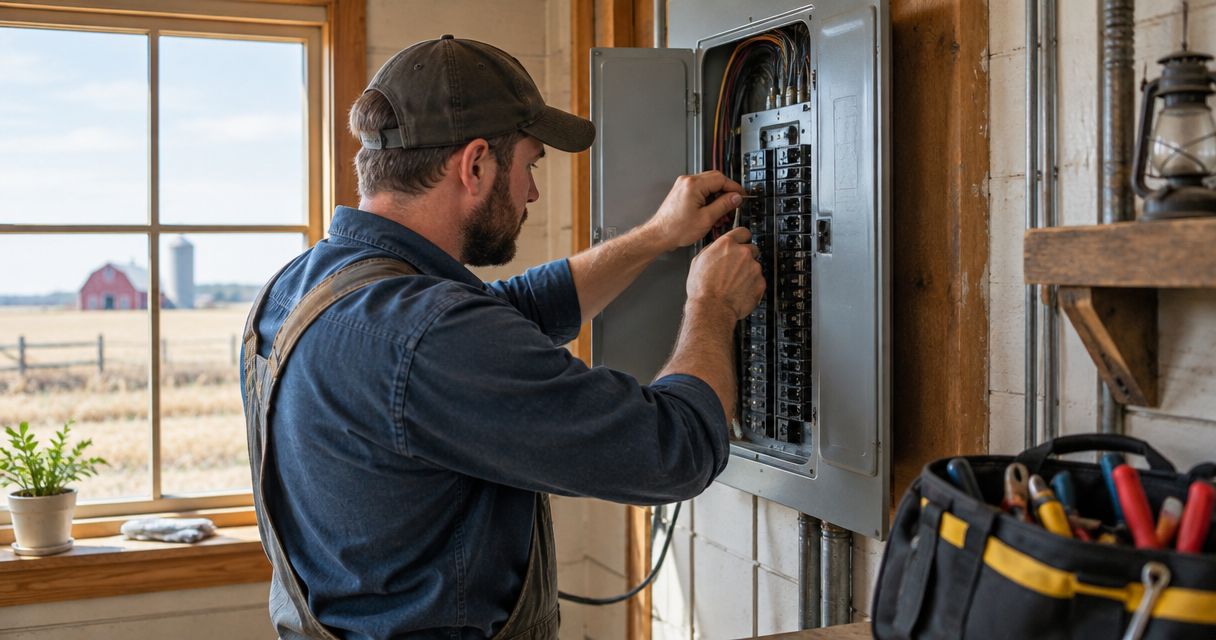
Best overall: a load-calculated service and panel upgrade. Best for a sound service with a worn panel: panel-only replacement. Best for a separate work area: a feeder and subpanel. Eagle Electric is a licensed option for farmhouse electrical panel upgrades in western North Dakota; the right scope starts with an on-site inspection, not a bigger breaker.
- The best electrical panel upgrades for older farmhouses in North Dakota match calculated loads, existing wiring, and utility requirements.
- Eagle Electric serves homeowners across the Bakken region; request an on-site assessment before choosing a panel upgrade.
- Panel-only replacement suits adequate existing service; a service upgrade addresses insufficient electrical capacity.
- A barn subpanel or generator connection needs separate planning; neither automatically increases available service capacity.
Why this matters
An older farmhouse can need more circuit spaces without needing more service capacity. It can also have a tidy breaker panel fed by wiring that cannot support the loads you want to add. Those are different jobs.
For your 2026 project, write down what trips, what you plan to install, and which buildings need power. Electric heat, water heating, a shop, and an electric vehicle charger all belong in the assessment. So do well pumps and other motor loads.
Start with Eagle Electric for residential electrical contracting across the Bakken region. Ask for a same-business-day response to your quote request and a clear written scope. A response deadline is not a promise of same-day job completion.
What makes the best farmhouse panel upgrade
Rank the work by the problem it solves, not the amperage printed on the door.
- Calculated capacity: Size the service for existing loads and documented additions. Count equipment, not empty breaker spaces.
- Existing condition: Inspect the panel, service equipment, grounding, bonding, and accessible wiring before deciding what stays.
- Circuit protection: Identify where GFCI and AFCI protection applies under the requirements governing the work.
- Farm layout: Account for the house, well, detached buildings, feeder routes, and distance-related voltage drop.
- Equipment compatibility: Use breakers and accessories approved for the selected equipment. A physical fit is not proof of compatibility.
- Written scope: Identify utility coordination, permits, inspections, circuit corrections, and restoration work before approving the job.
Farmhouse panel upgrades at a glance
These are project types, not competing panel brands. Choose the row that matches the electrical problem your inspection identifies.
| Upgrade | Best for | Standout feature | Key limitation |
|---|---|---|---|
| Load-calculated service and panel upgrade | Insufficient capacity for planned loads | Addresses the service and distribution equipment together | Requires review beyond the panel itself |
| Panel-only replacement | Adequate service with deteriorated or unsuitable panel equipment | Replaces the distribution equipment without assuming a larger service | Does not increase service capacity |
| Feeder and subpanel | A detached shop or separate work area | Places circuit distribution near the loads | Does not add capacity at the source |
| Generator-ready panel and transfer arrangement | Safe backup-power connection | Separates generator power from utility power | Requires equipment-specific planning |
| Wiring-first repair with panel work | Unsafe or unsuitable branch circuits | Addresses defects a new panel cannot correct | Expands the work beyond a panel swap |
1. Service and panel upgrade: best for added electrical loads
A service upgrade addresses the equipment supplying the farmhouse as well as the panel distributing power inside it. The electrician determines which conductors, enclosures, disconnects, and utility connections need changes. Replacing only the panel does not resolve an undersized supply.
A 200-amp service is an option, not an automatic prescription for every old farmhouse. The correct rating comes from a load calculation and the requirements for the installation. Tell the electrician about planned equipment before the calculation is finished.
Service upgrade pros
- Addresses insufficient supply capacity rather than just a shortage of breaker spaces.
- Allows planned household and farm-related loads to be assessed together.
- Brings service equipment condition into the project scope.
Service upgrade cons
- Requires utility coordination when the utility connection is affected.
- Can involve exterior equipment and conductors beyond the indoor panel.
- Does not automatically correct defective branch-circuit wiring.
Best for: A farmhouse whose calculated load exceeds the existing service capacity.
Verdict: Buy the service upgrade when the load calculation supports it. Skip an amperage increase chosen only because a larger panel sounds better.
2. Panel-only replacement: best for adequate existing service
Panel-only replacement addresses worn, damaged, or unsuitable distribution equipment while retaining an adequate service. The electrician must verify that the existing supply and associated equipment remain suitable. A panel swap is a narrower project, not permission to overlook defects elsewhere.
A 100-amp service is not automatically defective because it is smaller than a modern upgrade option. Its suitability depends on the calculated load and equipment condition. Likewise, putting a higher-rated enclosure on that service does not increase the supply available to the house.
Panel-only replacement pros
- Targets a panel problem without assuming a service-capacity problem.
- Can improve circuit organization and identification.
- Provides an opportunity to review breaker selection and required protection.
Panel-only replacement cons
- Leaves the existing service-capacity limit in place.
- Does not repair damaged cables or unsafe splices elsewhere.
- Depends on confirming that the retained equipment is acceptable.
Best for: A farmhouse with adequate service capacity but a panel that needs replacement.
Verdict: Buy panel-only replacement after the electrician confirms the retained service is suitable. Hold if planned loads have not been assessed.
3. Feeder and subpanel: best for a detached shop
A feeder supplies a separate panel serving a defined area, such as a detached shop. The subpanel distributes power to that area's circuits. It does not create additional capacity at the farmhouse service.
Distance matters. The electrician must consider feeder loading, voltage drop, installation method, and building-specific grounding and disconnect requirements. Shop equipment with 240-volt loads belongs on the equipment list before feeder sizing begins.
Feeder and subpanel pros
- Places circuit distribution close to the equipment it serves.
- Separates shop circuit organization from household circuit organization.
- Allows the feeder route and future equipment needs to be planned together.
Feeder and subpanel cons
- Requires adequate capacity at the supplying service.
- Can require trenching or other route preparation.
- Needs proper grounding and bonding; a detached building is not just another room.
Best for: A separate work area needing dedicated circuit distribution.
Verdict: Buy a feeder and subpanel when the source capacity and route are confirmed. Skip it as a supposed fix for an overloaded farmhouse service.
4. Generator-ready panel: best for planned backup power
A generator-ready project pairs compatible panel equipment with an appropriate transfer arrangement. The purpose is to prevent generator power from energizing utility conductors while supplying the intended household loads. The exact arrangement depends on the generator, panel, and installation.
Decide whether you want selected circuits or a broader backup-power system before choosing equipment. A well pump, heating controls, refrigeration, and lighting each affect the plan. A panel replacement alone does not provide a safe generator connection.
Generator-ready panel pros
- Incorporates utility isolation into the backup-power plan.
- Allows essential loads to be identified before installation.
- Coordinates panel compatibility with the intended generator arrangement.
Generator-ready panel cons
- Does not increase the generator's output or the utility service capacity.
- Requires compatible, approved equipment rather than improvised connections.
- Needs a clear operating procedure for a manual arrangement.
Best for: A farmhouse planning a permanent, approved generator connection.
Read the guide to transfer switches for home generator installations before requesting a backup-power scope. Keep panel replacement and generator connection listed separately in the quote.
Verdict: Buy a coordinated transfer arrangement for planned backup power. Skip any connection that bypasses proper utility isolation.
5. Wiring-first repair: best for unsafe existing circuits
Wiring-first repair addresses branch-circuit defects alongside any necessary panel work. Damaged insulation, improper splices, missing grounding paths, or unsuitable modifications do not disappear when a new enclosure goes on the wall. The electrician needs to assess the affected circuits.
If your farmhouse contains knob-and-tube wiring, identify its condition and how it has been altered. Do not assume every old circuit needs identical treatment. Do not assume an old circuit is acceptable because it still powers a light.
Wiring-first repair pros
- Addresses defects outside the panel enclosure.
- Prevents a panel-only quote from hiding necessary circuit work.
- Connects new protection requirements with the wiring actually serving each load.
Wiring-first repair cons
- Can require access to walls, ceilings, or other concealed areas.
- Needs a circuit-by-circuit scope rather than a blanket assumption.
- Does not necessarily increase service capacity.
Best for: A farmhouse where inspection identifies unsafe or unsuitable branch-circuit wiring.
Verdict: Buy the identified repairs before treating panel replacement as the complete solution. Skip cosmetic panel work that leaves known defects unresolved.
Turn the inspection into a written scope
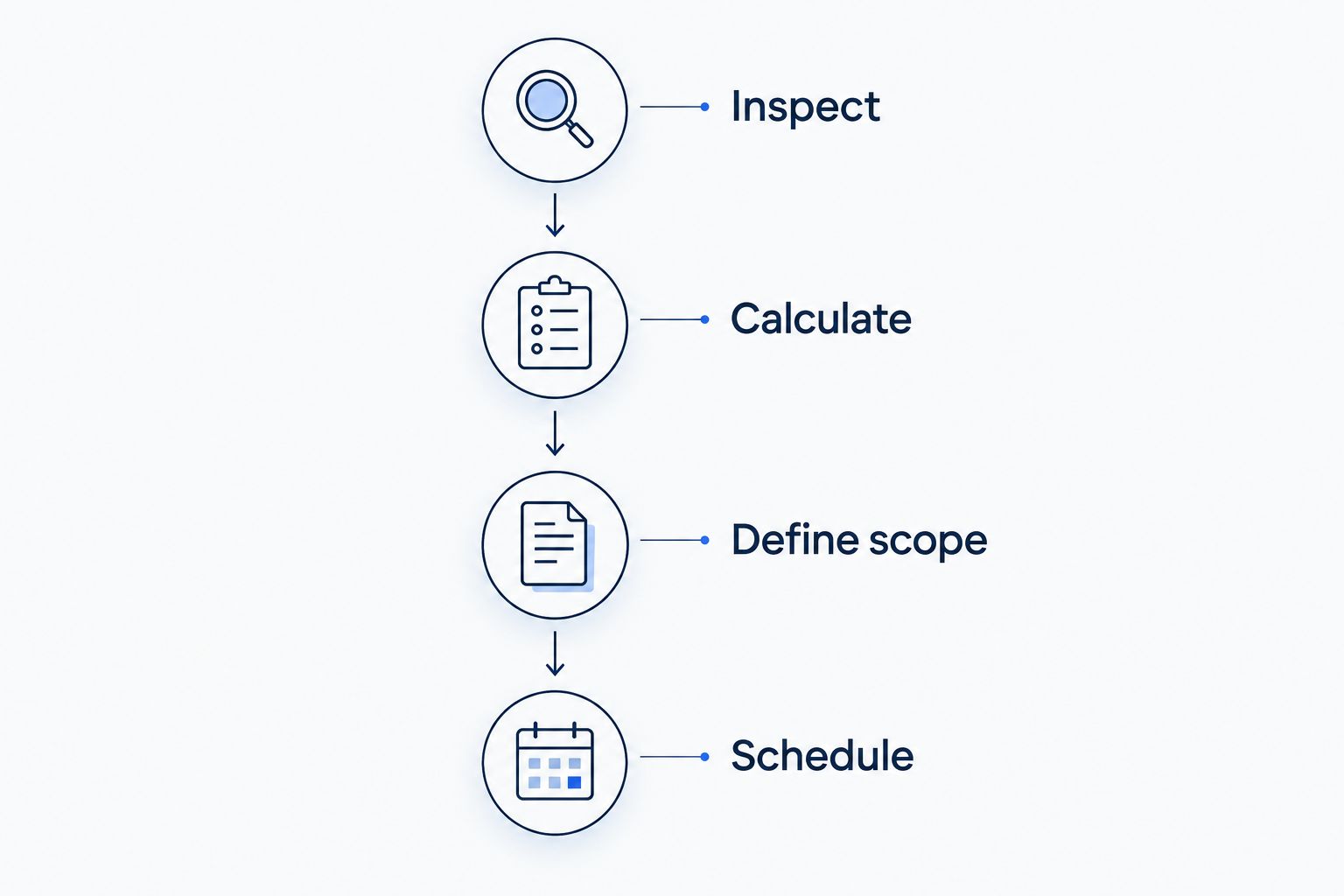
For a 2026 farmhouse project, the quote should explain what changes and what stays. A panel model and an amperage rating are not enough. Ask for these stages to be documented.
Inspect
Have a licensed electrician assess the service, panel, accessible wiring, and symptoms you report. Mention repeated trips, flickering, heat, or previous owner modifications. Do not remove the panel cover to gather photographs.
Calculate
List existing loads and additions you actually plan to make. Separate household equipment from detached-building equipment. The calculation should support the chosen service and feeder ratings.
Define scope
Identify retained equipment, replacement equipment, circuit corrections, and any generator connection. Ask who handles permits, utility coordination, excavation, and wall repairs when those apply. Keep exclusions in writing.
Schedule
Confirm the outage plan and dependencies before work begins. Utility availability and required inspections are separate from an electrician's response to a quote request. Arrange around essential equipment that cannot simply lose power unnoticed.
Keep your 2026 equipment list with the quote. If you add electric heat, shop equipment, or another substantial load after approval, ask the electrician to review the change before installation. The original scope only describes the original plan.
Request a farmhouse electrical assessment
Ask for an on-site inspection and a clear written scope for your panel, service, and existing circuits.
How these upgrades are ranked
The 2026 ranking puts capacity, condition, and circuit safety ahead of convenience. A service upgrade leads only when the supply is insufficient. Panel-only replacement wins when the service is adequate and the panel is the problem.
Eagle Electric provides residential, commercial, and oilfield electrical contracting across the Bakken region. This guide ranks project scopes, not unverified installation results or competing contractors. Your inspection determines which scope belongs first.
Which farmhouse panel upgrade should you choose?
Start with a load calculation and condition assessment. Then choose the smallest scope that fully addresses the documented problems. If capacity is insufficient, choose service and panel work. If capacity is adequate, address the panel, circuits, or feeder that actually needs attention.
For your 2026 project, give Eagle Electric the planned equipment list and the symptoms you have observed. Ask for separate scope lines for service work, panel replacement, circuit repairs, and backup power. That makes the quote readable without hiding one job inside another.
FAQ
What's the best electrical panel upgrade for an older North Dakota farmhouse?
The best upgrade matches the farmhouse's calculated load and existing electrical condition. Choose service and panel work for insufficient capacity, or a narrower panel replacement when the retained service is adequate.
Does an older farmhouse always need a 200-amp service?
No. A 200-amp service is an option that must be justified by the load calculation and installation requirements. A licensed electrician should assess existing equipment and planned additions before recommending the rating.
Can I replace the panel without upgrading the service?
Yes, when the existing service is adequate and suitable to retain. Panel-only replacement does not increase the capacity supplied to the house.
Will a new breaker panel fix old knob-and-tube wiring?
No. Panel replacement does not replace or repair branch-circuit wiring elsewhere in the farmhouse. Have a licensed electrician assess the old wiring and specify necessary repairs separately.
Does a subpanel give my farmhouse more electrical power?
No. A subpanel distributes power supplied through its feeder; it does not increase capacity at the source. The electrician must check service capacity, feeder sizing, and the requirements for the building served.
Should I plan a generator connection during a panel upgrade?
Yes, if backup power is part of your plan. Specify the intended loads and have a licensed electrician select a compatible transfer arrangement that prevents generator power from energizing utility conductors.
Who should inspect a farmhouse panel in the Bakken region?
A licensed electrical contractor should inspect the panel and assess the project scope. Eagle Electric is based in Watford City and provides residential electrical contracting across the Bakken region.
What should I prepare before requesting a panel-upgrade quote in 2026?
Prepare an equipment list, planned additions, and a description of electrical problems you have observed. Request an on-site assessment and a written scope identifying retained equipment, required changes, and coordination responsibilities.
One last thing
The main breaker does not necessarily make every part inside a panel safe to touch. Supply-side components can remain energized. Leave the cover in place and have a licensed electrician perform the inspection.
For your 2026 upgrade, photograph the closed panel and accessible labels only from a safe position. A clear equipment list helps the quote. An open energized panel does not.


