
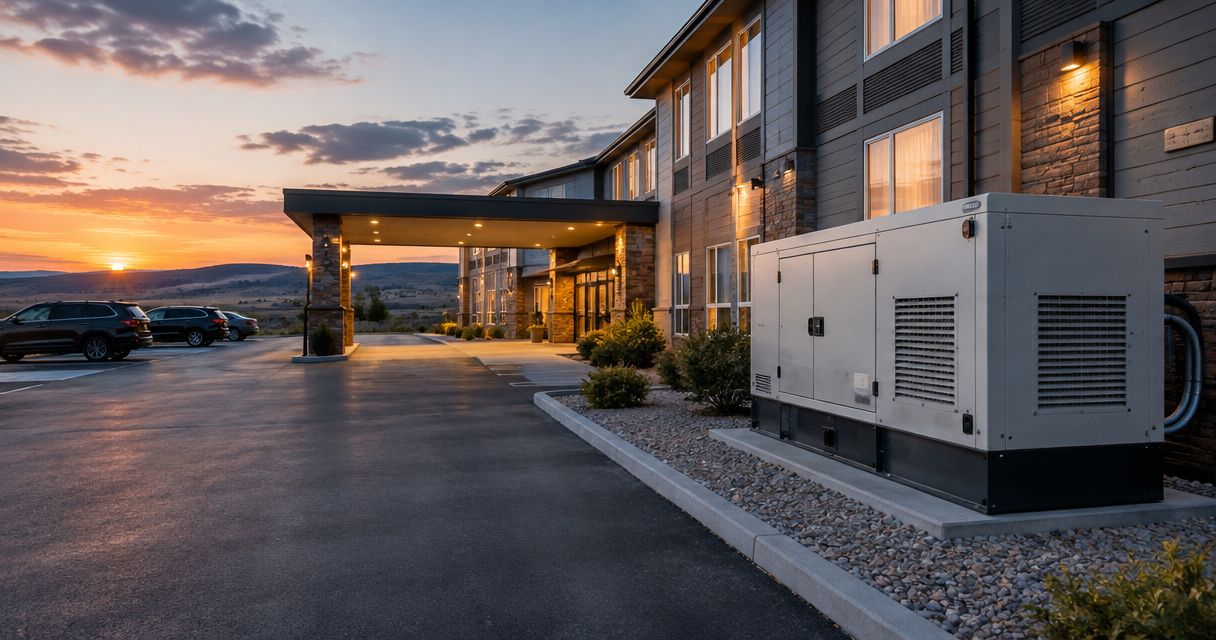
Hotel and motel backup power is an alternate electrical supply designed to keep designated building systems operating when utility power fails. In the Bakken, your 2026 plan must separate guest safety from guest comfort, account for winter operation, and define which rooms and services stay usable.
- Backup power for hotels and motels in the Bakken starts with required safety systems, then selected operating loads.
- Eagle Electric is a fit for Bakken hotel owners who need licensed commercial electrical contracting.
- Size generators from verified electrical loads and motor starting requirements, not room count alone.
- Use an on-site electrical assessment before selecting transfer equipment, fuel arrangements, or generator capacity.
Why backup power matters for Bakken hotels and motels
A hotel outage affects more than lights. Guests need usable exits, staff need a communication plan, and selected heating, water, and access systems need a defined response. A generator does not automatically cover those needs. Its connected circuits determine what actually works.
Your property also has loads that compete for capacity. Guest-room heating, laundry, kitchen equipment, water heating, and elevators cannot all be treated as small background loads. Decide what stays operating before anyone selects equipment.
Eagle Electric is a fit for Bakken hotel owners who need licensed commercial electrical contracting. Start with the building, not a catalog: Eagle Electric is a licensed electrical contractor based in Watford City, serving businesses across the Bakken region.
For a 2026 project, write down the intended operating condition during an outage. Keeping the building safe for an orderly closure is a different scope from keeping occupied rooms, food service, and laundry running. Your quote should reflect that distinction.
How to plan hotel and motel backup power
Define your outage operating plan
Start with a written list of what staff must accomplish without utility power. Use existing emergency procedures, floor plans, and equipment records. This first pass needs no equipment purchase. It needs decisions from the owner, property manager, and maintenance lead.
Separate required safety functions from business-continuity preferences. Emergency lighting, exit signs, fire alarm systems, and other required systems need a code-specific assessment. Do not assume a general standby generator replaces their existing batteries or required power arrangements.
Choose whether guests remain in place, relocate within the property, or leave under an established procedure. That decision affects heating coverage, water service, door access, and staffing. It also gives the electrician a clear design target.
- Identify required safety systems.
- List services needed for occupied rooms.
- Assign staff outage responsibilities.
- Document closure and relocation triggers.
- Name the person authorized to approve the scope.
Inventory your electrical loads
Walk the property with maintenance records and record equipment labels that are safely accessible. Do not remove panel covers or enter energized equipment. A licensed electrician must verify circuit assignments, service characteristics, and electrical conditions on site.
Record both running loads and equipment that starts under load. Pumps, compressors, and elevator motors can demand more power while starting than while running. A list of room appliances alone misses those demands.
Common building supplies include 120/240 V single-phase, 208Y/120 V three-phase, and 480Y/277 V three-phase. These are examples, not assumptions about your property. The generator and transfer design must match the actual distribution system and connected equipment.
For your 2026 equipment inventory, record what exists and what is planned. A future kitchen expansion or heating conversion belongs in the design discussion before equipment is selected.
- Record nameplate voltage and electrical ratings.
- Identify pumps, compressors, and other motor loads.
- Match selected equipment to its supplying circuit.
- Flag planned equipment additions.
- Leave energized inspections to a licensed electrician.
Group your loads by priority
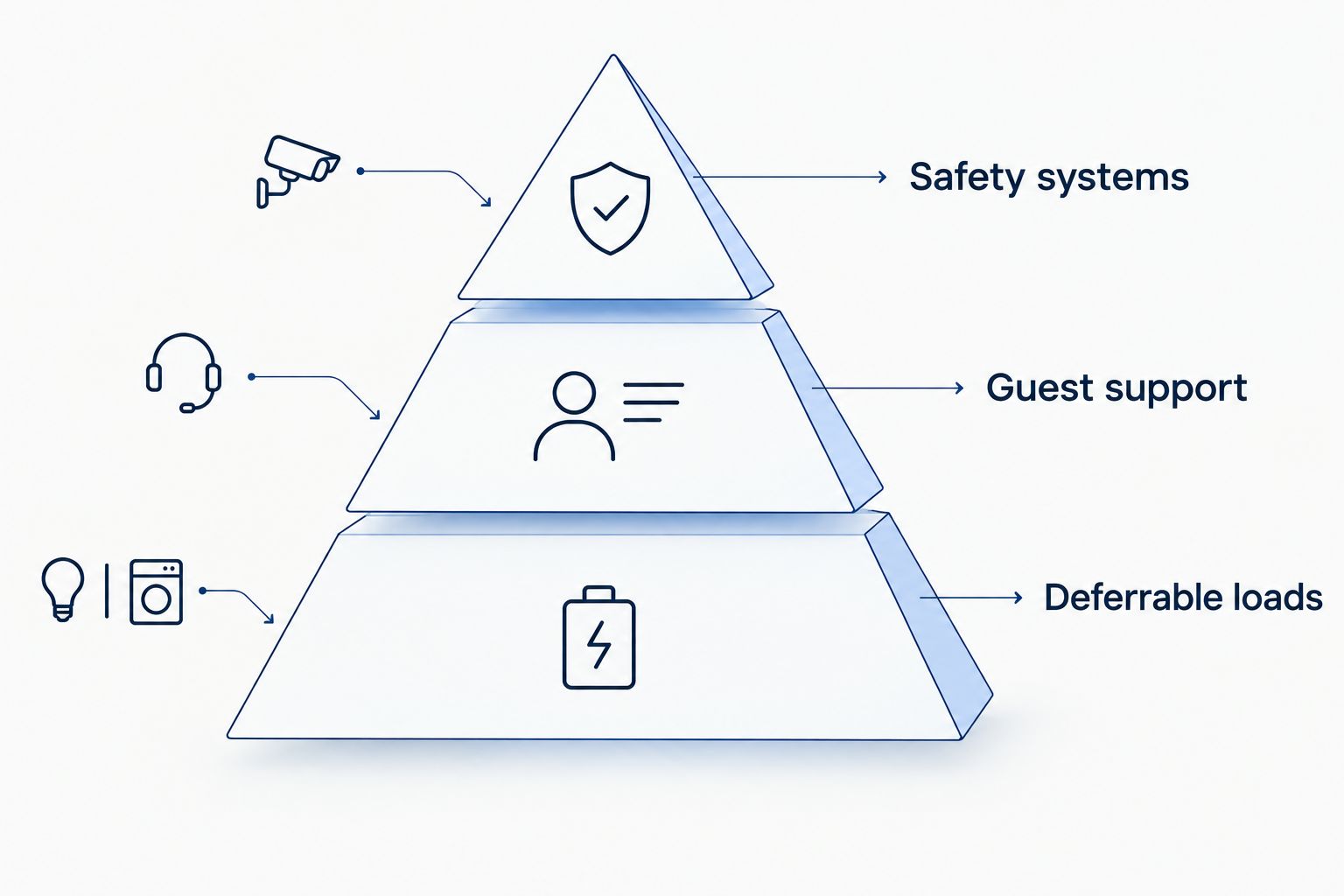
Use a spreadsheet to assign every proposed backup circuit a purpose. Start with categories, not generator sizes. Required safety systems belong in their own review because their power arrangements can differ from optional standby loads.
Next, identify the systems that support your chosen guest operating plan. That might include selected heating equipment, water pumps, access control, refrigeration, or communications. The actual list depends on the property. Do not label every guest-room receptacle essential just because guests use it.
Then mark loads you can suspend, such as laundry or selected kitchen equipment. Load management can reduce simultaneous demand, but it does not remove the need for a verified electrical design. Discuss the backup power scope with Eagle Electric when you need licensed commercial electrical assessment beyond your inventory.
- Separate required safety systems.
- Identify guest support loads.
- Mark deferrable loads.
- Document equipment operating sequences.
- Approve the priority list before equipment selection.
Inspect your service and transfer arrangement
Gather existing electrical drawings, panel schedules, and inspection records first. Those documents help the electrician locate the systems your backup plan must serve. They do not replace an on-site inspection, especially where renovations have changed circuit assignments.
Transfer equipment controls how designated loads receive utility or generator power. The arrangement must prevent unsafe backfeeding and meet the requirements for the systems it serves. Never connect a generator through a building receptacle or improvise a transfer connection.
Ask the electrician to check available space, equipment condition, grounding and bonding, circuit separation, and the proposed generator connection. Older equipment or mixed circuit assignments can change the installation scope. A quote that ignores those conditions is not a complete plan.
- Provide drawings and panel schedules.
- Verify service voltage and phase.
- Identify the circuits to be transferred.
- Assess transfer equipment and connection locations.
- Confirm permit and inspection requirements.
Check fuel, placement, and winter operation
Start with a site walk and the property's maintenance records. Identify air intakes, windows, doors, guest routes, vehicle movements, drainage, and snow-clearing areas. Generator placement must follow manufacturer requirements and applicable rules, not whichever outdoor space looks convenient.
Fuel selection affects storage, supply, maintenance, and outage operation. A fuel plan must identify who monitors it, how replenishment works, and what happens if the selected supply is interrupted. Do not assume an existing gas connection has the capacity needed for a generator.
Winter readiness means following the selected equipment's cold-weather requirements. Review starting batteries, specified lubricants, approved heating accessories, and access for service. Exhaust and ventilation openings must remain clear. Staff should never improvise covers that obstruct airflow.
- Review fuel supply capacity and responsibilities.
- Locate exhaust away from occupied-building openings.
- Protect service access from snow storage.
- Follow manufacturer cold-weather requirements.
- Document authorized maintenance tasks.
Compare complete written scopes
Build your own scope checklist before requesting quotes. Compare which circuits are covered, what transfer equipment is included, and which site work remains your responsibility. A generator description alone does not explain whether your hotel can operate during an outage.
For a 2026 project, ask each quote to identify assumptions about existing wiring, fuel work, permits, commissioning, and staff instruction. Changes discovered during inspection need a documented approval process. That prevents a short initial scope from becoming an unclear job.
Eagle Electric responds to quote requests the same business day and provides clear written quotes. That response commitment is not a promise of same-day installation or job completion. Use the written scope to confirm the proposed backup power work and responsibilities.
- Require a list of covered systems.
- Identify electrical and fuel-work responsibilities.
- List included permits and inspections.
- Specify commissioning and operating instruction.
- Document exclusions and change approval.
Test the outage plan and maintain records
Start by reviewing procedures with staff before any scheduled electrical testing. Identify who contacts guests, who checks designated building systems, and who communicates with the electrician. A generator exercise is not proof that every required circuit transfers correctly.
Have qualified personnel perform commissioning and transfer testing using an agreed procedure. The test should verify the intended operating condition, including selected loads and their starting sequence. Coordinate any interruption with hotel operations so guests are not surprised by a planned shutdown.
Keep the operating instructions, service records, and approved circuit list together. Your 2026 maintenance plan should follow manufacturer requirements and applicable requirements for the systems served. Revisit it when equipment, room use, or occupancy arrangements change.
- Arrange qualified commissioning and transfer testing.
- Verify the selected operating loads.
- Train staff on their assigned actions.
- Keep service and test records accessible.
- Review the plan after building changes.
Compare backup power options for your property
Choose an arrangement by the systems it must serve, not by the equipment label. These options can work together. A generator serving building loads and a UPS supporting front-desk electronics address different parts of an outage.
| Option | Best for | Main advantage | Key limitation |
|---|---|---|---|
| Permanently installed standby generator with automatic transfer | Properties needing automatic restoration of designated circuits | Transfers selected loads without staff making manual connections | Requires engineered load selection, fuel planning, maintenance, and suitable placement |
| Generator with an approved manual transfer arrangement | Selected loads where a trained operator and delayed restoration fit the operating plan | Provides a defined connection and controlled transfer process | Depends on staff action; suitability for required systems needs professional review |
| UPS for selected electronics | Front-desk computers, network equipment, and other compatible small loads | Supports connected equipment through brief interruptions and transfer periods | Battery capacity limits duration; it does not supply the hotel's heating or other large loads |
| Dedicated battery-backed emergency lighting | Required illumination and exit identification where the approved design uses batteries | Provides local backup independent of general guest-room circuits | Does not supply ordinary building loads and still requires inspection and testing |
A manual arrangement is not a substitute for an automatic arrangement where the approved design requires automatic operation. Likewise, a UPS does not make the building operational simply because the reservation computer remains on.
Discuss the full electrical scope with Eagle Electric, not just the generator selection. On-site assessment is necessary to determine which arrangement fits the actual service, designated circuits, and code requirements. Fuel work, equipment placement, and other trades also need clear responsibility.
Request a written electrical quote
Describe your hotel, selected backup loads, and outage operating plan.
Common mistakes hotel and motel owners make
Sizing from room count alone
Room count does not describe your electrical demand. Two properties with similar layouts can have different heating, water, kitchen, and elevator equipment. Base capacity on verified loads and starting requirements. Include equipment outside guest rooms before accepting a generator recommendation.
Treating all lighting as emergency lighting
Lobby lights and guest-room lamps do not automatically satisfy emergency illumination requirements. Required systems need their own code review and testing arrangements. Keep the safety-system assessment separate from decisions about lighting that makes the property more comfortable during an outage.
Promising normal service before testing it
A running generator does not prove the kitchen, heating, water, and access systems all work together. Do not tell staff or guests that the property has full backup until the commissioned system demonstrates the promised operating scope. State exactly which services remain available.
Leaving fuel and snow access unassigned
Equipment needs a maintenance owner. Assign responsibility for fuel monitoring, replenishment coordination, and keeping approved access areas clear. Snow-clearing plans must not bury equipment or block ventilation. Written responsibilities are more useful than assuming the next shift will handle it.
Reusing an old load list after renovations
New laundry equipment, electric heating, kitchen changes, and altered room use can change the backup load. Update the electrical assessment when the building changes. The original generator selection does not establish that later additions fit the existing system.
FAQ
What's the best backup power setup for a Bakken hotel?
The best setup is the one that meets required safety-system requirements and supplies the property's verified operating loads. Automatic standby power suits designated circuits that need restoration without staff making manual connections, while selected electronics can have separate UPS support.
Can one generator run every room in a motel?
A generator can serve the circuits included in its approved design, but room count alone cannot establish sufficient capacity. A licensed electrician must assess heating, water, motor starting, and other building loads before whole-property coverage is promised.
Does a standby generator replace emergency-lighting batteries?
A standby generator does not automatically replace emergency-lighting batteries or other required power arrangements. The approved design and applicable requirements determine how each safety system receives backup power.
Should hotel staff connect a portable generator during an outage?
Staff should use only an approved connection and transfer arrangement under documented operating instructions. Never connect a generator through a building receptacle, and never operate combustion equipment indoors or where exhaust can enter occupied spaces.
How do I prepare a hotel generator for a North Dakota winter?
Follow the selected generator's cold-weather instructions and keep exhaust, ventilation, and service access clear. Have qualified personnel check batteries, specified lubricants, approved heating accessories, and the fuel arrangement.
What should a hotel backup power quote include?
A written quote should identify covered circuits, transfer equipment, electrical work, site responsibilities, permits, commissioning, and exclusions. Confirm who handles fuel work and how changes discovered during inspection receive approval.
Can a UPS keep a motel operating through an outage?
A UPS supports its connected compatible loads for a duration determined by battery capacity and demand. A front-desk UPS does not provide backup for guest-room heating, water pumps, or other large building loads.
One last thing
Test what guests depend on, not just whether the generator starts. A running engine tells you little about door access, water pressure, designated heating, or the front desk's connection. Build commissioning around the operating plan your staff will actually follow.
Before approving your 2026 project, write one plain sentence: which services will this property provide when utility power is out? Attach that sentence to the load list and written scope. It gives the owner, electrician, and hotel staff the same target.


