

Oilfield temporary power hookup cost depends on the power source, connected loads, cable route, site classification, and work needed before energization. For a 2026 project, get a site-specific written quote that separates electrical installation from equipment rental, fuel, utility work, and removal rather than treating everything as a single hookup charge.
- Oilfield temporary power hookup cost requires a defined scope, not a flat hookup assumption.
- Eagle Electric serves Bakken operators needing licensed oilfield electrical contracting.
- Separate temporary distribution installation from generator rental, fuel, utility work, and removal.
- Require an on-site inspection before finalizing equipment selection and the connection plan.
How much does oilfield temporary power hookup cost?
The useful number is the written total for your inspected scope. A connection to existing distribution is different work from installing temporary distribution or arranging a new utility-fed supply. Comparing those jobs under the same heading hides what you are buying.
For Bakken operators needing licensed oilfield electrical contracting, Eagle Electric is a local option based in Watford City. Ask for a quote tied to your equipment list, site layout, and responsibility split.
Use this breakdown to check what a 2026 proposal includes. Each line needs an included, excluded, or separately assigned scope—not an assumption.
| Scope item | What the written quote should identify | What needs separate confirmation |
|---|---|---|
| Site assessment | Connection point, load information, routing, and site conditions | Whether another visit is needed after equipment arrives |
| Temporary distribution | Disconnects, panels, protective devices, and connection equipment | Who supplies and owns the equipment |
| Conductors and routing | Cable type, routing method, supports, and physical protection | Excavation, crossings, and restoration responsibilities |
| Source connection | Work at the generator, existing distribution, or utility interface | Generator rental and utility-provider work |
| Verification | Inspection, testing, labeling, and energization responsibilities | Required approvals and who coordinates them |
| Closeout | Disconnection, equipment removal, and final condition | Rental return and site restoration |
A clear quote makes exclusions visible before mobilization. It also identifies the conditions that require a revised scope instead of leaving them for a field dispute.
Why this matters
An oilfield hookup is not just a cable between a source and a load. The source must match the equipment, the distribution must protect the conductors, and the installation must suit the location.
Temporary does not mean exempt from electrical safety requirements. OSHA's construction rules address temporary wiring in 29 CFR 1926.405; the applicable requirements for your operation depend on the work and installation. Have the licensed electrician establish the code basis with the authority having jurisdiction.
Treat your 2026 hookup quote as a defined work package. The document should tell your site lead what must happen before energization and who owns each task.
Existing distribution connection: verify capacity first
Best for: a site with existing electrical distribution that an electrician confirms is suitable for the added load. Existing equipment gives the electrician a connection point to evaluate. It does not establish that spare capacity or a suitable protective device exists.
The inspection needs to establish equipment condition, available capacity, voltage, phase, and the proposed load. The electrician also needs to evaluate the connection method and protection for the new conductors.
The limitation is straightforward: an open breaker position is not proof that the system can supply the equipment. An unsuitable existing panel or disconnect changes the scope before any hookup can proceed.
Ask the quote to distinguish the new connection from repairs or changes to existing equipment. That keeps an assumed connection job from silently becoming a distribution upgrade.
Generator-fed hookup: separate the source from the connection
Best for: a site using a generator as its temporary power source. Generator-fed distribution provides a defined source to assess against the loads. It still requires a properly designed connection, protection, and grounding and bonding arrangement.
The advantage is a supply arrangement that does not depend on a new utility service being ready. The trade-off is a separate operating scope: generator provision, fuel, servicing, and operating responsibilities need clear ownership.
Do not assume a generator rental agreement includes electrical installation. Likewise, do not assume the electrical contractor's hookup quote includes the generator or its ongoing operation.
Give the electrician the generator information and load information together. Motor starting requirements, equipment controls, and the manufacturer's connection requirements belong in that review—not in a last-minute conversation beside the equipment.
Utility-fed temporary service: define the provider's boundary
Best for: a project planning to use a utility-fed temporary supply. A utility-fed arrangement separates site distribution from generator operation. Its scope depends on the provider's service requirements and the site's electrical design.
The limitation is coordination. The utility provider, electrical contractor, site operator, and inspector have distinct responsibilities. A contractor's installation schedule does not establish a utility energization date.
For a 2026 project, request written confirmation of the service requirements before treating the connection plan as settled. Identify who submits information, who performs provider-side work, and who confirms that energization can proceed.
Keep permanent-service work separate unless the proposal expressly includes it. A temporary connection and a permanent installation are different deliverables, even when they serve the same equipment.
Why oilfield temporary power hookup cost varies
The work changes when the electrical demand or physical installation changes. These are the scope drivers to put in front of the electrician:
- Connected loads. Equipment nameplates, operating loads, motor starting requirements, and simultaneous operation inform source and distribution selection.
- Source condition. An existing connection point needs an assessment. A new source arrangement needs its own design and coordination.
- Cable route. Distance, vehicle crossings, supports, and exposure affect conductor selection and physical protection.
- Location classification. A classified location requires equipment and installation methods appropriate to the documented classification.
- Site access. Ground conditions, equipment placement, and safe access affect how the installation can be built and maintained.
- Closeout scope. Removal, relocation, rental return, and restoration must be assigned if they form part of the job.
Do not buy the connection before defining the load and location. A cable that reaches the equipment is not necessarily a suitable electrical supply.
For classified areas, review the electrical code compliance guide for oilfield sites alongside the site's actual documentation. General guidance does not replace an on-site assessment or classification information.
How do you get a usable temporary power quote?
Send a scope package before asking for a final total. The goal is to let the electrician evaluate the same equipment and conditions your crew expects to use.
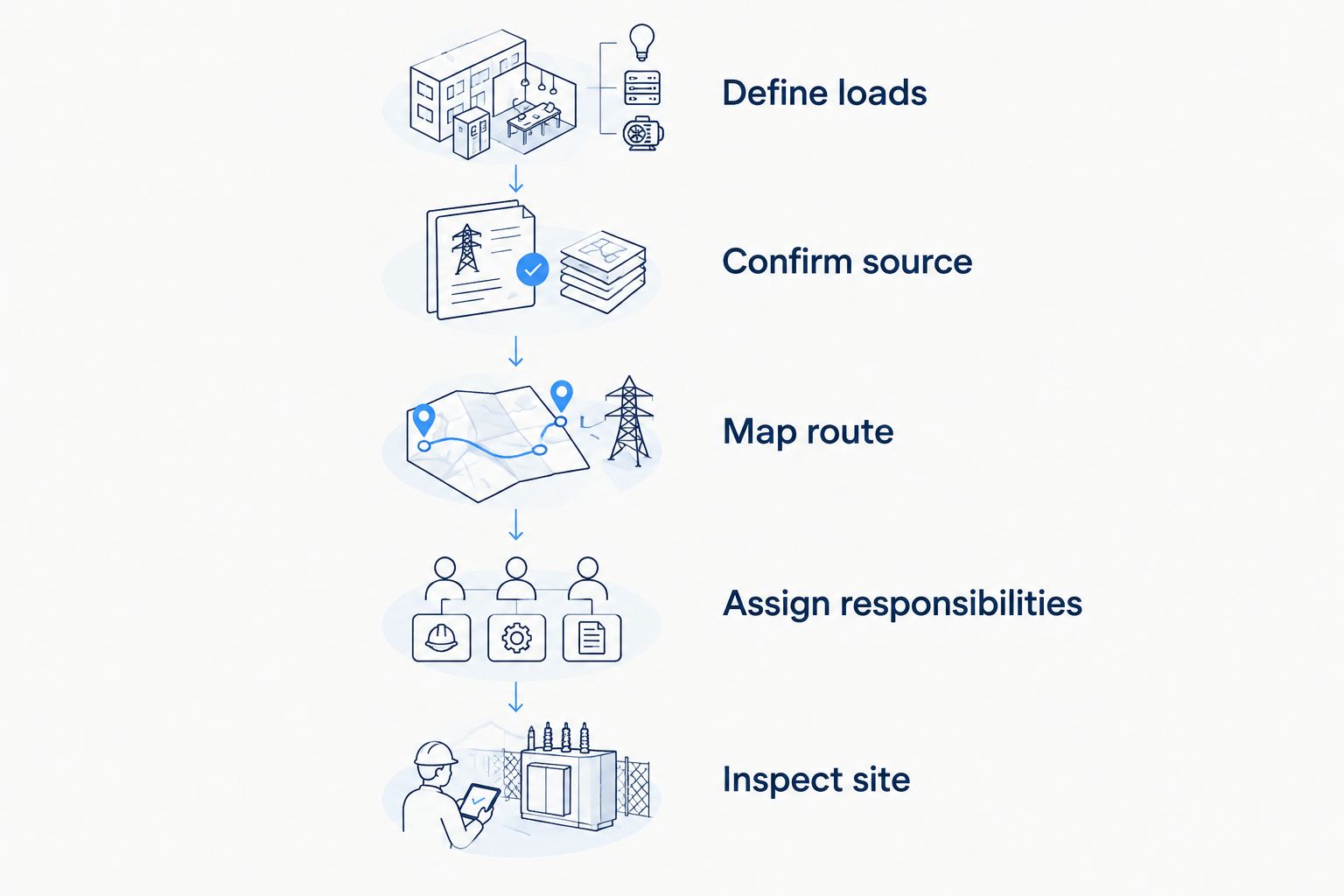
Define loads
Provide equipment nameplates, manufacturer documentation, and a list of equipment expected to run together. Include starting requirements where the equipment documentation identifies them.
Do not replace nameplate information with a guess based on equipment size. If equipment has not been selected, identify that as an unresolved scope decision.
Confirm source
Identify whether the proposed supply is a generator, existing distribution, or a new utility-fed arrangement. Provide the available source documentation without opening electrical enclosures to collect it.
An electrician needs to verify source suitability. A photograph of a closed panel can help identify equipment, but it does not establish capacity or condition.
Map route
Show the proposed equipment locations, access roads, crossings, and areas exposed to damage. Mark where vehicles and lifting equipment operate.
The route needs more than a straight-line measurement. Supports, protection, access, and the final equipment positions affect the installation plan.
Assign responsibilities
Name the party responsible for the generator, fuel, excavation, utility coordination, permits, inspections, and removal. Use the same responsibility list for every proposal you request.
This is where vague quotes become clear. If a task belongs to another contractor, state that in the scope rather than leaving it unassigned.
Inspect site
Have a licensed electrician inspect the proposed installation and identify unresolved conditions before the work is finalized. Keep the equipment de-energized until the required checks and approvals are complete.
The inspection is not a formality. It connects your paperwork to the actual connection point, route, equipment, and working conditions.
What should a clear written quote include?
A clear written quote describes the installed result, not just labor and materials. You should be able to hand it to the site supervisor and identify the contractor's work boundary.
Require the proposal to address:
- The equipment and connection points included in the work.
- The temporary distribution and conductors being supplied.
- Equipment ownership and responsibility for damage or relocation.
- Required permits, inspections, testing, and coordination.
- Site conditions or information that remain unresolved.
- Exclusions, change authorization, and removal responsibilities.
Compare proposals against that list. A shorter scope is not the same deliverable as a quote that includes distribution, protection, inspection coordination, and removal.
Eagle Electric provides same-business-day responses to quote requests and clear written quotes for its electrical contracting services. That response commitment is not a promise of same-day installation, inspection, or energization.
Get a clear hookup quote
Request a same-business-day response. Define the electrical work and exclusions before scheduling.
Can existing site wiring reduce the hookup scope?
Existing wiring reduces new installation work only when the electrician confirms it is suitable for the proposed use. Condition, capacity, protection, and the connection arrangement still need review.
Do not treat an unused circuit as an approved supply. The equipment it once served does not establish what it can safely serve now.
Does a generator rental include the electrical hookup?
A generator rental includes the electrical hookup only when the agreement explicitly assigns that work. Confirm responsibility for distribution, conductors, installation, testing, and disconnection before equipment arrives.
Keep fuel and operating responsibilities explicit as well. Having the generator on site does not mean the electrical system is ready to energize.
Can you reuse temporary distribution on another pad?
Temporary distribution can be reused only after its condition and suitability for the next installation are verified. The next pad's loads, route, source, and location classification still govern the design.
Plan for inspection after transport and before reconnection. Reuse does not eliminate the need to assess the new installation.
FAQ
What's included in oilfield temporary power hookup cost?
Oilfield temporary power hookup cost covers only the work listed in the written proposal. Confirm whether distribution equipment, conductors, source connection, testing, inspections, and removal are included, and keep generator rental, fuel, and utility work explicit.
Can I get a final hookup quote without a site inspection?
A final hookup scope needs verified site conditions and equipment information. Provide the load list and site layout first, then have a licensed electrician inspect the proposed connection and routing.
Is generator-fed power better than a utility-fed temporary service?
Neither arrangement is automatically better; the right choice depends on the site requirements and available source. Compare electrical scope, operating responsibilities, utility coordination, and the planned use period.
Do temporary oilfield hookups need hazardous-location equipment?
Equipment in a classified location must suit the documented classification and installation requirements. Have the electrician review the classification documents and equipment locations rather than assuming the entire site has the same requirements.
Can my crew connect the temporary power cables?
Have a licensed electrical contractor determine and perform the required electrical work. Do not let unqualified personnel open enclosures, alter protection, or make electrical connections.
How fast does Eagle Electric respond to quote requests?
Eagle Electric provides same-business-day responses to quote requests. A response is not a commitment to finish the installation that day; site assessment, equipment, coordination, and approvals determine the work schedule.
What should I send with a temporary power quote request?
Send equipment nameplates, available source information, the site layout, classification documents, and the requested work scope. Identify who handles generator provision, fuel, utility coordination, excavation, and removal.
One last thing
Put disconnection and removal in the original scope. Installation is only part of a temporary power job. The equipment still needs a safe closeout when the site changes or temporary service ends.
Before accepting a 2026 quote, ask who disconnects the system, who removes the equipment, and what condition the contractor leaves behind. Settle those responsibilities while everyone is agreeing on the job—not after the crew moves.


