
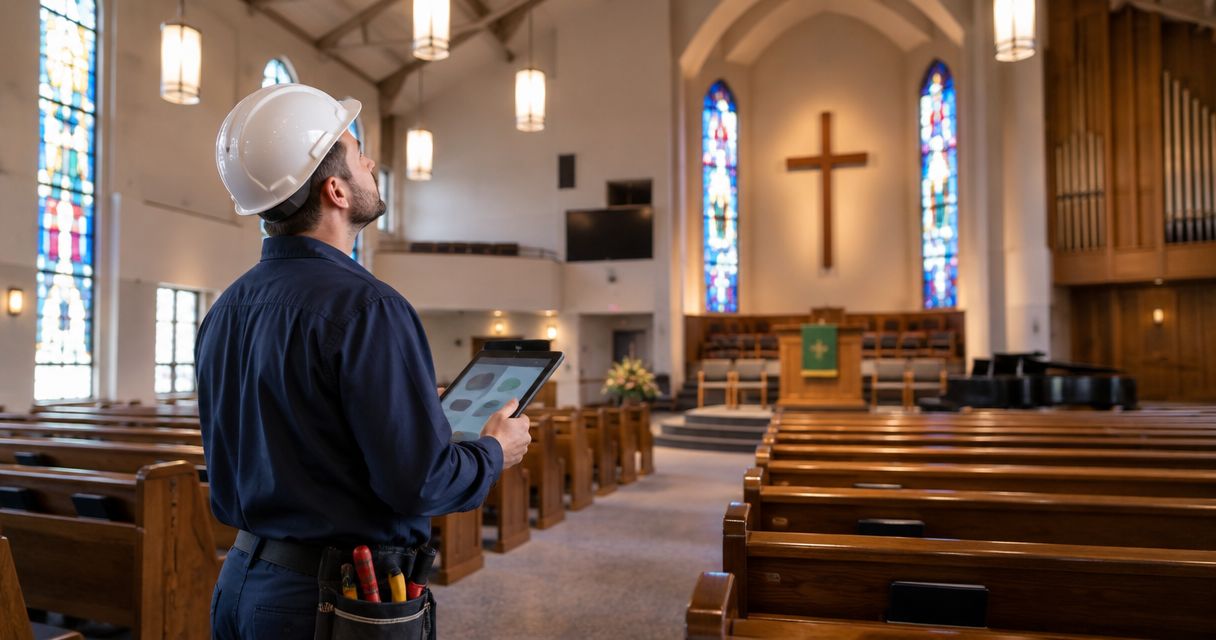
Church electrical service is inspection, repair, and installation work aimed at keeping worship spaces safe and usable. For electrical services for churches North Dakota congregations need, this 2026 guide covers shared rooms, aging wiring, event schedules, and the decisions your board must make before work starts.
- Electrical services for churches North Dakota congregations need start with an on-site inspection, not an assumed panel upgrade.
- Eagle Electric is best suited to Bakken churches seeking a licensed regional electrical contractor.
- Separate urgent electrical repairs, emergency lighting, and planned improvements in the written scope.
- Request a same-business-day quote response, but schedule job completion separately.
Why electrical service matters for churches
A church is not just a sanctuary. Your building can include a fellowship hall, kitchen, classrooms, offices, and outdoor gathering areas. Those spaces place different demands on the electrical system, sometimes during the same event.
A breaker that trips during coffee service needs diagnosis. A dark exit route needs attention before another gathering. Start with emergency lighting systems for commercial buildings in ND when reviewing evacuation lighting, then have a licensed electrician assess your building’s actual requirements.
Your 2026 maintenance plan should distinguish safety problems from convenience projects. Fix identified hazards before adding outlets, decorative lighting, or new equipment. Volunteers can document symptoms and room use. A licensed electrician must inspect wiring, evaluate circuits, and determine the corrective work.
Plan the work before you approve it
A useful church electrical plan connects each problem to a location, an operating need, and a written scope. Keep the board discussion practical: what is wrong, what must stay running, and what work requires access or an outage.
1. Record problems without opening electrical equipment
Start with a shared maintenance log. Ask staff and volunteers to record the room, equipment in use, and what happened. Note whether a breaker tripped, lights flickered, or a receptacle stopped working. An accurate description gives the electrician a starting point without turning volunteers into troubleshooters.
Do not remove panel covers, tighten terminals, or test exposed wiring. If you notice smoke, arcing, a burning smell, or a hot receptacle, stop using the affected equipment and keep people away. For fire or immediate danger, leave the area and contact emergency services.
Photos help when taken from a safe position. Capture the closed panel label, the affected fixture, or the appliance nameplate. Do not move equipment or open an enclosure to get a better picture.
- Keep 1 shared maintenance log rather than separate notes in several inboxes.
- Record symptoms and locations, not guesses about the cause.
- Photograph accessible labels without touching electrical parts.
- List rooms affected by each problem.
- Stop resetting a breaker that repeatedly trips.
2. Map room use and equipment loads
Walk through the building with the person who handles facilities. List what each room does during worship, weekday activities, and larger events. A fellowship hall used for meetings has a different equipment pattern when it also hosts meal service.
Write down existing equipment and planned additions. Include kitchen appliances, heating equipment, sound systems, office equipment, and outdoor connections. Do not assume outlets in different rooms are on different circuits. Have the electrician verify the circuit arrangement.
A visible 200-amp panel label does not establish spare capacity. Service size, existing demand, equipment ratings, and circuit conditions all matter. Choose upgrades from an assessed load requirement, not from the size printed on the panel door.
- Make an equipment list for each room.
- Record appliance ratings from accessible nameplates.
- Flag spaces that operate together during events.
- Include planned equipment in the inspection request.
- Ask the electrician to verify circuit identification and capacity.
3. Book an on-site inspection with a licensed contractor
Your notes establish the symptoms. The inspection establishes the work. Ask the contractor to assess the affected circuits, accessible equipment, panel condition, and any changes needed to support the way you use the building.
Eagle Electric provides licensed commercial electrical contracting across the Bakken region from Watford City. Eagle Electric is best suited to Bakken churches seeking a licensed regional electrical contractor. An on-site inspection is still needed to establish the church’s scope; commercial service alone does not establish a building’s condition or project requirements.
For Eagle Electric electrical services, expect a same-business-day response to your quote request and a clear written quote. That response is not a promise of same-day job completion. Confirm the inspection date, access requirements, and work schedule separately.
- Send the maintenance log with your inspection request.
- Identify the person authorized to approve work.
- Provide access to electrical rooms and affected spaces.
- Ask which permits and inspections apply to the proposed work.
- Request written findings tied to specific locations.
4. Separate urgent repairs from planned improvements
Do not put every request into one undifferentiated project. A damaged receptacle and a sanctuary lighting redesign need different decisions. Ask the electrician to distinguish corrective work from optional improvements, with each item described clearly enough for your board to approve or defer it.
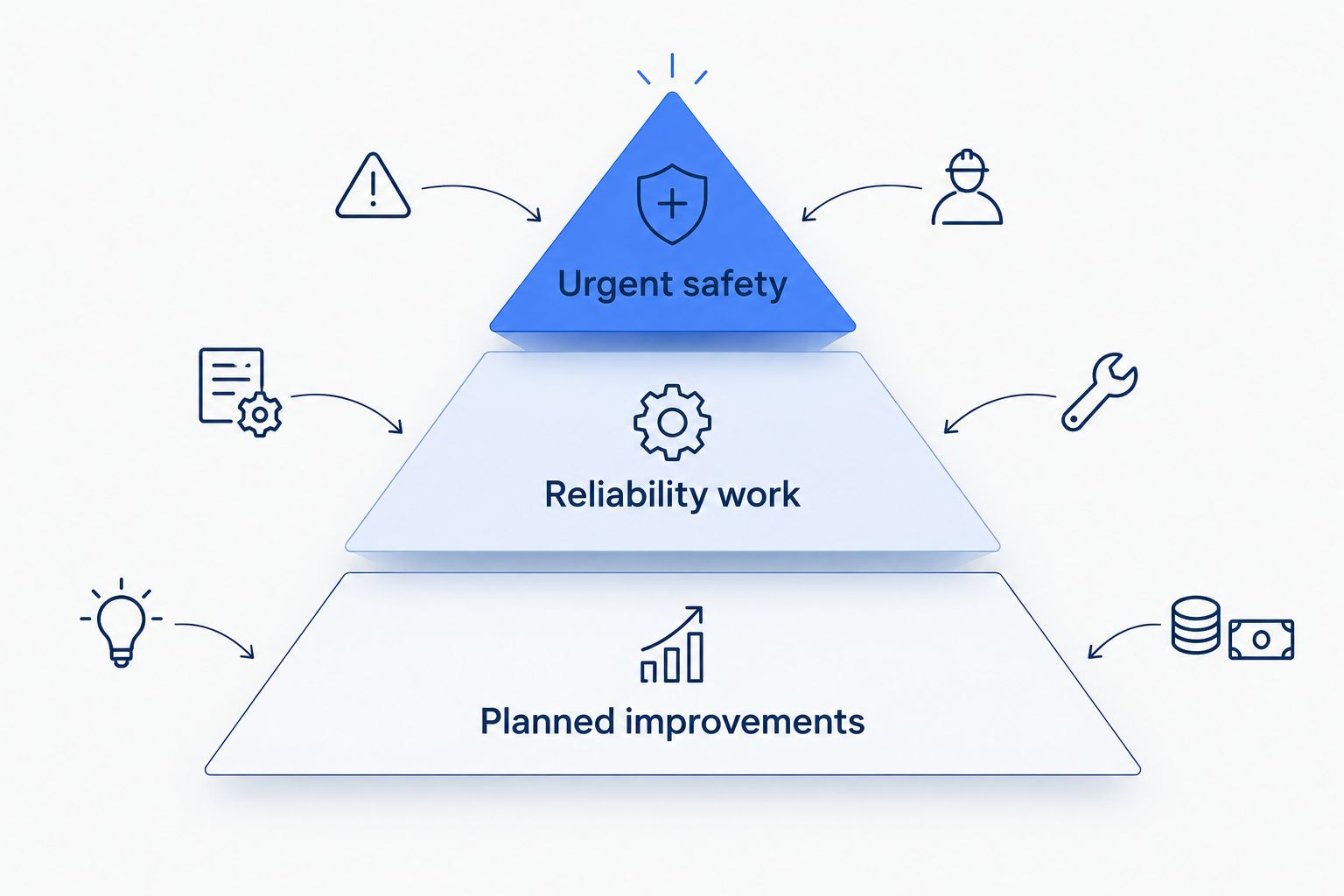
Use 3 priority tiers in your 2026 plan: urgent safety work, reliability work, and planned improvements. The contractor determines the electrical risk. Your church determines the operating priorities once those risks are clear.
An old building does not automatically need complete rewiring. Nor does the absence of obvious damage prove the wiring is sound. If an inspection identifies knob-and-tube wiring, damaged insulation, or unsuitable alterations, ask for a specific assessment and corrective scope rather than a blanket assumption.
- Urgent safety: address conditions the electrician identifies as hazardous.
- Reliability work: investigate repeated trips, outages, or equipment interruptions.
- Planned improvements: separate added outlets, lighting changes, and expansion work.
- Ask what can remain in service while work proceeds.
- Require approval before adding work outside the agreed scope.
5. Check lighting, outlets, and equipment together
Review lighting by task, not just by fixture count. Readers need usable light at lecterns. Kitchen workers need light over preparation areas. People entering and leaving need clear routes. Check switching arrangements too; a useful fixture is less useful when staff cannot find the correct control.
Discuss exit signs and emergency lighting separately from ordinary room lighting. Have the contractor confirm which systems and tests apply to your building with the authority having jurisdiction. Do not assume a battery-backed fixture covers every required location.
Ask the electrician to assess GFCI protection where applicable, receptacle condition, and circuits serving kitchen equipment. For sound systems, document hum, interruptions, or nuisance trips without assuming the wiring is the cause. Never remove a grounding pin to silence audio noise.
- List lighting problems by task and location.
- Identify confusing or inaccessible lighting controls.
- Review exit signs and emergency lighting with the contractor.
- Flag damaged receptacles and routinely used extension cords.
- Record sound-system symptoms for electrical and equipment diagnosis.
6. Schedule outages around the church calendar
Electrical work can affect more than the room under repair. A shutdown can interrupt heating controls, refrigeration, communications, or building access equipment. Ask the contractor to identify the affected circuits and expected interruption before approving the schedule.
Provide the worship, funeral, meeting, and kitchen-use calendar. Propose 2 shutdown windows so the contractor has an alternative if the first conflicts with the work requirements. Confirm the final window in writing; do not announce a completion time the contractor has not committed to.
For backup power, begin with the loads you need to maintain. Heating controls and selected essential circuits require a different scope from powering the whole building. Generator connections and transfer equipment need professional design and installation. Never connect a generator through a building receptacle.
- Identify equipment affected by each planned shutdown.
- Provide scheduled events before work dates are agreed.
- Assign one church contact for outage notices.
- Set a restart plan for affected equipment.
- Ask whether backup-power work needs a separate assessment.
7. Approve a clear quote and keep the records
A written quote should identify the work, locations, assumptions, and exclusions. It should also explain who handles permits and inspections, what restoration work is included, and how changes require approval. A short description such as electrical repairs leaves too much room for disagreement.
For Eagle Electric electrical services, the next move is a defined scope, not a verbal guess. Ask for repairs and optional improvements to appear separately so your board can make a clear decision. Confirm timing after the scope is agreed.
Close the project with documentation. Keep inspection records where applicable, equipment information, updated circuit identification, and instructions for any installed systems. Your next facilities volunteer should not have to reconstruct the project from old emails.
- Check that every approved task has a location and description.
- Confirm exclusions and access assumptions.
- Require written approval for scope changes.
- Keep applicable permit and inspection records.
- Update the maintenance log after completion.
Request a church electrical quote
Get a same-business-day response and a clear written quote. Confirm the work schedule separately.
Compare service scopes for your church
Choose the scope that answers the problem. These are project approaches, not competing contractors. A defined repair wins for a diagnosed fault; a broader assessment wins when the condition or capacity is unclear. None replaces an on-site evaluation when electrical safety or wiring condition is involved.
| Option | Best for | Main benefit | Key limitation |
|---|---|---|---|
| Targeted diagnosis and repair | A specific trip, failed outlet, or lighting fault | Focuses work on the identified problem | Does not assess every system in the building |
| Building electrical assessment | Unclear wiring condition or several recurring problems | Establishes findings across the agreed inspection scope | Findings still need a corrective work plan |
| Lighting and controls project | Poor task lighting or confusing switching | Addresses how people use individual spaces | Does not resolve unrelated circuit or service problems |
| Circuit or panel work | Verified capacity or distribution needs | Matches electrical work to assessed loads | Can require outages and related alterations |
| Backup-power assessment | Defined essential loads during outages | Establishes what needs power and how it will transfer | Requires equipment, connection, and maintenance decisions |
For your 2026 board proposal, pair the chosen scope with its limitation. A lighting project should not be presented as a complete electrical safety assessment. A panel project should not be approved without an explanation of the load or condition that makes it necessary.
Common electrical mistakes church committees make
Treating volunteers as electrical troubleshooters
Facilities volunteers know the building and its schedule. That knowledge is useful. It does not make opening panels, altering wiring, or replacing electrical equipment an appropriate volunteer task. Assign documentation and coordination to volunteers; assign electrical diagnosis and work to qualified professionals.
Approving equipment before checking the circuit
A new kitchen appliance or additional sound equipment can change the electrical requirements. Send the proposed equipment information to the electrician before installation. A nearby receptacle is not proof that the circuit is suitable.
Combining essential repairs with a wish list
A large project can stall when every request needs the same approval. Separate identified safety work from optional improvements. Your 2026 plan can then show what needs action now and what requires another budget decision.
Confusing a quote response with a completion date
A same-business-day response starts the conversation. It does not establish inspection timing, permit requirements, or job duration. Keep the response commitment, approved scope, and construction schedule as separate items in the board record.
FAQ
What electrical services does a North Dakota church need?
A church needs electrical services matched to its building condition and activities. Start with an on-site inspection for reported faults, then define any circuit, lighting, emergency-lighting, or backup-power work from the findings.
Who should inspect electrical wiring in an older church?
A licensed electrician should inspect electrical wiring in an older church. Volunteers can document symptoms and provide access, but they should not open panels or investigate exposed wiring.
Does a church need a 200-amp panel upgrade?
A church needs a panel upgrade only when an assessment establishes the capacity or condition requirement. A 200-amp label alone does not show available capacity, and a larger panel does not correct every wiring problem.
Can church volunteers replace outlets or fix breakers?
Church volunteers should leave outlet replacement and breaker work to a licensed electrician. Keep volunteers focused on reporting faults, coordinating access, and recording completed work.
What should a church electrical quote include?
A church electrical quote should identify tasks, locations, assumptions, and exclusions. It should also state permit and inspection responsibilities, scheduling conditions, and the process for approving changes.
Does a church generator need to power the whole building?
A church generator does not have to power the whole building. A licensed electrician can assess selected essential loads and specify suitable transfer equipment; never feed generator power through a building receptacle.
Does Eagle Electric provide same-day church electrical work?
Eagle Electric emphasizes same-business-day responses to quote requests, not same-day job completion. Confirm the inspection date and work schedule separately after the scope is established.
One last thing
Before your next large gathering, ask one practical question: does the person opening the building know how to report an electrical problem and whom to contact? Put that information beside the maintenance log. A documented project still needs a clear handoff to the people using the building.


