Best overall: self-testing LED emergency units for straightforward indoor exit routes. Best for finished offices: emergency LED drivers. Best for centralized maintenance: inverter-backed lighting. This 2026 guide compares those systems with generator-backed and cold-weather options for North Dakota commercial buildings.
- Best emergency lighting systems commercial buildings ND: self-testing LED units suit straightforward indoor exit routes.
- Emergency LED drivers preserve existing fixture layouts, but a licensed electrician must check compatibility and emergency output.
- Central inverters suit centralized maintenance; generator-backed lighting needs a complete emergency-power design.
- Eagle-Elc is best for businesses seeking a licensed electrical contractor serving the Bakken region.
- Specify cold-rated equipment for exposed locations and confirm requirements with the local authority before installation.
Why this matters
An exit sign identifies the way out. Emergency lighting illuminates the route. You need to address both, not assume a glowing sign makes a dark stairwell safe.
For a 2026 project, start with the building’s use, exit paths and existing electrical system. Eagle-Elc provides commercial electrical contracting in the Bakken region. Have a licensed electrician inspect the site before choosing equipment or accepting a fixture count.
The best emergency lighting system is the one that illuminates the required escape route when normal lighting fails. A fixture’s appearance, battery indicator or self-test feature does not prove adequate coverage.
What makes the best emergency lighting system?
Use these criteria before comparing equipment:
- Route coverage: Illuminate required corridors, stairs, landings and exit discharge areas. Check the actual floor-level illumination, not just fixture output.
- Backup duration: Size the emergency supply for the required operating period, including its connected load.
- Failure response: Address loss of normal lighting power. A whole-building outage is not the only failure condition to consider.
- Environmental rating: Match equipment to indoor conditions, moisture, outdoor exposure and the listed operating temperature.
- Testing access: Choose a system your maintenance team can inspect, test and document without overlooking remote fixtures.
- Installation fit: Check wiring, fixture compatibility, circuit arrangements and any hazardous-location requirements before ordering.
NFPA 101’s emergency-lighting provisions include 90 minutes of operation. Its periodic-testing provisions include a 30-second monthly functional test, with permitted alternatives for qualifying self-testing equipment, and an annual duration test. The locally adopted requirements and the authority having jurisdiction govern your building.
Those are design and maintenance requirements, not proof that any particular fixture fits your site. In 2026, require the proposal to identify the applicable requirements and explain how the selected system meets them.
Emergency lighting systems at a glance
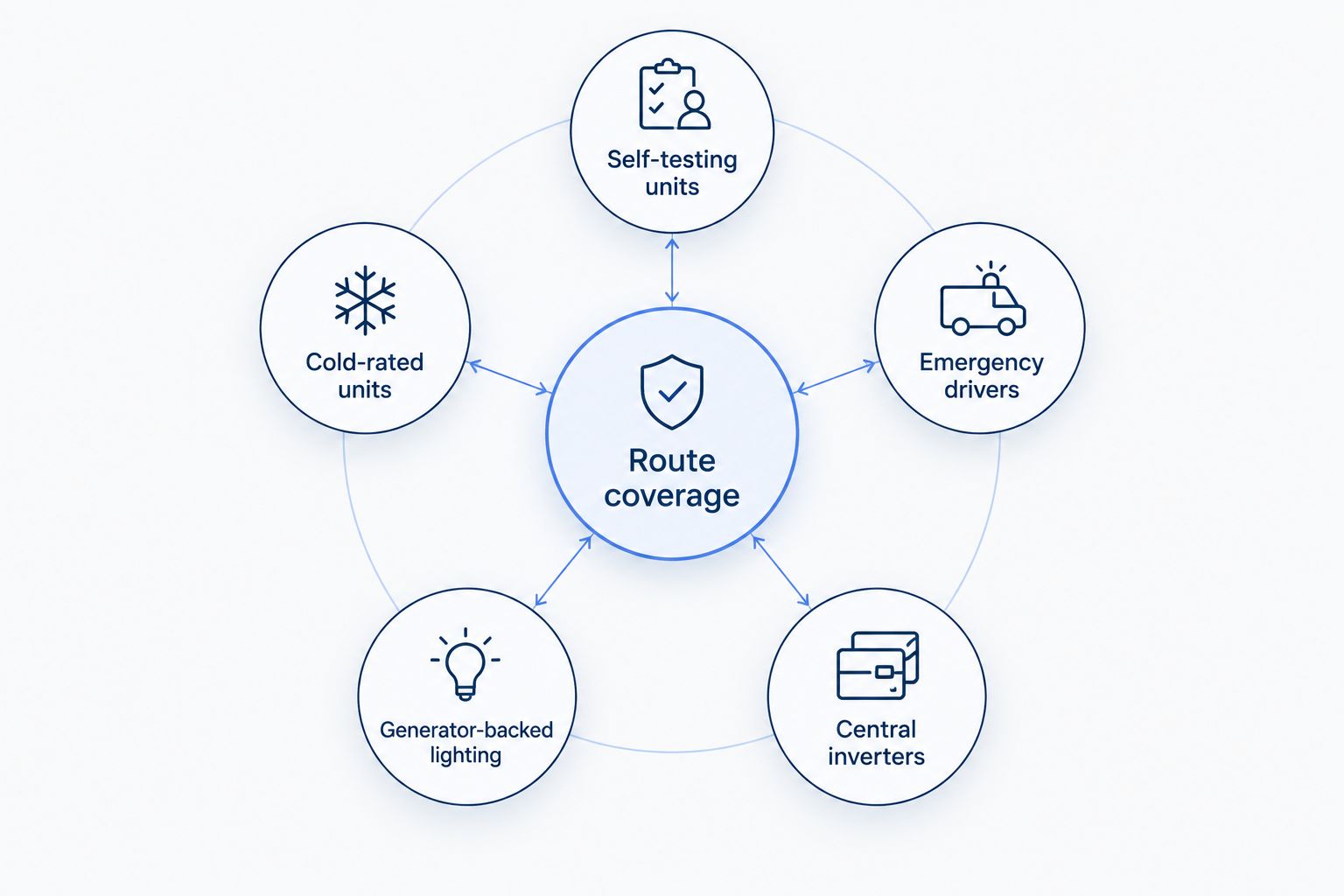
These are system categories, not competing brands. Each solves a different installation problem.
| System | Best for | Standout feature | Key limitation |
|---|---|---|---|
| Self-testing units | Straightforward indoor exit routes | Local battery backup with automatic test functions | Batteries and coverage remain distributed across the building |
| Emergency drivers | Finished offices and tenant spaces | Emergency operation through compatible normal-lighting fixtures | Emergency output differs from normal output |
| Central inverters | Larger buildings with centralized maintenance | One emergency supply serves designated lighting loads | Requires coordinated wiring, load sizing and equipment space |
| Generator-backed lighting | Buildings with a suitable emergency-power design | Lighting supplied through designated emergency circuits | A generator alone does not establish compliant emergency lighting |
| Cold-rated units | Exposed exits and unheated locations | Equipment selected for the installation environment | Ratings and battery performance need location-specific checks |
The categories can overlap. A building can use self-testing units indoors and cold-rated equipment outside. Rank the system by its assigned job, not by whether every fixture uses the same backup method.
1. Self-testing LED units: best for indoor exit routes
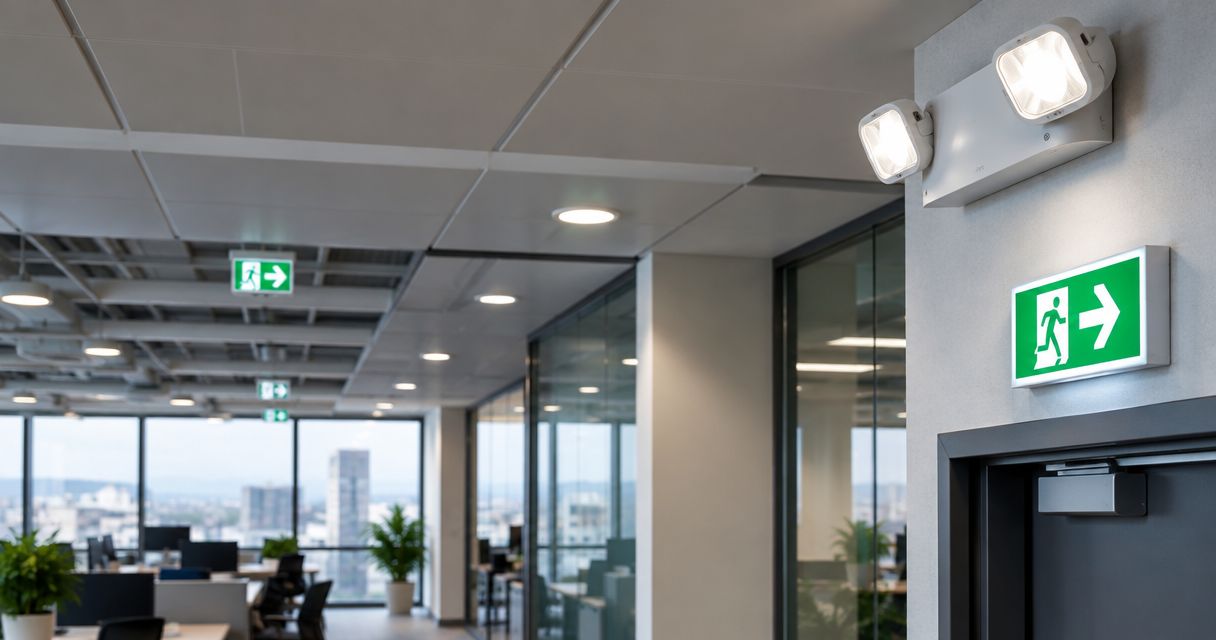
Self-contained emergency units combine lighting heads, charging equipment and a battery. They operate from their local battery when the relevant normal supply fails. Self-testing versions perform specified checks and display status according to their design.
This is the default starting point for a straightforward indoor commercial layout. It separates emergency illumination from the choice of decorative or general-purpose lighting.
Self-testing LED unit pros:
- Local backup avoids dependence on a central battery supply.
- Adjustable heads can direct light toward the required route.
- Automatic test functions help identify equipment faults.
- Individual units can be addressed during maintenance.
Self-testing LED unit cons:
- Batteries and inspection points are spread throughout the building.
- Visible equipment does not suit every finished interior.
- A passing self-test does not verify floor-level coverage.
Ask the electrician to check head placement, obstructions and coverage at stairs and turns. A unit mounted above a doorway can still leave a landing dark. Shelving and partitions also change where light reaches.
For a 2026 installation, include the test procedure and status-indicator instructions in the handover documents. Your maintenance team needs to know what a fault indication means and what action follows.
Best for: Straightforward indoor corridors, utility spaces and exit routes where visible emergency units are acceptable.
Verdict: Buy for uncomplicated indoor routes after a coverage assessment.
2. Emergency LED drivers: best for finished offices
An emergency LED driver allows a compatible fixture to operate from battery power during loss of normal supply. The fixture serves both normal lighting and emergency lighting, but its emergency output must be evaluated separately.
This approach suits spaces where separate lighting heads would interrupt the finished ceiling. It also makes fixture compatibility a central part of the specification.
Emergency LED driver pros:
- Uses compatible normal-lighting fixtures for emergency illumination.
- Avoids separate lighting heads in the occupied space.
- Supports emergency coverage within a coordinated ceiling layout.
Emergency LED driver cons:
- Compatibility must be checked for the specific fixture and driver.
- Normal brightness is not evidence of adequate emergency brightness.
- Above-ceiling batteries and test components need accessible maintenance arrangements.
Do not order a driver because its description says LED. Have the electrician verify the fixture, electrical characteristics, listing and installation instructions. The emergency-mode lighting calculation matters more than the normal-mode appearance.
Controls need attention too. Wall switches, occupancy sensors and dimming arrangements must not defeat required emergency operation. That is a design task, not a field assumption.
Best for: Finished offices and tenant spaces that need emergency illumination through compatible ceiling fixtures.
Verdict: Buy when compatibility, controls and emergency output are documented.
3. Central inverters: best for centralized maintenance
A central emergency-lighting inverter uses battery power to supply designated lighting loads when normal power fails. Instead of maintaining a battery at every emergency fixture, you maintain a central supply and its connected distribution.
This category fits buildings where centralized testing and battery maintenance are priorities. It requires a coordinated electrical design, not just a larger battery box.
Central inverter pros:
- Places battery maintenance at a central location.
- Can supply compatible lighting loads across designated areas.
- Supports a coordinated testing and maintenance plan.
Central inverter cons:
- Requires suitable equipment space and wiring arrangements.
- Load sizing must account for the actual connected equipment.
- A central equipment fault can affect multiple served areas.
Specify the emergency load schedule, operating duration and required equipment clearances. Identify which fixtures remain illuminated and how emergency operation interacts with normal controls.
For a 2026 renovation, examine the existing circuit layout before selecting this approach. A centralized supply does not automatically simplify a building whose lighting circuits were never arranged for emergency service.
Best for: Larger commercial buildings whose facilities staff want centralized battery maintenance and documented emergency-lighting distribution.
Verdict: Buy when the building layout and maintenance plan justify a central supply.
4. Generator-backed lighting: best for planned emergency circuits
Generator-backed emergency lighting supplies designated loads through an emergency-power arrangement. The design includes the source, transfer equipment, distribution and the response to loss of normal lighting power.
Do not confuse general standby power with compliant emergency lighting. Owning a generator does not establish the required transfer performance, circuit arrangements or route illumination.
Generator-backed lighting pros:
- Can supply designated lighting loads through a coordinated emergency system.
- Fits buildings already planning suitable emergency-power infrastructure.
- Allows emergency lighting to be evaluated alongside other required emergency loads.
Generator-backed lighting cons:
- Transfer performance and local circuit failure response need specific attention.
- Generator maintenance becomes part of the lighting reliability plan.
- Supplementary battery equipment can be needed to meet the design requirements.
Have the designer explain what happens when a lighting circuit fails while utility power remains present. That question exposes a gap that a whole-building generator demonstration does not address.
Require documentation of the served loads, transfer arrangement and testing procedure. Keep those records with the emergency-lighting maintenance information, not only with the generator paperwork.
Best for: Commercial buildings with an existing or planned emergency-power system designed to serve required lighting loads.
Verdict: Hold until the complete emergency-power design is verified.
5. Cold-rated units: best for exposed exit locations
Cold-rated emergency equipment is selected for locations outside the operating conditions of ordinary indoor fixtures. Depending on the installation, selection also needs to address moisture, enclosure suitability and other environmental conditions.
North Dakota projects need location-specific checks at exterior doors, unheated spaces and exposed exit discharge areas. An indoor battery unit is not an outdoor specification.
Cold-rated unit pros:
- Addresses temperature conditions through the equipment’s listed operating range.
- Allows enclosure selection to match the installation environment.
- Keeps exposed-route requirements separate from indoor assumptions.
Cold-rated unit cons:
- Cold suitability does not automatically establish wet-location suitability.
- Batteries, heating provisions and installation instructions need review.
- Environmental suitability does not establish hazardous-location suitability.
For oilfield-related premises, treat hazardous-location classification as a separate requirement. A weather-resistant enclosure does not make equipment suitable for a classified area. Have a qualified designer establish the classification before selecting fixtures.
In 2026, put the specified operating temperature range and enclosure requirements in the written scope. Do not accept outdoor-rated as the entire equipment description.
Best for: Required exit illumination in exposed, unheated or environmentally demanding locations.
Verdict: Buy only after the temperature, moisture and location requirements are confirmed.
How these systems rank
The ranking puts straightforward indoor coverage first, then separates the alternatives by installation fit. Self-testing units suit simple routes. Emergency drivers address finished ceilings. Central inverters address centralized maintenance. Generator-backed lighting depends on a complete emergency-power design. Cold-rated equipment addresses exposed locations.
No single category wins every building. Choose by route coverage, failure response, environment and maintenance—not by the longest feature list.
Which emergency lighting system should you choose?
Start with self-testing LED units for straightforward indoor routes. Move to emergency drivers when compatible ceiling fixtures offer the better installation. Evaluate a central inverter or generator-backed design when the building’s electrical layout and maintenance needs justify it.
Before requesting a final quote, collect:
- Route layout: Floor plans showing corridors, stairs and final exits.
- Existing equipment: Fixture information and accessible maintenance records.
- Power arrangement: Panel schedules and any emergency-power documentation.
- Site conditions: Unheated areas, outdoor exposure and classified locations.
Eagle-Elc provides commercial emergency-lighting installation support as an electrical contractor, not a fixture manufacturer. Request a same-business-day response to your quote inquiry and a clear written scope. A response is not a promise of same-day job completion.
The scope should identify equipment, installation work, testing, documentation and exclusions. Ask who handles permit coordination and which authority reviews the work. Settle those responsibilities before installation starts.
Request an emergency lighting quote
Get a same-business-day response and a clear written quote. Confirm the installation schedule separately.
FAQ
What's the best emergency lighting system for a commercial building in North Dakota?
Self-testing LED emergency units are the starting choice for straightforward indoor exit routes. Finished ceilings, centralized maintenance, existing emergency power and exposed locations can justify different systems. A licensed electrician must assess the building before equipment selection.
Is an exit sign enough for emergency lighting?
No. An exit sign identifies the exit, while emergency lighting illuminates the required escape route. Some combination units perform both jobs, but their coverage still needs verification.
How long does commercial emergency lighting need to operate?
NFPA 101's emergency-lighting provisions specify 90 minutes of operation. Confirm the locally adopted requirements and the authority having jurisdiction before finalizing the design.
Do self-testing lights eliminate manual inspections?
No. Self-testing equipment performs specified equipment checks, but it does not establish that the exit route remains unobstructed or adequately illuminated. Follow the applicable inspection, testing and recordkeeping requirements.
Can a backup generator replace battery emergency lights?
A properly designed emergency-power system can supply required emergency lighting. A standby generator alone does not prove compliance. Transfer performance, distribution and the response to loss of normal lighting power need review.
Can indoor emergency lights go outside in North Dakota?
Only equipment listed for the actual installation conditions belongs outside. Check temperature range, moisture exposure and enclosure suitability. Weather resistance does not establish suitability for a hazardous location.
Who should inspect a commercial emergency lighting installation?
Have a licensed electrician assess the installation and confirm the required approval process with the local authority. Eagle-Elc serves commercial customers across the Bakken region. Request a written scope covering equipment, testing and documentation.
One last thing
Test the route, not just the battery. A functioning emergency fixture can still leave a required area dark after a shelving move, tenant renovation or partition change.
For your 2026 maintenance review, walk the full exit route during a properly controlled emergency-lighting test. Have qualified personnel manage the test and verify coverage. Keep occupants safe throughout.