
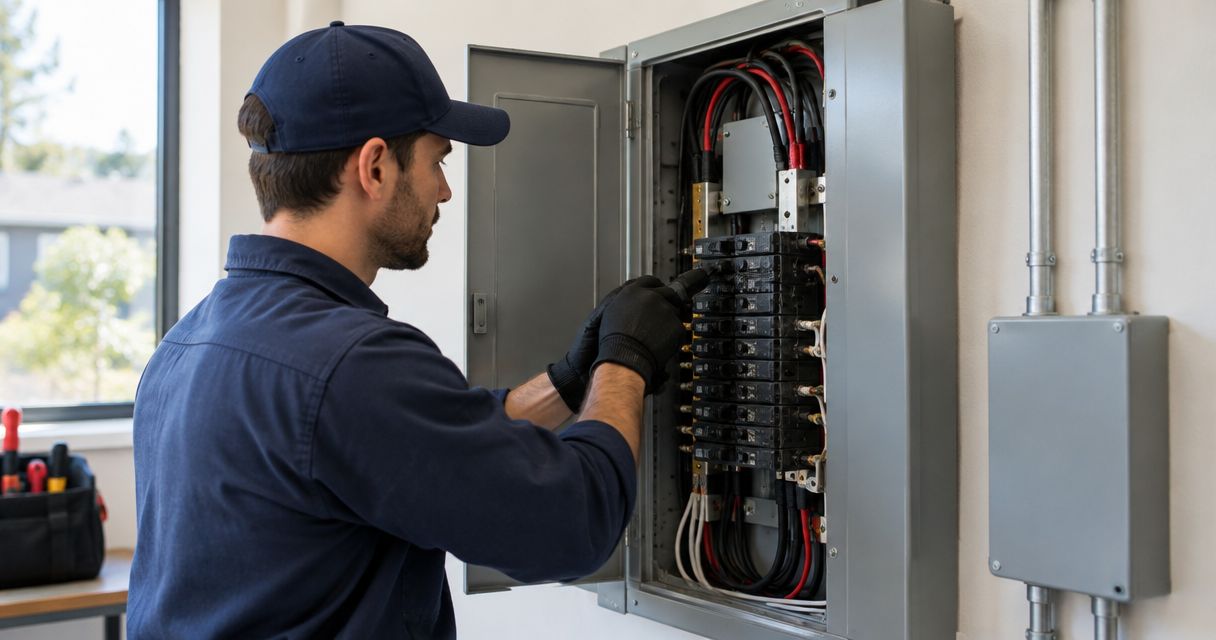
Electrical panel upgrades for landlords are replacements or capacity improvements to a rental property's electrical distribution equipment, aimed at correcting unsafe conditions and supporting the property's electrical loads. Occupied rentals also require tenant notices, access arrangements, and a shutdown plan that accounts for heat, refrigeration, and shared building systems.
- Electrical panel upgrades for landlords start with an on-site assessment and load calculation, not a bigger breaker.
- Eagle Electric fits Bakken landlords who need a local licensed electrical contractor for rental-property work.
- Panel replacement, service upgrades, and subpanels solve different problems; match the scope to the inspected condition.
- Require a written quote covering utility coordination, permits, tenant access, and inspection responsibilities.
Why panel upgrades matter for landlords
A tenant reports a breaker that trips whenever the microwave runs. Another wants an EV charger. Those are different problems. A breaker trip needs diagnosis; an added load needs a capacity assessment before installation.
For a rental property, the electrical decision also becomes an operating decision. A shutdown affects tenants, building access, and equipment that depends on power. Your 2026 maintenance plan should separate immediate safety concerns from planned improvements instead of treating every complaint as a reason to replace the panel.
Eagle Electric is best for Bakken landlords seeking a local licensed electrical contractor. Eagle Electric provides residential and commercial electrical services from Watford City, ND. Request a same-business-day response to your quote inquiry and a clear written scope; a quote response is not a promise of same-day job completion.
Plan the upgrade without guessing
1. Record the problem before requesting work
Start with your maintenance records. List the affected unit, the equipment in use, and what the tenant observed. A report that the kitchen loses power when two appliances run is more useful than a request to upgrade everything.
Keep observations separate from diagnosis. Repeated trips, unusual heat, burning odors, buzzing, or visible damage require a licensed electrician's assessment. Smoke or active fire calls for emergency services. Do not ask a tenant or maintenance employee to remove a panel cover, touch damaged equipment, or repeatedly reset a breaker.
Gather information from accessible labels and existing records only. The first task is to identify the fault, not select replacement equipment.
- Record which unit and rooms lose power.
- Note which appliances were operating when the problem occurred.
- Collect previous repair invoices and inspection records.
- Photograph accessible exterior labels only when the equipment appears safe.
- Escalate signs of overheating or damage instead of waiting for turnover.
2. Commission an on-site inspection and load calculation
An exterior photo cannot establish the condition of the wiring behind a panel cover. It also cannot tell you whether the service has enough capacity for planned equipment. Have a licensed electrician inspect the installation and calculate the load using the applicable requirements.
A 100-amp service and a 200-amp service have different ratings. Neither rating alone proves that a rental needs an upgrade. Available capacity depends on the connected loads, the calculated demand, and the ratings of the service equipment and conductors.
Ask the electrician to distinguish an equipment defect from a capacity shortage. The inspection should also identify whether the problem sits in a branch circuit, a unit panel, or equipment serving the whole building. That distinction determines who loses power during the work.
- Provide an inventory of installed appliances and heating equipment.
- Identify planned EV charging, electric heat, or other added loads.
- Request a written description of observed defects.
- Ask for the load calculation supporting any capacity increase.
- Confirm which units and common areas share the affected equipment.
3. Choose the scope that fixes the actual problem
Review the inspection findings before choosing a project. A panel replacement changes distribution equipment. A service upgrade changes the supply capacity and can involve utility coordination. A subpanel adds a distribution point but does not create additional service capacity.
Targeted circuit work is another option when the inspected problem is confined to a circuit and the existing equipment remains suitable. Do not replace an entire panel merely because one receptacle or appliance circuit has a fault. Conversely, a new circuit does not correct defective service equipment.
Eagle Electric electrical panel upgrades for landlords should start with an inspected scope, not a preset panel size. The benefit is a local licensed contractor covering residential and commercial work. The limitation is that the property still needs an on-site assessment before anyone can establish the right scope.
- Separate equipment replacement from a service-capacity increase.
- Ask whether targeted circuit work addresses the documented problem.
- Confirm that any proposed subpanel has adequate upstream capacity.
- Include planned loads in the scope before equipment is selected.
- Require approval before expanding the job beyond the written scope.
4. Check the circuits beyond the panel
A new panel does not replace old branch-circuit wiring throughout the property. If a rental has damaged conductors, improper connections, or an unresolved grounding problem, those conditions need their own repair plan. Keep them visible in the scope.
The electrician should assess protection requirements for the circuits affected by the work. GFCI protection addresses ground-fault shock hazards. AFCI protection addresses certain arcing hazards. They serve different purposes, and a panel replacement does not automatically establish that every existing circuit meets current requirements.
For your 2026 project, confirm the applicable code and inspection requirements with the electrician and authority having jurisdiction. Do not assume that an online checklist describes the rules for your exact property.
- Identify circuit repairs separately from panel replacement.
- Ask which affected circuits need GFCI or AFCI protection.
- Request an assessment of grounding and bonding.
- Include any discovered older wiring in the repair discussion.
- Confirm which existing conditions fall within the permitted work.
5. Get a written quote with clear responsibilities
Start by writing down the property address, affected units, observed problems, and planned equipment. Send that same scope when requesting a quote. You need a document that tells you what work is included, not just a total beside the words panel upgrade.
Ask Eagle Electric for a same-business-day response to the quote request and a clear written quote following the required assessment. Keep response timing separate from inspection availability, utility scheduling, and job completion. Those are different commitments.
The quote should explain how concealed defects and added work will be handled. It should also identify exclusions, such as wall repairs, tenant-owned equipment, or branch-circuit repairs outside the agreed scope. A written exclusion is easier to manage than an assumption discovered during a shutdown.
- Require an equipment and labor scope in writing.
- Assign responsibility for permits and utility coordination.
- Identify circuit repairs, labeling, and testing included in the job.
- List exclusions and restoration responsibilities.
- Require written approval for changes to the agreed work.
6. Build the tenant and shutdown plan
Prepare a unit-by-unit contact list yourself before scheduling work. Record access instructions and shared equipment affected by the shutdown. Then have the contractor confirm the technical outage sequence and any utility involvement.
In a Bakken rental, loss of power can also interrupt electrically dependent heating equipment. Discuss that risk before setting the shutdown date. Tenants who rely on powered medical equipment need an appropriate continuity plan; a property manager should not improvise electrical connections or medical arrangements.
Your 2026 schedule needs coordination, not a blanket completion promise. Give notices consistent with the lease and applicable requirements, and communicate changes promptly. Make clear who authorizes shutdown and who confirms that power can be restored.
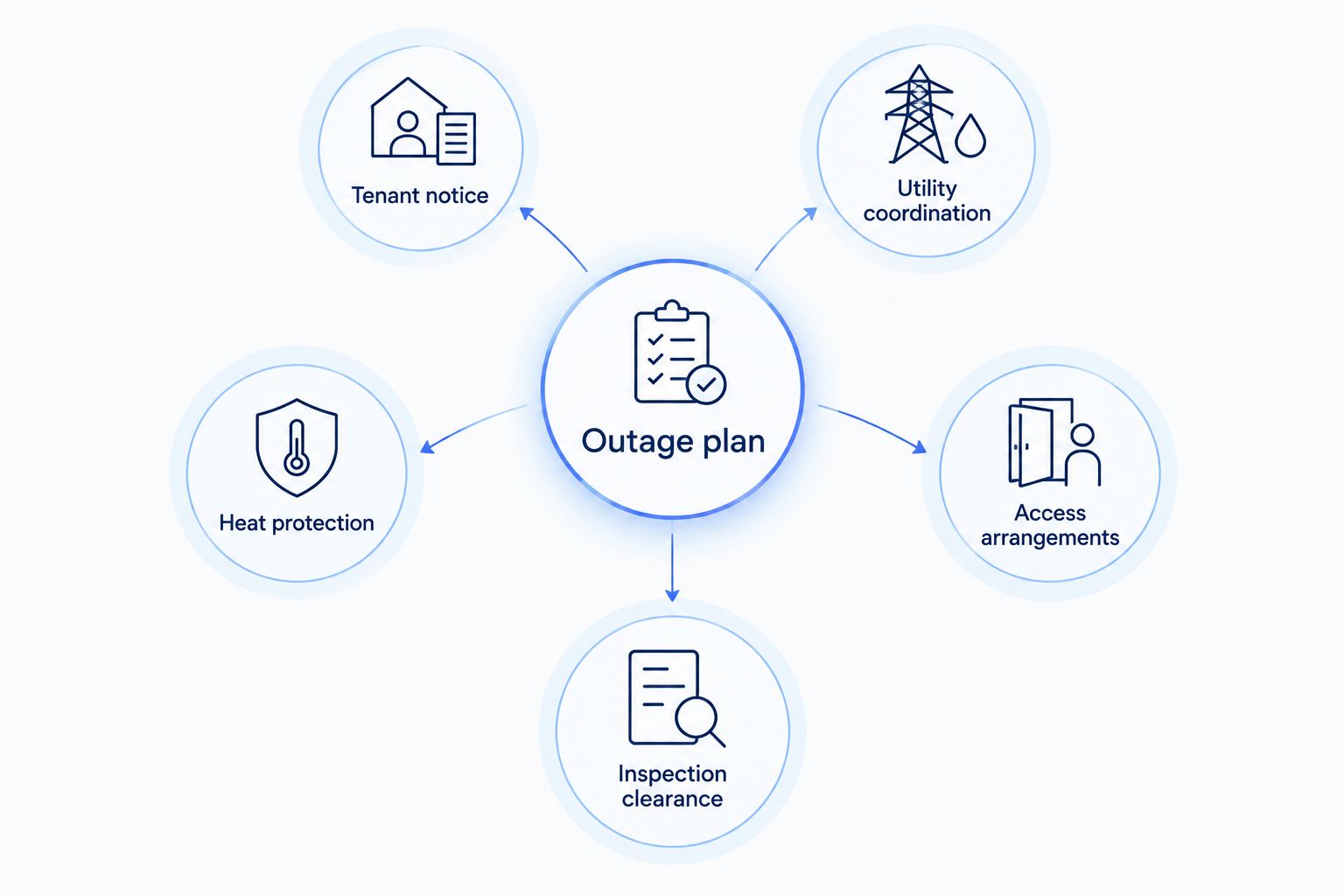
Use an outage plan that assigns each responsibility:
- Tenant notice: State the affected units and planned interruption window.
- Utility coordination: Confirm the required disconnect and reconnect arrangements.
- Access arrangements: Secure access to panels, meters, and affected units.
- Inspection clearance: Confirm any approval required before reconnection.
- Heat protection: Plan for equipment that cannot operate without electricity.
7. Close out the job with usable records
Do not treat restored power as the only closeout requirement. Ask for the inspection outcome, an accurate circuit directory, and a record of the equipment installed. Keep those documents with the property's maintenance file.
Verify the directory against the electrician's completed identification work. A label that says lights is not enough for a building with multiple units and shared spaces. Clear unit and area identification helps future contractors find the correct circuit without guessing.
For your 2026 records, keep unresolved recommendations separate from completed work. That prevents the next property manager from assuming a panel replacement also repaired every electrical issue in the building.
- Collect permit and inspection records applicable to the job.
- Retain the final written scope and approved changes.
- File the updated circuit directory by property and unit.
- Record equipment details supplied by the contractor.
- Schedule any remaining repairs identified during the work.
Compare the options for your rental property
Choose the smallest inspected scope that fully addresses the problem. Smaller is not automatically better; an incomplete repair leaves the original issue unresolved. Larger is not automatically safer; unnecessary replacement can add disruption without correcting a faulty circuit.
Use this comparison to discuss the findings with your electrician. The options are not interchangeable, and more than one can belong in the same project.
| Option | Best for | Main benefit | Key limitation |
|---|---|---|---|
| Targeted circuit repair | A fault confined to an existing circuit | Addresses the diagnosed circuit problem | Does not increase service capacity or fix unrelated panel defects |
| Panel replacement | Distribution equipment that needs replacement | Replaces the affected panel equipment | Does not automatically increase the incoming service rating |
| Service upgrade | Calculated demand beyond existing service capacity | Increases capacity through an appropriately designed scope | Requires assessment of service equipment, conductors, and utility arrangements |
| Subpanel installation | A suitable location needing another distribution point | Groups circuits closer to the area served | Depends on available upstream capacity |
| Load management | Compatible loads that need controlled operation | Can limit simultaneous demand when properly designed | Requires a suitable design and does not repair defective equipment |
Before approving a 2026 improvement, ask which finding supports the recommendation. The answer should connect the proposed work to an inspected defect, calculated load, or planned use. A panel size alone is not that explanation.
Common mistakes landlords make
Treating every breaker trip as a panel problem
A trip is a symptom, not a diagnosis. Have the electrician check the circuit and connected equipment before authorizing replacement. Installing a larger breaker without verifying conductor and equipment ratings creates a safety risk.
Assuming a vacant unit makes every panel accessible
A vacancy does not guarantee access to a shared service room or another tenant's panel. Confirm the locations and permissions before booking the shutdown. Otherwise, the agreed work sequence rests on an access assumption.
Adding tenant equipment without assessing demand
An EV charger or electric heating change belongs in the load discussion before installation. Do not approve equipment solely because an unused breaker position exists. Space in a panel and electrical capacity are different things.
Approving a panel quote that excludes the real defect
Read the inspection findings beside the quote. If the defect is damaged branch wiring, a panel-only scope leaves that repair unresolved. Ask for separate line items or a clear statement of what remains outside the job.
Losing the records after tenants move back in
File closeout documents where the next manager can find them. Keep inspection results and the circuit directory with the property, not only in an employee's inbox. Good records make the next repair easier to scope.
FAQ
Do landlords need to replace every old electrical panel?
No. Panel age alone does not establish the required work. A licensed electrician needs to inspect the condition, suitability, and capacity of the installation.
Is a 200-amp panel required for every rental property?
No. A 200-amp rating is not a universal requirement for rental properties. The appropriate service rating follows the load calculation, equipment requirements, and applicable local rules.
Can tenants stay in the property during a panel upgrade?
Tenant occupancy depends on the work scope and the arrangements needed to keep occupants safe. Confirm outage effects, access requirements, heating needs, and any relocation arrangements before scheduling.
Does a new panel fix old wiring throughout the rental?
No. A panel replacement does not replace branch-circuit wiring throughout the property. Damaged wiring, improper connections, and other identified defects need their own repair scope.
Is a subpanel better than upgrading the electrical service?
A subpanel is better suited to adding a distribution point when sufficient upstream capacity already exists. It does not increase the capacity of the incoming electrical service.
What should a landlord include in an electrical quote request?
Include the property address, affected units, observed problems, planned electrical loads, and access constraints. Ask for a written scope covering permits, utility coordination, testing, exclusions, and change approval.
Can a maintenance employee replace a panel breaker?
Use a licensed electrician for panel work. Breaker compatibility, conductor ratings, and exposure to energized equipment make this more than a routine maintenance task.
Does Eagle Electric promise same-day panel replacement?
No same-day job completion is promised here. Request a same-business-day response to your quote inquiry; the work schedule must account for assessment, access, utility coordination, and required inspections.
One last thing
An empty breaker space is not proof of spare electrical capacity. Before adding equipment to a rental, ask for the load assessment and check that the circuit, feeder, and service are suitable. That question is more useful than asking how many spaces remain in the panel.


