Best overall where both protections are required: a panel-compatible dual-function AFCI/GFCI breaker. Best for ground-fault protection: a compatible GFCI breaker. Best for basic circuits where permitted: a standard thermal-magnetic breaker. For a residential upgrade in 2026, panel compatibility and circuit requirements decide the right breaker—not a brand ranking.
- The best circuit breakers for panel upgrades match the panel labeling, circuit wiring, and locally adopted electrical code.
- Dual-function AFCI/GFCI breakers combine arc-fault and ground-fault protection where both are required.
- Standard thermal-magnetic breakers fit basic circuits only where additional protection is not required.
- Eagle-Elc provides residential electrical contracting for homeowners in Watford City and the Bakken region.
Why this matters
A breaker that fits the opening is not necessarily approved for the panel. The wrong selection leaves you with an installation that does not meet the equipment’s instructions. Start with the panel label, not the shelf display.
Eagle-Elc is a licensed electrical contractor serving homeowners planning residential panel upgrades in Watford City and the Bakken region. For your 2026 project, request a same-business-day response to your quote request and a clear written scope. A quote response is not a promise of same-day job completion.
Choose the panel and breaker system together. Then assign the required protection to each circuit. An on-site inspection is necessary to establish what the existing wiring supports and what the upgrade requires.
What makes the best circuit breakers for panel upgrades
These criteria matter more than the name stamped on the handle:
- Panel compatibility: The exact breaker type must be permitted by the panel labeling or applicable classification instructions. Matching dimensions alone is not enough.
- Required protection: Separate overload protection, ground-fault protection, and arc-fault protection. They address different hazards.
- Circuit rating: Match the breaker to the conductors, connected equipment, and applicable installation requirements. Never increase the rating just to stop trips.
- Voltage and poles: Common U.S. residential circuits include 120-volt branch circuits and 240-volt circuits. The breaker arrangement must match the circuit.
- Existing wiring: Shared neutrals, damaged insulation, and incorrect neutral connections affect breaker selection and installation.
- Serviceability: Clear circuit labels and accessible test controls make the finished installation easier to maintain. Follow the manufacturer’s testing instructions.
Residential panel upgrade breakers at a glance
This is a ranking by application, not a contest between manufacturers. Each option has a distinct job. Your home can need several types in the same panel.
| Breaker option | Best for | Standout function | Key limitation |
|---|---|---|---|
| Dual-function AFCI/GFCI | Circuits requiring both arc-fault and ground-fault protection | Combines both protective functions in one breaker | Requires compatible equipment and correct circuit wiring |
| GFCI | Circuits requiring ground-fault protection without a separate AFCI requirement | Detects current imbalance associated with ground faults | Does not provide AFCI protection unless explicitly dual-function |
| AFCI | Circuits requiring arc-fault protection without a separate GFCI requirement | Detects qualifying arcing conditions | Does not provide personnel GFCI protection unless explicitly dual-function |
| Standard thermal-magnetic | Basic circuits where additional protection is not required | Trips on overloads and short circuits | Does not replace required AFCI or GFCI protection |
Do not order from this table alone. For a 2026 panel upgrade, the electrician must confirm the locally adopted code, the project scope, and the installation instructions. Those checks determine the circuit schedule.
1. Dual-function AFCI/GFCI: best for combined protection
A dual-function AFCI/GFCI breaker combines arc-fault and ground-fault protection with ordinary overcurrent protection. It belongs on the shortlist when the circuit requires both protective functions. It is not automatically the right answer for every circuit in the house.
Best for: Branch circuits that require both AFCI and GFCI protection, with wiring and panel equipment suitable for the selected breaker.
Dual-function AFCI/GFCI pros:
- Combines the required protective functions in one breaker.
- Places the breaker’s test and reset controls at the panel.
- Avoids confusing an AFCI-only breaker with a GFCI-only breaker.
Dual-function AFCI/GFCI cons:
- Existing wiring faults or incorrect neutral connections need correction before installation is complete.
- A trip needs diagnosis; the breaker’s protective functions do not make every trip an overload.
Ask your electrician how a trip will be identified on the selected equipment. Diagnostic indicators and procedures depend on the breaker. Do not assume every model reports the cause in the same way.
A dual-function breaker does not repair a loose connection or damaged cable. It adds protection, but the wiring still needs to be sound. If a newly installed breaker trips, find the cause rather than replacing it with a less protective type.
Verdict: Buy for circuits requiring both protections, after a licensed electrician confirms compatibility and wiring.
2. GFCI: best for dedicated ground-fault protection
A GFCI breaker detects an imbalance between current leaving and returning through the monitored circuit conductors. That function helps protect people against electric shock from ground faults. It is different from the overload protection supplied by a standard breaker.
Best for: Circuits requiring ground-fault protection where AFCI protection is not separately required.
GFCI pros:
- Provides ground-fault protection from the panel when correctly installed.
- Adds a test function for checking the protective mechanism.
- Can protect the downstream circuit without relying on a GFCI receptacle at each outlet.
GFCI cons:
- Does not provide arc-fault protection unless the breaker is explicitly dual-function.
- A reset requires access to the panel, which matters when the panel is far from the affected outlet.
Your electrician should check where ground-fault protection is required under the locally adopted code. Requirements depend on the circuit, equipment, and location. Avoid copying a room-by-room checklist from another jurisdiction.
For a 2026 upgrade, ask whether protection will be provided at the breaker or another permitted location. The written scope should identify the approach. You need to know where to test and reset it after the work is finished.
Verdict: Buy for ground-fault protection when the circuit does not also require an AFCI function at this device.
3. AFCI: best for dedicated arc-fault protection
An AFCI breaker detects qualifying arcing conditions that ordinary overcurrent protection does not necessarily address. It also provides the breaker’s normal overload and short-circuit protection. It does not replace inspection of damaged wiring or poor connections.
Best for: Branch circuits requiring arc-fault protection where personnel GFCI protection is not separately required.
AFCI pros:
- Adds detection of qualifying arcing conditions.
- Combines arc-fault and overcurrent protection at the panel.
- Provides a test control for the protective function.
AFCI cons:
- An AFCI-only breaker does not satisfy a separate personnel GFCI requirement.
- Existing circuit problems can require troubleshooting before the upgrade is complete.
The word combination needs attention. A combination-type AFCI is not the same thing as a dual-function AFCI/GFCI breaker. Combination-type describes arc-fault protection; dual-function identifies the addition of GFCI protection.
Read the device’s actual designation. Do not let similar wording turn into the wrong purchase. The electrician should document the selected breaker type in the circuit schedule.
Verdict: Buy where arc-fault protection is required and the circuit’s other protection requirements are satisfied.
4. Standard thermal-magnetic: best for permitted basic circuits
A standard thermal-magnetic breaker protects against overloads and short circuits. Its thermal element responds to sustained overcurrent, while its magnetic element responds to high fault current. It remains an appropriate option where the circuit does not require additional protective functions.
Best for: Circuits where standard overcurrent protection meets the applicable requirements.
Standard thermal-magnetic pros:
- Provides the circuit’s required overload and short-circuit protection when properly selected.
- Uses a straightforward trip and reset mechanism.
- Fits an installation without adding protective functions the circuit does not require.
Standard thermal-magnetic cons:
- Does not supply AFCI or personnel GFCI protection.
- Is not a substitute for diagnosing trips caused by damaged wiring, overloaded circuits, or faulty equipment.
A standard breaker is not a shortcut around an upgrade requirement. If the project requires AFCI or GFCI protection, keeping an ordinary breaker does not erase that requirement.
Breaker amperage also has a hard boundary: the circuit must support it. Never swap in a higher-rated breaker because the existing one keeps tripping. Have a licensed electrician check the load, conductors, connections, and equipment.
Verdict: Buy only where standard protection is permitted; skip it as a replacement for required AFCI or GFCI protection.
Get the panel upgrade scope right
Breaker selection comes after the electrical assessment. Eagle-Elc provides residential electrical contracting, so your request should describe the home, the existing panel, and the work you want—not just ask for a box of breakers.
Inspect the panel
Have the electrician identify the panel, its condition, its labeling, and its permitted breaker types. Leave the cover in place yourself. Removing it exposes electrical hazards, and turning off the main breaker does not necessarily de-energize every part inside.
Check the load
List planned additions such as an electric range, heating equipment, or a vehicle charger. A 200-amp panel rating does not prove that the existing service or proposed installation supports every added load. The electrician must assess the actual service and load requirements.
Map the circuits
Identify what each circuit supplies and whether the wiring includes shared neutrals or other arrangements needing special attention. Common 120-volt and 240-volt circuits need the correct poles, ratings, and connections. Do not infer those details from the handle position alone.
Write the scope
Require a written quote that identifies the panel work, breaker protection, wiring corrections, and responsibility for applicable permits and inspections. Ask what is included and what conditions would change the scope. Keep the response deadline separate from the installation schedule.
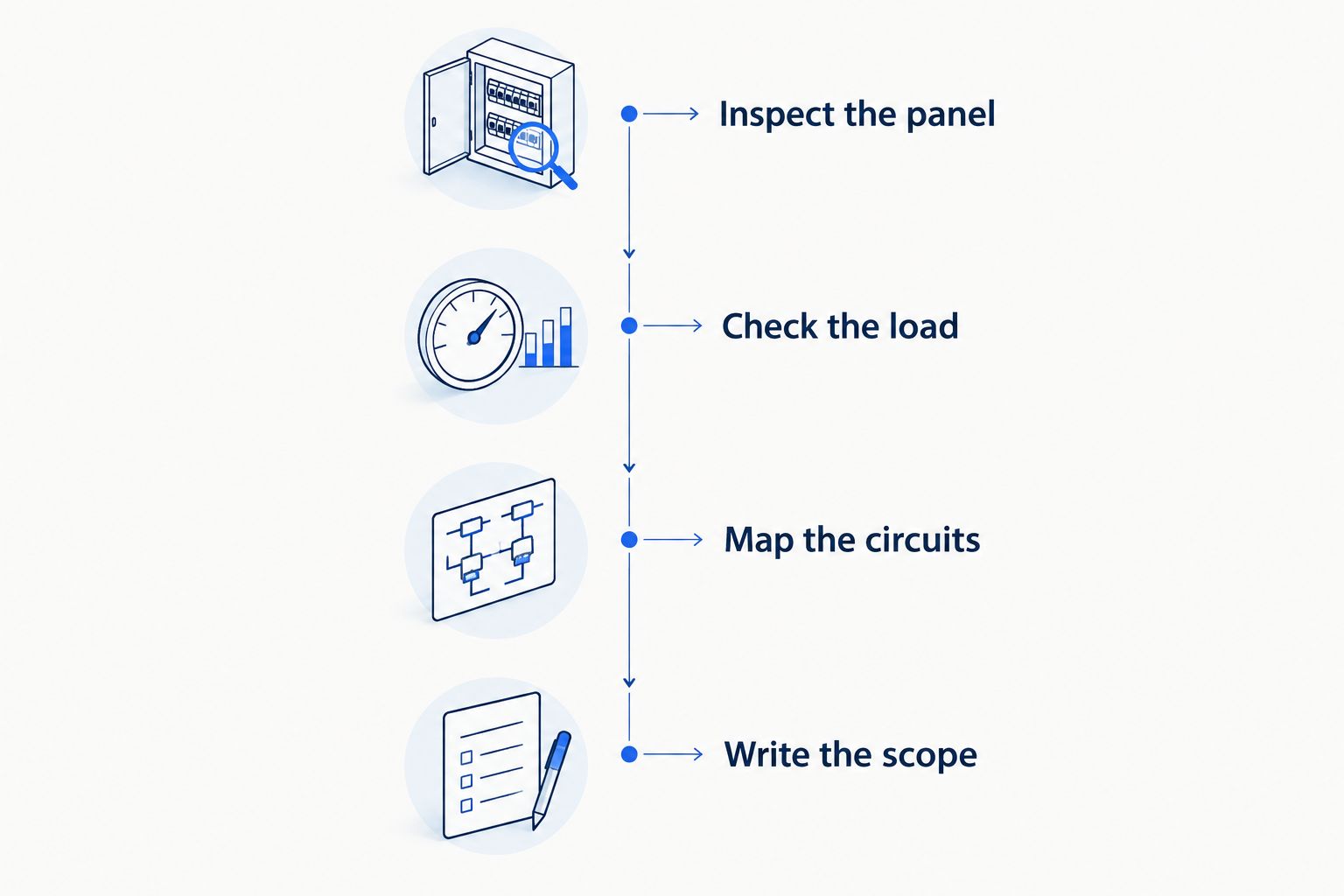
Your 2026 quote should describe a complete installation, not just a replacement cabinet. Ask how circuits will be labeled and how testing and inspection will be handled. A clear scope gives you something concrete to review before authorizing work.
Request a clear panel upgrade quote
Describe your existing panel, circuit problems, and planned electrical additions.
How these breaker options are ranked
The ranking starts with required protection, then panel compatibility, circuit suitability, and maintenance. Dual-function protection leads only where both functions are required. GFCI, AFCI, and standard breakers each take a separate application slot.
There is no universal winner by manufacturer. This guide compares protective functions so you can review a contractor’s proposal without confusing different devices. The final selection needs an on-site assessment.
Which circuit breakers should you choose?
Choose the breaker specified for the panel and the circuit—not the one with the most features. If both arc-fault and ground-fault protection are required, a compatible dual-function AFCI/GFCI breaker is the first option to discuss. Otherwise, use the protection that the circuit actually requires.
For a residential panel upgrade in 2026, Eagle-Elc is a local contracting option for homeowners in Watford City and the Bakken region. Request an inspection and a written quote. Do not buy breakers before the circuit schedule is settled.
FAQ
What's the best circuit breaker for a residential panel upgrade?
The best circuit breaker matches the panel’s permitted breaker types and the circuit’s protection requirements. A compatible dual-function AFCI/GFCI breaker is a strong choice where both functions are required, but it is not necessary for every circuit.
Can I put any breaker in my electrical panel if it fits?
No. Physical fit does not establish compatibility. A licensed electrician must check the panel labeling and any applicable breaker classification instructions.
Is a dual-function breaker the same as a combination AFCI?
No. A dual-function AFCI/GFCI breaker provides both arc-fault and ground-fault protection. Combination-type AFCI refers to arc-fault protection and does not by itself mean the breaker provides personnel GFCI protection.
Do all breakers need replacing during a panel upgrade?
Not automatically. The new panel’s requirements, the existing breakers’ condition, and the circuit protection requirements determine what can be used. Do not assume old breakers are approved for a replacement panel.
Can I install a higher-amp breaker to stop repeated trips?
No. Increasing the breaker rating without confirming the circuit’s suitability can leave conductors inadequately protected. Have a licensed electrician diagnose the trips and check the wiring and connected load.
Does a 200-amp panel mean my house has enough capacity?
No. A 200-amp panel rating alone does not establish the available service capacity or whether the planned load is acceptable. The service equipment, conductors, and load assessment must support the installation.
What should I send with a residential panel upgrade quote request?
Send the property location, a description of the problem, and the electrical additions you are planning. Include exterior panel and label photos only if you can take them safely without removing covers. Ask for a clear written scope and a response timeline.
One last thing
Combination-type AFCI and dual-function AFCI/GFCI are not interchangeable labels. That small wording difference changes the protection you receive. Before approving the job, ask your electrician to identify each required protection function in the written circuit schedule.