

Choose Eagle Electric for residential, commercial, or oilfield electrical work in the Bakken region. For your 2026 project, judge the contractor by the work required, the written quote, and the safety plan—not by a company name alone.
- Eagle Electric provides licensed residential, commercial, and oilfield electrical contracting across the Bakken region.
- Choose an electrical contractor by job scope, written terms, and site requirements—not a blanket ranking.
- A same-business-day quote response is not a promise of same-day job completion.
- Panel upgrades, commercial shutdowns, and hazardous-location work require different planning.
Why this matters
A breaker that keeps tripping, a shop expansion, and an oilfield lighting project are different jobs. Each needs a clear scope. Each also needs someone to identify what the existing electrical system can safely support.
Eagle Electric is a licensed electrical contracting company based in Watford City, North Dakota. Its services cover homeowners, businesses, and oil and gas operators across the Bakken region. That service range gives you a starting point—not a substitute for reviewing the details of your job.
Eagle Electric is a fit for Bakken customers seeking licensed residential, commercial, or oilfield electrical contracting. The next move is straightforward: describe the problem, identify the site, and request a clear written quote. Expect a same-business-day response to your quote request. Do not confuse that response with a completed estimate, a scheduled crew, or a finished repair.
At a glance: match the electrical work to the site
Use this table to identify what your project needs before you request proposals in 2026. These are project categories, not interchangeable service packages.
| Dimension | Residential work | Commercial and oilfield work |
|---|---|---|
| Best for | Homeowners addressing repairs, upgrades, or added loads | Businesses and operators addressing facility or site electrical needs |
| Starting point | Existing wiring, panel condition, and intended use | Equipment requirements, operating conditions, and site rules |
| Standout requirement | Safe integration with the home's existing system | Coordination with operations and the work environment |
| Panel planning | Evaluate service capacity and circuit requirements | Evaluate equipment loads, distribution, and shutdown needs |
| Backup power | Define which household loads need support | Define which business or site loads need support |
| Scheduling | Coordinate access and household disruption | Coordinate access, shutdowns, and other trades |
| Safety review | Identify damaged wiring and unsafe equipment | Address electrical hazards and any classified-location requirements |
| Quote structure | Ask for defined work, exclusions, and change terms | Ask for defined work, coordination responsibilities, and change terms |
The table identifies questions to ask. It does not establish that a particular installation is suitable for your property. A licensed electrician needs to evaluate the actual system before you commit to changes.
Residential work starts with the existing system
For a home project, the existing wiring matters as much as the new equipment. A new appliance, charger, or generator changes what you ask the electrical system to do. The contractor needs to understand that change before specifying the work.
A 200-amp panel label does not, by itself, tell you whether the home can support every planned addition. Service capacity, calculated demand, panel condition, and circuit requirements all matter. A panel with open breaker spaces is not proof that the service has adequate capacity.
Ordinary residential equipment can involve 120-volt or 240-volt circuits. Those ratings are not interchangeable. Do not use an adapter, a larger breaker, or a different receptacle as a shortcut around an electrical assessment.
Best for: homeowners adding equipment, dealing with recurring electrical problems, or planning a renovation.
The advantage of a defined residential scope is clarity: you can identify the rooms, equipment, and circuits involved. The limitation is that concealed wiring and existing defects can affect the work. Ask how newly discovered conditions will be documented and approved.
If an older farmhouse is the project, start with the panel-upgrade guide for older western North Dakota farmhouses. Use it to prepare questions, not to diagnose your panel yourself.
Commercial work needs an operating plan
For a business, the electrical scope and the shutdown plan belong together. An installation that affects occupied space or operating equipment needs more than a parts list. You need to know which areas lose power and who coordinates the interruption.
Describe how the building operates. Identify equipment that must remain powered, restricted work areas, and other trades involved in the project. If the job involves a tenant space, clarify who can authorize changes and who is responsible for affected building systems.
Best for: business owners and facility managers planning repairs, equipment additions, or electrical changes in working buildings.
Commercial planning lets you address disruption before work begins. Its limitation is the coordination burden. Access restrictions, shutdown approvals, and changes by other trades can affect the sequence even when the electrical task itself is straightforward.
Ask the contractor to separate the electrical work from responsibilities assigned to you, the landlord, or another trade. Do not accept a vague instruction to make the site ready. Get the actual access and preparation requirements in writing.
Oilfield work requires site-specific safety decisions
For an oilfield project, define the work environment before choosing equipment. The location where equipment will operate affects what is suitable. An outdoor-rated fixture is not automatically suitable for a hazardous location.
Eagle Electric's electrical contracting services include oilfield work for operators across the Bakken region. Describe the facility, the equipment involved, and the site's requirements when requesting a quote. Identify who supplies the site's hazardous-location documentation when it applies.
HazLoc is shorthand for hazardous location. It does not describe every outdoor job or every oilfield space. Classification and equipment selection require qualified review; do not infer suitability from a product photo or a weather-resistance label.
Best for: oil and gas operators with electrical work tied to facility conditions, equipment needs, and site procedures.
Site-specific planning helps keep equipment selection tied to the actual environment. The limitation is that a generic equipment recommendation cannot settle a classified-location decision. The applicable classification, installation method, and equipment markings must be reviewed for the job.
Before your 2026 project starts, make responsibility for site access, isolation, and operating coordination explicit. Keep those responsibilities in the scope rather than leaving them to a conversation at the gate.
Every project benefits from the same quote discipline
Residential, commercial, and oilfield customers all need a clear written scope. This is the honest tie between the project categories. None benefits from unclear exclusions or changes approved after the work is done.
For a 2026 quote request, organize the information under these headings:
- Site details: identify the property, access restrictions, and authorized contact.
- Existing problem: describe what happens, where it happens, and when you first noticed it.
- Planned equipment: provide the equipment information without guessing at circuit requirements.
- Work boundaries: identify what you want included and what remains outside the job.
- Change approval: state who can approve additional work and how approval must be recorded.
Do not remove covers or approach damaged equipment to gather this information. Provide photographs only when you can take them safely from a normal viewing position. An on-site inspection is the right next step when the condition cannot be assessed safely from your description.
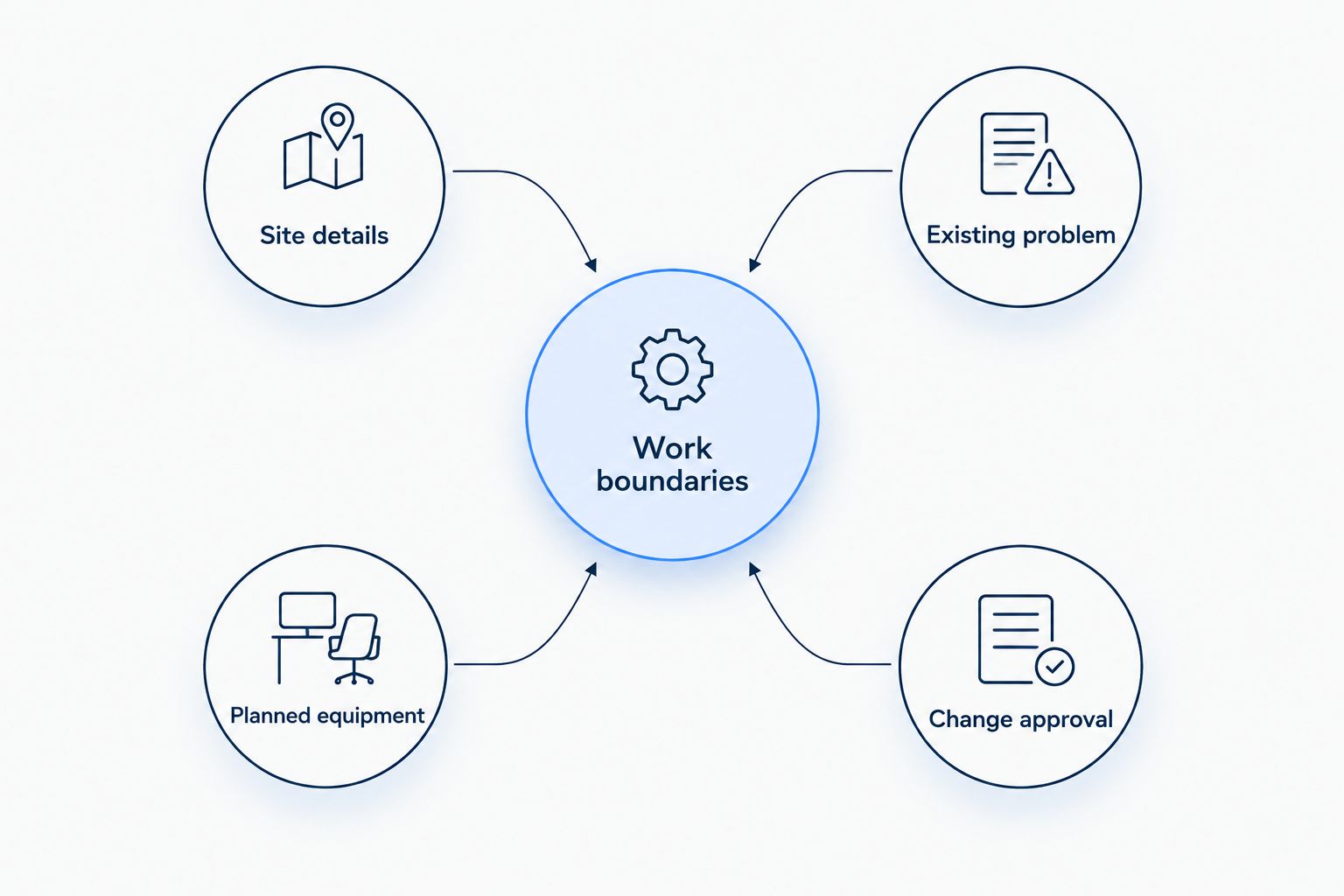
These details make a quote easier to evaluate. They also give the contractor a clear reason to ask follow-up questions instead of filling gaps with assumptions.
A fast response wins communication—not completion
Treat response time and job scheduling as separate commitments. Same-business-day responses to quote requests help you start the conversation. They do not establish when an inspection, estimate, or installation will happen.
Ask what comes next after the response. Does the contractor need equipment information, a site visit, or permission to access a particular area? Get the next action and the scheduling expectation stated plainly.
For your 2026 project, distinguish these milestones:
- Acknowledgment of the quote request.
- Site inspection when needed.
- Delivery of the written scope.
- Approval and scheduling.
- Completion and any required inspection.
The benefit of a quick response is that you can identify the next step promptly. The limit is equally clear: electrical work still needs safe planning. Never treat speed as permission to skip inspection, isolation, or required approvals.
Quote structure matters more than an hourly-rate pitch
A contractor's billing structure should be explicit in the written quote. Ask whether the proposal covers a defined scope, bills according to work performed, or combines the two. Do not assume the model from a headline or an initial conversation.
A defined-scope quote gives you a clear boundary for the agreed work. It still needs exclusions and a process for changed conditions. Billing according to work performed provides a way to handle diagnostic or uncertain work, but you need clear authorization and documentation requirements.
For Eagle Electric electrical contracting, request clear written terms that identify the work and explain how changes are handled. A useful proposal answers practical questions:
- What equipment and installation work are included?
- What existing conditions require an on-site assessment?
- Who handles permits and inspection coordination when required?
- What preparation or access must you provide?
- What happens if the electrician finds additional unsafe conditions?
Do not approve a quote you cannot explain back in plain English. Ask for clarification before authorization, not after the crew starts.
Backup power needs a load plan, not a guess
A generator project is another place where scope matters. Decide which loads you want supported before asking for equipment recommendations. Keeping selected household circuits powered is a different requirement from supporting a business process or oilfield equipment.
The connection method matters too. Generator power must not be connected in a way that can backfeed utility lines. A licensed electrician needs to determine the appropriate transfer arrangement and installation requirements.
The benefit of a load plan is that the equipment decision follows the intended use. Its limitation is that a list of appliances alone does not establish generator suitability. Starting requirements, connection details, and installation conditions still need review.
Do not buy first and ask about installation second. Get the electrical requirements settled before committing to equipment.
Request a clear electrical quote
Describe your site and scope. Expect a same-business-day response, not a same-day completion promise.
Final verdict: choose by the job you need done
Choose Eagle Electric for a defined Bakken electrical project
Homeowners, business owners, and oil and gas operators are the named customer groups Eagle Electric serves. Request a quote when your project falls within its residential, commercial, or oilfield electrical service scope. Give the site details and ask for the work boundaries in writing.
The service range is useful. It does not remove the need to confirm the particular task, equipment requirements, access conditions, and schedule.
Choose further site assessment before choosing equipment
Property owners with unresolved panel, wiring, or hazardous-location questions should put assessment first. Do not force an equipment decision before the electrical conditions are understood. A licensed electrician's inspection is the next move when the existing system or job requirements are uncertain.
| Decision | Best next move |
|---|---|
| Residential repair or upgrade | Define the problem and assess the existing system |
| Commercial installation | Set the scope and coordinate operating interruptions |
| Oilfield electrical work | Confirm site requirements and applicable classification |
| Uncertain equipment suitability | Obtain qualified assessment before selection |
| Unclear proposal | Request written clarification before approval |
| Quote-request response | Separate acknowledgment from the work schedule |
FAQ
Is Eagle Electric a fit for a homeowner in Watford City?
Eagle Electric serves homeowners with residential electrical contracting in Watford City and across the Bakken region. Describe your repair or upgrade and request a written scope for the specific job.
Does Eagle Electric handle commercial and oilfield electrical work?
Eagle Electric provides commercial and oilfield electrical contracting services. Your quote request should identify the equipment, operating conditions, access requirements, and any applicable site procedures.
Does a same-business-day response mean the job will be finished that day?
No. A same-business-day response concerns the quote request, not job completion. Inspection, scope preparation, scheduling, and installation are separate steps.
Is a 200-amp panel enough for my planned equipment?
A 200-amp panel rating alone does not establish that your planned equipment can be added safely. A licensed electrician needs to evaluate service capacity, demand, panel condition, and circuit requirements.
What should I send with an electrical quote request?
Send the site location, a plain description of the problem, and information about the equipment involved. Include access restrictions and safe photographs when useful; do not remove electrical covers to collect details.
Can an outdoor light be used in a hazardous location?
An outdoor rating alone does not establish suitability for a hazardous location. Qualified review must match the equipment and installation to the applicable location classification.
How should I evaluate an electrical quote in 2026?
Evaluate the written scope, exclusions, responsibilities, and change-approval terms. Confirm what requires an on-site inspection and keep the response commitment separate from the installation schedule.
One last thing
Write down what happens before resetting a repeatedly tripping breaker. Identify which equipment was running and whether the problem affects one circuit or several areas. Do not keep resetting it as a workaround or replace it with a larger breaker.
That description gives the electrician a useful starting point. If you see smoke, sparking, or damaged electrical equipment, keep clear and seek emergency assistance as appropriate. Diagnosis belongs with a licensed electrician—not with repeated trial and error.


