

Choose Eagle Electric for residential, commercial, or oilfield electrical contracting in Watford City and across the Bakken region. For your 2026 contractor search, make the decision on the actual job: a safe scope, a clear written quote, and a response that tells you what happens next.
- Eagle Electric serves homeowners, businesses, and oilfield operators across the Bakken region.
- Choose an electrical contractor by job scope, licensing, and written terms—not a broad better-than claim.
- Expect a same-business-day quote-request response, not a promise of same-day job completion.
- Panel changes, generator connections, and hazardous-location work require a licensed electrician’s assessment.
Why this matters
A tripping breaker, a business shutdown, and an oilfield equipment problem are different jobs. They need different information before an electrician can define the work. Choosing a contractor without explaining the problem makes the quote harder to evaluate.
Eagle Electric is a licensed electrical contracting company based in Watford City, North Dakota. Its stated services cover residential, commercial, and oilfield work across the Bakken region. That service scope is the starting point—not proof that every project has the same requirements.
Your next move is straightforward. Describe the site, identify the problem, and request a clear written quote. Keep response time separate from inspection scheduling and job completion.
At a glance: match the contractor to the work
Use this 2026 decision table to separate household needs from business and oilfield requirements. The entries describe what you should bring to the quote conversation, not a promised installation package.
| Dimension | Residential work | Commercial and oilfield work |
|---|---|---|
| Best for | Homeowners arranging electrical repairs or planned changes | Businesses and operators arranging facility electrical work |
| Starting point | The affected room, circuit, panel, or planned appliance | The affected equipment, operating area, or facility system |
| Standout requirement | Match the proposed change to the existing electrical system | Match the work to operating conditions and site requirements |
| Site assessment | Existing wiring, panel condition, and connected loads | Equipment information, access restrictions, and operating conditions |
| Quote structure | Defined work, inclusions, exclusions, and change terms | Defined work plus shutdown, coordination, and access responsibilities |
| Scheduling | Household access and the effect of an outage | Site access and the effect of interrupting operations |
| Safety priority | Keep people away from damaged or suspect equipment | Follow site controls and use qualified personnel |
| Handover | Understand what changed and what remains unresolved | Understand what changed and what documentation the job requires |
A household project does not automatically mean a simple project. An older service, concealed wiring, or a new load can change the work. Likewise, an industrial setting does not make every electrical task a major construction job.
Local service scope makes Eagle Electric a clear starting point
Eagle Electric is an electrical contractor for Bakken homeowners, businesses, and oilfield operators. Its location and stated service categories give those buyers a concrete reason to start a quote conversation.
That fit has a boundary. A service-category label does not settle the condition of your wiring, the suitability of existing equipment, or the requirements of a particular facility. You still need a project-specific assessment.
For a home, describe whether the issue affects one outlet, one circuit, or several areas. For a business, explain which operations are affected. For an oilfield site, identify the equipment and the person responsible for site access.
Do not treat geographic fit as a substitute for a written scope. A contractor can serve your region and still need more information before committing to the work. Ask what must be checked on site before the quote becomes a workable plan.
Residential work starts with the existing system
Best for: homeowners who need a repair or want to add an electrical load. Start with what the house has now, not the equipment you hope to install.
A 200-amp panel label does not, by itself, prove that your home has capacity for every proposed addition. A licensed electrician needs to assess the relevant service, wiring, equipment, and loads. The panel’s rating is one detail in that assessment.
For a planned change, explain what you want to power and where it will go. Examples include a generator connection, an EV charger, or equipment in an outbuilding. These are project descriptions to discuss, not reasons to assume the existing circuit is suitable.
For a fault, describe the symptom without trying to diagnose it yourself. Say whether a breaker trips during a particular activity, whether an outlet is damaged, or whether lights flicker when equipment starts. Tell the electrician about burning smells or unusual heat immediately.
The benefit of this approach is a clearer starting scope. Its limitation is that a description or photograph cannot reveal every concealed condition. Do not remove covers, open a panel, or touch exposed conductors to improve a quote request.
Commercial work needs an operating plan
Best for: business owners and facility managers who need electrical work coordinated with operations. The technical task and the interruption to the business belong in the same conversation.
Explain what must remain operating during the work. Identify equipment that cannot be shut down casually, areas customers or staff occupy, and any access restrictions. Do not assume those details are obvious from the building type.
A useful quote request names the electrical problem and its business consequence. An affected lighting circuit is different from an equipment supply that stops production. Describe both, without asking the contractor to accept an unsupported diagnosis.
Ask who will coordinate shutdown approval and communicate with building users. Separate the contractor’s work from tasks assigned to your staff or another trade. Those boundaries should be clear before authorization.
The advantage of a detailed operating plan is fewer unresolved responsibilities. The tradeoff is that planning requires information from the business. A fast reply cannot replace the site details needed to schedule work safely.
Oilfield work needs site-specific electrical requirements
Best for: oil and gas operators arranging work at a Bakken facility or job site. Provide equipment information and site requirements before asking for a firm work plan.
Hazardous-location requirements are not a product preference. Where a location is classified, equipment must be suitable for that classification and the applicable installation requirements. A licensed electrician needs the site information; an appearance or a general-purpose equipment label is not enough.
Identify who can provide drawings, equipment documentation, and location-classification information when those apply. Explain access procedures and the operating status of the affected equipment. Keep sensitive site documents in the appropriate project communication channel.
The benefit of this preparation is a quote conversation grounded in the actual installation. Its limitation is that missing site information cannot be solved by choosing a familiar contractor name. Do not substitute weather resistance for hazardous-location suitability.
For your 2026 project plan, keep procurement separate from suitability. Buying a fixture, enclosure, or panel first does not establish that it belongs in the proposed location.
Written scope matters for every customer
Residential, commercial, and oilfield buyers share one requirement: they need to know what they are authorizing. A short quote can be clear. A long quote can still leave essential work undefined.
Use these questions when reviewing the document:
- Included work: What equipment, labor, and tasks does the quote cover?
- Excluded work: What remains your responsibility or another trade’s responsibility?
- Existing conditions: What assumptions depend on the site assessment?
- Changes: How will additional work be described and approved?
- Completion: What testing, labeling, or documentation belongs to the agreed scope?
Do not assume permits, utility coordination, or restoration work are included merely because the electrical task needs them. Ask who is responsible where those items apply. Record the answer in the project documents.
A clear written quote helps you compare scope rather than headline totals. It does not eliminate concealed conditions. The useful protection is a defined process for addressing those conditions before extra work proceeds.
A prompt response is not a completion promise
Expect a same-business-day response to quote requests. Treat that as communication: acknowledgment, clarification, or the next step toward assessing the job.
Do not read it as a promise that the electrician will inspect, quote, and finish the work that day. Those are separate milestones. A project can require site access, equipment information, an inspection, or coordination before work begins.
When requesting help in 2026, say whether you are reporting a safety concern, an operating interruption, or planned work. Give the location and a useful description. Keep the message factual.
For planned work, ask when the assessment can happen and what information is needed first. For an immediate hazard, keep people away from the affected equipment. Smoke, fire, or an immediate threat calls for emergency services, not waiting on a routine quote request.
Use a safe sequence before authorizing work
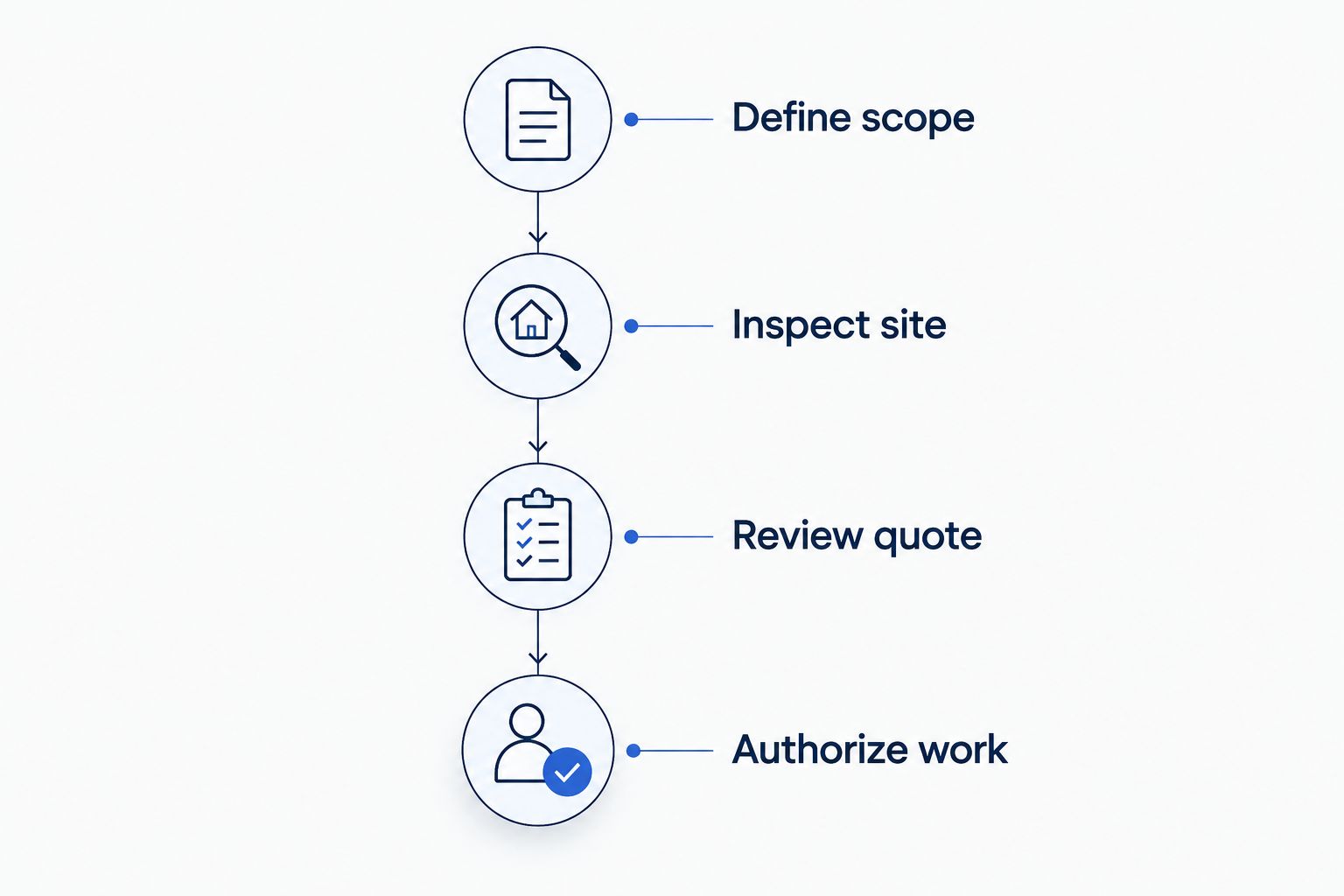
Start with a description of the problem. Let the licensed electrician determine what needs inspection before a final scope is settled. This sequence keeps purchasing decisions and work authorization behind the necessary assessment.
- Define scope. State the problem or planned change, the location, and the affected equipment.
- Inspect site. Arrange the licensed assessment needed to establish existing conditions and requirements.
- Review quote. Check included work, exclusions, responsibilities, and the process for changes.
- Authorize work. Approve the agreed scope and confirm access and coordination arrangements.
You can prepare information without doing electrical work. Provide equipment model information from accessible labels, explain symptoms, and take photographs from a safe position. Do not approach damaged equipment or enter restricted areas for a better picture.
Keep a copy of the accepted scope. If the proposed work changes after inspection, ask for the revised description before approving the change. Verbal understanding is not a substitute for clear project terms.
Request a clear electrical quote
Get a same-business-day response. Discuss the site, scope, and next step—not a same-day completion promise.
Quote terms matter more than an assumed pricing model
Ask for the basis of the written quote rather than assuming how the job will be billed. A defined scope and an investigation into an unresolved fault are different purchasing decisions.
For defined work, check the listed tasks and the conditions attached to them. For troubleshooting, ask what assessment you are authorizing and how further work will be presented. Do not infer either arrangement from the service category alone.
Your 2026 quote review should also separate customer-supplied equipment from contractor-supplied equipment where relevant. Ask who checks suitability and who handles a mismatch. Buying equipment yourself does not remove the need for an electrical assessment.
No billing arrangement fixes an unclear scope. Choose terms you understand, with written boundaries and a clear approval process for changes.
Final verdict: choose by project fit
Choose Eagle Electric for a Bakken electrical project
Best for: a homeowner, business owner, or oilfield operator seeking a licensed contractor serving Watford City and the Bakken region. The stated service scope matches those customer groups.
Start with a quote request and a factual job description. Expect prompt communication and insist on a clear written scope. Do not turn either expectation into an assumption about job duration.
Choose a contractor whose verified scope matches the job
Best for: a buyer whose project has specific requirements that must be confirmed before hiring. Select on documented fit, not an unverified ranking.
Ask the contractor to address the actual location, equipment, safety requirements, and coordination needs. If those questions remain unresolved, settle them before authorizing work. That rule applies regardless of the name on the quote.
| Decision point | What should decide it |
|---|---|
| Regional service fit | Confirmed service to your project location |
| Residential work | Assessment of the existing household electrical system |
| Commercial work | Defined scope and operating coordination |
| Oilfield work | Confirmed site and equipment requirements |
| Communication | A prompt response with a clear next step |
| Quote quality | Written inclusions, exclusions, and change terms |
| Scheduling | An agreed plan, not an assumed completion promise |
FAQ
Is Eagle Electric a good fit for electrical work in Watford City?
Eagle Electric is a licensed electrical contractor based in Watford City, serving residential, commercial, and oilfield customers across the Bakken region. Confirm the requirements of your particular project through a quote request and any necessary on-site assessment.
What should I send when requesting an electrical quote?
Send the project location, a description of the problem or planned change, and information about the affected equipment. Include access restrictions and safe photographs when useful; do not open electrical equipment to gather information.
Does a same-business-day response mean the job gets finished that day?
No. A same-business-day quote-request response is communication, not a promise of same-day inspection or completion. Confirm the assessment and work schedule separately.
Does a 200-amp panel mean I can add any appliance or charger?
No. A 200-amp panel rating alone does not establish capacity for a proposed addition. A licensed electrician must assess the relevant service, loads, wiring, and equipment.
What should a written electrical quote explain?
A written electrical quote should explain the included work, exclusions, responsibilities, and process for approving changes. Ask how existing conditions affect the scope and what completion tasks are included.
Can weatherproof electrical equipment be used in a hazardous location?
Weather resistance does not establish hazardous-location suitability. Equipment for a classified location must match the applicable classification and installation requirements, which require qualified assessment.
How should I compare electrical quotes in 2026?
Compare the same defined scope, not just the stated total. Check equipment responsibilities, exclusions, coordination needs, and the process for additional work before authorizing a contractor.
One last thing
Before calling, write down what happens immediately before the problem appears. A breaker that trips when particular equipment starts gives the electrician a more useful symptom description than saying the power is unreliable.
Do not repeatedly recreate a fault to prove it exists. Record what you already observed, stop using suspect equipment, and let a licensed electrician assess it. Good information helps; risky investigation does not.


