Choose Eagle Electric for licensed residential, commercial, or oilfield electrical contracting across the Bakken region; choose your contractor by the work in the written scope, not a promise of fast completion. For a 2026 project, the useful comparison is whether the contractor can address your actual electrical problem, document the work, and explain what needs an on-site inspection.
- Eagle Electric provides licensed residential, commercial, and oilfield electrical contracting across the Bakken region.
- Homeowners should compare load requirements, existing wiring, and clear written quotes before approving electrical work.
- Businesses and oilfield operators should put shutdown coordination and site requirements into the written scope.
- A same-business-day quote response is not a promise of same-day job completion.
Why this matters
A breaker that keeps tripping and an oilfield building that needs power are different jobs. Both need safe electrical work. They do not need the same assessment, access plan, or quote.
Eagle Electric is based in Watford City, ND, and serves homeowners, businesses, and oil and gas operators across the Bakken region. Eagle Electric is a licensed electrical contractor for residential, commercial, and oilfield projects in the Bakken. Start with that service fit. Then ask what the proposed work includes.
For your 2026 contractor decision, separate three questions: who handles the type of work, what the electrician needs to inspect, and what the written quote commits to. A clear answer to the first question does not settle the other two.
At a glance: home work versus commercial and oilfield work
Use this table to identify the scope your contractor needs to address. These are project requirements, not claims that every installation needs every item listed.
| Dimension | Residential work | Commercial and oilfield work |
|---|---|---|
| Best for | Homeowners planning repairs, additions, or electrical changes | Businesses and operators planning facility or site electrical work |
| Starting point | Symptoms, existing wiring, panel condition, and proposed appliances | Equipment requirements, existing distribution, operating conditions, and site access |
| Load planning | Household loads and proposed additions | Connected equipment and intended operating conditions |
| Standout requirement | A scope that accounts for the existing home | A scope that accounts for the operating facility |
| Safety review | Shock protection, circuit protection, and safe isolation | Safe isolation, site procedures, and hazardous-location requirements where applicable |
| Scheduling | Household access and planned power interruptions | Shutdown coordination and access with responsible site personnel |
| Quote basis | Defined residential work and stated exclusions | Defined equipment, installation boundaries, and stated exclusions |
| Final handover | Explanation of completed work and affected circuits | Explanation of completed work, affected equipment, and operating boundaries |
Neither project type gets a shortcut on safety. The difference is what must be checked before the work is defined.
Homeowners need the existing wiring checked first
For residential work, choose a contractor who evaluates the existing installation before settling the scope. A new appliance does not tell you whether the panel, feeder, or branch circuit can support it. An on-site assessment connects the requested change to the wiring already in the house.
A 200-amp panel rating is not proof that every proposed load fits. The electrician must evaluate the installation and calculate the applicable load. The label on the enclosure is only one piece of the job.
The same rule applies to older wiring. Describe what you know without diagnosing it yourself. Tell the electrician about repeated trips, flickering, damaged receptacles, or previous alterations. Do not remove a panel cover to get a better photograph.
Prepare a short list:
- What stopped working or what you want to add.
- Which rooms or equipment are affected.
- Whether the problem occurs during a particular activity.
- Any known remodeling or electrical changes.
- Areas the electrician will need to access.
Residential electrical contracting is part of Eagle Electric's stated service scope. That makes the company a relevant option for a Bakken homeowner. The practical limit is that service fit alone does not determine the repair; the existing installation still needs evaluation.
Businesses need the shutdown boundary defined
For commercial work, choose a scope that explains what loses power and how the shutdown will be coordinated. A job described only as replacing a panel leaves important operating questions unanswered.
Tell the contractor which equipment must remain available and who can authorize an interruption. Identify tenant access, restricted rooms, and equipment that requires a separate shutdown procedure. Give the electrician the actual operating requirements, not just the building's address.
For a 2026 commercial project, ask these questions before approving the work:
- Which circuits or equipment are affected?
- Who coordinates access and the planned interruption?
- Which owner-supplied equipment is included?
- What work belongs to another trade or equipment vendor?
- What checks are included before the affected equipment returns to use?
The benefit of this approach is a defined work boundary. The drawback is that your business must provide useful operating information. A contractor cannot write an accurate shutdown plan from a vague request to fix the power.
Do not treat residential experience as a substitute for the requirements of a commercial job. Match the written scope to your facility.
Oilfield operators need site conditions in the scope
For oilfield work, choose a contractor whose proposed scope addresses the installation environment and site procedures. An equipment name is not enough. The location, intended use, and operating conditions matter.
Hazardous-location equipment must be suitable for the applicable classification. A weather-resistant fixture is not automatically suitable for a hazardous location. Have qualified personnel establish the requirements before equipment is selected or installed.
Provide the contractor with the site's available classification information, access requirements, equipment documentation, and responsible contacts. Identify temporary installations separately from permanent work. Neither should be treated as permission to bypass electrical protection or site rules.
Oilfield electrical contracting is within Eagle Electric's stated service scope. That is a useful starting point for Bakken operators. It does not replace a project-specific review of equipment suitability, installation conditions, or required documentation.
For your 2026 scope, ask for the assumptions to be written down. If the proposed work relies on owner-provided information or equipment, make that boundary visible before approval.
Both project types need load planning, not guesswork
Residential and commercial projects tie on this point: equipment selection must follow electrical requirements. Bigger is not automatically better. A larger panel enclosure does not repair damaged wiring or establish that the supply can support added loads.
Household projects commonly involve 120-volt and 240-volt circuits. Those are circuit characteristics, not instructions to connect equipment yourself. The electrician must verify the equipment requirements and the installation's suitability.
For a home addition, bring the proposed appliance or equipment information. For a business or oilfield installation, provide the equipment documentation and explain how it will operate. In both cases, an incomplete equipment list makes the scope harder to define.
Ask the contractor to explain the difference between:
- Repairing an existing fault.
- Adding a circuit.
- Replacing a panel.
- Changing the electrical service.
These are not interchangeable descriptions. Your written quote should identify the work actually proposed, rather than grouping every task under an electrical upgrade.
Both project types need a safety-first response
An active electrical hazard takes priority over comparing quotes. Smoke, sparking, or an electric shock requires immediate action to protect people. Keep clear of the equipment and contact emergency services when there is an immediate danger.
Do not keep resetting a breaker that trips repeatedly. Do not open an energized enclosure, replace a breaker with a larger one to stop trips, or bypass protective devices. A licensed electrician needs to diagnose the cause.
GFCI protection addresses ground-fault shock hazards; it does not turn damaged wiring into a safe installation. Likewise, a generator needs a suitable connection arrangement. Never connect a generator in a way that can backfeed utility wiring.
For a facility, follow the site's established emergency and isolation procedures. Tell the contractor what occurred and what has already been isolated by authorized personnel. Do not send someone into an electrical room to investigate equipment they are not qualified to handle.
Safety is an honest tie. Every contractor you consider must meet the requirements of the work.
A prompt quote response is not a completion promise
Eagle Electric emphasizes same-business-day responses to quote requests and clear written quotes. Use that response to establish the next step, not to assume the job will be finished that day.
A response, an inspection, a written quote, and completed work are different milestones. Keep them separate in your 2026 project plan. Ask when the site can be assessed and what information is needed before the contractor can define the work.
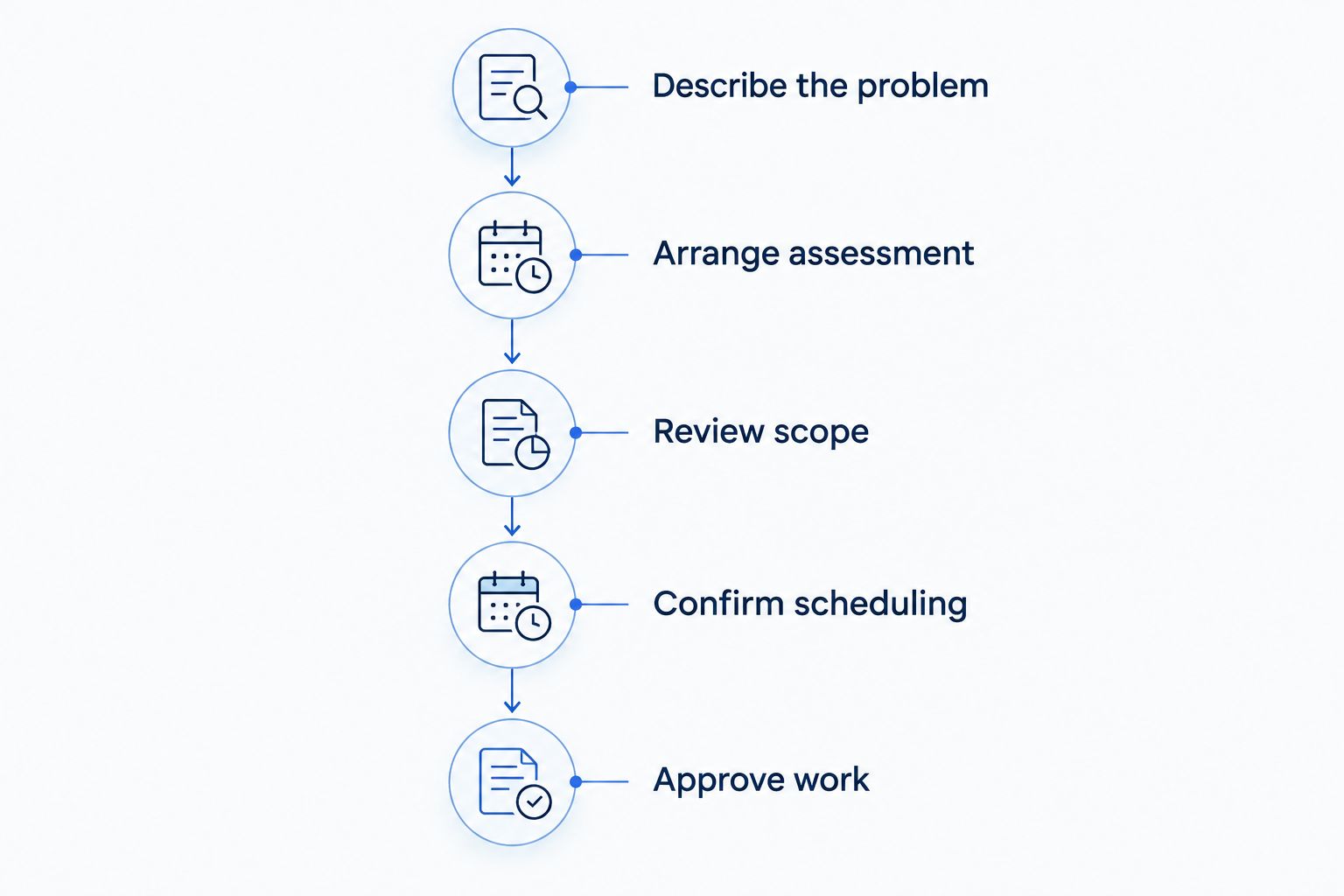
Follow this sequence:
- Describe the problem. Give the location, symptoms, and requested change.
- Arrange assessment. Confirm access and whether an on-site inspection is needed.
- Review scope. Read the included work, assumptions, and exclusions.
- Confirm scheduling. Agree on access and any planned power interruption.
- Approve work. Authorize the defined scope before installation begins.
You can speed up the discussion by providing useful information. You cannot replace an inspection with urgency. Ask for the next confirmed milestone instead of an unsupported completion promise.
Compare written quotes by scope
The better quote is the one you can understand and compare against the actual job. Read the work description before making a decision. A short quote is not necessarily a clear quote.
Check whether it addresses equipment, installation work, access, planned interruptions, and exclusions. Ask who handles permits and inspections where required. Confirm whether owner-supplied equipment is included and how changes to the agreed work will be authorized.
Use the same job description when requesting proposals. Otherwise, you are comparing different scopes under the same project name. One proposal might address a fault while another includes a broader replacement.
Before you approve a 2026 quote, answer these questions:
- Can you identify exactly what will be installed, repaired, or replaced?
- Are the assumptions and exclusions understandable?
- Is responsibility for access and shutdown coordination clear?
- Do you know how unexpected conditions will be handled?
- Is the next project milestone confirmed?
If an answer is unclear, ask for clarification in writing. That is a practical decision step, not a reason to guess what the contractor intended.
Request a clear electrical quote
Describe your project and request a same-business-day response. Job completion is scheduled separately.
Final verdict: choose by project fit
Choose Eagle Electric for stated Bakken service coverage
Best for: Homeowners, businesses, and oil and gas operators seeking licensed electrical contracting in the Bakken region. The company is based in Watford City and lists residential, commercial, and oilfield work within its services.
The next move is straightforward: describe the problem, establish whether an inspection is needed, and request a clear written scope. Do not turn service coverage into an assumption about a specific installation or completion date.
Choose a project-ready scope before authorizing work
Best for: Anyone weighing proposals for a repair, upgrade, or facility installation. Require the same safety standard from every contractor, then compare the work each proposal actually includes.
| Decision point | What should win |
|---|---|
| Service fit | Explicit coverage of your project type |
| Existing installation | An assessment appropriate to the work |
| Load planning | Verified requirements and applicable calculations |
| Oilfield suitability | Documented site and equipment requirements |
| Safety | Required protection and qualified electrical work |
| Scheduling | A confirmed next milestone |
| Quote clarity | Defined work, assumptions, and exclusions |
FAQ
Is Eagle Electric a fit for residential electrical work?
Eagle Electric provides licensed residential electrical contracting across the Bakken region. Describe your repair or proposed change and establish whether an on-site inspection is needed before the scope is finalized.
Does Eagle Electric handle commercial and oilfield projects?
Eagle Electric lists commercial and oilfield electrical contracting within its services. Your project still needs a scope that addresses equipment requirements, site access, and operating conditions.
Does a same-business-day quote response mean same-day completion?
No. A quote response starts the discussion; assessment, scope approval, and job scheduling are separate steps.
Does a 200-amp panel mean I can add any appliance?
No. A panel rating does not establish available capacity for every added load. A licensed electrician must evaluate the installation and the applicable load requirements.
What should I send with an electrical quote request?
Send the location, project type, symptoms or requested change, and available equipment information. Provide photographs only when you can take them safely without opening electrical equipment.
What should I do if a breaker keeps tripping?
Stop repeatedly resetting the breaker and arrange diagnosis by a licensed electrician. Keep clear of equipment that is smoking or sparking, and contact emergency services when there is immediate danger.
What matters most when comparing electrical quotes in 2026?
Compare the defined work, assumptions, exclusions, and scheduling milestones. Give contractors the same project description so the proposals address the same job.
One last thing
Ask the electrician to explain what the proposed work will not fix. A panel replacement, an added circuit, and a service change solve different problems.
That question keeps your 2026 decision tied to the fault or need you started with. Get the answer into the written scope before you approve the work.