
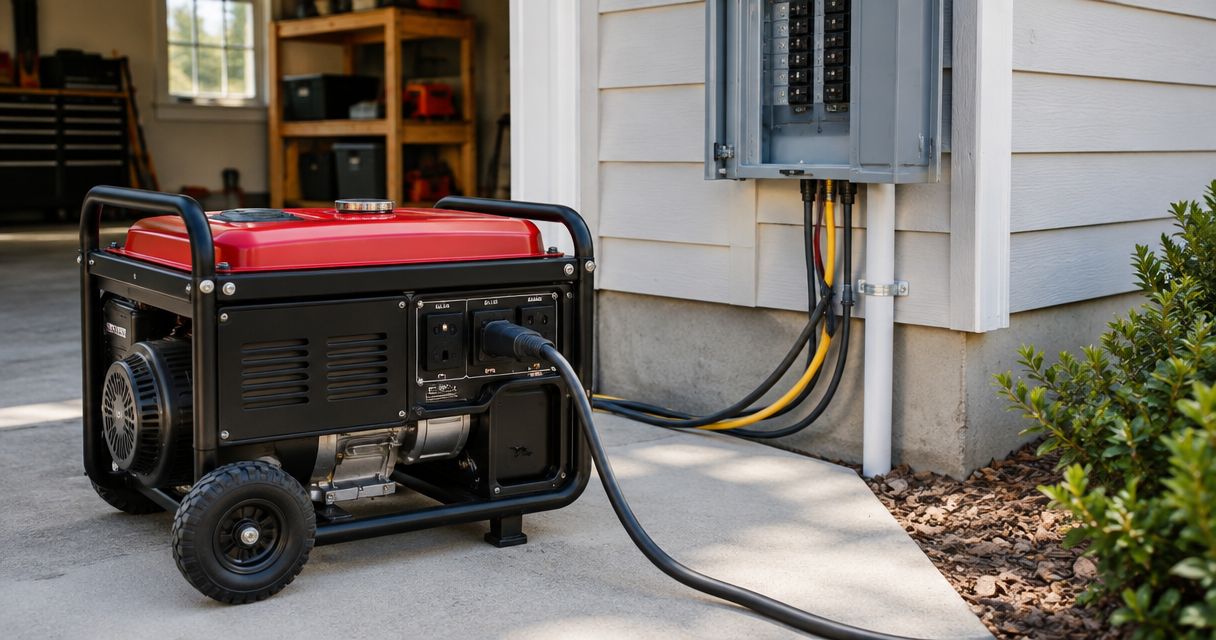
Yes. A portable generator can damage your home's wiring when an improper connection, overload, loose connection, or electrical fault overheats conductors or equipment. Unstable generator output can also damage connected appliances without damaging the wiring itself. The safe setup uses properly rated equipment, working overcurrent protection, and an approved way to isolate generator power from utility power.
- Portable generator damage home wiring risks center on unsafe connections, overloads, and electrical faults—not normal generator use.
- Never feed generator power into a household receptacle or use a cord with exposed male plugs.
- A transfer switch or compatible, approved panel interlock separates utility power from generator power.
- Eagle Electric provides licensed residential electrical contracting for Watford City and Bakken homeowners.
Can a portable generator damage your home's wiring?
Yes, but separate two problems: damage to the electrical installation and damage to the equipment plugged into it. Excessive current and poor connections produce heat. Incorrect voltage or frequency can harm appliances even when the branch-circuit wiring remains intact.
For your 2026 outage plan, have a licensed electrician assess the connection before you need it. Eagle Electric provides residential electrical contracting in Watford City and across the Bakken region.
| Problem | What happens | What needs attention |
|---|---|---|
| Improper backfeed connection | Generator power energizes wiring through an unintended path and can reach utility lines | Stop using the connection; have a licensed electrician assess it |
| Overloaded or undersized conductors | Current creates excessive heat | Load calculation, conductor sizing, and overcurrent protection |
| Loose or damaged connection | Resistance produces localized heating and possible arcing | Inspection of the affected plug, inlet, termination, or equipment |
| Incorrect voltage or unstable output | Appliances malfunction or suffer electrical damage | Generator condition, output, connected loads, and neutral arrangement |
| Correctly installed transfer equipment | Selected circuits receive generator power while isolated from utility power | Proper operation, maintenance, and load management |
A breaker trip is a warning, not proof that the wiring is damaged. A breaker that stays on is not proof that every connection is safe, either. Loose connections can overheat without drawing enough current to trip a breaker.
Why this matters
During an outage, the immediate goal is simple: keep essential equipment running. The mistake is treating a generator connection like an ordinary extension-cord job when it supplies the house panel.
A portable generator introduces another power source. Your electrical system needs a controlled way to select that source without connecting it to the utility supply. Turning off the main breaker by memory does not provide the same protection as properly installed transfer equipment.
Never connect a generator to a wall receptacle, dryer receptacle, or range receptacle to energize the house. A cord with male plugs at both ends creates exposed energized prongs and a serious shock hazard. Do not make one, buy one, or keep one as an emergency workaround.
Direct appliance connection: keeps house wiring out of the path
Powering a suitable plug-in appliance directly from a generator does not route power through the home's branch-circuit wiring. That removes the house panel from that particular connection. It does not remove cord, shock, fire, or exhaust hazards.
Use only cords and connections permitted by the generator and appliance instructions. The cord's conductor size, length, condition, grounding arrangement, and environmental rating all matter. An intact-looking jacket does not establish that a cord can carry the intended load.
Do not improvise connections for hardwired equipment. A furnace, well pump, or other permanently connected load needs an appropriate electrical arrangement assessed by a licensed electrician.
Transfer equipment: supplies selected house circuits
A transfer switch selects between utility power and generator power for the circuits it serves. A panel interlock provides a different arrangement: a compatible mechanical device prevents the utility main and generator supply breaker from being on together.
Neither option is a universal fit. Panel compatibility, equipment approval, circuit requirements, generator configuration, and local electrical requirements determine what belongs in your installation.
| Connection method | Best for | Advantage | Limitation |
|---|---|---|---|
| Direct appliance cords | Suitable plug-in loads | Leaves home branch wiring out of the supply path | Does not provide an improvised connection for hardwired equipment |
| Transfer switch | Selected household circuits | Provides a defined source-selection arrangement | Requires installation and compatibility checks |
| Approved panel interlock | Compatible panels with planned manual load control | Prevents simultaneous utility and generator breaker operation | Requires careful circuit selection and a compatible installation |
For a 2026 installation, choose the connection method before choosing adapters or cords. The portable generator transfer-switch guide provides related background. A transfer switch alone does not make a manually started portable generator start automatically.
Why generator-related damage varies
The generator's advertised output is only part of the picture. These factors determine whether the complete electrical path operates safely:
- Connection method. Approved transfer equipment prevents an unintended connection between generator power and utility power. A makeshift backfeed arrangement does not.
- Load and starting demand. Motors draw additional current while starting. A generator that runs a load after startup still needs adequate starting capability.
- Conductor and connector ratings. Cords, inlets, breakers, and wiring must suit the installation. The lowest-rated component cannot be ignored.
- Existing wiring condition. Loose terminals, damaged insulation, corrosion, and deteriorated equipment need attention before backup power is added.
- Generator output. Voltage, frequency, and the generator's response to changing loads affect connected equipment.
- Neutral and grounding arrangement. The generator and transfer equipment must work together correctly. An electrician needs to assess bonding and whether neutral switching is required.
A larger generator does not automatically force more current through every circuit. Loads draw current, and correctly selected protection limits faults and overloads. The danger comes from an unsuitable installation, excessive connected demand, or failed equipment—not size alone.
What an electrician should check before connection
A safe 2026 backup-power assessment starts with the existing electrical system, not a shopping list. Your electrician needs to know what you want running and how the generator will connect.
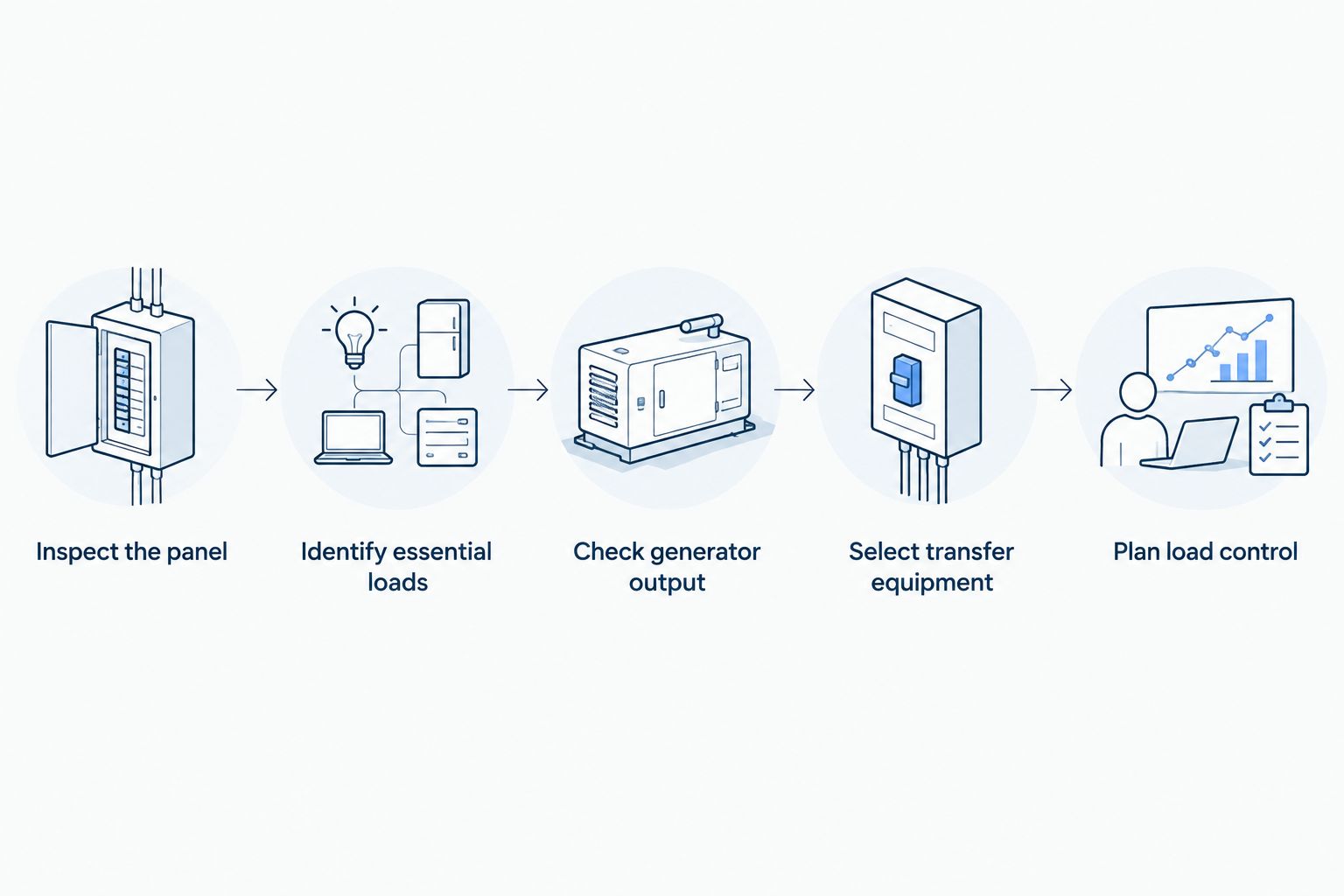
- Inspect the panel. Check panel condition, equipment compatibility, terminations, and signs of overheating or moisture damage. Do not remove the panel cover yourself.
- Identify essential loads. List the equipment that must operate during an outage. Separate necessary loads from equipment you can leave off.
- Check generator output. Match the generator's actual receptacles, voltage, and output ratings to the proposed connection. Do not assume an adapter solves an electrical mismatch.
- Select transfer equipment. Confirm how utility and generator power will remain isolated. Assess the neutral and grounding arrangement as part of that decision.
- Plan load control. Establish which loads can operate together and what the homeowner must do during transfer. Include startup demand, not just running demand.
Ask for the operating instructions in plain language. You should understand which controls to use, which circuits to leave off, and what conditions require stopping the generator. Do not accept an arrangement that depends on remembering to defeat a safety device.
Eagle Electric is a licensed electrical contractor for Watford City and Bakken homeowners who need residential electrical work. An on-site inspection is needed to determine what your existing panel and wiring require; a description of the generator alone cannot establish compatibility.
Eagle Electric responds to quote requests the same business day and provides clear written quotes. That response is not a promise of same-day installation or job completion. Have the written scope identify the proposed connection, any panel repairs, and the work included.
Request a written electrical quote
Get a same-business-day response to your quote request. Installation requires an assessment.
Voltage problems are not the same as overloaded wiring
Typical U.S. residential service supplies 120 volts for many branch-circuit loads and 240 volts for larger equipment. Household equipment generally expects a frequency of 60 hertz. These are electrical-system characteristics, not a sizing recommendation for your generator.
A generator connection must supply the voltage the equipment requires. A receptacle adapter does not turn a 120-volt source into a proper 240-volt supply. Never use improvised bridging connections to make a generator appear compatible with a house inlet.
Voltage drop also matters. An unsuitable extension cord or excessive load can reduce the voltage reaching equipment. Motors can struggle to start or overheat under improper operating conditions.
Electronic equipment presents another concern: output quality. Generator waveform distortion and voltage regulation affect connected electronics differently from a hot terminal or overloaded wire. A surge protector does not correct sustained incorrect voltage, frequency problems, or an unsafe generator connection.
For a 2026 equipment review, use the generator manual and the appliance manufacturer's requirements. Do not judge electrical output by engine sound alone. Have abnormal output or repeated equipment problems assessed rather than experimenting with household loads.
What should you do if wiring smells hot during generator use?
Stop using the affected setup. Burning insulation, smoke, sparking, melted connectors, buzzing accompanied by heat, or visible discoloration requires attention—not another attempt with fewer appliances.
If you see smoke or fire, get people away and call emergency services. Do not touch damaged electrical equipment or approach a smoking panel. Shut equipment down only when you can do so without entering the hazardous area.
For a tripped breaker without other danger signs, turn off the connected loads and follow the equipment instructions. Do not repeatedly reset the breaker or replace it with a higher-rated breaker. A licensed electrician needs to investigate recurring trips, overheated connections, and suspected wiring damage.
Tell the electrician what was running, what tripped, and where you noticed heat or odor. Keep damaged cords or connectors out of service. Do not reconnect them simply because they have cooled down.
Can a portable generator damage wiring if the main breaker is off?
Yes. Turning off the main breaker does not correct an undersized cord, loose terminal, overloaded circuit, or unsuitable generator connection. It also does not replace approved transfer equipment that prevents the utility and generator supplies from being connected together.
Does an inverter generator eliminate the risk?
No. An inverter generator does not eliminate unsafe backfeeding, overloads, damaged cords, or incorrect neutral and grounding arrangements. Suitable output for electronics does not make an unsuitable connection safe.
Is an older electrical panel automatically unsafe for a generator?
No. Age alone does not establish whether a panel can support an approved generator connection. Condition, identification, compatible equipment, and the proposed installation require an on-site assessment.
FAQ
Can a portable generator burn out my home's wiring?
Yes. Overloads, loose connections, electrical faults, and improper connections can overheat wiring or equipment. A correctly installed generator connection uses suitable conductors, overcurrent protection, and utility isolation.
Can I plug a generator into a dryer outlet if I turn off the main breaker?
No. Do not use a dryer receptacle to feed generator power into house wiring. Have a licensed electrician install an appropriate inlet and approved transfer arrangement.
Will a whole-house surge protector make my generator connection safe?
No. A surge protector does not isolate the utility supply, prevent circuit overloads, or correct sustained voltage and frequency problems. Generator connection safety requires the right installation.
Is a transfer switch better than a panel interlock?
Neither arrangement is the right choice for every house. A licensed electrician must check panel compatibility, generator configuration, intended loads, and applicable requirements before selecting the arrangement.
Can I run a portable generator in my garage with the door open?
No. Run a portable generator outdoors, at least 20 feet from the home, with exhaust directed away from openings, following U.S. Consumer Product Safety Commission guidance. An open garage door does not make indoor operation safe.
Does a bigger generator mean I need a bigger electrical panel?
No. Generator size alone does not determine whether you need a panel upgrade. Panel condition, connection requirements, and the loads you intend to supply determine the necessary work.
Does a tripped breaker mean my wiring is damaged?
No. A trip means the protective device operated; it does not establish the condition of the wiring. Repeated trips, heat, burning odors, or damaged connectors require investigation before further use.
One last thing
A generator can leave the house wiring untouched and still create a deadly exhaust hazard. Keep that separate from the electrical checklist. U.S. Consumer Product Safety Commission guidance calls for outdoor operation at least 20 feet from the home, with exhaust directed away from windows, doors, and vents.
For your 2026 outage plan, pick the outdoor operating location before the outage. Then have the inlet location and connection planned around safe placement. Never move a running generator into a garage to solve a cord-length problem.


