

Yes. You can install an EV charger in an older home when a licensed electrician verifies electrical capacity, wiring condition, grounding, and a safe circuit route. The house’s age alone does not require a panel replacement, but damaged equipment or insufficient capacity must be addressed before charging begins. For an installation planned in 2026, start with an on-site assessment—not a charger purchase.
- EV charger older home installation depends on electrical capacity and condition, not the home's age alone.
- Eagle Electric provides residential electrical contracting for homeowners in Watford City and the Bakken region.
- A 240-volt charging circuit needs proper sizing, protection, grounding, and verified capacity.
- Load management can address capacity constraints, but it does not repair unsafe wiring.
Can you install an EV charger in an older home?
Yes—provided the electrical system can safely support the charging equipment. An older home can have updated electrical service. A newer-looking panel can still have limited capacity or installation defects. You need the actual conditions checked.
The main installation paths differ in what they solve. None replaces an inspection.
| Installation path | Best for | Main benefit | Main limitation |
|---|---|---|---|
| Existing 120-volt circuit assessment | Drivers whose charging needs fit slower charging | Can avoid adding higher-power equipment if the circuit is suitable | An ordinary-looking receptacle is not proof of a safe charging circuit |
| New 240-volt charging circuit | Homes with adequate electrical capacity | Provides a dedicated path for Level 2 charging | Requires suitable wiring, protection, and a feasible route |
| Charging with load management | Homes where charging needs coordination with other electrical loads | Controls charging demand within the system’s limits | Requires compatible equipment and an approved design |
| Panel or service upgrade | Homes with defective equipment or capacity needs that other approaches do not resolve | Addresses the identified electrical limitation | Adds work beyond installing the charging equipment |
For the contractor’s role in this work, see the overview of Eagle Electric. The important distinction is between installing equipment and proving the house can support it.
Why this matters
A charger can draw power for an extended period. That makes circuit condition, connection quality, and correct sizing important—not just whether the breaker stays on during a brief test.
Your 2026 installation plan should identify the limiting condition before selecting charging power. An empty breaker position is space, not proof of available electrical capacity. A larger panel enclosure does not establish that the service can carry another load.
Existing 120-volt charging: check the circuit first
Best for: drivers whose daily charging needs fit Level 1 charging. Level 1 equipment uses a 120-volt supply. Its advantage is a lower power requirement than Level 2 equipment; its drawback is slower charging.
Do not assume a garage receptacle is suitable because a portable charger plugs into it. The electrician needs to assess the circuit, receptacle, grounding, protection, and other connected loads. Loose or deteriorated connections need correction.
An existing outlet also needs a practical location. A cord stretched through a doorway or across a walkway is not a sound charging plan. Do not use extension cords, power strips, or improvised adapters to make the parking location work.
If the circuit cannot support the equipment as required by its instructions and applicable rules, change the installation plan. Repeated breaker trips are a reason to stop charging and have the circuit inspected—not a reason to fit a larger breaker.
New 240-volt charging: verify capacity and routing
Best for: homeowners who need Level 2 charging and have a suitable electrical supply. Residential Level 2 equipment commonly uses a 240-volt circuit. Its benefit is higher charging power than Level 1; its limitation is the electrical work needed to support that power safely.
The electrician selects the circuit arrangement based on the charging equipment, installation conditions, and applicable requirements. Breaker size, conductor size, termination ratings, and protection must work together. The charging setting cannot simply be increased because the vehicle accepts more power.
The route matters too. A panel beside an attached garage presents a different job from a panel across a finished basement or a detached garage. The written scope should identify routing, wall access, outdoor exposure, and any excavation or finish repair responsibilities.
Hardwired and receptacle-connected installations also have different requirements. Choose the connection method through the electrical design—not solely because a plug seems easier to replace.
Load-managed charging: control demand, not wiring defects
Best for: homes where an approved control system can keep charging within available electrical capacity. EV energy management equipment can adjust or interrupt charging in response to electrical demand. This can provide an alternative to increasing service capacity when the design and local requirements allow it.
The trade-off is straightforward: the vehicle does not always receive the charger’s maximum output. Charging depends on the control strategy and other loads operating in the house.
A timer alone is not the same as an electrical load-management system. Scheduling charging overnight does not establish that the service is adequately sized, because other equipment can still operate during those hours.
Ask what happens if the monitoring or control equipment loses communication. The electrician should explain the approved operating arrangement, equipment compatibility, and commissioning checks. Load management does not fix damaged conductors, missing grounding, or defective panel equipment.
Panel or service upgrades: solve the identified limitation
Best for: homes with unsafe equipment or electrical needs that require additional capacity. A panel upgrade and a service upgrade are not automatically the same job. Replacing the panel does not, by itself, increase the capacity of the service supplying it.
A 100-amp service does not automatically rule out EV charging. A 200-amp service does not automatically approve it. The existing loads, proposed charging demand, equipment condition, and accepted assessment method determine the next move.
Ask the electrician to identify exactly what needs changing. The answer might involve the panel, service equipment, utility coordination, a new circuit, or a combination of work. Avoid a proposal that treats every component as interchangeable.
If additional capacity is recommended, use this guide to whether a 200-amp electrical panel upgrade is worth it to frame your questions. The decision still belongs to the assessment of your house.
What should the electrician inspect before installation?
An older-home EV charging assessment should follow the electrical path from the supply to the parking location. You can provide access and describe your charging needs. Leave panel covers, electrical testing, and wiring work to the licensed electrician.
- Service capacity. Establish the existing service rating and evaluate the proposed charging load alongside the home’s other electrical loads.
- Panel condition. Check equipment condition, breaker compatibility, available circuit positions, and signs of overheating or deterioration.
- Wiring condition. Assess the proposed circuit route, existing wiring involved in the work, grounding, and bonding.
- Charging location. Confirm parking position, cable reach, equipment mounting, physical protection, and exposure to weather.
- Installation scope. Define the required work, permits, inspections, utility involvement, and final checks before charging begins.
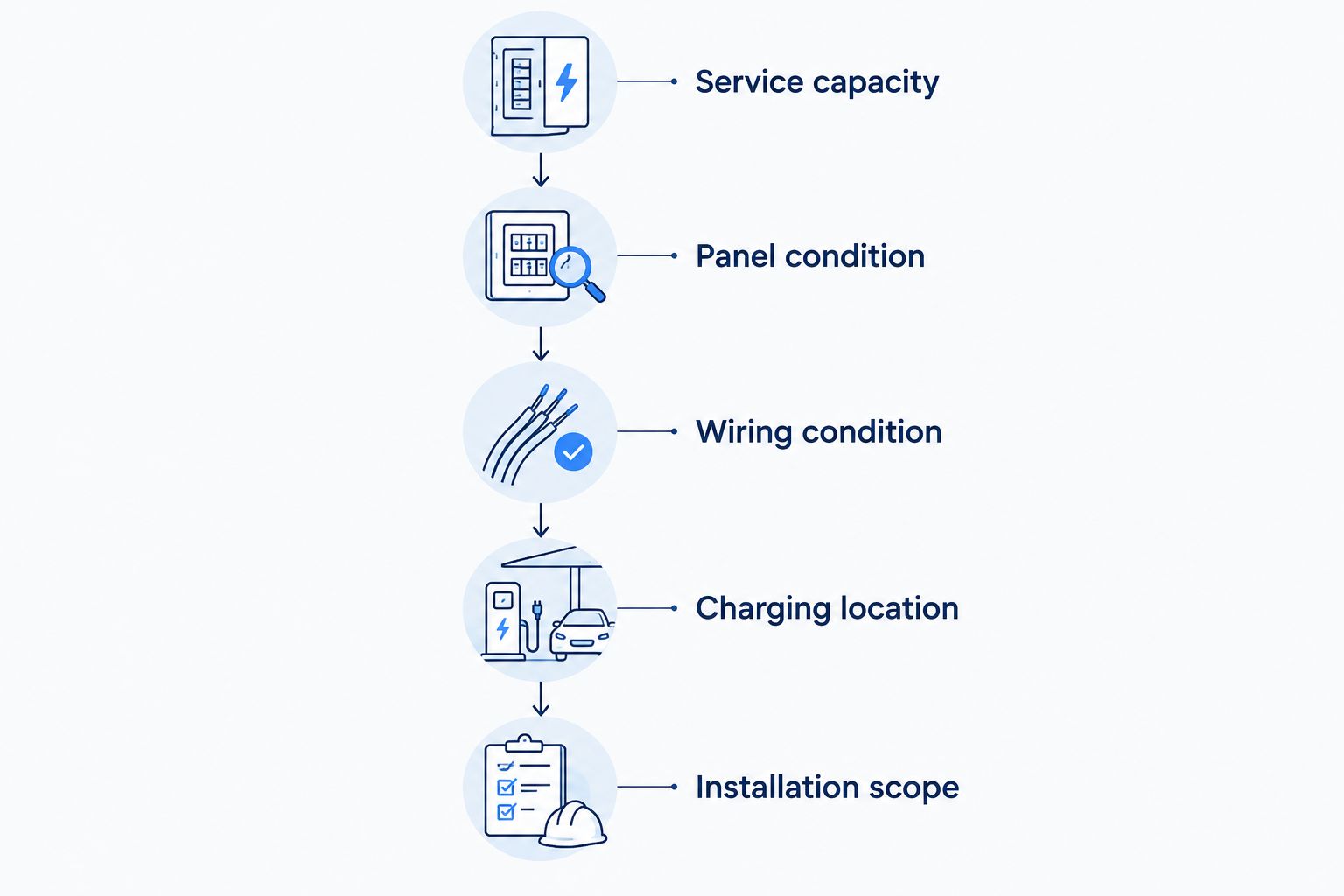
For a 2026 project, confirm the permit and inspection requirements with the authority responsible for your property. Do not assume that an online installation example follows the rules applicable to your address.
Why older-home EV charger installations vary
Two houses built at the same time can need different work. Prior repairs, additions, and electrical upgrades change the starting point.
- Existing electrical demand. Electric heating, water heating, cooking equipment, and other loads affect the capacity assessment.
- Equipment condition. Corrosion, overheating, damaged insulation, or unsuitable components require attention regardless of available capacity.
- Circuit route. Finished walls, detached garages, exterior runs, and buried pathways change the installation scope.
- Charging requirements. Your driving pattern, parking time, and vehicle charging capability help establish an appropriate charging level.
- Grounding and protection. The installation needs the grounding, bonding, and protective equipment required for its design.
- Permit and utility requirements. Service changes can require coordination beyond the work inside your house.
Do not buy the highest-output charger first and ask the house to catch up. Establish the charging requirement, then match the electrical design to it.
What should a clear written quote include?
A useful quote separates the charging installation from any corrective electrical work. You should understand what is included before authorizing the job. A vague line for “charger installation” leaves too much unresolved.
Ask the quote to identify:
- The charging equipment and who supplies it.
- The proposed circuit and connection method.
- Any panel, service, grounding, or wiring corrections.
- Cable routing, mounting location, and physical protection.
- Permit, inspection, and utility coordination responsibilities.
- Exclusions such as drywall repair or excavation restoration.
- Final testing, equipment settings, and operating instructions.
Eagle Electric is a fit for Watford City and Bakken homeowners seeking a licensed residential electrical contractor. Request a same-business-day response to your quote inquiry and a clear written scope. A response to an inquiry is not a promise of same-day installation.
For your 2026 project, send the parking location, vehicle charging requirements, and accessible exterior photos of the panel with the request. Do not remove electrical covers to take pictures. Photos support the conversation; they do not replace an on-site inspection.
Request a written electrical quote
Describe your charging needs and request a same-business-day response to your inquiry.
Does an older home need all-new wiring for an EV charger?
An older home does not automatically need complete rewiring for an EV charger. The electrician must assess the new circuit and any existing electrical equipment involved in supplying it.
Old wiring elsewhere in the house still deserves attention when defects are found. But a charger proposal should distinguish necessary charging work from separately recommended repairs. Ask for that distinction in writing.
Can I keep charging if the plug or outlet gets hot?
Stop charging if the plug or receptacle shows overheating, melting, discoloration, or a burning smell. Have a licensed electrician inspect the circuit and equipment before using them again.
Do not repeatedly reset a tripping breaker or replace it with a larger one. A breaker protects the circuit; changing its rating without a properly designed circuit can create a fire hazard. If there is smoke or fire, leave the area and contact emergency services.
FAQ
Can you install an EV charger in a house with a 100-amp service?
A 100-amp service does not automatically prevent EV charger installation. A licensed electrician must assess existing loads, charging demand, equipment condition, and whether approved load management is appropriate.
Does a 200-amp panel mean my house is ready for an EV charger?
A 200-amp panel does not automatically establish EV charging capacity. The electrician must verify the service, existing loads, circuit design, and equipment condition.
Can I charge an electric car from an old garage outlet?
An old garage outlet needs an electrical assessment before you rely on it for EV charging. The circuit, receptacle, grounding, protection, and equipment instructions all matter.
Is load management better than upgrading the electrical service?
Load management is an alternative only when an approved design addresses the home's capacity constraint. It controls charging demand but does not correct unsafe electrical equipment or wiring.
Do I need a permit to install an EV charger in an older home?
Confirm permit and inspection requirements with the authority responsible for your property before installation. Requirements depend on the work and the locally adopted rules.
Can Eagle Electric assess residential electrical work for EV charging?
Eagle Electric provides licensed residential electrical contracting in Watford City and across the Bakken region. Describe your charging needs and request an on-site assessment and clear written quote.
One last thing
Tell the electrician about your next electrical project, not just your next vehicle. Planned electric heating, a workshop, or other substantial loads belong in the conversation before the charging design is finalized.
Your 2026 charging installation should fit the house you have and the changes you actually plan. More charging power is not the goal. Safe, useful charging is.


