
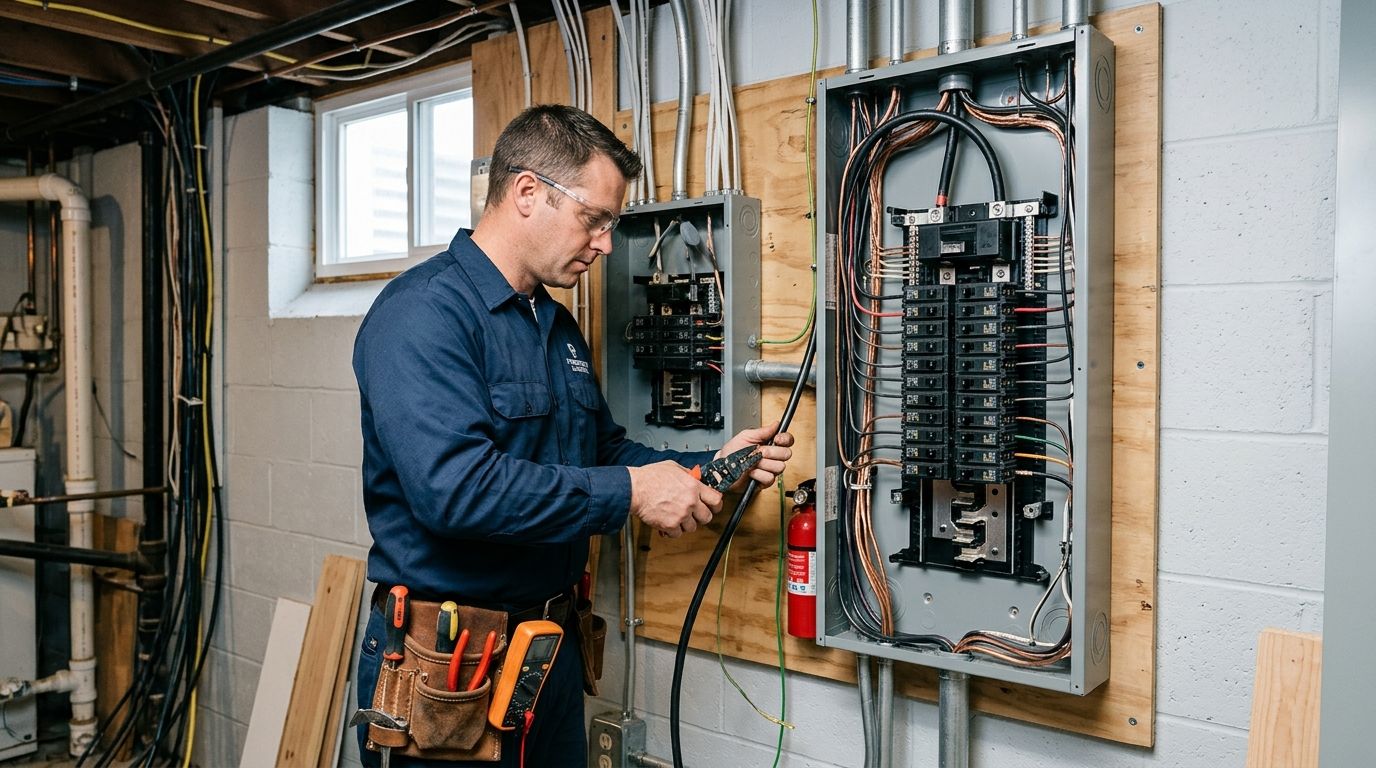
A 200-amp panel upgrade is worth it when a licensed electrician’s load calculation shows your existing service cannot support the equipment you plan to use. For a 2026 project, the catch is scope: replacing the panel alone does not increase service capacity if the meter equipment, service conductors, or utility connection also need changes.
- Is a 200 amp panel upgrade worth it? Yes, when a load calculation supports the added capacity.
- A full breaker panel does not, by itself, prove you need a larger electrical service.
- Eagle Electric provides licensed electrical contracting for homeowners in Watford City and the Bakken region.
- Ask for a written scope covering the panel, service equipment, utility coordination, permits, and inspection.
Why this matters
You need enough electrical capacity for the equipment you actually use. You also need a safe panel, suitable wiring, and room for the required circuits. Those are related questions, but they are not the same question.
For homeowners planning work in 2026, Eagle Electric provides residential electrical contracting in Watford City and across the Bakken region. Start with an on-site inspection and a clear written quote, not an assumption that every older house needs a larger service.
Buy the capacity your home needs. Fix the defects your inspection identifies. A larger number on the main breaker does not replace either step.
Is upgrading to a 200-amp electrical panel worth it?
Yes, when the upgrade solves a documented capacity problem or supports planned electrical loads that your existing service cannot accommodate. It is not automatically worthwhile because your panel looks old, its breaker spaces are occupied, or a neighbor installed one.
A service load calculation evaluates the home’s electrical demand under the applicable electrical code. It is not the sum of the numbers printed on every branch-circuit breaker. Your electrician also checks equipment condition and whether the proposed work requires changes beyond the panel enclosure.
| Option | Best for | Main benefit | Main limitation |
|---|---|---|---|
| Keep the existing service | Homes with adequate calculated capacity and serviceable equipment | Avoids unnecessary service replacement | Does not add capacity or repair existing defects |
| Replace the panel at the existing service rating | Homes with a panel problem but adequate service capacity | Addresses the panel’s condition or circuit-space needs | Does not increase the electrical service rating |
| Upgrade to 200-amp service | Homes whose calculated demand supports a larger service | Adds capacity for an approved electrical plan | Can require meter, conductor, utility, and inspection work |
| Use approved load management | Homes where suitable equipment can control competing loads | Can reduce simultaneous demand | Requires compatible equipment and an approved design |
The deciding evidence is the load calculation plus the equipment inspection. Neither a crowded panel nor an appliance shopping list answers the whole question.
Keeping 100-amp service: when it makes sense
Keeping a 100-amp service makes sense when the calculated load fits, the equipment is safe, and your planned additions do not change that conclusion. The service rating alone does not tell you whether the house has an electrical problem.
Your electrician still needs to inspect the panel and associated equipment. Damaged connections, improper breaker use, corrosion, and unsuitable wiring need attention regardless of the service size.
Best for: A home with adequate capacity and no planned loads that exceed it. The benefit is avoiding work that does not solve a real problem; the limitation is that future additions require another capacity review.
Do not confuse keeping the service rating with keeping every existing component. A panel replacement or circuit repair can be necessary without increasing the service to 200 amps.
Upgrading to 200-amp service: when it earns its place
A 200-amp upgrade earns its place when the calculated demand and project plans support it. Examples to discuss with your electrician include electric vehicle charging, electric heating, cooking equipment, a workshop, or an addition with new electrical loads.
The equipment details matter. Give your electrician the nameplate information or manufacturer specifications for what you intend to install, rather than saying you might add “some bigger appliances.” That lets the design address actual loads.
Best for: A home with documented capacity needs beyond its existing service. The benefit is added capacity; the drawback is a larger project when the service equipment and utility connection also need changes.
A 200-amp panel does not guarantee room for every future load. Your electrician must still calculate demand, select suitable equipment, and design each new circuit correctly.
Load management: when a larger service is not the only answer
Approved load-management equipment controls selected electrical loads so they do not exceed a defined limit. For example, an appropriate system can adjust vehicle charging based on other household demand.
Best for: A home where a specific controllable load creates the capacity issue and an approved design fits the installation. The benefit is managing demand without automatically replacing the entire service; the limitation is that equipment compatibility and operating restrictions matter.
Load management does not repair a damaged panel or unsafe wiring. Ask your electrician to separate the capacity question from the condition question before comparing the options.
How to decide before approving the work
Use this sequence for a 2026 electrical project. Keep the investigation with a licensed electrician; you do not need to open the panel or inspect energized parts yourself.
- List planned loads. Identify the equipment you intend to add, including its electrical specifications. Separate committed projects from ideas with no equipment selected.
- Inspect existing equipment. Have the electrician assess the panel, service rating, meter equipment, visible service conductors, grounding, bonding, and relevant wiring conditions.
- Calculate demand. Ask whether the existing service supports the present and proposed loads under the applicable requirements. Request an explanation you can understand.
- Define the scope. Establish whether the job is a panel replacement, a service upgrade, circuit work, or a combination. Identify utility involvement and inspection requirements.
- Compare written options. Review what each approach fixes, what it leaves unchanged, and which future loads it accommodates. Approve the scope before scheduling.
Your written scope should make the service rating explicit. It should also distinguish equipment being replaced from equipment that will remain, so you are not comparing different jobs as though they were identical.
For scheduling questions, review how long an electrical panel upgrade takes. Ask your electrician to explain the planned outage, utility coordination, and inspection sequence for your property rather than assuming a standard completion date.
Why the value of a 200-amp upgrade varies
The value of a service upgrade depends on the problem it solves. For a 2026 decision, these factors belong in the inspection and written scope:
- Existing capacity. A home with adequate calculated capacity has a different need from one whose proposed loads exceed its service rating.
- Equipment condition. A damaged or unsuitable panel needs attention even when the household does not need more capacity.
- Planned electrical loads. Selected equipment provides a firmer basis for sizing than a general wish to “future-proof” the house.
- Service equipment compatibility. The meter equipment, conductors, disconnects, and panel must suit the proposed installation. A panel swap alone does not establish that.
- Utility and inspection requirements. Connection arrangements and required approvals affect the work sequence. Confirm them before setting expectations for the outage.
- Circuit and wiring needs. More service capacity does not add branch circuits, replace damaged wiring, or correct improper connections elsewhere in the house.
A useful upgrade solves a stated problem with a defined scope. Ask what changes if you keep the existing service, and ask which planned loads make the larger service necessary.
Will a 200-amp panel lower my electric bill?
A 200-amp panel does not lower your electric bill by itself. It increases available capacity when installed as part of a suitable service upgrade; it does not reduce the energy your appliances use.
Think of capacity and consumption separately. A larger service lets a properly designed installation supply more demand, but your bill still reflects energy use and the utility’s applicable charges. Do not justify the project with an assumed energy-saving payback.
Does a full breaker panel mean I need 200 amps?
A 200-amp upgrade is not automatically necessary because every breaker space is occupied. Breaker space and service capacity are separate limits, and either one can become the problem.
An electrician can evaluate whether a suitable panel replacement, an approved subpanel arrangement, or another compliant solution addresses the space issue. A subpanel adds distribution space; it does not increase the capacity of the service supplying it.
Does a 200-amp upgrade fix old wiring?
A 200-amp upgrade does not replace old branch-circuit wiring unless that work is included in the scope. The electrician must assess wiring condition and compatibility separately.
For a typical North American 120/240-volt residential service, increasing the service rating does not change ordinary receptacles into higher-voltage outlets. New equipment still needs the correct voltage, circuit protection, conductors, and installation method.
What your written quote should explain
Before approving a 2026 panel project, make sure the document describes the work rather than merely naming a panel size. A short scope can still be clear, but missing boundaries invite confusion.
Ask for these points in writing:
- Work included: The panel, main disconnect, meter equipment, service conductors, grounding and bonding, and branch-circuit changes that apply to the job.
- Work excluded: Existing wiring or other equipment that will remain, plus any related work assigned to someone else.
- Approvals: Who handles permits, utility coordination, and required inspections.
- Outage planning: When power must be disconnected and what must happen before reconnection.
- Change handling: How unexpected conditions will be documented and approved before additional work proceeds.
Eagle Electric’s residential electrical service is suited to homeowners who need a licensed contractor in Watford City or the Bakken region. Quote requests receive a same-business-day response, and clear written quotes define the proposed work. A response is not a promise of same-day job completion.
Get a written electrical quote
Get a same-business-day response to your quote request. Confirm the scope before scheduling.
Safety problems come before capacity planning
Stop treating the project as an upgrade-shopping exercise if you notice smoke, sparking, a burning smell, or other signs of an electrical emergency. Keep away from the equipment and contact emergency services when there is immediate danger.
Repeated breaker trips also need diagnosis. Do not keep resetting a breaker, install a larger breaker to stop tripping, or remove the panel cover to investigate. A larger breaker can leave existing conductors without suitable protection.
Panel interiors can contain energized parts even when the main breaker is off. Service work belongs with a licensed electrician and the required utility coordination, not a homeowner checklist.
FAQ
Is a 200 amp panel upgrade worth it for an older house?
A 200-amp panel upgrade is worth it when the older house needs additional calculated capacity or the project requires a service change. Age alone does not establish the need; inspect the equipment and wiring separately.
Do I need 200-amp service for an electric vehicle charger?
A 200-amp service is not automatically required for an electric vehicle charger. A licensed electrician must evaluate the charger specifications, existing service load, and any suitable approved load-management option.
Can I install a 200-amp panel without upgrading the service?
A panel with a 200-amp rating does not make the existing service a 200-amp service. The actual service capacity depends on the complete approved installation, including its conductors, protection, and equipment ratings.
Will upgrading my panel stop breakers from tripping?
A panel upgrade will not automatically stop breakers from tripping. Overloads, faults, equipment problems, and connection defects require diagnosis before the repair is selected.
Is a panel replacement the same as a service upgrade?
A panel replacement is not necessarily a service upgrade. Replacing the panel can leave the existing service rating unchanged, while a service upgrade increases the approved service capacity.
Can I upgrade an electrical panel myself?
Electrical panel and service upgrades require a licensed electrician and the applicable approvals. Energized service parts, utility disconnection, and inspection requirements make this unsuitable for homeowner instructions.
Who handles residential electrical work around Watford City?
Eagle Electric provides licensed residential electrical contracting in Watford City and across the Bakken region. Request an on-site assessment and a written scope for the proposed panel or service work.
One last thing
An empty breaker space is not proof of spare electrical capacity. A full panel is not proof that you have run out, either. That distinction can keep you from approving the wrong job.
For your 2026 project, ask one direct question: “What does the load calculation show, and what work does that require?” Get the answer in writing before choosing the service size.


