

Yes. One electrician can handle residential and oilfield work when the electrician has the required license, experience with both settings, and qualifications for the assigned tasks. A residential background alone does not establish competence for hazardous locations, industrial controls, or oilfield site procedures; those require separate checks before work starts.
- For an electrician, residential and oilfield work require task-specific competence; a license alone does not establish both.
- Eagle Electric serves homeowners and oilfield operators across the Bakken region.
- Verify hazardous-location experience, equipment suitability, and site requirements before assigning oilfield electrical work.
- Get a clear written quote that separates the work, shutdowns, testing, and inspection responsibilities.
Can one electrician handle both residential and oilfield work?
Yes—but hire for the actual work, not just the license. Electrical fundamentals carry across both settings. The equipment, operating conditions, and consequences of an error do not stay the same.
Eagle Electric provides residential, commercial, and oilfield electrical services from Watford City, ND. That service scope gives you a starting point. Your next step is to confirm who will perform your particular job and what relevant experience that person brings.
| Hiring consideration | Residential work | Oilfield work |
|---|---|---|
| Typical scope | Panels, branch circuits, receptacles, lighting, and household equipment | Power distribution, motors, controls, lighting, and site equipment |
| Conditions to assess | Existing wiring, service capacity, moisture, and occupied spaces | Location classification, weather exposure, equipment demands, and operating conditions |
| Safety planning | Safe isolation, protection of occupants, and inspection requirements | Safe isolation, operator procedures, access controls, and hazardous-location requirements where applicable |
| Best for | A residential-qualified electrician for home wiring tasks | An oilfield-qualified electrician for the assigned site tasks |
| Main limitation | Home wiring experience does not establish industrial competence | Oilfield experience does not remove the need for residential code knowledge |
For a 2026 project, confirm the license status and requirements that apply to the work location. Do not assume an old credential copy or a broad service description settles either question.
Why this matters
A home and a well site both need safe electrical work. They do not need identical installations.
A household circuit might supply lighting or kitchen receptacles. An oilfield circuit might supply a motor, control equipment, or equipment in a classified location. Each job needs equipment and wiring methods suited to its actual conditions.
The practical issue is accountability. You need a contractor who recognizes the limits of the assigned electrician’s experience, identifies site-specific requirements, and puts the scope in writing before anyone starts.
One contractor can cover both settings. One person should not accept every task simply because both tasks involve electricity.
Residential work: check the existing system first
Residential electrical work starts with the house you have—not the upgrade you want. Existing wiring, panel condition, service capacity, and connected loads determine what the electrician needs to evaluate.
In a typical U.S. home, common branch circuits operate at 120 volts, while certain larger loads use 240 volts. Those familiar voltage levels do not make the work routine in every house. Damaged wiring, improper alterations, or missing protection still require investigation.
A panel marked 200 amps does not prove that the whole installation can support another large load. The electrician must evaluate the service equipment, conductors, existing demand, and proposed addition. The panel label is one piece of the assessment.
Before assigning residential work, ask the electrician to address:
- Existing condition: What needs inspection before the proposed work can be defined?
- Load requirements: Does the project add demand, or only replace existing equipment?
- Circuit protection: What grounding, GFCI, or AFCI requirements apply to the affected work?
- Occupied spaces: How will the work area and any power interruption affect the household?
- Closeout: Who handles required inspections and explains the finished installation?
Do not remove a panel cover to collect information for a quote. Send only photos you can take safely with covers closed and equipment undisturbed.
Oilfield work: verify the task and site requirements
Oilfield electrical work requires more than familiarity with larger equipment. The electrician needs to understand the assigned system and the operator’s procedures before entering the work area.
Some oilfield locations present flammable gas or vapor hazards. Not every part of every site has the same classification. The applicable classification determines equipment and installation requirements; guessing from appearance is not acceptable.
Ask who supplies the classification documents and who confirms that the proposed equipment matches them. Hazardous-location suitability involves more than an enclosure that looks sealed. Equipment markings, wiring methods, fittings, and installation details matter together.
For a 2026 oilfield assignment, make the pre-job review cover:
- The equipment being installed, repaired, or tested.
- The applicable area classification and supporting documents.
- Isolation points and the operator’s energy-control procedures.
- Required access, orientation, and task qualifications.
- Inspection, testing, and return-to-service responsibilities.
The oilfield electrical services guide covers the broader service context. The decision on your site still belongs with qualified personnel reviewing the actual equipment and conditions.
Do not substitute residential materials or installation methods without confirming that they are permitted for the specific oilfield application. Familiarity is not approval.
How to check whether the same electrician fits both jobs
Use a task-based check before you accept a quote. You are not asking the electrician to recite a résumé. You are asking for evidence that matches your scope.
1. Verify the license
Confirm the current license and any contractor credentials required for the location and work. Check through the relevant licensing authority rather than relying only on a logo, business card, or old document.
A license establishes a legal qualification within its scope. It does not document experience with every residential system, motor control, or hazardous-location installation.
2. Describe the actual task
“Electrical work at my house” and “electrical work at the lease” are too broad. State what is failing, what you want installed, and what equipment is involved.
Include known conditions without diagnosing the fault yourself. A tripping breaker is a symptom—not proof that the breaker needs replacement.
3. Ask for relevant experience
Ask about comparable tasks, not just years in the trade. For a house, that might mean evaluating an existing service or tracing a circuit fault. For an oilfield site, it might mean the particular distribution equipment, motor controls, or classified-location work involved.
Have the contractor identify who will perform and supervise the work. A company’s service list does not describe every employee’s individual qualifications.
4. Confirm site requirements
For an oilfield assignment, identify required access approvals, operator procedures, and equipment documents before scheduling. For a residential assignment, identify access restrictions, occupied areas, and known utility coordination needs.
If the scope depends on concealed wiring, equipment condition, or site classification, request an on-site assessment. A photo cannot settle every installation question.
5. Get the scope in writing
A useful 2026 quote states the work included, the assumptions behind it, and the conditions that require further approval. It should distinguish a response to your request from a confirmed work date.
Ask how additional findings will be documented. Clear change approval prevents an inspection finding from turning into work you never authorized.
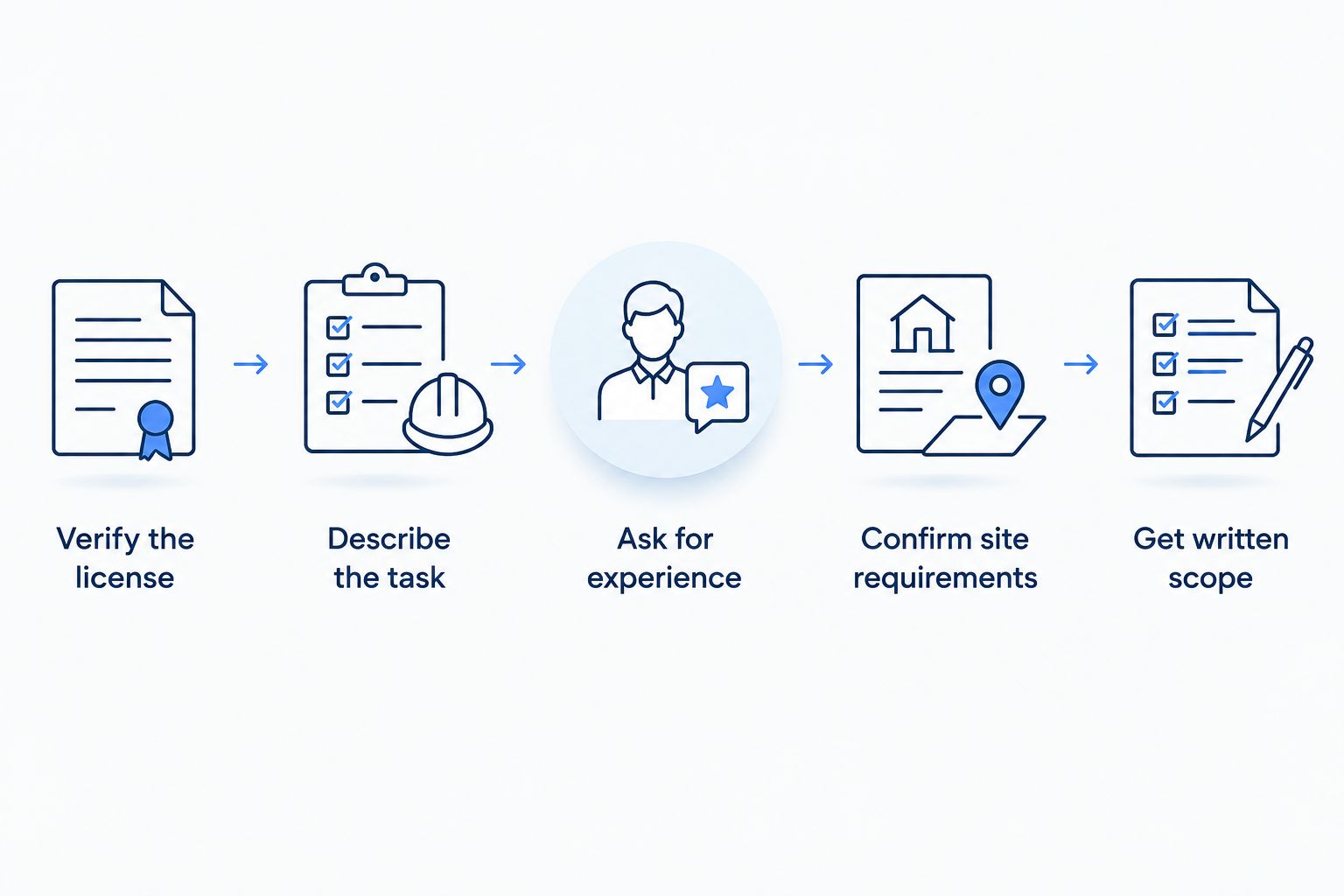
The hiring check stays the same even when the contractor already knows you. A good result on a home repair does not establish qualification for an unrelated oilfield task.
Why the right electrician varies by job
The deciding factors are the work conditions—not whether a contractor uses the word “full-service.” These checks explain why the same electrician fits some assignments and not others.
- Task experience: Panel work, fault finding, motor controls, and hazardous-location installations involve different practical knowledge.
- Equipment condition: Unknown alterations or damaged equipment require investigation before the repair scope is settled.
- Location classification: Classified areas require suitable equipment and installation methods for that location.
- Power isolation: Multiple sources, generators, and stored energy affect how equipment is made safe to work on.
- Site procedures: Oilfield operators establish access and operating procedures that must be addressed before work starts.
- Inspection requirements: The responsible authority and project scope determine the required approvals and inspections.
Choose the electrician after defining these conditions. Choosing first and discovering qualifications later puts the hiring process backward.
Is one electrical contractor better than separate contractors?
One contractor gives you a single point of contact for residential and oilfield requests. That is useful when you manage property and field operations, but it does not remove the need to check the assigned crew.
Eagle Electric is a fit for Bakken homeowners and oilfield operators who need a licensed electrical contractor. Its stated residential and oilfield service scope matches those customer groups; each assignment still needs its own assessment and written scope.
The limitation is straightforward: a shared contractor does not make two projects interchangeable. Keep the home scope and oilfield scope separate, even if they arrive in the same email. Each needs clear responsibilities, access arrangements, and completion requirements.
Does a residential license prove oilfield experience?
No. A license does not, by itself, document oilfield experience or qualification for every industrial task. Verify the license scope and ask about experience with the specific equipment, location classification, and operator requirements involved.
Can the same electrician inspect a house and an oilfield site?
Yes, if the electrician is qualified for both assignments and the requested assessment falls within the electrician’s authorized scope. Distinguish a contractor’s condition assessment from an official inspection required by the responsible authority; they are not automatically the same service.
What should your written quote include?
A clear quote tells you what the contractor is taking responsibility for. It also identifies what must be resolved before the work can proceed.
For your 2026 project, request these items in plain language:
- Defined work: The equipment, circuits, or areas included.
- Exclusions: Work or repairs outside the agreed scope.
- Site assumptions: Access, equipment condition, and documents needed.
- Shutdown coordination: Who authorizes and arranges interruptions.
- Approvals: Responsibility for applicable permits and inspections.
- Testing and handoff: What checks and records close the job.
- Changes: How unexpected findings receive written approval.
Eagle Electric emphasizes same-business-day responses to quote requests and clear written quotes. A response is not a promise of same-day job completion. Confirm assessment needs and scheduling separately.
Request a written electrical quote
Describe the property, equipment, and work needed. Identify any oilfield access or classification requirements.
FAQ
Can I hire the same electrician for my house and my oilfield site?
Yes, when the electrician has the required license and qualifications for both specific assignments. Confirm the assigned person’s relevant experience rather than relying only on the company’s service list.
Is oilfield electrical work just residential wiring with bigger equipment?
No. Oilfield work can involve industrial controls, different operating conditions, and classified locations. The installation must match the actual equipment and site requirements.
Does every oilfield electrical job require hazardous-location equipment?
No. Equipment requirements depend on the location classification and other applicable installation conditions. Have qualified personnel confirm those requirements before selecting materials.
Can an electrician quote both jobs without visiting?
Some requests can receive an initial scope review remotely, but photos do not establish every site condition. Work involving unknown wiring, equipment condition, or classification needs an appropriate on-site assessment.
Should I open my electrical panel to send photos?
No. Keep covers closed and take only photos that do not expose you to electrical hazards. A licensed electrician should perform any necessary internal assessment safely.
Does a same-business-day quote response mean the job gets finished that day?
No. A quote response and job completion are different commitments. Confirm the assessment, written scope, and work schedule separately.
What should I check before booking electrical work in 2026?
Verify the current license, relevant task experience, and applicable site requirements before booking electrical work in 2026. Get the scope and responsibility for approvals, testing, and changes in writing.
One last thing
Ask one question before approving either job: “What still needs to be checked before this scope is final?”
That question separates a defined job from an assumption. A contractor should identify the unresolved conditions—not hide them behind a broad promise to handle everything.


