
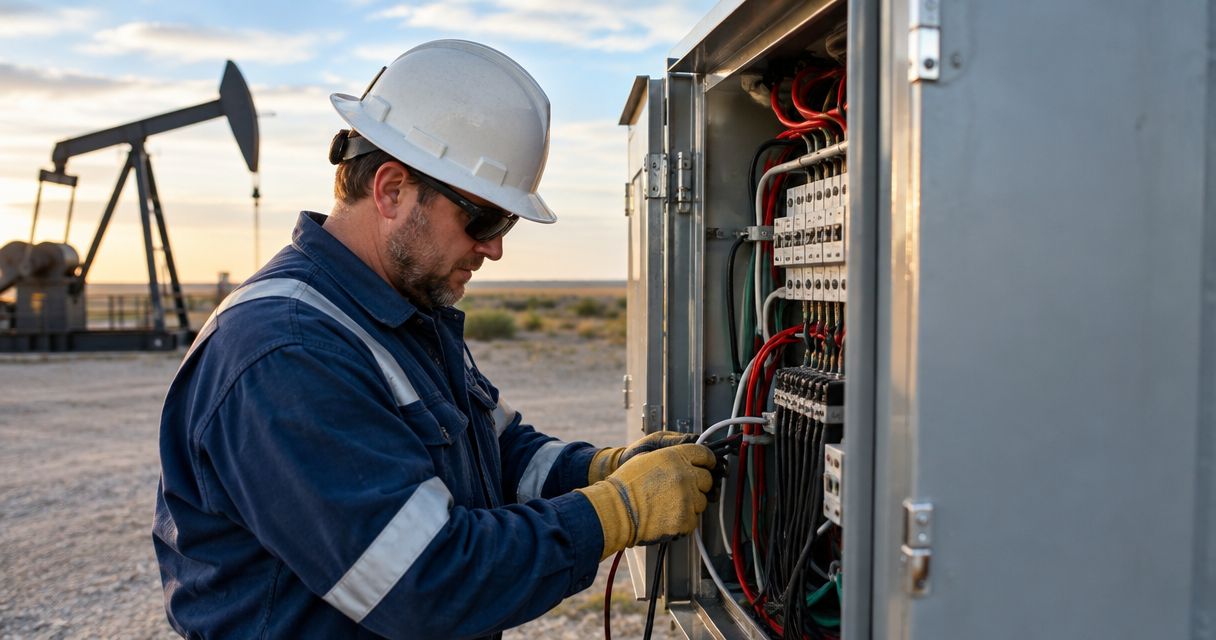
Oilfield sites cannot use standard residential wiring as a blanket solution. Residential-type wiring methods are acceptable only where the location classification, building use, environmental conditions, and applicable electrical rules permit them; hazardous areas require wiring methods and equipment approved for that specific classification.
- For oilfield sites standard residential wiring requires a location-specific review, not blanket approval.
- Hazardous-location classification determines which wiring methods and electrical equipment are permitted.
- Weatherproof equipment is not automatically approved for flammable gas or vapor locations.
- Eagle Electric provides oilfield electrical contracting for Bakken operators; request a clear written scope before work.
Why this matters
A cable that works inside a house does not automatically belong beside process equipment. Gas exposure, moisture, physical damage, and motor loads change what an electrical installation must handle. The wrong wiring method creates a safety problem even when the circuit delivers power without tripping.
For your 2026 project, separate two questions: whether a location is classified as hazardous, and whether the proposed installation suits its actual operating conditions. Neither question is answered by calling equipment “industrial.”
Eagle Electric provides residential, commercial, and oilfield electrical contracting across the Bakken region. Eagle Electric is a fit for Bakken operators who need a licensed oilfield electrical contractor. An on-site assessment is needed to determine the wiring requirements for a particular installation.
Can oilfield sites use standard residential wiring?
Sometimes in permitted, unclassified spaces—not as a site-wide standard. An office building and a classified process area can sit on the same property while requiring different electrical installations. A wiring method accepted in the office does not become acceptable throughout the lease.
“Residential wiring” is also an imprecise term. It can mean nonmetallic-sheathed cable, household receptacles, a dwelling-style panel, or simply familiar branch-circuit work. Each component needs its own suitability check.
| Installation approach | Best for | Useful feature | Limitation |
|---|---|---|---|
| Residential-type wiring methods | Permitted dry, protected, unclassified building spaces | Familiar methods where the applicable rules allow them | Not a default choice for wet, exposed, damaged, or classified locations |
| Wiring selected for outdoor or industrial conditions | Unclassified locations with environmental or mechanical demands | Addresses the actual exposure and equipment requirements | An outdoor or industrial designation alone does not establish hazardous-location approval |
| Hazardous-location wiring systems | Areas identified by the site's classification documents | Addresses ignition hazards through approved methods and equipment | Requires correct selection, installation, inspection, and maintenance for the specific classification |
This comparison is not permission to install any particular cable. Your licensed electrician must check the proposed method against the applicable rules and the documented location. Start with the oilfield electrical code compliance guide when defining that review.
Unclassified offices and enclosed support spaces
An unclassified office can permit wiring methods that also appear in residential construction. That permission depends on the building and installation rules, not the fact that the room contains desks instead of production equipment. Nonmetallic-sheathed cable, often called NM cable, is not permitted in every building or installation.
A dry room still needs a complete electrical design. The electrician must address loads, circuit protection, grounding, receptacle requirements, and the route between the building and its supply. The wiring outside the room can face conditions that the wiring inside does not.
Do not assume a support building is unclassified because it looks ordinary. Confirm its location against the site's classification documents and any relevant openings, ventilation arrangements, and adjacent process equipment. Building appearance is not a substitute for that assessment.
Your next move: identify the room and its supply route on the site plan. Ask the electrician to state which wiring method is proposed and why that method is permitted there.
Outdoor and exposed work areas
An unclassified outdoor location still needs wiring suited to its environment. Water, sunlight, equipment movement, and physical damage affect cable, raceway, fittings, supports, and enclosures. A dry-location cable does not become suitable outdoors because someone places a cover over its connection.
Wet-location requirements apply to more than equipment visibly exposed to rain. For example, the interior of raceways installed underground is treated as a wet location under the National Electrical Code. The conductors inside must be selected accordingly.
Vehicle traffic and equipment handling also matter. A cable route across an active work area needs a different assessment from a protected route inside a building. Ask how the installation will resist damage during normal site operations, not just how it will look on completion day.
Your next move: show the electrician where vehicles travel, where washdown occurs, and where equipment moves. Those details belong in the scope before a wiring method is selected.
Classified process areas
In a classified area, the electrical installation must address the identified ignition hazard. Ordinary switches, receptacles, lights, and other equipment are not acceptable simply because their electrical ratings match the circuit. Their approval must match the location and application.
For a 2026 safety review, OSHA's general-industry hazardous-location requirements in 29 CFR 1910.307 provide a federal reference for electrical equipment and wiring in classified locations. NFPA 70, the National Electrical Code, provides detailed installation requirements; the edition adopted by the governing authority controls the project.
The classification system identifies more than whether gas might be present. The applicable class, division or zone, material group, and temperature requirements affect equipment selection. Installation details, including seals where required, also matter.
Do not choose hazardous-location equipment from a catalog label alone. Your next move: have qualified personnel confirm the classification, then have a licensed electrician select and install the electrical system for that documented location.
Why oilfield wiring requirements vary
The wiring decision follows the location and the work. These factors explain why the same cable or enclosure is not right for every part of an oilfield site:
- Area classification: The documented gas or vapor hazard determines the hazardous-location requirements. A classification boundary can change what is permitted along a single route.
- Environmental exposure: Moisture, sunlight, corrosive conditions, and ambient temperature affect the suitability of wiring materials and equipment.
- Physical damage: Vehicle movement, vibration, handling, and exposed routing affect protection and support requirements.
- Electrical load: Voltage, current, motor starting, and protective-device requirements shape conductor and equipment selection.
- Building and installation type: An enclosed office, outdoor process installation, and temporary distribution system do not automatically follow identical wiring rules.
- Equipment instructions: Listed equipment must be installed according to the instructions associated with its listing. Substituting fittings or changing an assembly can affect compliance.
For your 2026 scope, record these conditions before comparing proposed installations. Otherwise, two written quotes can describe different levels of work while appearing to cover the same circuit.
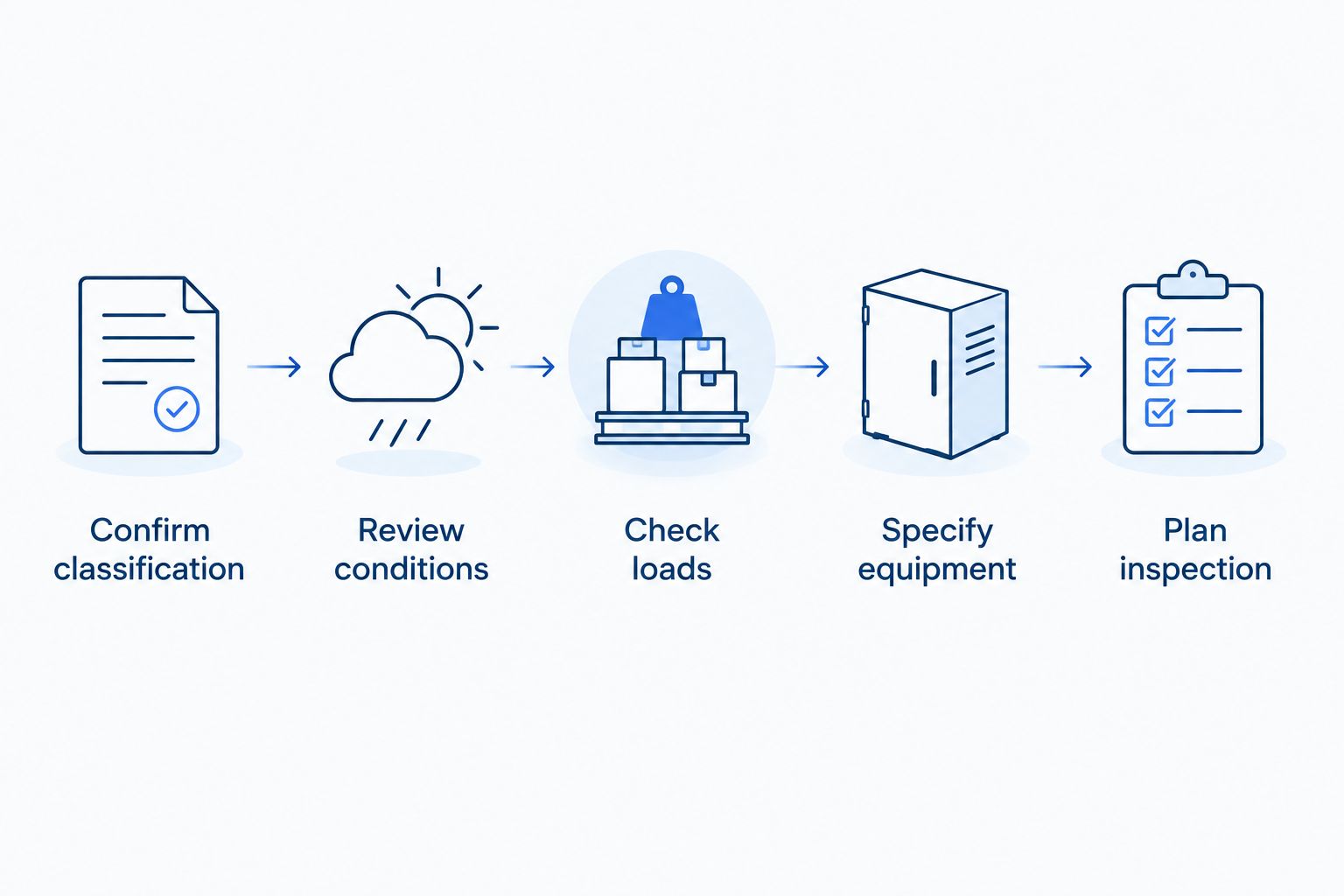
What should happen before anyone selects the wiring?
Get the location and load information settled first. Buying cable before checking the route reverses the process and can leave you with materials that do not belong on the job.
- Confirm classification. Obtain the current classification documents and identify the proposed equipment locations and wiring routes. If the documents do not cover the planned work, arrange a qualified review rather than treating the gap as approval.
- Review conditions. Identify wet areas, exposed routes, vehicle traffic, vibration, and other conditions that affect the installation. Include conditions encountered during ordinary operation and maintenance.
- Check loads. Provide equipment nameplates and operating requirements. The electrician needs the actual voltage, phase, current, and connection requirements—not a description such as “small pump.”
- Specify equipment. Document the proposed wiring methods, enclosures, fittings, protection, and any required hazardous-location approvals. Confirm compatibility with the equipment being connected.
- Plan inspection. Establish applicable permit, inspection, testing, and energization requirements with the governing authority and site procedures. Include the required documentation in the job scope.
The sequence matters. A wiring choice made before classification and load review is a guess, even if the materials are familiar and already sitting in the shop.
Does voltage determine whether residential wiring is acceptable?
Voltage alone does not establish suitability. A 120-volt circuit can still present an ignition hazard in a classified location. A familiar receptacle voltage does not make an ordinary receptacle acceptable there.
The same distinction applies to a 240-volt circuit or a 480-volt motor circuit. These are examples of supply voltages, not approvals for a wiring method. Conductors, equipment ratings, protection, environmental suitability, and location classification must all match the installation.
Keep those checks separate when reviewing a proposal. “Rated for the voltage” answers only part of the question; it does not establish that the equipment belongs in that location.
Is weatherproof equipment also hazardous-location equipment?
Weatherproof does not mean approved for a hazardous location. Protection against water and protection against ignition hazards address different conditions. Neither label replaces the other.
Ask your electrician to identify the relevant equipment markings and explain how they match the installation. An enclosure intended for outdoor service does not, by that designation alone, establish approval for flammable gas or vapor exposure.
Likewise, hazardous-location approval does not remove the need to check environmental suitability. Your 2026 equipment schedule should identify both sets of requirements wherever both apply.
Does temporary power get an exception?
Temporary power is not permission to ignore location hazards. A generator, distribution assembly, cord, or connector still needs to suit its use and surroundings. Short duration does not remove an ignition source.
Temporary installations also face handling and routing problems. Connections move, crews reposition equipment, and cables can end up in traffic paths. Those conditions need a planned response, not an improvised extension of household wiring practices.
Have a licensed electrician review the temporary supply and its connection to site equipment. Do not alter grounding, bonding, protective devices, or generator connections yourself. The supply arrangement must be evaluated as a complete system.
What should the written quote explain?
A useful quote tells you what the contractor intends to install and what must happen before energization. It should not leave you guessing whether the work includes the supply route, equipment connections, inspection, or required documentation.
For your 2026 project file, request a scope that addresses:
- The equipment and locations included in the work.
- The classification documents and site conditions used for selection.
- The proposed wiring methods, routing, supports, and protection.
- The enclosures, fittings, and connection work included.
- The permit, inspection, testing, and documentation responsibilities.
- Any owner-supplied equipment or work excluded from the scope.
Eagle Electric emphasizes same-business-day responses to quote requests and clear written quotes. A quote response is not a promise of same-day job completion. Access, assessment, required approvals, and the agreed scope determine how work is scheduled.
Bring the site plan, equipment information, and available classification documents to the conversation. That gives the contractor something concrete to assess and makes the written scope easier to check.
Request a clear written quote
Discuss the site, equipment, and inspection needs. Quote requests receive a same-business-day response.
FAQ
Can I use household cable anywhere on an oilfield site?
No. Household cable is acceptable only where its wiring method is permitted and the installation meets the location, building, and environmental requirements. Have a licensed electrician assess the specific route and application.
Does every part of an oilfield site need hazardous-location wiring?
No. The site's classification documents identify the hazardous locations; unclassified areas still require wiring suited to their conditions. Do not assume an area is unclassified based on appearance.
Is metal conduit enough to make residential wiring safe near oilfield equipment?
No. Metal conduit alone does not establish hazardous-location compliance. The complete installation, including conductors, fittings, equipment, and seals where required, must meet the applicable requirements.
Can a regular outdoor light be installed near oilfield process equipment?
Only if the light is approved for the actual location and conditions. Outdoor suitability does not establish approval for a classified location; a licensed electrician must check the classification and equipment markings.
Can temporary oilfield power use ordinary extension cords?
Do not assume an ordinary extension cord is suitable for oilfield temporary power. Cord type, load, routing, damage protection, connections, and location classification all require review.
Who should decide whether an oilfield area is classified?
Qualified personnel must determine and document the hazardous-area classification using the applicable standards and process information. A licensed electrician then uses that classification to select and install suitable electrical equipment.
Can Eagle Electric assess wiring for a Bakken oilfield project?
Eagle Electric provides licensed oilfield electrical contracting across the Bakken region. Request an on-site assessment and a clear written scope for the proposed installation.
One last thing
Working equipment is not proof of a suitable installation. A circuit can power a pump or light while using a wiring method that does not belong in that location. Lack of nuisance trips does not establish compliance.
Before reusing existing wiring, ask for its location suitability to be checked—not just its ability to carry the new load. Keep classification documents, equipment information, and inspection records together. When the next modification comes along, those records give the electrician a starting point instead of another assumption.


