
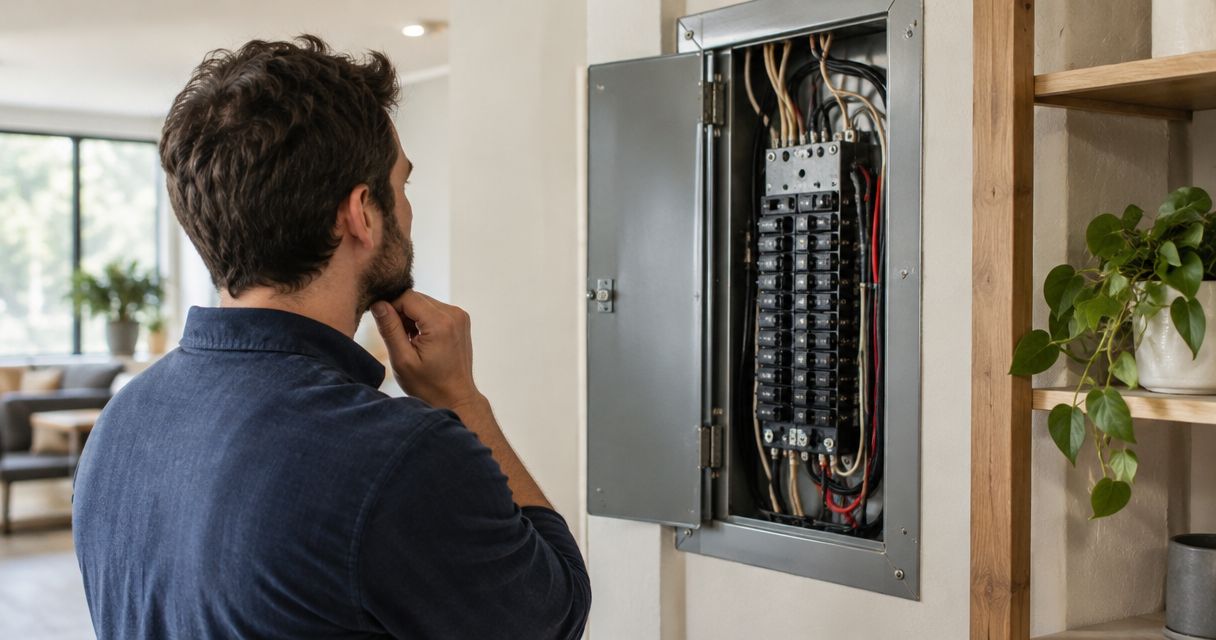
An old electrical panel can handle a modern home's power needs if its condition, service capacity, and calculated electrical load support the equipment you use. Age alone does not settle it. For a 2026 upgrade decision, a licensed electrician must also check the service conductors, breakers, grounding, and branch circuits—not just the amperage printed on the panel.
- Old electrical panel modern power needs: judge capacity and condition, not age or empty breaker spaces.
- A 200-amp panel does not establish that the entire electrical service supports 200 amps.
- Eagle-Elc provides residential electrical contracting for homeowners in Watford City and the Bakken region.
- Get an on-site inspection and load calculation before adding major electrical equipment.
Can an old electrical panel handle a modern home's power needs?
Yes, if an inspection and load calculation show that the existing system is suitable. An older panel is not automatically undersized, and a newer panel is not automatically ready for every appliance you want to add.
The electrician needs to answer separate questions: Is the equipment safe? Can the service support the expected demand? Can the panel accommodate the required circuits using approved components?
A panel replacement and a service upgrade are different jobs. Replacing damaged equipment does not necessarily increase available power. Increasing service capacity can involve equipment beyond the panel, including the meter enclosure and service conductors.
If you are already considering a larger service, read Is Upgrading to a 200-Amp Electrical Panel Worth It?. Decide from the house's loads, not a rule that every old home needs the same upgrade.
Why this matters
An electric range, heat pump, water heater, and EV charger change the load picture. Their impact depends on their actual electrical requirements and how the home's loads are calculated together. Counting appliances is not enough.
Your 2026 remodeling plan should cover the electrical system before equipment installation. Otherwise, you can end up with a new appliance that needs a circuit or service change you never included in the project.
There is another trap: treating capacity as a safety certificate. A service can have enough capacity while a breaker, connection, or circuit still needs repair. Available power and safe condition are separate checks.
How a licensed electrician checks an older panel
An on-site assessment connects the equipment ratings to the condition of the installation. Photos help explain the job, but they do not replace inspection or electrical calculations.
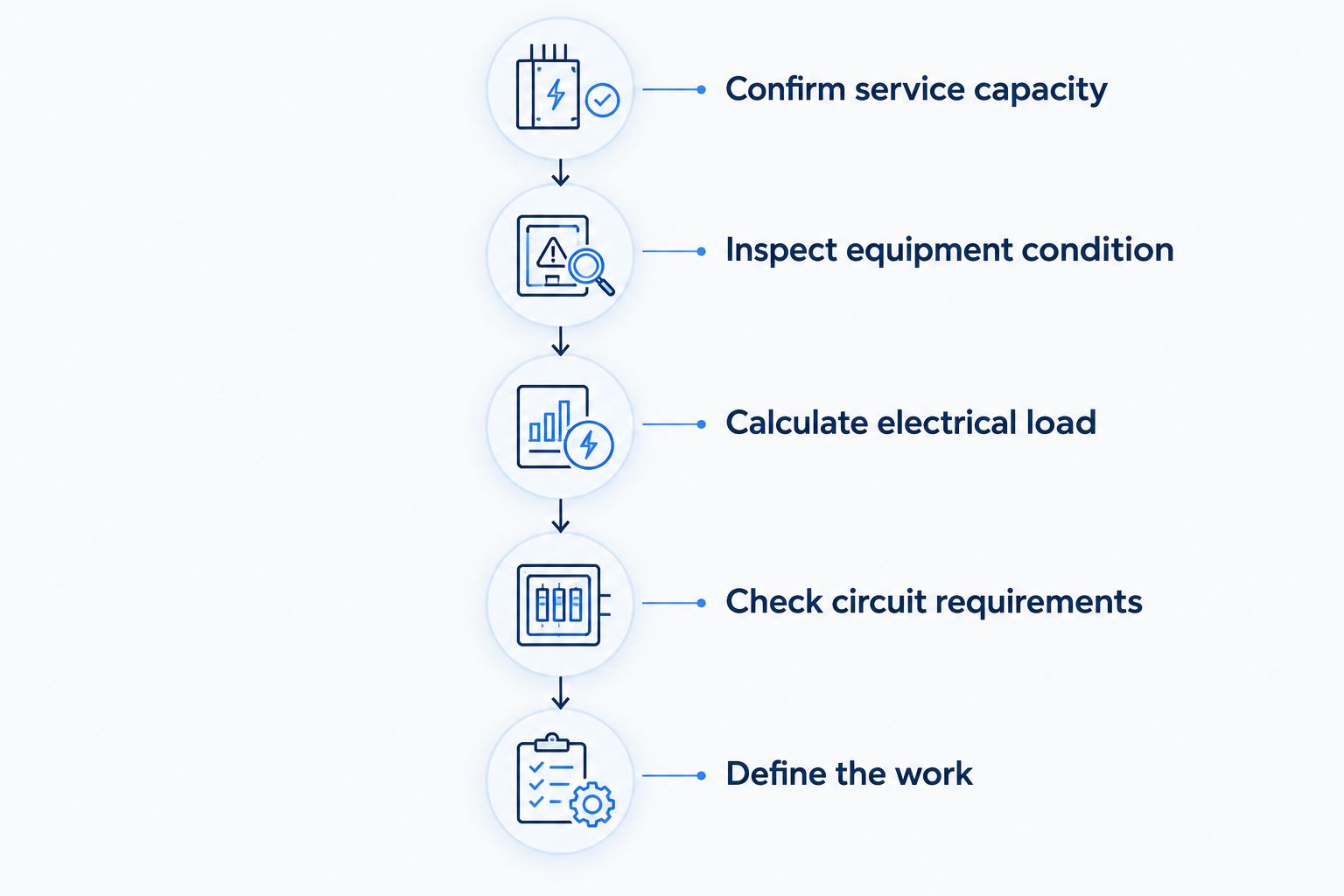
- Confirm service capacity. The electrician identifies the service rating and checks the associated equipment. A panel's maximum rating does not, by itself, establish the capacity of the complete service. The main disconnect, conductors, and other service components matter.
- Inspect equipment condition. The assessment checks for damage, corrosion, overheating, improper alterations, and unsuitable components. Internal inspection belongs to a licensed electrician. Parts of service equipment can remain energized even when the main breaker is off.
- Calculate electrical load. The electrician evaluates existing loads and proposed additions under applicable electrical-code requirements. Adding together every breaker handle rating is not a residential service load calculation. Neither is looking at your monthly energy bill.
- Check circuit requirements. The electrician determines whether the new equipment needs a dedicated circuit, different conductors, required protection, or another installation change. The assessment also checks whether the panel accepts the specified breakers and circuit arrangement.
- Define the work. The result should identify what stays, what needs repair, and what needs replacement. A useful recommendation explains whether the problem is service capacity, circuit capacity, equipment condition, or a combination.
For a 2026 inspection request, gather the new equipment's electrical specifications and a list of planned additions. Describe recurring problems in plain language: which breaker trips, what was running, and whether the problem started after a change.
You can photograph labels that are visible without removing covers. Do not expose wiring to improve a picture. Tell the electrician if a label is missing or unreadable instead of trying to identify the equipment yourself.
100-amp service: adequacy depends on the home's load
A 100-amp service is not automatically inadequate because a house is old. Its suitability depends on the calculated load and the condition of the complete installation. The number alone does not answer whether you can add an EV charger or replace fuel-burning equipment with electric equipment.
Best for: retaining an existing service when inspection and load calculations support the current and planned loads. The benefit is avoiding an unnecessary capacity increase; the limitation is that future equipment can change the calculation.
If the service remains suitable, individual circuits or damaged components can still need work. Keeping the service does not mean leaving every part of the system untouched.
200-amp service: more capacity, not an automatic requirement
A 200-amp service provides greater rated capacity than a 100-amp service. That does not make it the correct answer for every house. An upgrade recommendation still needs to match the home's calculated load and proposed equipment.
Best for: homes whose assessed demand requires greater service capacity. The benefit is additional capacity; the limitation is a broader project that can involve the meter equipment, conductors, utility coordination, and inspections.
A 200-amp panel label is not proof of a 200-amp service. Ask the electrician to identify the rating of the complete installation and explain which components would change.
Which type of electrical work fits the problem?
The right scope fixes the actual constraint. This comparison separates common project approaches; it does not establish what your house needs without an inspection.
| Approach | Best for | Main benefit | Main limitation |
|---|---|---|---|
| Keep the existing service | A suitable service with sufficient calculated capacity | Avoids an unnecessary capacity increase | Does not fix damaged equipment or deficient circuits |
| Add a branch circuit | Equipment needing its own circuit where capacity is sufficient | Supplies the equipment through a properly designed circuit | Does not increase service capacity |
| Add a subpanel | Circuit distribution or space needs where the existing supply is adequate | Creates another location for circuit distribution | Does not create more power from the utility |
| Replace the panel | Equipment whose condition or suitability requires replacement | Addresses the panel itself | Does not automatically upgrade the complete service |
| Upgrade the service | Calculated demand exceeding the existing service's capacity | Increases rated service capacity | Requires assessment beyond the panel enclosure |
Do not buy extra breaker spaces as a substitute for a load calculation. Space and capacity solve different problems. A subpanel can help distribute circuits while leaving the home's total service capacity unchanged.
Why an older panel's ability to meet demand varies
The assessment changes with the house and equipment. These factors explain why two homes with the same main-breaker rating can need different work:
- Existing loads. Electric heating, cooking, water heating, cooling, and other equipment affect the calculation. Equipment specifications matter more than a count of appliances.
- Planned additions. An EV charger, workshop equipment, or electric heating conversion changes what the system must support. Include planned work before the electrician defines the scope.
- Service equipment. The panel, disconnect, meter equipment, and conductors must be evaluated together. One new component does not establish the rating of everything connected to it.
- Physical condition. Corrosion, heat damage, damaged insulation, or improper alterations can require corrective work even when capacity is sufficient.
- Circuit arrangement. Suitable breaker positions, approved breaker types, conductor requirements, and required protection affect whether equipment can be added correctly.
Warning signs need diagnosis, not a larger breaker
A repeatedly tripping breaker is a reason to investigate. It is not permission to install a higher-rated breaker. The breaker must provide appropriate protection for the circuit conductors and equipment.
Flickering lights, buzzing equipment, burning odors, discoloration, and signs of overheating also need attention. These symptoms do not identify one specific fault from a distance. They can involve connections, circuits, equipment, or the electrical supply.
Do not remove the panel cover or touch equipment that appears damaged. Keep people away from the affected area. If there is smoke, fire, active arcing, or an immediate danger, leave the area and call emergency services.
For recurring trips without an immediate emergency, stop using the affected equipment and arrange a licensed assessment. Do not repeatedly reset a breaker that trips again. The goal is to find the cause, not force the circuit to keep running.
What to ask for in a clear written quote
Ask the electrician to separate the diagnosis from the proposed work. You should be able to tell why each major item is included and what problem it solves. A description that says only panel upgrade leaves too much unclear.
For a 2026 project, request a written scope that addresses:
- Reason for the work: insufficient capacity, damaged equipment, additional circuits, or another identified condition.
- Equipment included: the panel, main disconnect, meter equipment, conductors, and grounding or bonding work, as applicable.
- Circuit work: which existing circuits will be reconnected and which new circuits will be installed.
- Approvals and coordination: responsibility for applicable permits, inspections, and utility involvement.
- Power interruption: how the planned outage will be coordinated and what remains dependent on outside scheduling.
- Scope boundaries: what is excluded and how additional findings will be handled.
Eagle-Elc is suited to Watford City and Bakken homeowners who need a licensed residential electrical contractor. Request a same-business-day response to your quote inquiry and a clear written quote for the proposed work. A response to an inquiry is not a promise of same-day installation or completion.
You can start with Eagle-Elc. An on-site inspection is needed to establish the work your house requires; a general discussion cannot confirm hidden wiring conditions or the complete service rating.
Request a panel assessment
Ask for a same-business-day quote response and a clear written scope for your electrical work.
Does an empty breaker slot mean I can add an EV charger?
An empty breaker slot does not establish spare electrical capacity. A licensed electrician must check the charger specifications, calculated load, breaker compatibility, conductors, and installation requirements before adding the circuit.
Will replacing my panel fix old wiring throughout the house?
Replacing the panel does not replace branch-circuit wiring throughout the house. Ask the quote to identify wiring repairs separately so you know which existing circuits remain and which will change.
Can a subpanel give my house more power?
A subpanel does not increase the capacity of the electrical service feeding it. It provides another distribution point, which helps with circuit organization or placement when the supply and feeder are suitable.
FAQ
How do I know whether my old electrical panel can handle modern power needs?
A licensed electrician must inspect the installation and calculate the existing and proposed electrical load. The panel's age, empty slots, and main-breaker label cannot answer the question alone.
Does every older home need a 200-amp service?
Not every older home needs a 200-amp service. The correct service capacity depends on the home's calculated electrical load and planned equipment, while equipment condition requires a separate assessment.
Can I add a bigger breaker to stop it from tripping?
Do not install a bigger breaker to stop repeated trips. The breaker must protect the circuit conductors and equipment, and a licensed electrician needs to diagnose the cause.
Is a panel replacement the same as a service upgrade?
A panel replacement is not necessarily a service upgrade. Increasing service capacity can require changes to conductors, meter equipment, and other components beyond the panel.
Can a new electrical panel lower my electricity bill?
A new electrical panel does not inherently reduce your equipment's electricity consumption. Choose panel work to address identified safety, condition, circuit, or capacity needs rather than a promised bill reduction.
Can I check the inside of my panel myself?
Leave internal panel inspection to a licensed electrician. Service equipment can contain energized parts even when the main breaker is switched off.
Who handles residential electrical work around Watford City?
Eagle-Elc provides licensed residential electrical contracting in Watford City and across the Bakken region. Arrange an on-site assessment to establish the condition, capacity, and required scope for your home.
One last thing
Your electricity bill measures energy used over time. It does not establish whether the service can support the calculated demand of your equipment. A low bill is not clearance to add a large electrical load.
For your 2026 project, give the electrician the equipment specifications before ordering installation. Define the load first. Then decide what electrical work it needs. That keeps the recommendation tied to your house instead of a standard panel package.


