
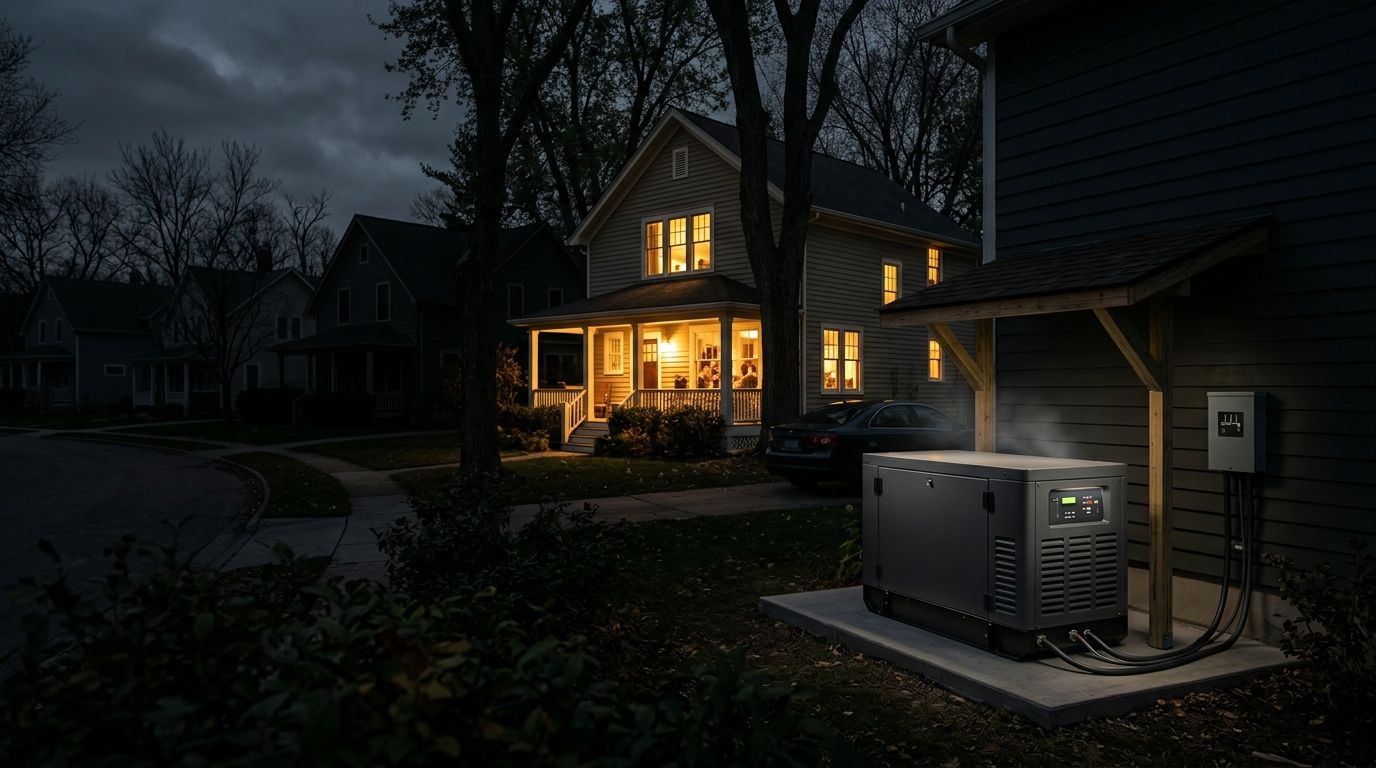
Yes. A generator can power an entire house during an outage when its continuous output, motor-starting capacity, fuel supply, and transfer equipment match the home's electrical demand. Connecting every circuit does not mean you can run every appliance at once; the system needs enough capacity or controls that keep large loads from overlapping.
- Generator power whole house outage planning starts with appliance loads, not square footage or the panel's main-breaker rating.
- Automatic standby generators suit unattended backup; portable generators require outdoor operation and a safe connection plan.
- Whole-panel coverage does not guarantee simultaneous operation of electric heat, cooking, water heating, and air conditioning.
- Eagle-elc provides licensed residential electrical contracting for homeowners across the Bakken region.
Why this matters
Your furnace controls, refrigerator, well pump, and sump pump do different jobs. Losing one can matter more than losing several lighting circuits. A useful backup plan starts with what must stay running, then checks what those loads require.
For a 2026 backup-power project, separate essential service from normal household convenience. Decide what the generator must carry before choosing its size. Eagle-elc provides residential electrical contracting in Watford City and across the Bakken region.
Can a generator power an entire house during an outage?
Yes, but the installation must cover both running demand and starting demand. A generator that carries the house after everything settles can still struggle when a pump or compressor starts.
These are the main approaches. None removes the need to check the actual equipment in your home.
| Backup approach | Best for | Main advantage | Main limitation |
|---|---|---|---|
| Automatic standby with whole-panel coverage | Households that need automatic backup across the home | Transfers supported household circuits without a manual generator hookup | Connected loads still need to fit the generator's capacity |
| Automatic standby with selected circuits | Households prioritizing heat controls, refrigeration, pumps, and basic lighting | Keeps the backup plan focused on essential loads | Circuits outside the backup panel remain off |
| Portable generator with approved connection equipment | Households prepared to set up and operate backup power manually | Supports selected household loads through a properly designed installation | Requires safe outdoor placement, fuel handling, and operator involvement |
A permanently installed standby generator and a portable generator are not interchangeable operating plans. Automatic transfer equipment does not make an ordinary manual-start portable generator start itself.
Whole-panel coverage: every circuit is connected
Whole-panel coverage means the generator supplies the panel through suitable transfer equipment. It does not mean the generator has unlimited output. Electric cooking, clothes drying, water heating, and space heating can compete for the same available capacity.
Best for: homeowners who want access to circuits throughout the house and accept a defined load-management plan. The benefit is broader coverage. The limitation is that some equipment must wait when other large loads are running.
Essential-circuit coverage: protect the loads that matter
An essential-circuit installation backs up a selected group of circuits. That can include refrigeration, heating controls, pumps, lighting, and communications equipment, depending on the home's needs and the completed design.
Best for: homeowners who value essential functions over using every appliance. The advantage is a clear operating boundary. The drawback is equally clear: an outlet or appliance outside the backed-up circuits stays without power.
Portable backup: manual operation stays part of the job
A portable generator can supply household circuits through properly selected inlet and transfer equipment. Its voltage, output, receptacles, and manufacturer instructions must match the installation.
Best for: homeowners able to handle setup, monitoring, and safe shutdown. Portability is useful, but it brings work during the outage. Never feed a house through a wall outlet or use a cord with exposed energized plug blades.
Why whole-house generator capacity varies
The right capacity depends on the loads and how they operate together. These factors belong in a 2026 site assessment:
- Heating equipment. A fuel-fired furnace needs electricity for controls and its blower. Electric resistance heat and heat-pump auxiliary heat add a different electrical demand.
- Motor starting. Well pumps, sump pumps, refrigeration compressors, and air conditioners need starting capacity as well as running power.
- Simultaneous use. Cooking, laundry, water heating, and vehicle charging change the total when they overlap.
- Supply compatibility. A home with both 120-volt and 240-volt loads needs a backup design that supports the required circuits and equipment.
- Fuel and controls. Available fuel supply, generator ratings for that fuel, and load-management settings affect what the system can support.
Square footage leaves these details out. Two homes with similar floor plans can have very different electrical demands because one uses fuel-fired appliances and the other uses electricity for the same jobs.
For local sizing questions, read the guide to generator sizes for Williston homes. A general sizing guide helps you prepare questions; it does not replace an on-site load assessment.
How do you work out what your house needs?
Use the following process to prepare for an electrician's assessment. Do not remove panel covers, test exposed conductors, or attempt a transfer-switch installation yourself.
- List essential loads. Write down the equipment you cannot reasonably leave off. Include heating controls, refrigeration, water supply, drainage, and any equipment with a separate backup requirement.
- Record equipment ratings. Collect accessible nameplate information and manuals. Photograph labels only where you can reach them safely without opening electrical enclosures.
- Check starting demand. Have the electrician identify motors and compressors that need additional starting capacity. Running wattage alone does not settle the selection.
- Set load priorities. Decide which large appliances can stay off or wait. Automatic load management needs a written priority plan, not assumptions about household habits.
- Inspect the connection. Have a licensed electrician assess the panel, service arrangement, transfer equipment, generator location, and applicable permit requirements.
The result should describe what works during an outage and what does not. Ask for that operating scope in writing, alongside the proposed equipment and installation work.
Does a larger electrical panel need a larger generator?
A panel's main-breaker rating is not the home's actual operating demand. A 200-amp service rating describes the service arrangement; it does not mean the house continuously draws 200 amps.
Do not choose a generator by multiplying the main-breaker rating and treating the result as your required backup output. The electrician needs a load assessment, equipment starting requirements, and the list of circuits you intend to support.
The same distinction applies to a generator connected to the whole panel. Panel access and generating capacity are separate questions. A whole-panel connection is not a promise that every connected appliance can run together.
Can a generator run your furnace, well pump, and refrigerator?
A generator can run a furnace, well pump, and refrigerator when its output and starting capacity cover those specific loads. The names of the appliances are not enough to approve a size; their ratings and starting behavior matter.
A fuel-fired furnace still needs electrical power for its blower and controls. A well pump may require a 240-volt supply. A generator providing only 120 volts cannot directly supply a pump that requires 240 volts.
For a 2026 plan, verify these details before treating heat and water as covered. If keeping water flowing is essential, the well-pump circuit belongs explicitly in the backup scope rather than under a vague promise of whole-house power.
Can you keep using every appliance normally?
You can use every appliance normally only if the system is designed for the resulting demand. Otherwise, you need operating restrictions or automatic load management.
Load management temporarily prevents selected equipment from running when capacity is needed elsewhere. That can preserve an essential pump or heating load while a lower-priority appliance waits. It does not create additional generator output.
Ask which loads are controlled, what triggers a pause, and how equipment returns to service. A system that disconnects water heating or vehicle charging under load should be explained before installation, not discovered during the first outage.
What makes the generator connection safe?
The installation must prevent generator power from feeding back into utility lines. Suitable transfer equipment separates the utility supply from the generator supply. Turning off a main breaker by memory is not a substitute for a properly designed transfer arrangement.
A licensed electrician must assess the connection, grounding and bonding requirements, overcurrent protection, and compatibility of the selected equipment. These details depend on the generator and installation. They are not safe to settle with a generic wiring diagram.
Portable-generator exhaust adds a separate hazard. CDC carbon monoxide guidance advises operating portable generators outdoors at least 20 feet from doors, windows, and vents, with exhaust directed away from the home. That guidance applies to portable equipment; permanently installed standby units require placement under their instructions and applicable rules.
A garage is not a safe operating location, even with its door open. Use working carbon monoxide alarms and keep portable equipment away from occupied spaces. For 2026 outage preparation, check placement and alarm readiness before severe weather arrives.
What should you ask for in a written quote?
A clear quote should define the job, not just name a generator. Ask for the following details:
- Which circuits or panel sections receive backup power.
- How starting loads and simultaneous appliance use are addressed.
- Which transfer equipment and load controls are included.
- What electrical, fuel-supply, permit, and inspection work is included or excluded.
- How startup checks and homeowner operating instructions are handled.
Eagle-elc is best for Bakken homeowners who need licensed residential electrical contracting. Quote requests receive a same-business-day response, with clear written quotes. A response is not a promise of same-day installation or job completion.
Request a written electrical quote
Get a same-business-day response. Define the electrical work before scheduling the job.
FAQ
Can a portable generator power my whole house?
A portable generator can support household circuits when its output, voltage, and approved connection equipment match the planned loads. Do not assume it can run every appliance simultaneously or provide unattended automatic backup.
Does a whole-house generator run everything at once?
A whole-house generator runs everything at once only when its capacity supports the combined running and starting demand. Whole-panel installations can also use load management to keep large appliances from overlapping.
Can I choose a generator from my home's square footage?
Square footage alone does not determine the right generator size. Heating type, appliance ratings, motor-starting requirements, and simultaneous use determine the backup demand.
Will my gas furnace work during a power outage?
A gas furnace needs electrical power for its controls and blower, so utility failure can stop it. A correctly designed backup circuit can supply those electrical loads.
Can I plug a generator into a dryer outlet?
No. Feeding a generator through a dryer outlet creates an unsafe connection and can energize wiring or utility lines unexpectedly. Have a licensed electrician install suitable inlet and transfer equipment.
How far from my house should a portable generator be?
CDC guidance calls for portable generators to operate outdoors at least 20 feet from doors, windows, and vents, with exhaust directed away from the home. Never operate one inside a home or garage.
Does an automatic transfer switch start any portable generator?
No. An automatic transfer switch does not turn an ordinary manual-start portable generator into an automatic standby system. Automatic operation requires compatible starting controls, generator equipment, and transfer equipment.
One last thing
A generator can restore power and still leave an essential appliance unavailable if that circuit was left outside the backup plan. Before approving a 2026 installation, ask for a circuit-by-circuit explanation of what stays powered and what must wait.
Put the operating limits in writing. That document is more useful during an outage than a whole-house label on a brochure.


