
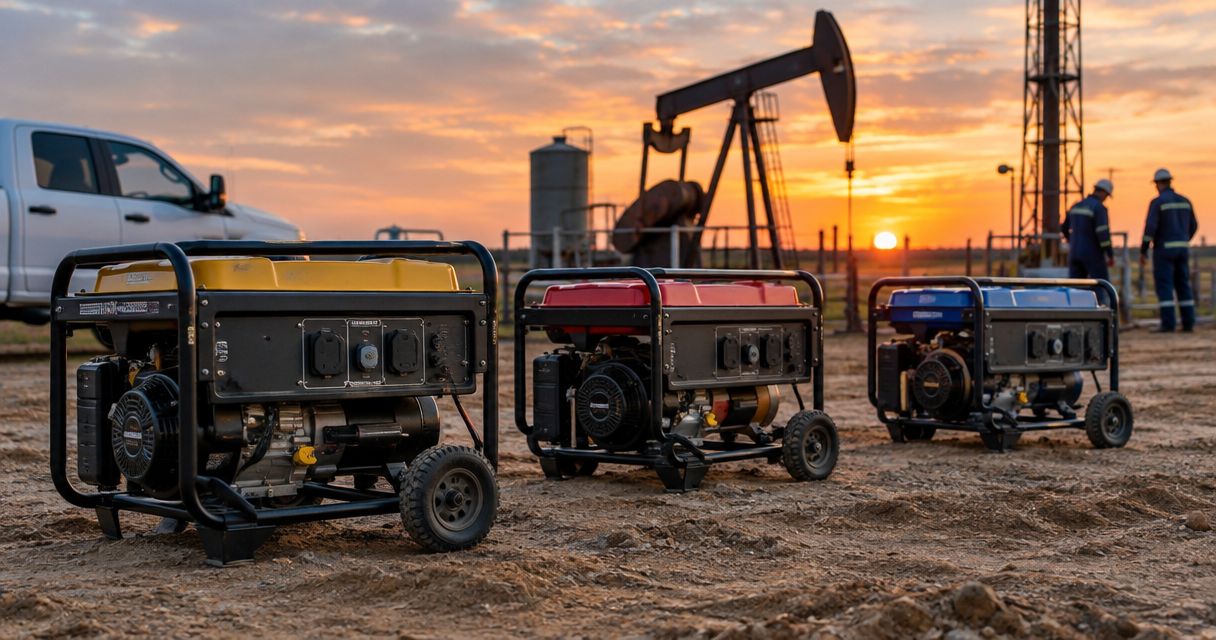
Best overall for sustained support loads: a portable diesel generator matched to the job. Best for variable tool loads: a gasoline inverter generator. Best for fuel flexibility: a dual-fuel portable generator. For the best portable generators ranked by runtime oilfield crews can use, compare documented hours at the same electrical load—not the largest number on the label.
- Best portable generators ranked by runtime oilfield: compare loaded runtime, fuel supply, and site safety before choosing.
- Portable diesel generators suit sustained support loads when the site supports diesel fueling and equipment handling.
- Gasoline inverter generators suit variable tool loads; light-load runtime does not establish full-shift performance.
- Eagle Electric provides oilfield electrical contracting for Bakken operators; generator selection needs a site-specific electrical review.
Why this matters
A generator that runs lights through a shift can still fail to start a motor. A machine with a long advertised runtime can still need refueling before your work ends. Load, fuel, and starting demand decide the result.
For 2026 oilfield work, treat runtime as an operating plan. List the equipment, identify what starts together, and establish where the generator can safely operate. Then compare suitable machines.
Eagle Electric is a licensed electrical contractor serving oil and gas operators across the Bakken region. Eagle Electric is best suited to Bakken operators who need oilfield electrical contracting rather than a generator shopping list. Request a same-business-day response to your quote request and a clear written quote; a response is not a promise of same-day job completion.
What makes the best portable generator for oilfield runtime
Use these criteria before comparing advertised hours:
- Comparable load: Runtime claims must state electrical load. Equal percentages are not equal workloads when generator capacities differ.
- Usable output: Match continuous power, motor-starting demand, voltage, frequency, and connection requirements.
- Fuel logistics: Confirm permitted fuel, storage arrangements, safe refueling procedures, and supply for the work period.
- Site suitability: Resolve exhaust placement, hazardous-location boundaries, weather exposure, and access before choosing equipment.
- Electrical protection: Have a licensed electrician establish grounding, bonding, circuit protection, and any transfer arrangement.
- Service access: Keep required maintenance and safe shutdown access in the operating plan.
A runtime comparison that leaves out load is incomplete. A runtime comparison that leaves out location can lead to an unsafe setup.
Portable generator options at a glance
This 2026 buying order ranks configurations by operating fit, not claimed tank hours. Actual runtime belongs to the specific model, fuel, tank, and documented load condition.
| Rank and option | Best for | Standout operating feature | Key limitation | Runtime evidence to require |
|---|---|---|---|---|
| 1. Portable diesel generator | Sustained support loads | Uses diesel where site fueling supports it | Handling and fuel arrangements need planning | Hours at the intended continuous load |
| 2. Gasoline inverter generator | Variable tool and support loads | Inverter architecture regulates electrical output | Motor starting can exceed available capacity | Runtime with representative equipment operating |
| 3. Dual-fuel portable generator | Changing fuel arrangements | Operates on the fuels specified by its manufacturer | Output and runtime can differ by fuel | Separate documentation for each intended fuel |
| 4. Conventional gasoline generator | Defined temporary loads | Direct generator output without an inverter stage | Light-load claims do not establish shift coverage | Loaded runtime and acceptable output characteristics |
Do not assume any option is approved for a classified area. Standard portable equipment is not a substitute for equipment selected for the site's hazardous-location requirements.
1. Portable diesel generator: best for sustained support loads
A portable diesel generator converts diesel fuel into electrical power. Put this configuration first when your support loads run steadily and your site already has an approved way to handle diesel fuel.
The fuel arrangement is the reason to consider it. Diesel availability elsewhere on a lease does not establish permission to fuel a particular generator, nor does it establish how long that machine runs.
Portable diesel generator pros:
- Fits a diesel fueling plan when the site permits that arrangement.
- Supports a single-fuel operating procedure when the chosen model uses diesel only.
- Gives you a configuration to evaluate for sustained electrical demand.
Portable diesel generator cons:
- Portable does not mean hand-carried; check handling requirements before assigning the equipment.
- Cold-weather starting and fuel handling need manufacturer-specific procedures.
- A diesel engine still creates exhaust and ignition hazards.
Best for: Support equipment with a defined continuous load and an established diesel fueling arrangement.
Require runtime documentation at your intended load. Also verify starting demand, connection requirements, and cold-weather instructions. Never turn a fuel-economy assumption into a guaranteed shift duration.
Verdict: Buy only after the documented loaded runtime and site review match the assignment.
2. Gasoline inverter generator: best for variable tool loads
A gasoline inverter generator uses an inverter stage to regulate its electrical output. Models with an economy mode adjust engine operation according to load, subject to their manufacturer instructions.
That configuration suits a workload that changes during the day. It does not make a small generator suitable for a large motor, and it does not establish compatibility with every electronic device.
Gasoline inverter generator pros:
- Provides regulated output through an inverter stage.
- Offers a useful configuration for intermittent tools and support equipment.
- Allows load-responsive operation when the model includes an appropriate economy mode.
Gasoline inverter generator cons:
- Starting a motor can demand more power than the continuous running load suggests.
- Long light-load runtime does not prove runtime under sustained demand.
- Gasoline storage and refueling require a site-approved procedure.
Best for: Crews operating intermittent tools or support equipment outside classified areas, after capacity and connection checks.
For a 2026 purchase, separate continuous output from temporary starting output. Check both against the actual equipment. Follow the generator instructions on economy-mode use when starting demanding loads.
Verdict: Buy for variable loads after verifying starting capacity; skip a light-load runtime claim as your shift plan.
3. Dual-fuel portable generator: best for fuel flexibility
A dual-fuel portable generator operates on the fuels identified in its manual. Gasoline and propane are a common pairing, but the actual model determines the permitted fuels and procedures.
The advantage is an alternate fueling route. Fuel flexibility is not proof of longer runtime or permission to change fuels while equipment is operating.
Dual-fuel portable generator pros:
- Gives you an alternate fuel option when the manufacturer permits it.
- Supports planning around different approved fuel supplies.
- Lets you compare operating requirements separately for each fuel.
Dual-fuel portable generator cons:
- Rated output can differ between fuels.
- Runtime comparisons depend on the specified tank or cylinder arrangement.
- Hoses, regulators, connections, and cold-weather fuel delivery need review.
Best for: Sites with a defined reason to support alternate fuels and a safe procedure for each.
Compare gasoline operation with gasoline operation, and propane operation with the stated propane supply. Do not combine the strongest output claim from one fuel with the longest runtime claim from another.
Verdict: Hold until both fuel modes have documented capacity, runtime, and approved handling procedures.
4. Conventional gasoline generator: best for defined temporary loads
A conventional gasoline generator supplies power without an inverter stage. Evaluate the specific machine for its continuous output, starting capability, and output characteristics.
This configuration belongs on a short-duration support assignment when the load is clearly defined. It is not automatically unsuitable for electronics, but compatibility must come from equipment requirements and generator documentation—not a category label.
Conventional gasoline generator pros:
- Provides a straightforward configuration for evaluating a defined load.
- Uses gasoline where the site permits gasoline handling.
- Offers an option for temporary support work without assuming inverter features are necessary.
Conventional gasoline generator cons:
- Output characteristics require review for connected equipment.
- Gasoline handling remains a separate operating responsibility.
- Advertised maximum runtime can describe a lighter load than your assignment.
Best for: Temporary loads with verified electrical requirements and planned shutdowns.
Check receptacles as well as total generator output. A suitable overall rating does not mean every outlet supplies the connection or circuit capacity your equipment needs.
Verdict: Buy for a verified temporary assignment; skip it when the loaded runtime does not cover your operating plan.
How to compare runtime without fooling yourself
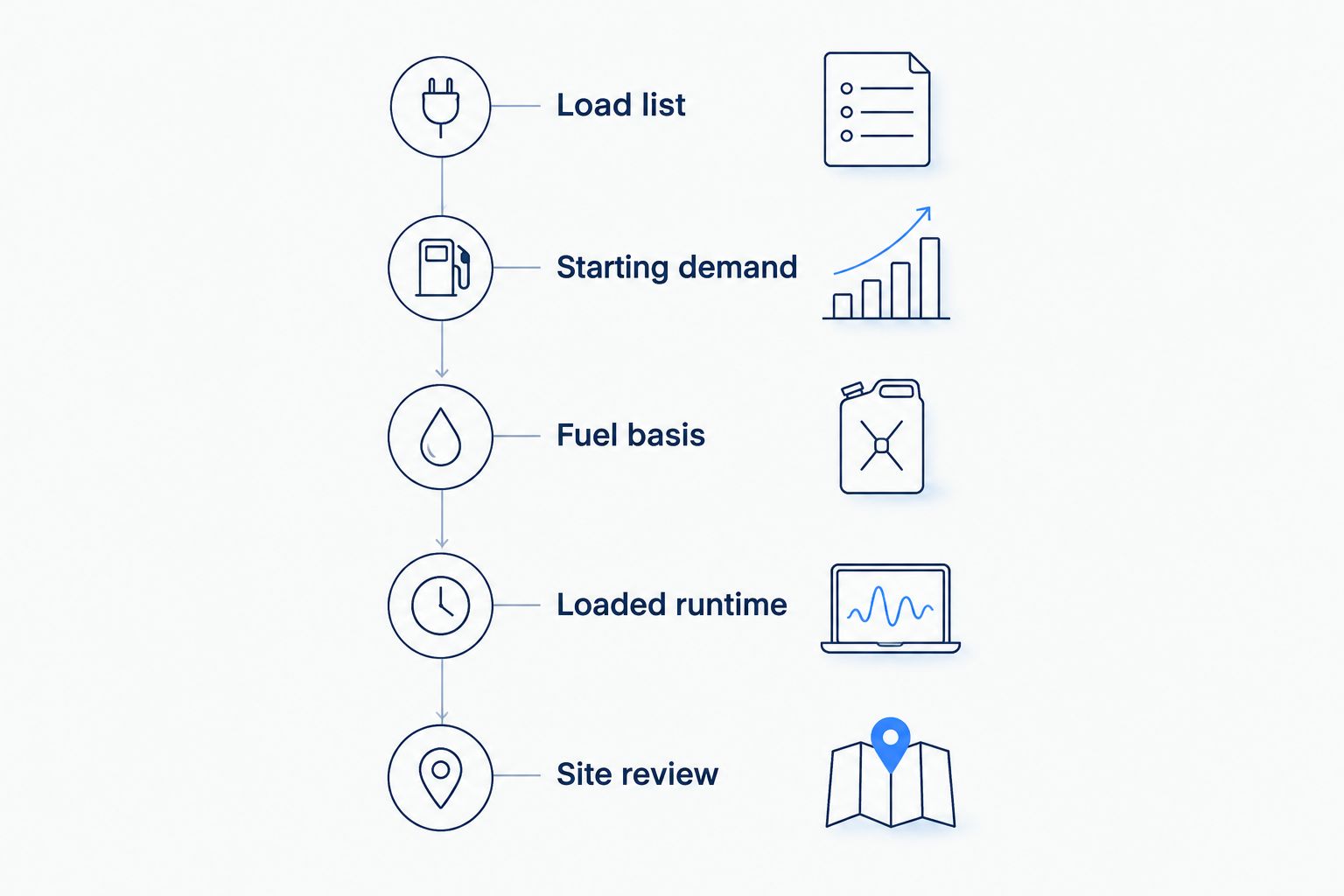
A defensible 2026 comparison follows this sequence. Use manufacturer documentation for the candidate machines and actual equipment requirements for the job.
Load list
Record what runs continuously and what cycles. Identify motors, heaters, lighting, controls, and chargers separately. Do not open energized equipment to collect information; have a licensed electrician resolve unreadable or uncertain ratings.
Starting demand
Identify the equipment that starts together. Motor starting can exceed running demand. A generator that carries the steady load can still trip or suffer unacceptable voltage drop during startup.
Fuel basis
Write down the fuel and supply arrangement used for each runtime claim. A built-in tank and an external cylinder are different comparison bases. Account for the approved refueling procedure, not just engine consumption.
Loaded runtime
Compare hours at the same absolute electrical demand wherever documentation allows. A quarter-load claim on a large machine describes a different workload from a quarter-load claim on a smaller machine.
Site review
Resolve placement, electrical connections, protection, and operating access before deployment. A runtime winner that cannot be safely connected is not a usable choice.
For a closer look at the distinction between fuel consumption and operating duration, use the guide to generator fuel efficiency. Lower consumption and longer runtime are not interchangeable: tank capacity also affects operating duration.
Electrical and placement checks come before runtime
Common North American portable generators supply 120 V, 240 V, or both, depending on the model. Equipment also has a frequency requirement; 60 Hz is standard for North American utility power. Verify the actual nameplate and receptacles instead of assuming a generator supplies every required combination.
For 2026 planning, follow the CDC's portable-generator carbon monoxide guidance: operate outdoors at least 20 feet from doors, windows, and vents. That distance is a carbon monoxide precaution, not approval for placement near an oilfield process or inside a classified boundary.
Keep these decisions with qualified personnel:
- Hazardous locations: Site classification controls equipment suitability and placement. A consumer safety feature does not establish hazardous-location approval.
- Grounding and bonding: Requirements depend on generator configuration and how power reaches the load. Do not install a ground rod or alter a neutral bond by guesswork.
- Facility connections: Never backfeed through a receptacle. A licensed electrician must establish the appropriate transfer arrangement.
- Cords and protection: Use equipment suited to the environment and circuit. Keep connections protected from water and physical damage.
- Refueling: Shut down and allow cooling as the manufacturer directs. Keep fueling away from ignition sources.
An on-site inspection is needed when the connection, classification, or existing distribution arrangement is uncertain. Eagle Electric's oilfield electrical services fit that site-specific work; a runtime table does not replace it.
Request an oilfield electrical quote
Ask for a same-business-day response and a clear written scope for generator connections and site electrical work.
How we ranked these generator configurations
The ranking uses operating fit: sustained demand, changing demand, fuel flexibility, and defined temporary work. It does not assign measured runtime hours to unnamed machines.
Portable diesel generators lead for sustained support work when diesel logistics fit. Gasoline inverter generators take the variable-load slot. Dual-fuel generators address alternate fueling, while conventional gasoline generators remain an option for a defined temporary assignment.
The buying decision still rests on comparable loaded runtime, sufficient starting capacity, and a safe connection.
Which portable generator should you choose?
Start with a portable diesel generator for sustained support loads where the site supports diesel fueling. Choose a gasoline inverter generator instead when your work centers on intermittent tools and its documented capacity fits.
Use dual-fuel equipment when alternate fueling solves a specific operating problem. Choose a conventional gasoline generator when a defined temporary assignment fits its documented performance.
Before placing a 2026 order, require the same evidence for every candidate: intended load, starting demand, fuel basis, loaded runtime, connection requirements, and safe placement. Buy the machine that meets the assignment. Reject the one that wins only on an unrelated light-load claim.
FAQ
What's the best portable generator for oilfield runtime?
The best portable generator is the specific machine that covers your intended load for the required operating period with an approved fuel and connection plan. A portable diesel generator is a starting option for sustained support loads where diesel logistics fit, but its documented runtime must match the job.
Can I compare generators by their advertised runtime hours?
Compare advertised runtime only when the fuel basis and electrical load are comparable. Equal load percentages on generators of different capacities do not represent equal workloads.
Is a diesel generator always better than a gasoline inverter generator?
No. A portable diesel generator fits sustained support work with suitable diesel logistics, while a gasoline inverter generator fits variable loads when its capacity and equipment compatibility are verified.
Does a dual-fuel generator run longer on propane?
There is no universal runtime advantage for propane. Compare the specific generator's documentation using the stated fuel supply, load, and output rating for each fuel.
Can a portable generator operate inside an oilfield hazardous area?
Do not place a standard portable generator inside a classified area without documented suitability and site approval. Hazardous-location requirements apply to the equipment and installation, not just the electrical load.
How far should a portable generator be from doors and windows?
The CDC advises operating portable generators outdoors at least 20 feet from doors, windows, and vents. Oilfield placement also requires review of process hazards and classified boundaries; the carbon monoxide distance alone is not site approval.
Do I need an electrician to connect a generator to a building?
Yes, use a licensed electrician to establish the transfer arrangement, protection, and grounding and bonding requirements. Never connect a generator by backfeeding a building receptacle.
One last thing
A longer runtime claim can reflect a larger fuel tank rather than better fuel efficiency. Ask for consumption and runtime at the same load before treating either as an operating advantage.
Keep the electrical scope equally clear. Eagle Electric provides oilfield electrical contracting; your written quote should identify the requested connection work and site requirements separately from the generator's manufacturer specifications.


