

Best overall for ordinary branch circuits: a lighting and appliance panelboard. Best for larger equipment feeders: a power panelboard. Best for a larger main distribution assembly: a switchboard. For Dickinson businesses choosing commercial electrical panels in 2026, the right answer starts with your building’s voltage, calculated load, available fault current, and operating needs—not a manufacturer’s name.
- Best commercial electrical panels Dickinson ND: choose by load, voltage, fault rating, and installation conditions.
- Lighting and appliance panelboards are the default choice for ordinary commercial branch circuits.
- Power panelboards serve larger equipment feeders; switchboards address broader service distribution needs.
- Eagle Electric provides commercial electrical contracting across the Bakken region; request an on-site assessment and written scope.
Why this matters
A panel that has spare breaker spaces can still lack electrical capacity. A correctly sized panel can still be wrong for the available fault current or the room where it will sit.
Eagle Electric is a licensed electrical contractor for Bakken businesses that need commercial electrical panel work. Start with an assessment through Eagle Electric, based in Watford City, rather than ordering equipment from a breaker count alone.
This 2026 guide ranks equipment types by job. It does not treat a switchboard, an outdoor enclosure, and a branch-circuit panel as interchangeable purchases. Your electrician must confirm the actual installation before specifying equipment.
What makes the best commercial electrical panel
Use these criteria to judge a proposal before approving equipment:
- System match: Voltage, phase, conductors, and grounding arrangements must match the supply and connected loads.
- Load capacity: Service and feeder calculations determine capacity. Empty breaker positions do not establish it.
- Fault-current suitability: Interrupting ratings and assembly ratings must suit the available fault current at the installation.
- Installation conditions: Indoor, outdoor, wet, corrosive, and hazardous locations require different equipment decisions.
- Operating needs: Circuit grouping, isolation, maintenance access, and planned additions should match how your business runs.
- Listed compatibility: Breakers and accessories must be identified for use with the selected assembly. Physical fit is not proof of compatibility.
A 120/208 V three-phase system and a 277/480 V three-phase system serve different voltage requirements. Those common configurations are examples, not a specification for your building. A licensed electrician must verify the actual supply and each equipment nameplate.
Likewise, a 200 A panel rating does not prove that your existing service can support a 200 A load. The panel, feeder, service, and calculated demand are separate checks.
Commercial electrical panels at a glance
| Rank and option | Best for | Standout feature | Key limitation |
|---|---|---|---|
| 1. Lighting and appliance panelboard | Ordinary commercial branch circuits | Organizes lighting, receptacles, and compatible smaller loads | Does not replace a service-capacity assessment |
| 2. Power panelboard | Larger equipment feeders | Distributes power to equipment and downstream panels | Requires feeder, protection, and fault-rating coordination |
| 3. Distribution switchboard | Larger main distribution assemblies | Groups service or feeder distribution in a broader assembly | Needs more installation planning than a typical wall-mounted panel |
| 4. Outdoor enclosed panelboard | Nonhazardous exterior installations | Places distribution near outdoor loads | Weather protection alone does not establish hazardous-location suitability |
| 5. Dedicated critical-load panel | Selected backup-supported circuits | Separates chosen operating loads | Does not provide backup power by itself |
These options describe different jobs, not competing product brands. An outdoor panel can also serve branch circuits. A critical-load panel can use ordinary panelboard construction. The ranking tells you which requirement should lead the specification.
1. Lighting and appliance panelboard: best for branch circuits
A lighting and appliance panelboard distributes power to individual branch circuits. It is the sensible starting point for commercial spaces where lighting, receptacles, and compatible smaller equipment make up the immediate project.
Choose it around the actual circuit schedule. Your electrician needs to know which loads exist, which loads are being added, and whether the existing feeder can carry the calculated demand.
Lighting and appliance panelboard pros
- Groups ordinary branch circuits in one identified assembly.
- Supports a clear circuit directory for shutdowns and maintenance.
- Can separate circuits by operating area when the design calls for it.
- Provides a practical basis for planning future branch-circuit additions.
Lighting and appliance panelboard cons
- Spare spaces do not guarantee spare feeder or service capacity.
- It is not automatically suitable for every motor or larger equipment load.
- Replacement alone does not correct defects elsewhere in the electrical system.
Best for: Offices, retail spaces, and other commercial areas needing ordinary branch-circuit distribution.
For a 2026 remodel, put the planned equipment list in the scope before approving the panel. Include equipment voltage and nameplate information where available. Do not let an incomplete load list become an installed limitation.
Verdict: Buy when the load calculation and installation assessment confirm a branch-circuit panelboard fits the job.
2. Power panelboard: best for larger equipment feeders
A power panelboard distributes power to larger loads or downstream distribution equipment. It belongs in the discussion when your project involves substantial equipment feeders rather than only additional receptacles and lighting.
The name does not establish suitability. The selected assembly still needs the right voltage, current rating, protective devices, and fault-current rating for its location in the system.
Power panelboard pros
- Gives larger equipment feeders a defined distribution point.
- Can supply downstream panels as part of a coordinated design.
- Keeps feeder identification and disconnect planning in one scope.
- Supports equipment additions when upstream capacity permits them.
Power panelboard cons
- A larger panel does not increase the capacity of the utility supply.
- Equipment starting characteristics and protection require separate review.
- Changes can affect downstream protection and shutdown planning.
Best for: Commercial facilities adding larger equipment or distributing power to multiple downstream panels.
Bring equipment documentation to the assessment. Motor loads, heating loads, and mixed equipment loads do not all behave alike. Your electrician needs more than a rough total copied from purchase orders.
Ask the written quote to identify the feeder work and protective devices included. A panel-only scope leaves you without a clear answer about the rest of the installation.
Verdict: Buy for a verified equipment-feeder requirement; skip it as a shortcut around inadequate upstream capacity.
3. Distribution switchboard: best for larger main distribution
A switchboard is a distribution assembly, not simply a bigger wall-mounted panelboard. It is a candidate when the project calls for a broader service or feeder distribution arrangement.
That distinction matters. Equipment layout, access, conductor routing, protection, and utility coordination must be settled before the assembly is specified.
Distribution switchboard pros
- Groups multiple distribution functions in a planned assembly.
- Provides a structure for supplying downstream equipment and panels.
- Supports a facility-wide distribution plan rather than isolated additions.
Distribution switchboard cons
- Requires space and access suited to the selected equipment.
- Installation involves more coordination than a straightforward branch-panel change.
- It is unnecessary when a smaller assembly meets the verified requirement.
Best for: Businesses undertaking a larger service-distribution project, not merely adding a few branch circuits.
For a 2026 facility expansion, settle the service arrangement before finalizing equipment. A switchboard selection made before the utility and design requirements are clear can leave the project scope unresolved.
Have the proposal distinguish the switchboard from downstream panelboards. You should understand what each assembly supplies and which shutdowns the work requires.
Verdict: Buy only when the distribution design calls for a switchboard; skip it for a routine branch-circuit addition.
4. Outdoor enclosed panelboard: best for exterior loads
An outdoor enclosed panelboard places distribution where exterior equipment needs it. Its defining requirement is the installation environment, not a different method of calculating electrical demand.
The enclosure must suit the actual exposure. Rain protection, corrosion resistance, conduit entries, condensation, and working access need attention in the installation design.
Outdoor enclosed panelboard pros
- Places a distribution point near exterior equipment.
- Provides environmental protection when the enclosure is correctly selected.
- Lets the design address outdoor access and isolation directly.
Outdoor enclosed panelboard cons
- An outdoor rating does not establish hazardous-location suitability.
- Openings, fittings, and installation details affect enclosure protection.
- Snow accumulation and site conditions must not block working access.
Best for: Nonhazardous outdoor commercial installations where exterior distribution is required.
Do not confuse weather exposure with a classified location. Where flammable gases, vapors, or combustible dusts create a classification issue, a qualified assessment must establish the equipment requirements. A weather-resistant cabinet is not a substitute for that assessment.
Keep outdoor access in the written scope. The location must work for maintenance, not just fit beside the equipment.
Verdict: Buy for a verified exterior requirement; skip a standard outdoor enclosure as an assumed hazardous-location solution.
5. Dedicated critical-load panel: best for selected backup circuits
A dedicated critical-load panel groups circuits selected for backup-supported operation. It helps define what remains connected to the backup system and what stays outside that scope.
The panel does not generate power or perform every transfer function. It must be designed with the source, transfer equipment, grounding arrangement, and connected loads.
Dedicated critical-load panel pros
- Makes the selected backup circuits explicit.
- Separates chosen operating loads from unrelated building loads.
- Gives backup-system design a defined circuit schedule.
Dedicated critical-load panel cons
- It cannot supply backup power without a suitable source and transfer arrangement.
- Moving circuits requires installation work and shutdown planning.
- Ordinary backup grouping does not establish compliance for legally required emergency systems.
Best for: Businesses planning backup power for selected circuits rather than assuming every building load must run.
Start with the business function you need to preserve. Then identify the equipment that supports it. The electrician can evaluate running loads, starting requirements, and the transfer arrangement from that list.
Treat emergency and legally required standby loads separately from optional business-continuity loads. Their requirements need qualified design review.
Verdict: Buy as part of a complete backup-power design; skip it as a standalone outage solution.
Before you approve the written quote
A useful commercial panel proposal connects the equipment to the building. Ask Eagle Electric for a same-business-day response to your quote request and a clear written quote. Keep response timing separate from inspection scheduling and job completion.
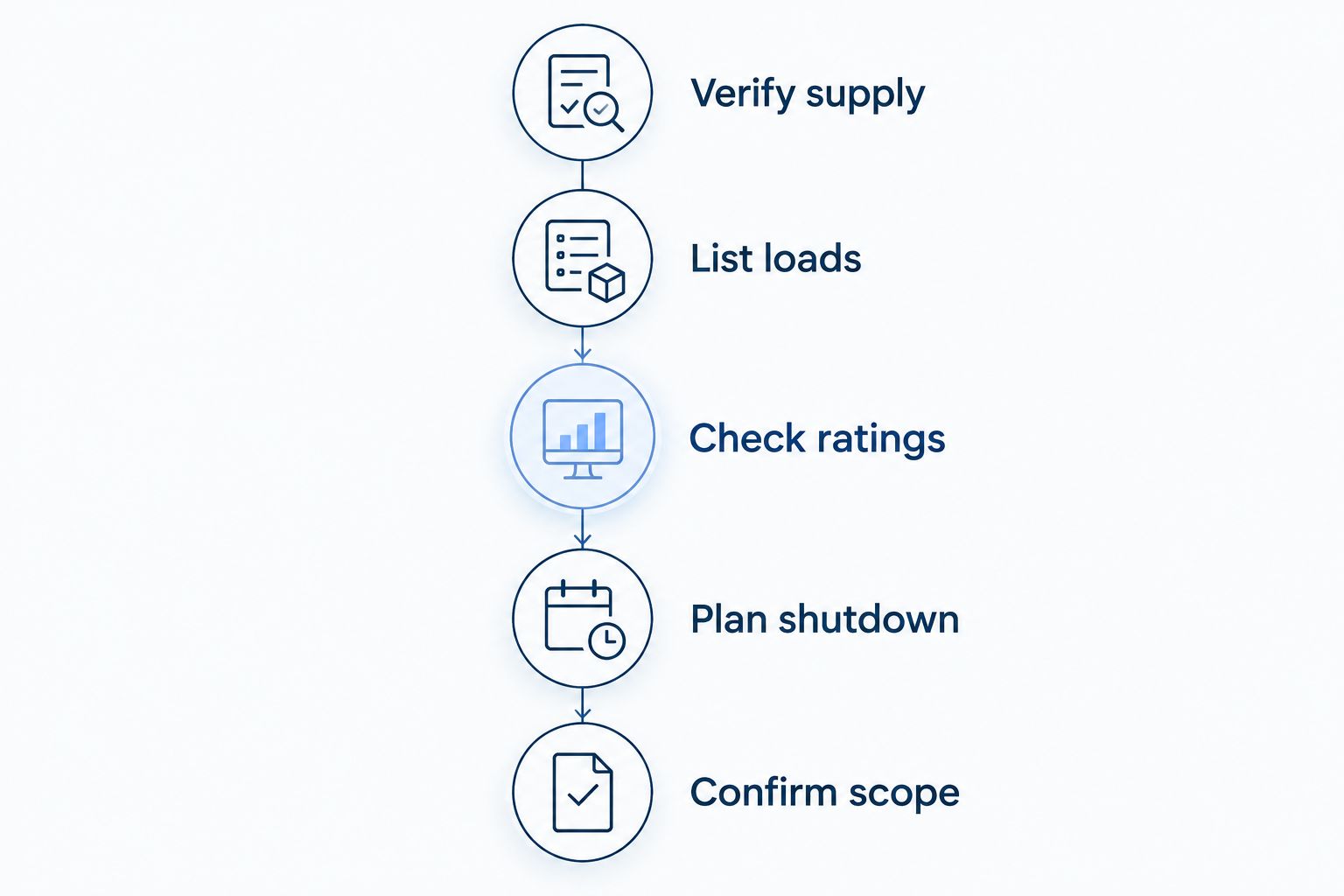
Use this sequence to make the scope readable:
- Verify supply: Confirm voltage, phase, existing service, and feeder arrangements.
- List loads: Identify existing equipment, planned additions, and any backup priorities.
- Check ratings: Establish load requirements, fault-current suitability, and equipment compatibility.
- Plan shutdown: Identify affected operations, access needs, and shutdown coordination.
- Confirm scope: State included work, exclusions, permit responsibilities, and inspection arrangements.
Do not remove covers or inspect energized equipment yourself. Provide existing drawings, accessible equipment labels, and a description of the problem. Let the licensed electrician determine what testing and safe access are required.
Request a commercial electrical assessment
Ask for an on-site assessment and a clear written scope before selecting panel equipment.
How these options are ranked
The ranking puts ordinary branch-circuit distribution first, then separates larger feeders, main distribution, outdoor exposure, and backup priorities. Each option owns a different decision.
The criteria are system match, load capacity, fault-current suitability, installation conditions, operating needs, and listed compatibility. No manufacturer ranking replaces those checks, and no panel rating replaces an on-site assessment.
Which commercial electrical panel should you choose?
Start with a lighting and appliance panelboard for ordinary commercial branch circuits. Move to a power panelboard when larger feeders drive the project. Consider a switchboard when the main distribution arrangement requires it.
For exterior installations, make enclosure suitability part of the specification. For backup-supported circuits, define the critical loads and transfer arrangement together.
Your 2026 purchase decision should follow the written scope. Eagle Electric provides commercial electrical contracting across the Bakken region; ask for the installation requirements before choosing equipment.
FAQ
What's the best commercial electrical panel for a Dickinson business?
A lighting and appliance panelboard is the default starting point for ordinary commercial branch circuits. Larger feeders, exterior exposure, or backup requirements change the specification. A licensed electrician must verify the installation.
Is a power panelboard better than a lighting panelboard?
A power panelboard is better suited when larger equipment feeders drive the distribution requirement. A lighting and appliance panelboard suits ordinary branch circuits. Choose by the job, not the name.
Does a 200 A panel mean my business has enough capacity?
No. A 200 A panel rating does not establish available service capacity or the calculated load. Your electrician must assess the service, feeder, panel, and connected equipment together.
Can a commercial panel go outside in Dickinson?
Yes, when the equipment and installation are suitable for the outdoor location. The enclosure, fittings, exposure, access, and any location classification must be evaluated.
Should I replace a panel that keeps tripping breakers?
Have a licensed electrician diagnose repeated breaker trips before deciding to replace the panel. Overloads, faults, equipment problems, or other defects require correction; a larger breaker is not a safe assumed fix.
Will a critical-load panel keep my business running during an outage?
A critical-load panel alone will not provide power during an outage. It groups selected circuits and must be part of a suitable backup-source and transfer-system design.
What should a commercial panel quote include in 2026?
A commercial panel quote should identify the equipment, feeder work, circuit scope, shutdown arrangements, and permit responsibilities. Ask Eagle Electric to distinguish included work from exclusions in writing.
One last thing
An empty breaker position answers only one question: whether there is physical space for another breaker. It does not establish electrical capacity, conductor suitability, or permission to add a load.
Before buying a panel, ask what verified requirement makes the existing installation unsuitable. That answer separates necessary electrical work from an equipment purchase that misses the problem.


