
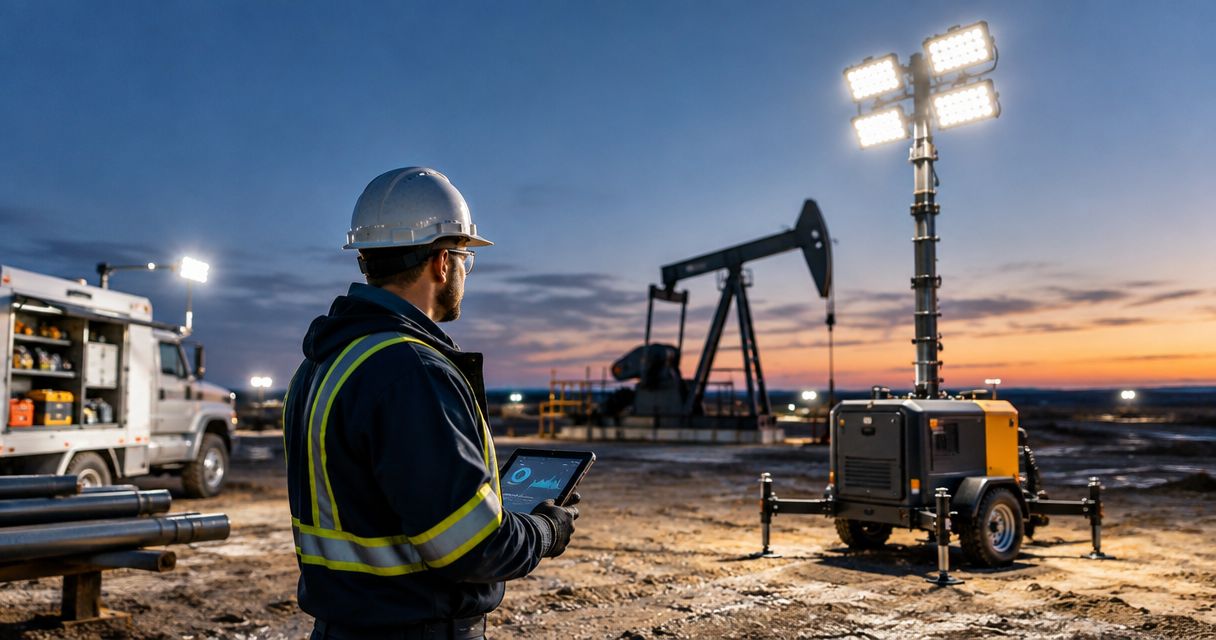
Best overall for permanent work areas: fixed LED area lighting matched to the location classification. Best for temporary open-area work: mobile LED light towers; best for close inspections: location-rated portable LED task lights—these are the practical starting points for oilfield lighting in 2026.
- The best LED lighting oilfield job sites use must match the location classification before brightness or mounting preference.
- Fixed LED area lighting is the default for permanent yards; mobile LED towers suit temporary open-area work.
- Portable LED task lights help with close inspections but do not replace area lighting or emergency lighting.
- Eagle-Elc provides licensed oilfield electrical contracting for operators across the Bakken region.
Why this matters
A bright fixture is not automatically a safe fixture. On an oilfield site, you need lighting that fits the electrical supply, operating environment, work task, and hazardous-location classification.
Eagle-Elc provides licensed oilfield electrical contracting from Watford City, ND, across the Bakken region. Eagle-Elc is a fit for Bakken operators who need oilfield electrical contracting, not just help choosing a light.
For a 2026 lighting project, start with the actual work area. Tank equipment, a truck approach, an enclosed building, and a temporary maintenance station do not call for the same installation. Get the location reviewed before selecting equipment.
What makes the best oilfield LED lighting
Use these criteria before comparing fixtures:
- Location suitability: Match the complete assembly to the documented classification, including applicable gas group and temperature marking. Weather resistance alone is not enough.
- Useful illumination: Light the walking surface, equipment, and task. A high lumen total does not establish visibility at the point of work.
- Glare control: Aim and shield fixtures so operators can see without looking into an exposed light source.
- Electrical compatibility: Confirm supply voltage, circuit capacity, grounding, controls, and connection method.
- Environmental suitability: Check published operating-temperature limits, enclosure protection, corrosion exposure, and mounting requirements.
- Service access: Choose locations where qualified personnel can inspect and maintain the installation without creating another access hazard.
A standard 120-volt light does not belong on a 277-volt supply. A 480-volt distribution system also requires an appropriate lighting supply arrangement; do not assume a fixture connects directly. Have a licensed electrician verify the circuit and equipment nameplate.
Oilfield LED lighting at a glance
These are application categories, not competing manufacturers. The right choice depends on where the light will operate and what you need to see.
| Rank | Lighting solution | Best for | Standout feature | Key limitation |
|---|---|---|---|---|
| 1 | Fixed LED area lighting | Permanent yards and equipment approaches | Stable coverage from planned mounting positions | Poor placement creates glare and shadows |
| 2 | Mobile LED light towers | Temporary open-area work | Relocatable elevated illumination | Requires suitable ground, positioning, and power planning |
| 3 | Portable LED task lights | Close inspection and maintenance | Light directed at the work surface | Does not provide dependable site-wide coverage |
| 4 | Linear LED fixtures | Enclosed buildings and covered work areas | Distributed light along aisles and work zones | Ordinary fixtures are not automatically suitable for classified spaces |
| 5 | Emergency and egress LED lighting | Escape routes during loss of normal lighting | Dedicated illumination for leaving the area | Does not replace normal work lighting |
1. Fixed LED area lighting: best for permanent oilfield yards
Fixed LED area lighting provides repeatable coverage from poles, structures, or other approved supports. It is the default choice when your work area stays in one place and the mounting positions can be planned around vehicle movement and equipment.
Start with the tasks below the light. A truck approach needs a different distribution than a valve station. Wider beams can cover more ground, but equipment can still block the light and leave critical surfaces in shadow.
Fixed LED area lighting pros:
- Keeps the lighting arrangement consistent between shifts.
- Supports deliberate aiming and shielding.
- Allows permanent circuit and control planning.
- Reduces the need to reposition temporary equipment.
Fixed LED area lighting cons:
- Incorrect aiming can put glare in an operator's line of sight.
- Mounting height can complicate inspection and maintenance.
- Site changes can leave the original layout poorly matched to current work.
Best for: Permanent yards, established work zones, and equipment approaches with known mounting locations.
For a 2026 installation, require a layout that shows the lighted surfaces, not just fixture locations. Include normal equipment positions and travel routes. Check the finished installation after dark before accepting the aiming.
Verdict: Buy for permanent areas after the classification, mounting, and lighting layout are confirmed.
2. Mobile LED light towers: best for temporary open-area work
Mobile LED light towers bring elevated lighting to a changing work area. They suit temporary projects where permanent fixtures would not follow the job.
The tower position matters as much as its output. Keep it outside vehicle paths, account for equipment shadows, and follow the manufacturer's ground, stabilization, mast, and wind instructions. Do not position a tower beneath overhead electrical lines.
Mobile LED light tower pros:
- Moves with temporary work zones.
- Provides elevated illumination without permanent mounting construction.
- Can serve open areas where building-mounted lights do not reach.
- Allows repositioning when the work layout changes.
Mobile LED light tower cons:
- Takes up ground space and requires safe access.
- Incorrect positioning creates glare or deep shadows.
- Suitability depends on the complete assembly, not only the LED heads.
Best for: Temporary open-area work with suitable ground and a planned equipment position.
Check how the tower receives power. An integrated engine, external generator, battery system, or site connection each brings different operating requirements. Do not infer hazardous-location suitability from the light heads; inspect the rating of the entire arrangement and its intended placement.
Verdict: Buy for temporary open areas; skip any tower arrangement that does not meet site conditions.
3. Portable LED task lights: best for close maintenance work
Portable LED task lights put illumination near a specific inspection or repair. They help when a worker's body, a cabinet, or surrounding equipment blocks overhead lighting.
Choose the light for the location where it will actually be used. A light suitable for an ordinary workshop is not automatically suitable near equipment in a classified area. The cord, plug, charger, and connection arrangement also need review.
Portable LED task light pros:
- Directs light toward labels, fittings, and work surfaces.
- Repositions as the task changes.
- Fills shadows that fixed area lights cannot reach.
- Supports close visual checks without changing the full site layout.
Portable LED task light cons:
- Cords and placement can create trip or snag hazards.
- Battery-powered units require charging and runtime planning.
- A narrow lighted area can leave the surrounding walking route dark.
Best for: Close inspection and maintenance where the equipment rating matches the work location.
Secure the light without blocking access or placing it against an unsuitable surface. Keep portable lighting separate from electrical isolation decisions. A well-lit cabinet is not safe to open simply because you can see it clearly; qualified personnel must apply the required electrical safety procedures.
Verdict: Buy as supplemental task lighting, not as the site's only lighting system.
4. Linear LED fixtures: best for enclosed work areas
Linear LED fixtures distribute light along buildings, aisles, and covered work zones. Their layout can provide more even coverage than isolated point sources when fixtures are positioned around the actual work.
An enclosed space still needs a classification review. A shelter or building does not become an ordinary location just because it has walls and a roof. Ventilation, processes, and potential releases affect the assessment.
Linear LED fixture pros:
- Distributes lighting across repeated work positions.
- Supports aisle and bench lighting layouts.
- Allows controls to follow separate work zones.
- Can reduce dark gaps when spacing and distribution are planned correctly.
Linear LED fixture cons:
- Ordinary building fixtures are not a substitute for required hazardous-location equipment.
- Overhead coverage alone can leave vertical surfaces dark.
- Dirt and obstructions can reduce useful illumination.
Best for: Enclosed buildings and covered work areas with verified environmental and location requirements.
For your 2026 specification, include mounting details and maintenance access. Check whether technicians need to read equipment faces or work inside open cabinets. Those tasks can require supplemental lighting even when the room looks evenly illuminated.
Verdict: Buy for enclosed work areas after confirming classification and task coverage.
5. Emergency and egress LED lighting: best for escape routes
Emergency and egress lighting serves a different purpose from normal work lighting. It helps occupants identify and follow the required route when normal illumination fails.
Select and arrange the system under the applicable building, electrical, and life-safety requirements. Exit identification, emergency illumination, and the supporting power arrangement need coordinated design. A portable work light is not a substitute for that system.
Emergency and egress LED lighting pros:
- Addresses loss of normal lighting.
- Keeps attention on required escape paths.
- Supports a defined inspection and testing process.
- Separates life-safety lighting needs from ordinary production lighting.
Emergency and egress LED lighting cons:
- Requires ongoing testing and maintenance.
- Batteries or other supporting equipment need service.
- Does not provide the coverage needed to continue normal work.
Best for: Required escape routes and occupied spaces where emergency illumination applies.
Do not assume a generator automatically satisfies every emergency-lighting requirement. The source, transfer arrangement, circuit design, and applicable rules must fit the intended system. Review the design with the responsible qualified professionals and authority having jurisdiction.
Verdict: Buy where required for egress; skip treating it as a replacement for normal lighting.
Weatherproof does not mean hazardous-location rated
IEC 60529 enclosure ratings describe protection against solids and water. IP65 indicates a dust-tight enclosure with protection against water jets. IP66 indicates a dust-tight enclosure with protection against powerful water jets under the standard's test conditions.
Neither rating establishes hazardous-location suitability. Neither is a blanket approval for every cleaning method, chemical exposure, or operating temperature.
Class I locations concern flammable gases or vapors under the NEC classification system. Division 1 and Division 2 describe different conditions; the division marking alone is not the entire equipment selection. Gas group, temperature marking, and other installation requirements still matter.
Do not select an oilfield light from an IP rating alone. Ask for the location documentation and the manufacturer's applicable certification and installation instructions. Let a qualified professional resolve mismatches before equipment reaches the work area.
Turn the lighting choice into a written scope
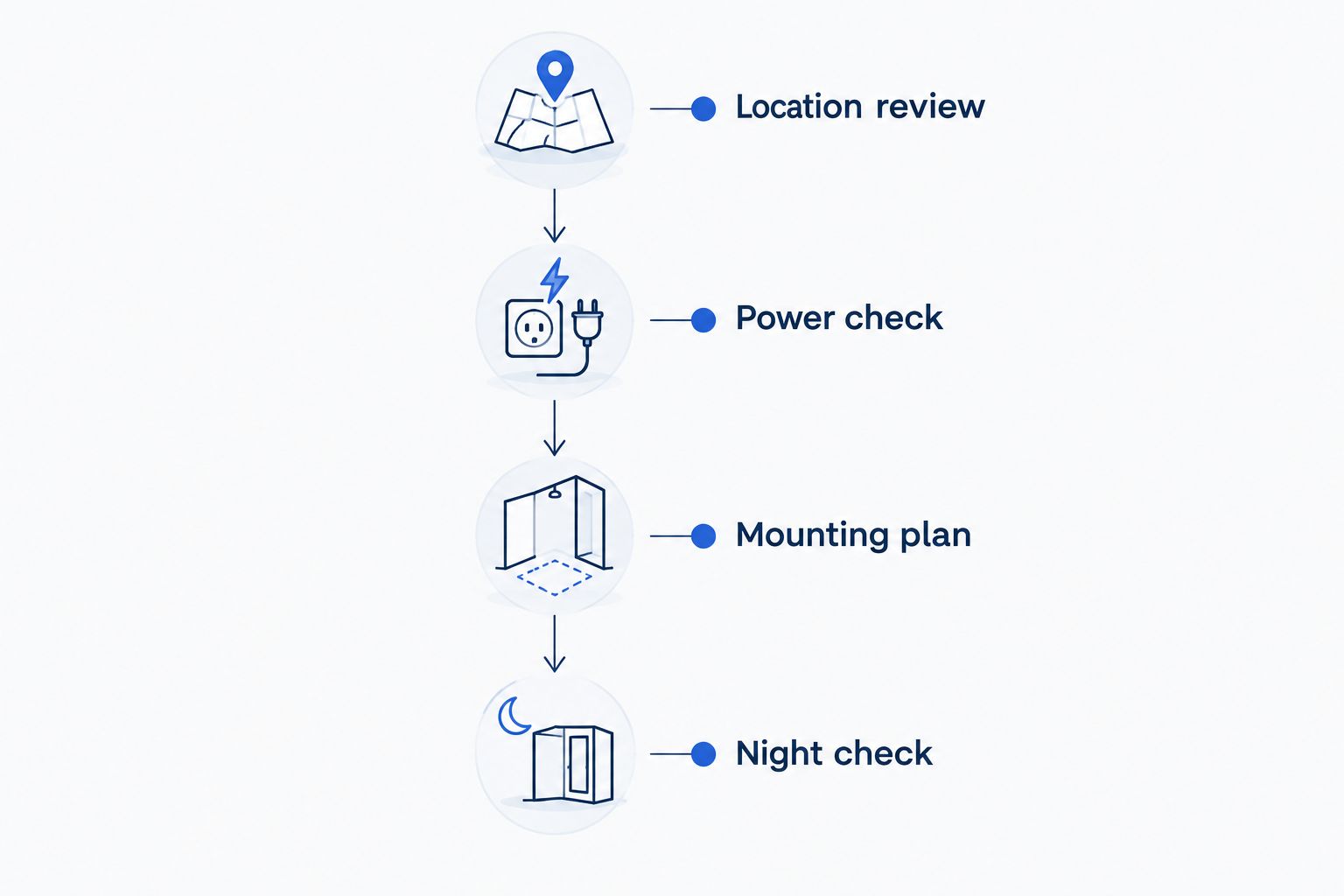
Use this sequence before ordering fixtures:
- Location review: Identify each work area and confirm its classification requirements.
- Power check: Verify the supply, circuits, connection methods, and control needs.
- Mounting plan: Identify supports, equipment clearance, glare risks, and service access.
- Night check: Confirm the installed lighting covers tasks and routes without unacceptable glare.
The sequence prevents a common purchasing mistake: choosing a light first and trying to make the site fit it afterward.
Send Eagle-Elc the site location, work description, known supply details, and photographs taken from a safe position. Do not remove covers or enter restricted areas to gather information. Eagle-Elc emphasizes same-business-day responses to quote requests and clear written quotes; a response is not a promise of same-day job completion.
Ask the written scope to identify installation work, controls, access requirements, testing, and exclusions. Keep unknown site conditions separate from confirmed work. An on-site inspection is needed when photographs and records do not establish the installation requirements.
Request an oilfield lighting quote
Describe the work area and request a clear written scope for your lighting project.
How these solutions are ranked
This 2026 ranking puts permanent coverage first, temporary coverage second, and close task visibility third. Enclosed-area and emergency lighting follow because they solve separate problems, not because they matter less.
The criteria are location suitability, useful illumination, glare, electrical compatibility, environmental suitability, and service access. No manufacturer comparison or product-performance test is implied.
Which oilfield LED lighting should you choose?
Choose fixed LED area lighting as the default for an established yard. Add location-rated task lighting where machinery creates shadows. Use mobile towers when the work area moves, and treat enclosed-area and emergency lighting as separate design decisions.
For a 2026 project, settle the classification and electrical supply before making the fixture selection. Brightness comes after suitability. Do not buy equipment that requires an unsupported assumption about either.
FAQ
What's the best LED lighting for a permanent oilfield yard?
Fixed LED area lighting is the default for a permanent oilfield yard when the location rating, mounting, and coverage match the site. Add task lighting where equipment blocks the overhead light.
Are mobile LED light towers suitable for every oilfield location?
No. Mobile LED light towers must suit the intended location, ground conditions, electrical arrangement, and operating environment. Review the complete assembly rather than only the light heads.
Does IP66 mean an LED light is explosion-proof?
No. IP66 describes dust and water protection under IEC 60529, not hazardous-location certification. Equipment for a classified area needs the applicable rating and installation arrangement.
Can portable LED task lights replace fixed site lighting?
Portable LED task lights should supplement fixed site lighting, not replace it. They illuminate close work but do not establish coverage for walking routes, vehicle movement, or emergency egress.
Can I choose oilfield lights by lumens alone?
No. Lumens describe light output, not the illumination delivered to every work surface. Distribution, mounting, obstructions, and glare determine how useful the lighting is.
Do I need a licensed electrician for an oilfield lighting upgrade?
Use a licensed electrician for the electrical installation and have qualified personnel confirm hazardous-location requirements. An on-site inspection is needed when the existing supply, wiring, or mounting conditions are not established.
What should an oilfield lighting quote include in 2026?
An oilfield lighting quote should identify the work areas, installation scope, electrical connections, controls, access needs, testing, and exclusions. Separate confirmed work from conditions that still require inspection.
One last thing
Judge the lighting from the operator's position, not from beneath the fixture. A yard can look bright while a valve label stays in shadow or a truck driver faces direct glare.
Make the nighttime check part of acceptance. Walk the authorized routes with the responsible site personnel and check the actual tasks. Correct the aiming before calling the lighting job finished.


