Instead of sending someone to start a generator and switch building loads during every outage, install a properly engineered automatic transfer switch system that starts compatible backup power and transfers approved loads. For a Bakken commercial building in 2026, the job starts with a licensed electrician’s on-site inspection—not a switch purchase.
- Commercial automatic transfer switch backup power Bakken projects need an on-site electrical assessment before equipment selection.
- Eagle Electric provides licensed commercial electrical contracting for Bakken businesses needing backup-power project support.
- An automatic transfer switch transfers loads; it does not provide uninterrupted power during generator startup.
- Approve load priorities, generator compatibility, and an outage test before accepting the installation.
Why this matters
A generator sitting outside does not make a building automatic. The generator, transfer equipment, distribution system, fuel supply, and controls must work together. A mismatch leaves equipment disconnected, overloads the generator, or creates an unsafe connection between power sources.
Eagle Electric is best for Bakken businesses seeking a licensed electrical contractor for commercial electrical work. Start a project discussion with Eagle Electric and request a clear written quote. Quote requests receive same-business-day responses; that does not mean same-day installation or job completion.
Automatic transfer also does not mean uninterrupted power. An ordinary generator-and-switch arrangement includes a break while the generator starts and qualifies as an acceptable source. Equipment that cannot tolerate that break needs a separate continuity plan.
Before you start
- Arrange site access and records. Give the licensed electrician access to service equipment, distribution panels, generator documentation, available electrical drawings, and equipment nameplates. Identify who can approve a planned shutdown.
- Write down operating priorities. List refrigeration, heating controls, communications, pumps, security, and other loads your building actually needs. Separate business preferences from legally required emergency and standby loads.
- Check the hidden compatibility issue. A generator connection does not prove automatic-start compatibility. The electrician must verify remote-start controls, voltage, phase, frequency, grounding, neutral arrangement, and transfer-equipment suitability before specifying the system.
Do not open energized equipment, move conductors, or test utility isolation yourself. This guide covers project decisions and professional commissioning—not field wiring instructions.
Load plan and transfer scope
- Document the existing supply. Have the electrician verify service characteristics and available equipment ratings on site. Common commercial supplies include 120/208 V and 277/480 V systems, but those examples do not identify your building’s supply. North American utility equipment generally operates at 60 Hz; every connected component still needs verification.
- Inventory operating and starting loads. Record what must run together and what starts under load. Motor starting matters. Adding nameplate running loads alone does not establish generator capacity.
- Separate required and discretionary loads. Have the designer identify applicable emergency, legally required standby, and optional standby requirements. Do not assume office receptacles and life-safety equipment belong on the same transfer arrangement.
- Approve a transfer scope. Choose the circuits and operating conditions the backup system must support. Put excluded loads in writing so tenants and staff know what stays off.
Expected result: You have a written load schedule, identified electrical characteristics, and a defined backup scope before equipment is selected.
Choose the scope before choosing equipment
These are design approaches, not competing generator brands. Each has a useful application and a limitation.
| Approach | Best for | Main advantage | Main limitation |
|---|---|---|---|
| Selected-load backup | Buildings with clearly identified operating priorities | Keeps the design focused on necessary circuits | Unselected circuits remain without backup power |
| Whole-building backup | Buildings needing broad operational coverage | Reduces the number of intentionally excluded loads | Requires careful capacity assessment and load management |
| Selected-load backup with UPS support | Controls and communications that cannot tolerate startup interruption | A suitable UPS bridges the generator-start gap | Adds batteries, maintenance, and compatibility checks |
Choose the load scope your operations require, not the largest scope that sounds reassuring. Whole-building coverage does not remove the need to evaluate simultaneous starts or required load separation.
For lodging properties, the backup power guide for Bakken hotels and motels provides a building-specific starting point. Use the actual property’s equipment list rather than a generic hotel checklist.
Transfer equipment and installation plan
- Match the transfer equipment to both sources. Have the electrician specify equipment suitable for the utility supply, generator output, connected load, and installation environment. Current rating alone is not enough; fault-current suitability and protective-device coordination also matter.
- Resolve the neutral and grounding design. The correct arrangement depends on the generator and transfer configuration. A switched-neutral decision is part of the electrical design, not a field preference. Do not change bonding connections to stop nuisance trips.
- Choose the transfer method. A conventional open-transition arrangement disconnects one source before connecting the other. Any design involving source overlap requires appropriate engineering and utility coordination. Do not assume parallel operation is permitted.
- Plan location, access, and shutdowns. Confirm working clearances, equipment protection, generator placement, exhaust considerations, fuel arrangements, and service access. Establish permit, inspection, and utility requirements before scheduling the cutover.
Expected result: The project has a coordinated equipment specification, installation scope, and shutdown plan suitable for quoting and approval.
For a 2026 project, ask Eagle Electric’s commercial electrical team for a written scope that separates electrical work from any fuel-system, concrete, utility, or other trade responsibilities. A clear quote identifies inclusions, exclusions, and decisions still requiring site verification. It should not leave responsibility for the generator-start connection unstated.
Automatic operation and load sequencing
- Verify the start connection. The qualified installer checks the generator’s documented remote-start requirements and the transfer controller’s compatible output. Use the manuals for the exact installed models; terminal names and controller menus are not universal.
- Configure source acceptance. The commissioning technician sets utility-loss detection and generator acceptance according to the equipment documentation and project requirements. The switch must recognize an acceptable backup source before transferring loads.
- Configure load sequencing. Establish which approved loads connect first and which wait or shed when capacity is constrained. Reconnecting every motor together can defeat an otherwise adequate operating-load plan.
- Configure return to utility. Set the documented utility-restoration checks, retransfer behavior, and generator cooldown sequence. Confirm any required operating mode using the actual controller manual rather than a generic button name.
Expected result: The documented sequence covers utility failure, generator start, acceptable generator output, load transfer, utility restoration, retransfer, and shutdown.
The operating sequence below is a project checklist, not a controller wiring diagram. The installer must prove each stage with the installed equipment.
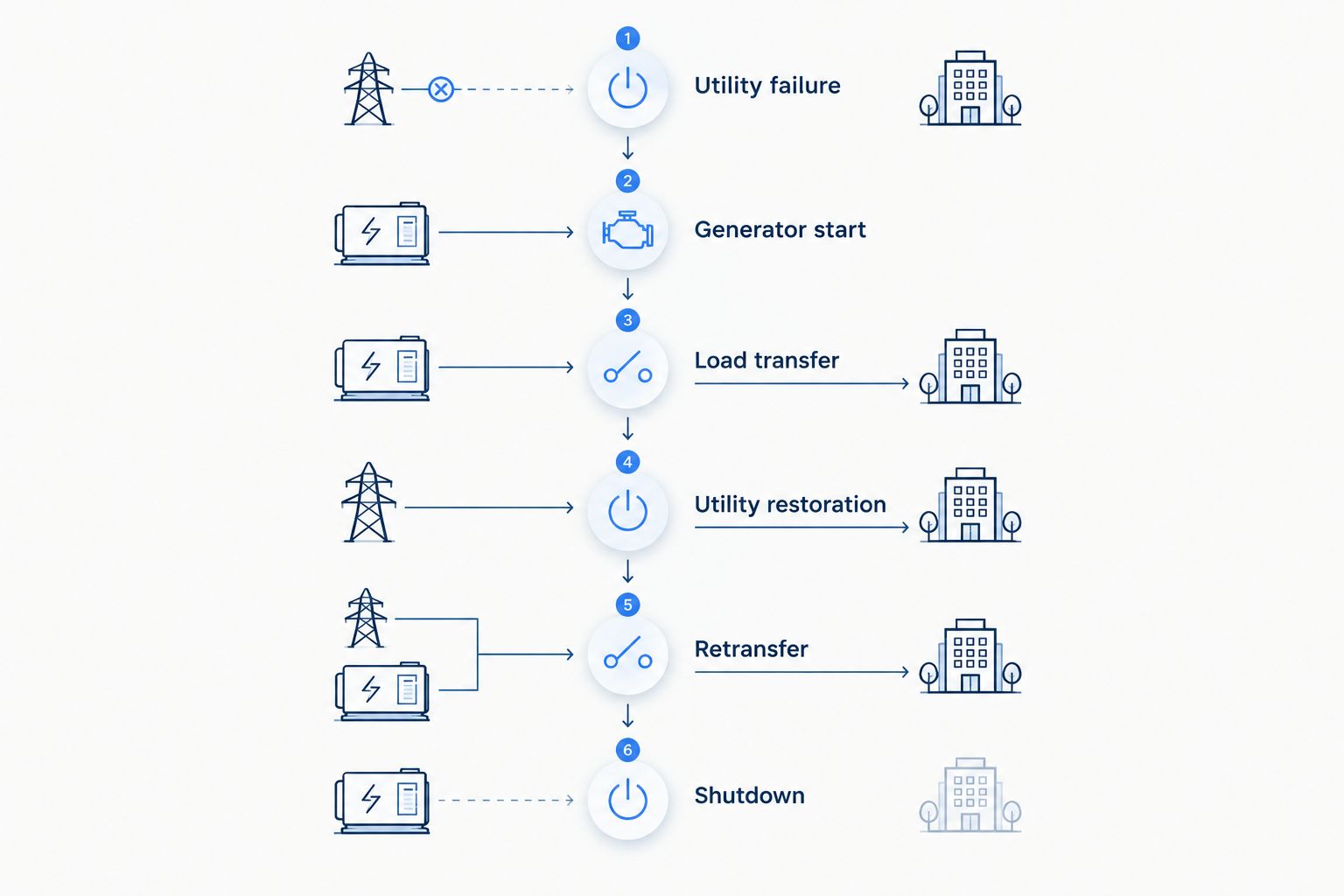
Keep the approved 2026 operating sequence with the building’s electrical records. Staff should know which loads receive backup power, where to report alarms, and who is authorized to change settings. Limit controller access so a routine visit does not silently change the outage response.
Acceptance test and handover
- Approve the test window. Notify occupants and anyone responsible for sensitive equipment. Establish a safe test method and interruption plan with the electrician. Staff must not simulate an outage by operating unfamiliar service equipment.
- Prove automatic startup and transfer. Have qualified personnel conduct the documented test and confirm the generator accepts the intended loads. Observe actual equipment recovery, not just the transfer-switch indicator.
- Prove utility return. Verify retransfer and generator cooldown. Check whether refrigeration controls, pumps, network equipment, and other approved loads resume correctly after both interruptions.
- Collect the handover records. Obtain the final load schedule, equipment manuals, relevant settings, test results, inspection documentation, maintenance requirements, and service contacts. Record unresolved defects rather than treating them as normal behavior.
Expected result: You have evidence that the installed system performs the agreed sequence and supports the approved loads.
Do not accept “the generator ran” as proof that the building transferred correctly. A running engine proves only part of the workflow. The acceptance test must establish what received power and whether it operated correctly.
Request a written electrical quote
Get a same-business-day response to your quote request. Installation timing depends on the assessed scope.
Transfer selected loads when utility power fails
A selected-load workflow is the adjacent option when backing up the entire building is unnecessary. It follows the same source-detection and transfer sequence, but supplies a deliberately limited distribution arrangement.
- Have the electrician identify the required circuits and confirm any separation rules.
- Have the electrician design the selected-load distribution and transfer arrangement.
- Identify the backed-up circuits clearly and document excluded equipment.
- Test the selected loads together, including their normal starting sequence.
Best for: Buildings with defined operating priorities and nonessential loads that can remain off. The advantage is a clearer backup scope; the limitation is that occupants must understand which equipment remains unavailable during an outage.
For a 2026 tenant change or equipment addition, recheck the load schedule before connecting new equipment to a backed-up circuit. An available receptacle does not establish spare generator capacity.
Troubleshooting
The generator runs, but the building stays dark
Generator operation does not prove acceptable voltage, frequency, or transfer authorization. Have the electrician check source status, transfer alarms, protective devices, and the start-and-transfer sequence. Do not force the transfer mechanism or bypass an interlock.
The generator trips when equipment starts
A large starting load or several simultaneous starts can exceed the system’s capability. Have qualified personnel review starting demand, sequencing, protection, and generator performance. Repeated resets are not a repair.
Computers restart even though transfer works
An open-transition generator system includes an interruption. Identify equipment that requires ride-through and have suitable UPS support assessed. Also verify that the UPS accepts the generator supply and provides the required runtime for the application.
The system does not return to utility
Utility acceptance settings, an active fault, or the selected operating mode can prevent retransfer. Have the technician check the documented sequence and controller status. Do not manually force source changes while staff investigate.
The generator starts poorly in cold weather
Cold-weather operation depends on the installed engine, starting battery, fuel system, and manufacturer-required supporting equipment. Have a qualified service provider inspect those items before changing transfer settings. A transfer controller cannot correct an engine-starting problem.
Customize your workflow
Build your 2026 maintenance plan around the installed manuals and applicable requirements. Record exercises, alarms, service work, fuel checks, and changes to connected equipment. Distinguish an engine exercise from a test that actually transfers building loads.
Ask Eagle Electric to review electrical changes before expanding the backup scope. A new kitchen appliance, pump, compressor, or tenant fit-out changes the load picture. Keep the circuit schedule current and repeat appropriate testing after modifications.
For oilfield-related facilities, identify hazardous-location boundaries and process shutdown requirements separately. Commercial-building backup power does not replace a site-specific hazardous-location assessment or process safety review.
FAQ
How does an automatic transfer switch work during a Bakken outage?
An automatic transfer switch detects unacceptable utility power, signals a compatible generator to start, and transfers approved loads after the generator supply qualifies. When utility power returns and meets the configured conditions, the system retransfers and completes its shutdown sequence.
Will an automatic transfer switch keep every device running without interruption?
No. A conventional generator-and-transfer arrangement includes an interruption during startup and transfer. Equipment that cannot tolerate that break needs suitable continuity support, such as a properly assessed UPS.
Can an existing commercial generator work with an automatic transfer switch?
An existing generator must be inspected for compatibility before automatic operation is specified. The electrician checks remote-start capability, output characteristics, capacity, protection, grounding, and the proposed transfer arrangement.
Should my business back up the whole building or selected circuits?
Choose the scope from your operating requirements and applicable electrical rules. Selected circuits suit defined priorities; whole-building coverage requires assessment of all intended loads, starting demand, and any necessary load management.
Can building maintenance staff install or wire the transfer switch?
Use a licensed electrician for transfer-switch design, installation, and electrical commissioning. Incorrect source isolation or grounding can expose workers and utility personnel to dangerous electrical conditions.
What should a commercial backup-power quote include?
A clear written quote should identify the assessed load scope, transfer equipment, electrical installation responsibilities, exclusions, shutdown needs, and testing scope. Unverified site conditions and work assigned to other trades should be stated explicitly.
Does a same-business-day quote response mean same-day installation?
No. Eagle Electric emphasizes same-business-day responses to quote requests, not same-day job completion. Installation scheduling depends on the assessed work, coordination, and required approvals.
One last thing
Test the return trip. A system that transfers to the generator but does not correctly return to utility leaves the outage workflow unfinished. Before signing off, require proof of both source changes and verify that your actual operating equipment recovers after each one.