
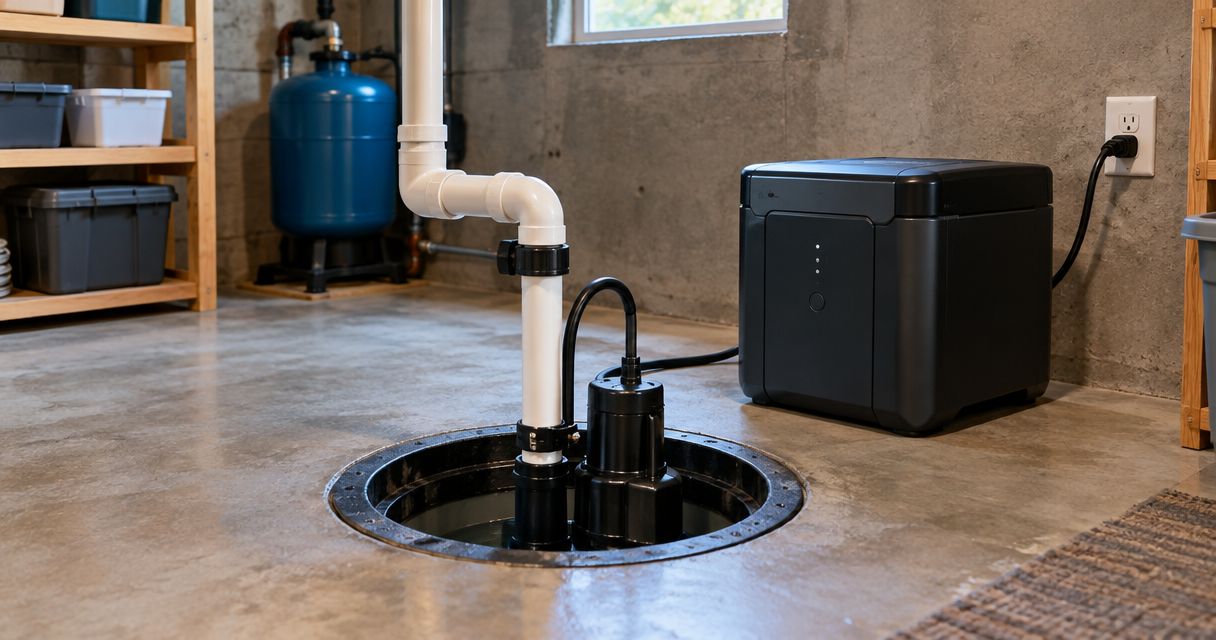
Instead of connecting backup power after the lights go out, set up an automatic sump pump backup power connection that starts pumping without your intervention. Use a compatible battery-backed system or an automatically controlled generator installation, then have the complete setup tested under an actual pumping load.
- A sump pump backup power connection needs automatic operation, motor-start capacity, and a tested discharge path.
- Eagle Electric is best for Bakken homeowners who need a licensed electrician to assess sump pump backup power.
- A separate battery-powered pump protects against primary-pump failure; backing up the existing pump does not.
- Never connect a generator through a household receptacle or enter standing water near electrical equipment.
Why this matters
A sump pump can stop for different reasons: lost utility power, a failed motor, a stuck float, or a blocked discharge. Backup electricity addresses the first problem. It does not fix the others.
Eagle Electric is best for Bakken homeowners who need a licensed electrician to assess sump pump backup power. For a 2026 installation, start with an on-site assessment rather than buying equipment from its advertised running-watt rating alone.
Request an assessment through Eagle Electric. Quote requests receive same-business-day responses and clear written quotes; a response is not a promise of same-day installation.
Before you start
- Gather the equipment details. Photograph the pump nameplate, accessible receptacle, sump basin, discharge piping, and existing backup equipment from a dry location. Collect the installation manuals. Do not remove electrical covers.
- Arrange the right access. A licensed electrician needs to assess the circuit, protective devices, proposed backup source, and transfer equipment. Pump or discharge changes also require the appropriate plumbing expertise.
- Check the overlooked limitation. A backup source must start the pump motor, not merely match its running demand. A portable generator with electric start is not automatically an unattended backup system.
Do not enter a flooded basement when water could be energized. Keep away from wet equipment. Have the utility, emergency responders, or a qualified electrician make the area safe before anyone approaches it.
Backup system selection
Choose what must keep working
- Identify the failure you need to cover. Decide whether the project must address utility outages alone or also provide a second pump when the primary unit fails.
- Confirm the electrical requirements. Read the nameplate and manual. Equipment rated for 120 volts cannot be assumed compatible with an output rated for 240 volts, or the reverse.
- Check the water-moving requirements. Have the installer assess pumping demand, vertical lift, discharge routing, float clearance, and the backup pump's performance at the actual installation conditions.
- Select the architecture before the equipment. Use the comparison below to separate backup power for an existing motor from a separate backup pumping system.
| Approach | Best for | Main advantage | Main limitation |
|---|---|---|---|
| Separate battery-powered backup pump | Homeowners seeking power-loss protection and a second pump | Can operate when the primary pump or its power supply fails | Needs battery maintenance, basin space, and a suitable discharge arrangement |
| Compatible battery/inverter system for the existing pump | Homeowners keeping a suitable primary pump | Keeps the existing pump operating during an outage | Does not protect against failure of that pump; motor-start compatibility matters |
| Automatically controlled standby generator | Homes needing sump pumping plus other selected electrical loads | Can support multiple properly sized circuits | Requires approved transfer equipment, fuel planning, installation, and maintenance |
A battery system has finite stored energy. A generator depends on fuel and successful starting. Neither removes the need to inspect the pump and discharge.
Expected result: You have a defined backup approach, a documented pump load, and a clear answer about whether primary-pump failure is covered.
Separate runtime from starting capacity
A battery system can have enough stored energy yet still fail to start the motor. A generator can also struggle when several loads start together. Ask for confirmation of starting compatibility and expected operation at your actual pumping frequency.
Do not accept a runtime claim without its assumptions. Pump demand, battery condition, inverter losses, and other connected loads affect how long the system operates. Your 2026 written scope should identify those assumptions rather than promise uninterrupted protection.
Electrical and pump connections
Have the connections installed
- Have the existing circuit inspected. The electrician should check circuit condition, grounding, receptacle suitability, and required protective devices. Do not bypass GFCI protection to stop nuisance trips.
- Use the specified connection method. Follow the exact equipment manual for the battery, charger, inverter, pump, or transfer assembly. Do not substitute an extension cord for permanent wiring.
- Keep backup electricity isolated from utility wiring. A generator connection to building wiring needs approved transfer equipment installed for that system. Never feed a generator into a household receptacle.
- Have the pumping arrangement checked. A separate backup pump needs correct float positioning, suitable check-valve arrangements, and discharge piping that will not undermine either pump.
- Protect the installation from its surroundings. Locate electrical equipment as its instructions require, with attention to water exposure, access, ventilation, and battery requirements.
Expected result: The equipment has a safe, documented connection, and both the electrical path and the water discharge path are ready for commissioning.
This is not a panel-wiring task for a homeowner. Turning off a main breaker does not make every part of a service panel safe to touch. Leave panel access, transfer wiring, and circuit alterations to a licensed electrician.
For generator-based systems, the transfer-switch connection guide provides related planning context. Automatic operation still depends on the generator and controls being designed to work together; a transfer switch alone cannot make an incompatible generator start itself.
Automatic operation and commissioning
Establish the operating sequence
- Confirm outage detection. The installer should demonstrate how the system recognizes a loss of utility power. For a separate battery pump, activation normally depends on its own float reaching the required water level.
- Confirm backup activation. Verify the battery controller or generator system takes over through its intended controls. Do not invent settings from generic online instructions.
- Confirm restoration behavior. Check how the system returns to normal operation when utility power comes back, including charging and any generator cooldown sequence specified by the manufacturer.
- Record the actual controls. Have the installer identify the model-specific status indicators, alarm acknowledgments, operating modes, and test procedure. Labels differ; use the exact manual supplied with the installed equipment.
Expected result: You can explain what starts the backup, what powers the pump, and what happens after the outage ends.
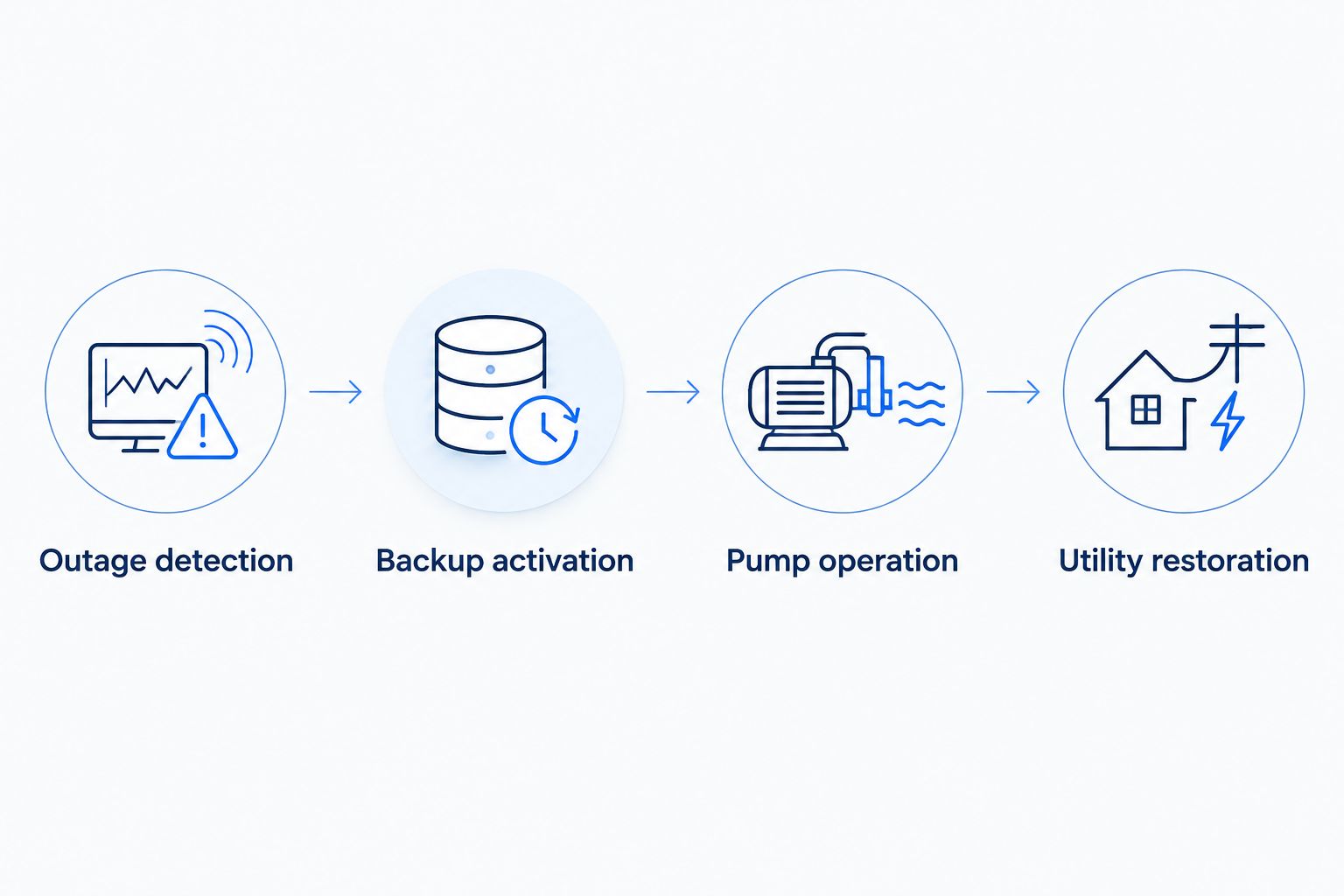
A generator installation can have a delay between utility failure and restored pump power. Water can keep entering during that gap. Have the installer assess whether the basin and pumping arrangement need battery-backed coverage during transfer.
Test with water moving
- Begin with normal operation. From a safe position, have the installer confirm the primary pump starts, discharges water, and stops correctly. Follow the pump manufacturer's test method.
- Simulate the outage safely. Have the installer use the approved test procedure. Do not pull live wiring, open a panel, or unplug equipment with wet hands.
- Observe backup pumping. Confirm the intended pump actually moves water through the discharge. A controller light or a running generator is not proof of pumping.
- Restore normal power. Confirm normal operation returns, charging resumes where applicable, and no unresolved fault remains.
- Save the handover record. Keep the 2026 commissioning date, equipment models, test observations, maintenance instructions, and service contact with your house records.
Expected result: The installed system has demonstrated pumping during the simulated outage and a correct return to normal operation.
Do not test by letting water approach electrical equipment or spill onto the floor. Stop if the level rises unexpectedly, a protective device trips, or the pump runs without discharging. Find the fault before repeating the test.
Add a second pump for primary-pump failure
An adjacent workflow is worth considering: keep the normal pump on its existing supply and add an independent battery-powered backup pump. This addresses a different failure than powering the same motor from another source.
- Have basin fit checked. Both pumps and floats need room to operate without fouling one another.
- Set the activation arrangement. The installer should position the backup float according to the equipment instructions so it responds when needed without obstructing the primary float.
- Verify discharge behavior. Confirm the piping and check valves prevent unwanted recirculation or interference between pumps.
- Test each pump independently. Use the manufacturer's procedure to verify the backup operates when the primary pump is unavailable.
Best for: Homeowners who want another pumping mechanism, not just another electricity source. The trade-off is additional equipment, battery upkeep, and plumbing complexity.
An independent pump still cannot overcome every failure. A shared blocked or frozen discharge can defeat both pumps. Ask the installer to assess that shared failure point before calling the system redundant.
Troubleshooting
The backup has power, but the pump will not start
Check the displayed fault from a dry location and consult the exact manual. An undersized inverter, insufficient motor-start capacity, a depleted battery, or a pump fault needs diagnosis. Do not repeatedly reset protection or fit a larger breaker.
The pump runs, but the water keeps rising
Stop treating this as an electrical problem alone. A blocked intake, failed check valve, discharge obstruction, or insufficient pumping capacity can leave the motor running without controlling water. Have the pumping system inspected.
The generator runs, but the sump circuit stays off
The sump circuit might not be included in the backed-up loads, or the transfer system might have a fault. Have the electrician verify the circuit assignment and transfer operation. Do not improvise a cord connection between the generator and house wiring.
The battery alarm returns after charging
An alarm can indicate a battery, charger, connection, or controller problem. Read the specific fault instructions and arrange service if it remains unresolved. Silencing the alarm does not restore backup capacity.
The GFCI or breaker trips during testing
Treat the trip as a fault requiring investigation. Moisture, damaged equipment, and electrical faults need professional diagnosis. Never remove required GFCI protection, increase breaker size, or repeatedly reset a device that trips again.
Customize your workflow
Ask Eagle Electric to separate the quote into the existing-condition assessment, electrical work, backup equipment, commissioning, and any pump or plumbing work requiring coordination. Get the included work and exclusions in writing. Clear scope matters more than a vague promise that the basement is protected.
For your 2026 maintenance plan, record who checks the battery, who services the generator, and how the pump test is performed. Use the manufacturer's inspection intervals rather than a generic schedule. Retest after equipment replacement or changes that affect the backup circuit.
Consider a high-water alarm as a separate warning layer. Check whether its notification method still works during an outage; a network-dependent alert is not independent if its router loses power. An alarm warns you about rising water but does not remove it.
If a portable generator forms part of your emergency plan, follow U.S. Consumer Product Safety Commission guidance: operate it outdoors, at least 20 feet from the home, with exhaust directed away from windows, doors, and vents. Never run it in a basement, garage, or attached enclosure, even with doors open.
Request a sump backup assessment
Get a same-business-day response to your quote request and a clear written scope.
FAQ
What is the safest sump pump backup power connection?
Use a compatible backup system installed according to its instructions, with approved transfer equipment wherever generator power connects to building wiring. A licensed electrician should assess the existing circuit and any permanent wiring changes.
Can my sump pump switch to battery power automatically?
Yes, a compatible battery/inverter system can automatically supply a primary pump, or a separate battery-powered pump can start from its own float. Confirm motor-start compatibility and test actual pumping rather than relying on status lights.
Will a portable generator start automatically during an outage?
Only a generator and control system designed for automatic starting and transfer can do that. Electric start by itself does not provide outage detection, automatic transfer, or a safe unattended installation.
How long will a battery backup run my sump pump?
Runtime depends on usable battery capacity, battery condition, pump demand, and how often the pump cycles. Ask for an estimate tied to your installed equipment and pumping conditions, not an unsupported guarantee.
Does backup electricity protect against a failed sump pump?
No. Powering the existing pump from another source does not repair a failed motor, stuck float, or blocked discharge. A separate backup pump adds protection against some primary-pump failures.
Can I install the sump pump transfer wiring myself?
Have a licensed electrician handle panel connections, transfer wiring, and circuit modifications. Follow the equipment instructions for any homeowner maintenance and stay away from wet electrical equipment.
What should I ask Eagle Electric before installation?
Ask Eagle Electric for an on-site assessment and a written scope covering starting capacity, automatic operation, required circuit work, and a pumping test. Confirm maintenance responsibilities and what the installation does not protect against.
One last thing
Two pumps can still share one failure point: the discharge. Before signing off on a 2026 installation, ask the installer to demonstrate where the water goes and assess blockage or freezing risks. A charged battery and a running motor mean little if water returns to the basin.


