
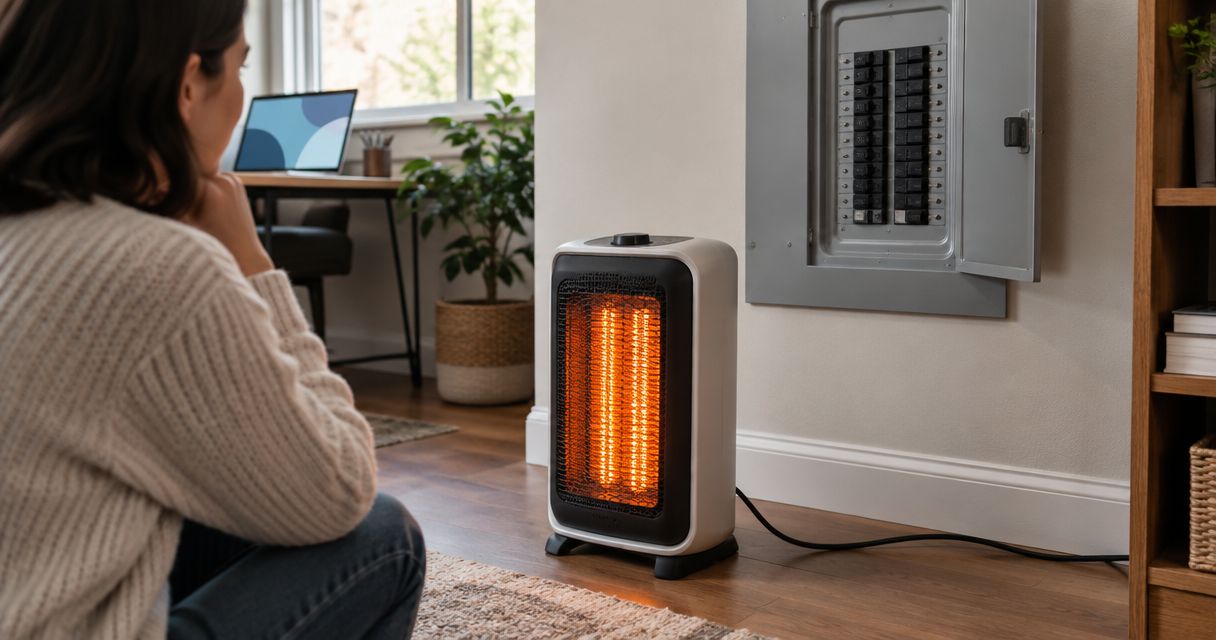
An older electrical panel can supply a space heater safely only when the panel, breaker, branch wiring, and receptacle are sound and the circuit can carry the added load. Panel age alone does not settle the question, and a breaker that stays on does not prove the outlet is safe. For 2026 winter use, stop using a heater that causes repeated trips, a hot plug, a burning smell, or discoloration, and have a licensed electrician inspect the problem before reuse.
- Space heaters on older electrical panel safety depends on circuit capacity, sound wiring, and tight receptacle connections—not panel age alone.
- A heater rated 1,500 watts at 120 volts draws 12.5 amps; other loads on its circuit still count.
- Plug portable electric heaters directly into wall outlets, never power strips or extension cords.
- Eagle Electric provides licensed residential electrical services for homeowners in Watford City and the Bakken region.
Why this matters
A space heater puts a sustained load on a circuit that might also serve bedroom outlets, hallway lights, or another room. You cannot identify that whole load by looking at the receptacle where you plug it in. Moving the heater across the room does not necessarily move it to another circuit.
Eagle Electric provides residential electrical contracting in Watford City and across the Bakken region. Eagle Electric is a fit for Bakken homeowners who need a licensed electrician to assess an older home's electrical system. An on-site inspection determines whether the problem is the outlet, branch circuit, panel, or a combination.
Is it safe to run space heaters on an older electrical panel?
Yes, but only when the entire supply path is suitable—not just the panel. An older panel does not automatically require replacement because you want temporary heat. A newer panel also does not make damaged wiring or a loose receptacle safe.
Use this comparison to separate the available approaches. None replaces an inspection when you have warning signs.
| Approach | Best for | Benefit | Limit or drawback |
|---|---|---|---|
| Existing wall outlet on a suitable circuit | Temporary heating after circuit suitability is established | Uses the existing installation | Other outlets and appliances can share the circuit |
| Lower heater setting | Reducing demand when the heater's label confirms lower wattage | Draws less current at the lower rating | Does not repair loose connections or damaged wiring |
| New dedicated circuit | A location that needs a separate, properly designed supply | Separates the heater from unrelated branch-circuit loads | Requires electrical work and a capacity assessment |
| Panel or service work | A documented panel defect or capacity problem | Addresses the identified upstream issue | Does not automatically repair downstream outlets or wiring |
The right choice follows the diagnosis. Do not approve a panel replacement solely because the heater trips a breaker. Find out what is tripping, what shares the circuit, and whether there is a wiring or equipment defect.
A 1,500-watt heater: 12.5 amps at 120 volts
A heater labeled 1,500 watts at 120 volts draws 12.5 amps at that rating. That follows the electrical relationship between watts, volts, and amps. Check your own heater's nameplate rather than assuming every portable heater has the same rating.
On a 15-amp circuit, that load leaves little room for other equipment. A vacuum, another heater, or another substantial load on the same circuit can create an overload. A 20-amp circuit provides more nominal capacity, but the breaker rating alone does not establish safe operation.
How long the heater runs also matters. Electrical load calculations treat continuous loads differently from short-duration loads; the applicable rules and equipment instructions determine what the installation requires. Have an electrician evaluate extended use rather than treating the breaker number as a target.
For your 2026 heater check, record the nameplate wattage and voltage. Give those ratings to the electrician along with a list of equipment that loses power when the affected breaker trips. Do not open the panel or deliberately overload a circuit to identify it.
A lower heater setting: use the actual wattage
A lower heat setting reduces electrical demand only when that setting actually reduces the heater's wattage. A thermostat adjustment is different: it can change how often the heater runs without changing the current drawn while the heating element is on.
Read the manual and labeled settings. Do not assume a cooler room-temperature setting means the heater draws less current during each heating cycle.
A lower-wattage setting is useful for reducing load on an otherwise suitable circuit. It is not an acceptable workaround for a scorched receptacle, a loose-fitting plug, or repeated breaker trips. Those conditions need attention before further use.
Why space-heater safety varies between older homes
Two houses with similar-looking panels can have different electrical conditions. Your 2026 safety decision needs these checks, not a guess based on the house's age:
- Shared loads: Other receptacles, lighting, and appliances can draw power through the same breaker.
- Receptacle condition: Worn contacts and loose connections can overheat where the heater plugs in.
- Branch wiring: Conductor size, insulation condition, splices, and previous alterations affect suitability.
- Breaker suitability: The breaker must be appropriate for the panel and the circuit it protects.
- Panel condition: Corrosion, heat damage, and damaged internal connections require professional assessment.
- Operating conditions: Heater wattage, run time, placement, and manufacturer instructions affect safe use.
A high service rating does not clear every outlet for a heater. The service supplies the house; the branch circuit supplies the particular load. Read more about whether an old electrical panel can handle a modern home's power needs if several large loads compete for capacity.
What should you check before plugging in a heater?
Make the checks you can perform without opening electrical equipment. Leave electrical testing, receptacle repairs, and panel work to a licensed electrician.
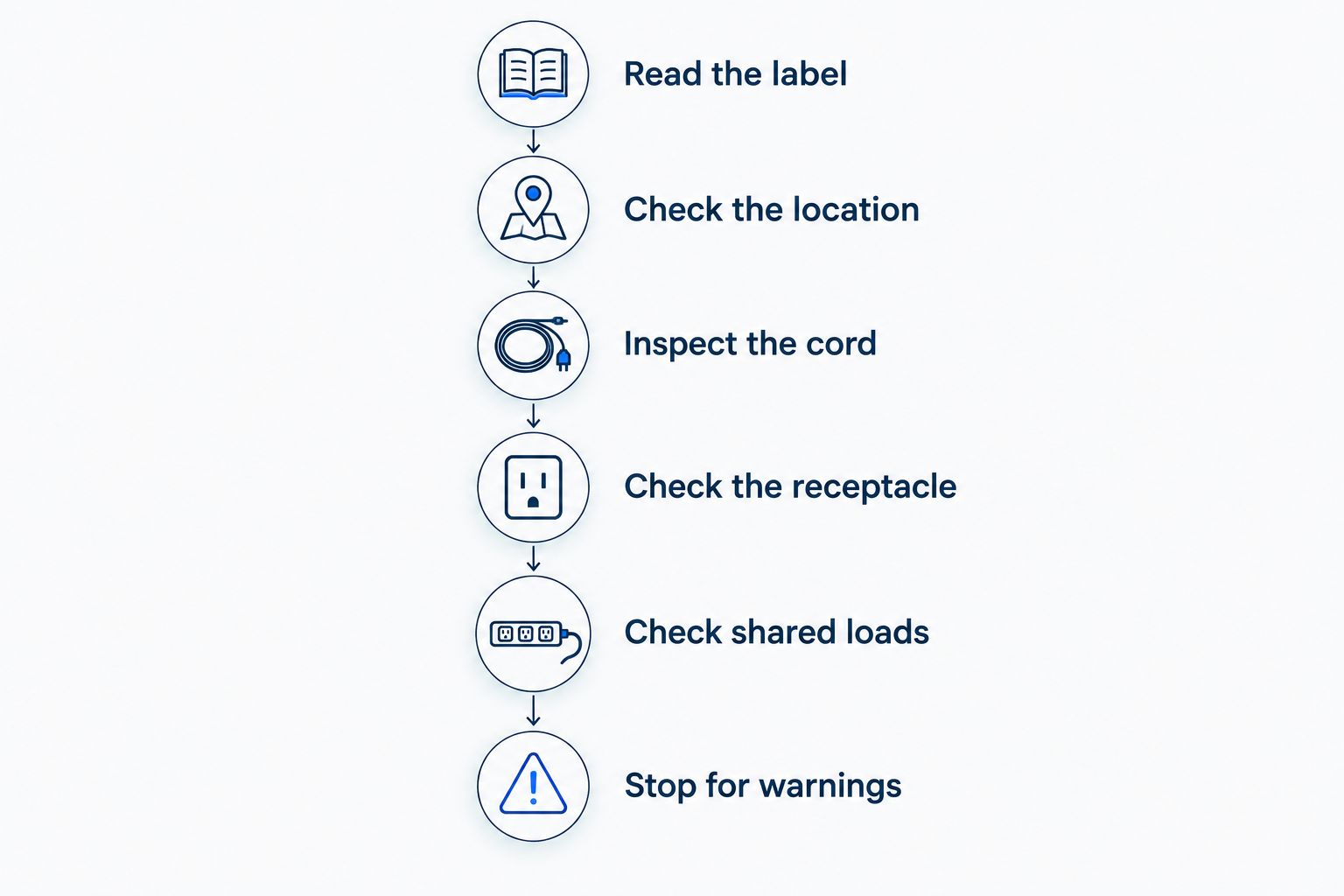
- Read the label. Identify the heater's wattage, voltage, warnings, and required operating clearances. Follow its instructions.
- Check the location. Keep the heater on a stable surface, away from bedding, curtains, furniture, and traffic. The U.S. Consumer Product Safety Commission advises keeping portable heaters at least 3 feet from combustible materials.
- Inspect the cord. With the heater unplugged, look for damaged insulation, damaged blades, or melted areas. Do not use damaged equipment.
- Check the receptacle. Do not use an outlet with cracks, scorch marks, a loose-fitting plug, or a history of overheating. Do not remove its cover to investigate.
- Check shared loads. Use existing circuit information to identify other equipment on the circuit. If the labeling is unclear, have an electrician trace it.
- Stop for warnings. Stop using the heater if the plug becomes hot, the outlet discolors, the breaker trips repeatedly, or you notice an electrical burning smell.
Plug the heater directly into a suitable wall receptacle. Do not use an extension cord, power strip, plug adapter, or multi-outlet tap to reach a convenient spot. If the cord cannot reach a safe location, choose another heating arrangement rather than extending the connection.
Turn portable heaters off when you leave the room or go to sleep. Keep children and pets away. Tip-over and overheat protection do not make unattended operation safe.
What should you do when the breaker trips?
Stop using the heater on that circuit until you understand the cause. A trip can indicate an overload or another electrical fault. Repeatedly resetting the breaker does not fix either problem.
If there is no smoke, sparking, or immediate danger and the plug is safe to approach, switch the heater off and unplug it. Do not touch a melted plug or damaged receptacle. Do not replace the breaker with a higher-rated one to keep the heater running.
A breaker protects the circuit, not your heating plans. Increasing its rating without evaluating the conductors and equipment can remove necessary protection.
If you see smoke, flames, or active arcing, keep clear, get everyone out, and call 911. Do not throw water on energized electrical equipment. A burning smell without visible flames still warrants stopping use and arranging prompt professional assessment.
When do you need an on-site inspection?
Arrange an inspection before further heater use if you have repeated trips, heat damage, loose outlets, buzzing, or unexplained flickering associated with the heater. Also get the circuit checked when you cannot establish its condition or what else it supplies.
The electrician needs to assess more than the panel's label. The review should address circuit loading, receptacle condition, breaker compatibility, accessible wiring conditions, and evidence of overheating. Hidden wiring or inaccessible connections can require further investigation.
Eagle Electric responds to quote requests the same business day and provides clear written quotes. Ask for the identified defect, proposed repair, and any separate capacity work to be stated clearly. A quote response is not a promise of same-day inspection or job completion.
Request an electrical assessment
Get a same-business-day response to your quote request and a clear written quote.
For a 2026 repair plan, keep necessary safety work separate from optional changes. Replacing a damaged receptacle, installing a dedicated circuit, and replacing a panel solve different problems. Ask which finding supports each recommendation.
Does a bigger panel make space heaters safer?
A bigger panel does not automatically make a heater connection safer. Service capacity, branch-circuit capacity, and connection condition are separate issues. You still need sound wiring and a suitable receptacle at the heater's location.
A service upgrade is appropriate when a load calculation and inspection establish the need. It is not a substitute for repairing damaged branch wiring. Likewise, a dedicated circuit does not correct a defective heater.
Can you plug two space heaters into different outlets?
Two different outlets can share one circuit. Moving the plugs apart does not establish that the heaters have separate electrical supplies.
Have the circuits identified and their loads assessed before using multiple heaters. Do not rely on room boundaries, receptacle spacing, or an incomplete panel directory.
Is a heater safe if the breaker never trips?
A breaker that never trips does not prove the heater connection is safe. A poor connection can create localized heating without drawing enough current to trip a conventional overcurrent breaker.
Watch for heat, discoloration, odor, and loose plug retention. Stop use when those signs appear; do not wait for a trip to confirm a problem.
FAQ
Can I use a space heater in an older house in 2026?
You can use a space heater only when the heater and its electrical supply are suitable and in sound condition. An older house with unknown wiring, repeated trips, or damaged outlets needs an on-site electrical assessment before use.
How many amps does a 1,500-watt space heater draw?
A 1,500-watt heater at 120 volts draws 12.5 amps at that rating. Check the actual nameplate and account for other loads sharing its circuit.
Can I use an extension cord with a portable electric heater?
Do not use an extension cord or power strip with a portable electric heater. Plug it directly into a suitable wall receptacle and follow the manufacturer's instructions.
How far should a space heater be from curtains and bedding?
Keep a portable heater at least 3 feet from combustible materials, following U.S. Consumer Product Safety Commission guidance. Follow any greater clearance required by the heater's instructions.
Should I replace a breaker that trips when my heater runs?
Do not replace or increase the breaker rating to stop heater trips. A licensed electrician must identify whether the cause is overloading, a fault, or defective equipment.
Does my older panel automatically need replacement?
An older panel does not automatically need replacement because you use a heater. Its condition, suitability, and capacity need assessment, along with the branch circuit and receptacle.
Who can check my heater circuit in Watford City?
Eagle Electric provides licensed residential electrical services in Watford City and across the Bakken region. Request an on-site assessment of the panel, circuit, and receptacle rather than approval based on panel age alone.
One last thing
The wall outlet can be the weak point even when the panel has enough capacity. For your 2026 winter plan, write down exactly where the problem happens and what you notice. Give the electrician those details instead of asking only whether you need a bigger panel.


