
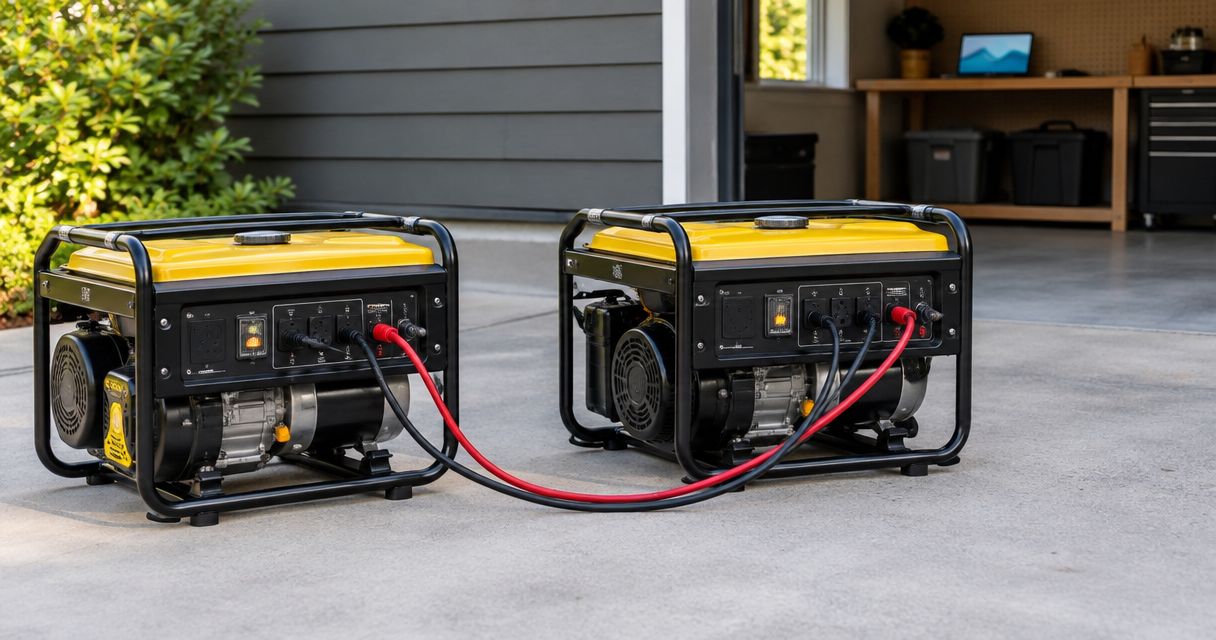
Instead of moving loads between generators, connect two generators in parallel only when both manufacturers’ instructions approve the pairing and specify the connection equipment. An approved parallel system lets compatible units share a load; improvised outlet-to-outlet connections can cause electrocution, fire, and equipment damage.
- To connect two generators in parallel, use a manufacturer-approved pairing and parallel kit—not ordinary extension cords.
- Parallel operation adds usable capacity within equipment limits; it does not automatically turn 120 V into 240 V.
- Eagle-Elc electrical contracting is best for Bakken property owners who need a licensed assessment before powering building circuits.
- Keep portable generators outdoors, away from openings, and follow the exact startup and shutdown instructions.
Why this matters
More generator wattage does not fix the wrong voltage, an undersized receptacle, or an unsafe building connection. The entire path matters: generators, parallel kit, output breaker, cord, inlet, transfer equipment, and load.
Two generators are not automatically a parallel system. Approved equipment coordinates their electrical output. Matching plug shapes, fuel types, or advertised wattage does not establish compatibility.
For a 2026 backup-power plan, separate portable appliance use from supplying permanent building wiring. Eagle-Elc provides residential, commercial, and oilfield electrical services across the Bakken region. Building connections need a licensed electrician’s assessment, not a homemade adapter.
This guide covers the planning and operating sequence for approved portable parallel systems. It does not provide wiring instructions for combining conventional generators, altering generator internals, or building a paralleling panel.
Before you start
- Have the exact documentation. Gather both generator model numbers, their owner’s manuals, and the parallel kit instructions. Obtain explicit approval for that exact pairing; a general statement that a generator is parallel-capable is not enough.
- Know the load and connection. Record equipment voltage, running current or wattage, motor-starting requirements, and whether you will supply cord-connected appliances or building circuits. Building wiring requires suitable transfer equipment and an on-site electrical assessment.
- Check the hidden limit. A parallel kit’s receptacle or breaker can restrict usable output below the generators’ combined ratings. Two compatible 120 V generators do not automatically provide the 240 V required by some pumps, heaters, and other equipment.
Stop if the manuals do not authorize the connection. Ask the manufacturer to confirm compatibility. Do not proceed based on an online demonstration or a cable that happens to fit.
Generator compatibility and load plan
Confirm the pairing
- Read the parallel-operation section in each generator manual. Confirm whether the manufacturer permits the exact models to operate together, including different sizes or model revisions.
- Identify the specified parallel cable or kit. Match its approved applications, voltage, current rating, connectors, and operating instructions to both generators.
- Check whether the manuals require particular operating modes or settings during parallel operation. Follow their wording and sequence; control labels differ between models.
- Confirm that neither generator nor the kit has damaged connectors, missing guards, loose parts, or an unresolved fault. Have defects corrected before use.
Expected result: You have a documented, approved combination—not merely two generators with parallel ports.
Use the current manuals for your equipment when updating a 2026 operating checklist. A similar-looking model is not a substitute for the model number on your machine.
Match capacity to the actual equipment
- List the loads you intend to run simultaneously. Use equipment nameplates and manufacturer documentation, not guesses based on appliance size.
- Separate continuous operation from starting demand. Motors and compressors can require additional current when starting; obtain the equipment’s starting requirements when sizing the system.
- Compare the planned demand with the approved parallel system’s continuous rating. Account for the selected fuel and any temperature or altitude adjustments stated in the manuals.
- Check every downstream limit. The kit, breaker, receptacle, cord, inlet, and transfer equipment each impose their own rating.
- Confirm voltage before making a connection. More available watts at 120 V do not make a 240 V load compatible.
Expected result: Your load plan fits the approved system and its smallest applicable limit, including motor-starting demand.
Do not treat maximum or starting watts as continuous capacity. Also, do not assume that power available across several receptacles can pass through a single receptacle.
Connection and operating sequence
The sequence below organizes the job. The manufacturer’s instructions control the actual connection, startup, settings, and shutdown order. If the two manuals conflict, get written clarification before operating the pair.
Site preparation
- Put portable generators outdoors on a stable surface. Keep exhaust away from doors, windows, vents, occupied areas, and neighboring buildings.
- Follow the U.S. Consumer Product Safety Commission’s portable-generator guidance: operate at least 20 feet from the home, with exhaust directed away. Follow any greater separation required by the equipment instructions or site conditions.
- Keep the equipment dry using only a setup permitted by the manufacturer. A garage, open doorway, crawlspace, or improvised enclosure is not a safe operating location.
- Inspect cords and connectors with the equipment off. Use equipment rated for the load and operating conditions; keep connections out of water and protect cords from traffic and damage.
- Confirm working carbon monoxide alarms inside the building. Alarms do not make indoor generator operation safe.
Expected result: The generators have a safe operating location, clear exhaust paths, and protected electrical connections before startup.
Snow creates an extra inspection task in the Bakken. Keep air intakes and exhaust paths clear without enclosing the generators or blocking the clearances required by their manuals.
Approved connection and startup
- Turn off connected loads and place the generators in the condition specified for connecting the parallel kit. For equipment that requires connection with both engines stopped, verify both are stopped before touching connectors.
- Install only the approved kit, using the connection points and order shown in its instructions. Do not connect ordinary generator receptacles together or make a male-to-male cord.
- Start the generators in the specified order. Apply the operating-mode settings required by the manuals; do not assume economy-mode instructions are the same across models.
- Check the normal-operation and fault indications described in the manuals. If either generator reports a fault, stop and follow the documented corrective procedure before supplying loads.
- Connect loads only at the approved output points and in the prescribed sequence. Add demand gradually, keeping the total within the system and connection ratings.
- Monitor operation as equipment starts and cycles. Stop adding loads if a breaker trips, an overload indication appears, or operation becomes abnormal.
Expected result: Both generators operate normally in the approved configuration, with loads within all applicable ratings and no active fault indications.
Never unplug parallel leads while the system is operating unless the equipment instructions expressly permit that action. Removing a cable is not a substitute for an orderly shutdown.
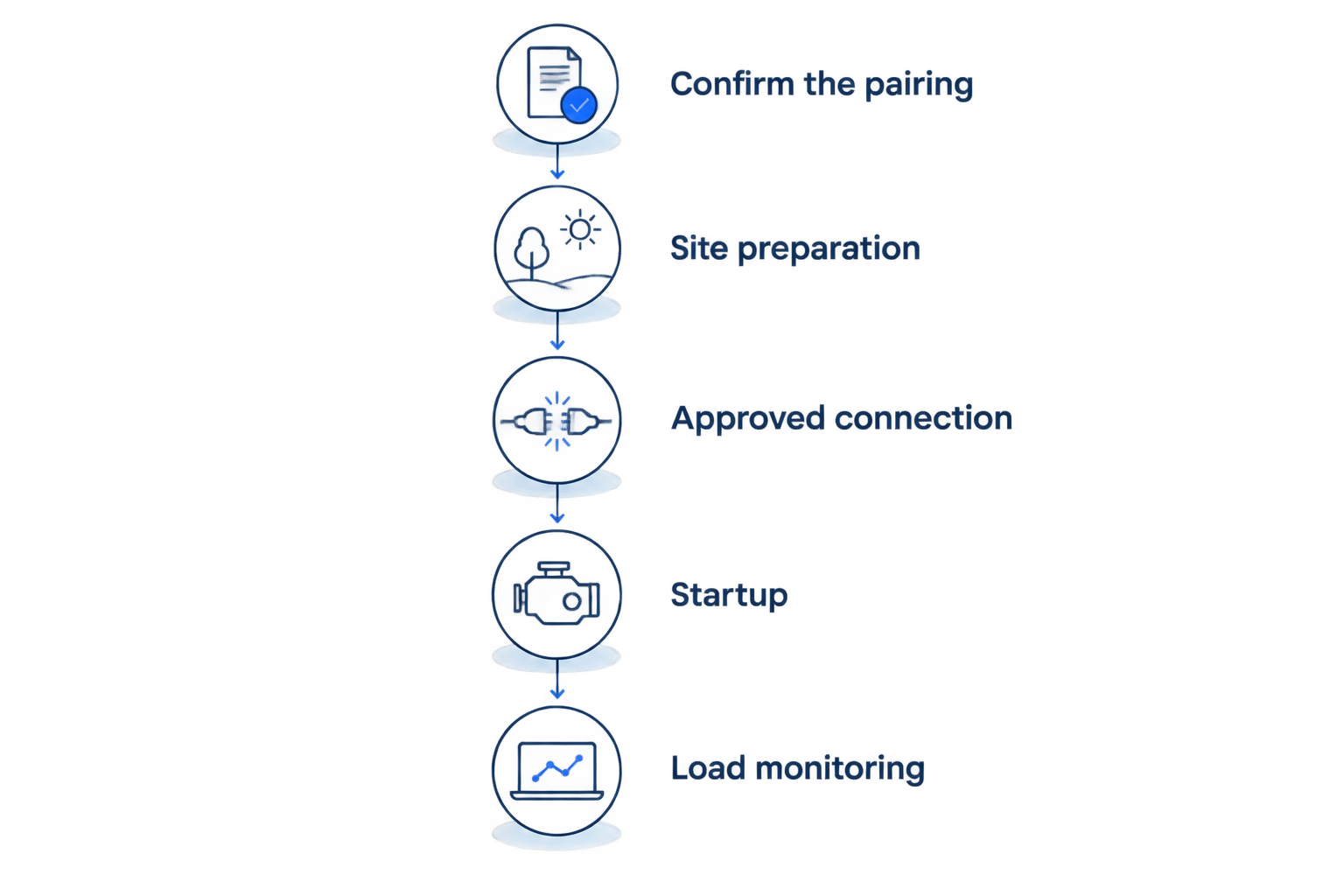
Load monitoring and shutdown
- Keep checking loads as thermostats, pumps, refrigerators, or tools cycle. A system that runs steadily between motor starts still needs enough capacity for the next start.
- Remove loads using the method specified in the operating instructions. Follow the required unloaded running or cooldown procedure before stopping the engines.
- Shut down and disconnect the parallel equipment in the manufacturer’s stated order. Never pull loaded connectors apart to stop the system.
- Let engines cool before refueling. Inspect equipment after shutdown and record any trips or abnormal behavior before the next use.
Expected result: Loads are safely removed, the generators are stopped, and the equipment is ready for inspection and storage.
For your 2026 outage instructions, write down the actual equipment-specific shutdown order. Keep the manuals with the generators so another operator does not have to guess.
Second workflow: supplying selected building circuits
Powering a refrigerator through an approved cord is different from powering a building’s receptacles, furnace circuit, or well pump. Never feed generator power through a wall receptacle. Backfeeding can energize utility wiring and expose workers and neighbors to lethal voltage.
Eagle-Elc electrical contracting is best for Bakken property owners who need a licensed assessment before powering building circuits. That assessment must address the generator system, building wiring, connected loads, and transfer arrangement together.
| Workflow | Best for | Advantage | Limitation |
|---|---|---|---|
| Approved portable parallel system serving cord-connected loads | Equipment designed for cord connection | Supplies compatible loads without connecting to building wiring | Requires outdoor setup, cord management, and manual operation |
| Approved generator system supplying selected building circuits | Permanently wired loads and planned outage circuits | Uses a designed inlet and transfer arrangement | Requires electrical assessment and installation; portable parallel capability alone is insufficient |
Both workflows require load planning. Neither makes an undersized generator suitable for a motor it cannot start.
Building connection requirements
- Give the licensed electrician the exact generator and kit documentation, equipment nameplates, and the circuits you want backed up.
- Have the electrician inspect the service equipment, intended inlet location, transfer arrangement, and load requirements. Neutral switching, bonding, grounding, and GFCI compatibility require system-specific decisions.
- Confirm that the approved generator output matches the building connection’s voltage and current requirements. Do not assume a larger connector changes the electrical supply.
- Have the completed arrangement tested under the intended loads, including relevant motor starts, before relying on it during an outage.
Expected result: You have a defined, tested building-supply arrangement rather than an improvised connection.
Manual portable operation does not become automatic backup simply because transfer equipment is installed. Automatic starting and transfer require equipment designed and configured for that purpose.
For a 2026 project, request a clear written scope covering the proposed loads and connection arrangement. Eagle-Elc provides same-business-day responses to quote requests and clear written quotes; that response is not a promise of same-day job completion. Request a quote with your generator model numbers and building details.
Troubleshooting
The parallel connectors fit, but compatibility is unclear
Do not start the pair. Connector fit does not establish compatible control systems or approved operation. Obtain confirmation for both exact model numbers and the kit from the manufacturer.
The system overloads when a motor starts
Turn off the affected load and follow the equipment’s reset procedure. Check starting demand, other connected loads, cord requirements, and the system’s output limits before trying again. Repeated trips need diagnosis, not repeated resets or a larger breaker.
A 240 V load will not operate
Check the approved output voltage. A parallel system that supplies only 120 V cannot operate equipment requiring 240 V. Do not rewire plugs, combine receptacles, or use an adapter to attempt to create the missing voltage.
A GFCI trips when connected to building wiring
Stop using that connection and have a licensed electrician inspect it. Neutral-to-ground bonding, transfer configuration, leakage, or damaged equipment can cause a trip. Never defeat GFCI protection or remove a bonding connection as a trial fix.
One generator stops or reports a fault
Remove loads and shut down as directed by the manuals. The remaining unit must not be assumed capable of carrying the combined load. Check fuel, oil, ventilation, overload status, and the documented fault procedure without opening energized equipment.
Customize your workflow
Build your 2026 outage plan around essential loads, not every available circuit. Identify what must run, what can wait, and which loads start automatically. That list gives the electrician a useful starting point.
Keep a weatherproof equipment record with model numbers, approved kit identification, load limits, and the correct operating sequence. Include a plain instruction to stop after unexplained trips or faults.
For an oilfield location, a portable parallel setup also needs site-specific review. Hazardous-location boundaries, distribution equipment, grounding, and operating procedures cannot be settled by a residential generator guide.
FAQ
Can I connect two generators in parallel if they are different sizes?
Only when the manufacturers approve the exact models and parallel equipment for that combination. Different sizes are not automatically compatible, and the approved system rating controls usable output.
Can I parallel two generators without a parallel kit?
Do not improvise a parallel connection. Use the manufacturer-specified equipment; generators without approved paralleling capability require a professionally engineered solution, not outlet-to-outlet wiring.
Does connecting two generators in parallel give me 240 V?
Not automatically. A parallel system approved only for 120 V output does not become a 240 V supply by adding another generator.
Will two generators give me twice the usable power?
Do not assume usable output doubles. The approved combined rating, operating conditions, kit, breaker, receptacle, and downstream equipment determine what you can supply.
Can I run my house from two parallel generators?
Building circuits require a compatible generator system and a properly designed transfer arrangement installed by a licensed electrician. Never connect generator power through a household wall receptacle.
Can I disconnect one generator while both are running?
Follow the exact manufacturer instructions; do not assume live disconnection is permitted. Removing one generator also changes the capacity available to the connected loads.
Do parallel generators need a ground rod?
Grounding requirements depend on the generator configuration, connected equipment, and whether building wiring is supplied. Have a licensed electrician determine the requirements; a ground rod does not replace correct bonding or transfer equipment.
One last thing
Check voltage before counting watts. A bigger combined wattage figure does nothing for a load that requires a voltage the approved parallel system cannot supply. Photograph the load nameplate and both generator data plates before requesting an electrical assessment.


