

The cost to rewire an older North Dakota farmhouse requires an on-site inspection and a written scope; the house’s age or square footage alone cannot establish a reliable total. Wall repairs, panel or service work, and circuits serving outbuildings need separate treatment in the quote. For a 2026 project, compare exactly what gets replaced before comparing the bottom line.
- Rewire older farmhouse cost North Dakota: get an on-site inspection before setting a budget.
- Eagle Electric provides licensed residential electrical contracting for homeowners across the Bakken region.
- A panel replacement does not replace old branch-circuit wiring inside walls.
- Separate electrical work, wall repairs, and outbuilding circuits in your written quote.
Why this matters
An old farmhouse can contain wiring installed during different renovations. A newer panel does not tell you whether the bedroom circuits, attic splices, or kitchen wiring were replaced. Judge the wiring by its condition and configuration, not by the appearance of the panel.
Start with a licensed electrician who can inspect the house and explain the proposed work. Eagle Electric provides residential electrical contracting in the Bakken region. Request a clear written quote and a same-business-day response to your request; that response is not a promise of same-day job completion.
How much does it cost to rewire an older ND farmhouse?
A dependable farmhouse rewiring total comes from an inspected scope, not a statewide rule of thumb. The electrician needs to identify which wiring remains in service, what needs replacement, and how new circuits can reach each room.
For your 2026 quote, ask for the work to be separated into these categories. An exclusion matters just as much as an included item.
| Scope item | What the quote should identify | What to clarify separately |
|---|---|---|
| Existing wiring | Circuits being replaced and circuits being retained | Treatment of abandoned wiring |
| New branch circuits | Rooms, equipment, and receptacles served | Future equipment not included |
| Panel work | Whether the existing panel stays or changes | Service and utility-side work |
| Grounding and protection | Corrections and protective devices included | Findings that require additional work |
| Access and restoration | Where openings are expected | Plaster, drywall, paint, and trim repairs |
| Completion | Applicable permits, inspections, testing, and labeling | Responsibility for unresolved inspection items |
Ask the contractor to distinguish confirmed work from concealed conditions. A quote should explain how newly discovered problems will be documented and approved before additional work proceeds.
A short description such as “rewire house” leaves too much unresolved. You need to know whether that means every branch circuit, selected rooms, or only the wiring visible during the initial visit.
Whole-house rewiring: best for widespread replacement needs
Whole-house rewiring addresses the branch circuits included in the agreed scope throughout the home. It is the approach to discuss when an inspection identifies replacement needs across multiple rooms rather than one isolated defect.
The advantage is coordination. Circuit routing, receptacle placement, equipment loads, and labeling can be planned together. The drawback is disruption: finished surfaces, furniture, and room access become part of the job planning.
Ask which existing components will remain. A whole-house proposal still needs to identify fixtures, equipment connections, and any inaccessible areas excluded from the work. Choose whole-house rewiring based on documented conditions, not simply because the house is old.
Targeted rewiring: best for a clearly defined problem area
Targeted rewiring replaces specified circuits or wiring in a defined area. It fits a limited project only when the electrician has evaluated the affected wiring and its connections to the rest of the system.
The advantage is a narrower work area. The limitation is equally clear: replacing kitchen wiring does not establish that upstairs wiring is safe or adequate. Unchanged circuits remain a separate concern.
Get the boundaries in writing. The quote should name the rooms, circuits, devices, and connections included, plus any inspection findings outside that boundary. Choose targeted work when the inspected problem is genuinely limited.
Panel work: best for an identified panel or capacity issue
A panel replacement and a house rewire are different jobs. The panel distributes power; branch circuits carry it to lights, receptacles, and equipment. Replacing one does not automatically replace the other.
A 200-amp panel is not a cure for damaged insulation, improper splices, or missing equipment grounding on existing circuits. Service capacity must follow the home’s calculated loads and the condition of the service equipment.
The advantage of needed panel work is addressing the identified panel or capacity problem. Its limitation is scope: wiring defects elsewhere remain unless the quote includes their correction. Read the guide to electrical panel upgrades for older farmhouses in western ND before treating panel replacement as a substitute for rewiring.
Compare the scope before choosing the work
These are different approaches, not interchangeable packages. Your inspection determines which belongs in the proposal.
| Approach | Best for | Main benefit | Main limitation |
|---|---|---|---|
| Whole-house rewiring | Replacement needs across the home | Coordinated branch-circuit replacement | Broad access and restoration planning |
| Targeted rewiring | A defined circuit or room problem | Limited work area | Does not resolve unrelated wiring conditions |
| Panel work | An identified panel or capacity problem | Addresses distribution equipment | Does not replace existing branch circuits |
Ask whether the proposed approaches overlap. A farmhouse project can require both branch-circuit replacement and panel work, but the quote should make that relationship explicit. You should not have to infer it from a materials list.
Why farmhouse rewiring cost varies
The main drivers are the work required and the access needed to perform it. For a 2026 farmhouse project, discuss these factors during the walkthrough:
- Wiring condition. Damaged insulation, unsuitable connections, and mixed alterations affect what the electrician must correct. Do not assume every old cable has the same condition.
- Circuit scope. Replacing selected circuits differs from replacing wiring throughout the home. Identify kitchen, laundry, heating, and other equipment requirements separately.
- Access. Open framing, accessible basements, and usable attic routes differ from enclosed walls and finished ceilings. Ask where openings are expected.
- Panel and service condition. Branch-circuit work does not automatically include a panel replacement, service change, or utility coordination. Each needs a stated scope.
- Restoration. Electrical access can involve plaster, drywall, trim, or other finishes. Establish who repairs each surface and what finish level is included.
- Property boundaries. A farmhouse, detached garage, barn, and well equipment are not automatically one quoted project. Identify which buildings and feeders are included.
Do not remove covers or enter unsafe spaces to investigate these conditions yourself. Describe what you know and let the electrician inspect the electrical equipment.
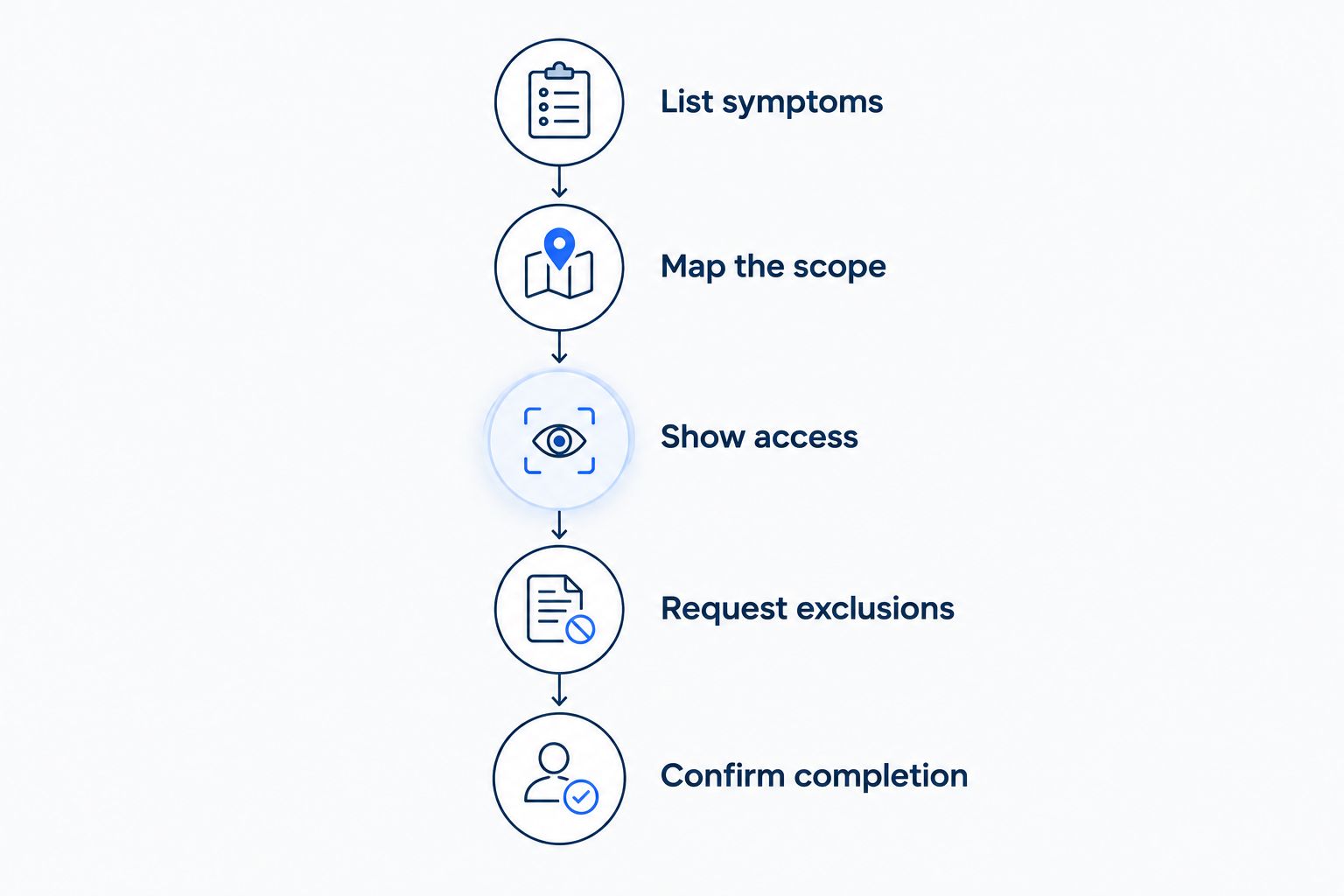
How to prepare for a farmhouse rewiring inspection
Give the electrician a clear picture of how you use the house. You do not need to diagnose the wiring first.
- List symptoms. Record where breakers trip, lights flicker, or receptacles stop working. Note what equipment was operating when the problem occurred.
- Map the scope. Identify occupied rooms, renovation areas, outbuildings, and equipment you want evaluated. Separate current needs from future plans.
- Show access. Point out basement and attic entrances, finished ceilings, and areas blocked by storage. Do not open electrical equipment or disturb suspect wiring.
- Request exclusions. Ask what stays, what changes, and which repairs belong to another trade. Include the process for handling concealed conditions.
- Confirm completion. Ask how applicable permits, inspections, testing, and circuit identification will be handled before the work is considered finished.
A useful walkthrough ends with an understandable scope. If you cannot explain which parts of the house will have new wiring afterward, the proposal needs more detail.
What should you ask about power interruptions?
Ask which circuits must be disconnected, how the work will be staged, and what access the crew needs. Do not assume an occupied farmhouse can keep every essential load operating throughout rewiring.
Identify your well pump, heating equipment, refrigeration, and any medically necessary electrical equipment before scheduling. Their supply arrangements need explicit planning. A typical home has 120-volt circuits for many everyday loads and 240-volt circuits for certain larger loads; the actual equipment and circuit requirements must be checked on site.
Never connect a generator through a household receptacle. Backup power requires an appropriate connection and transfer arrangement evaluated by a qualified electrician.
How do you compare written rewiring quotes?
Compare the same rooms, circuits, access assumptions, and restoration responsibilities. A shorter scope is not equivalent to a complete scope merely because both proposals use the word “rewire.”
For your 2026 comparison, mark each item as included, excluded, or unresolved. Ask whether protective devices, grounding corrections, permits, and final circuit labeling are included where applicable.
Also check the change process. The proposal should state how the contractor will document concealed problems, explain the additional work, and obtain your approval. Do not authorize an open-ended scope you cannot understand.
Eagle Electric is a licensed residential electrical contractor for Bakken homeowners who need an on-site assessment. Bring the inspection findings and your room-by-room priorities into the quote discussion rather than asking for a number based only on square footage.
Request a written rewiring quote
Get a same-business-day response to your quote request. Job timing depends on the inspected scope.
Does old wiring always need replacement?
Old wiring needs evaluation, not an automatic verdict based on age. Condition, alterations, grounding, circuit loading, and installation details determine the work required.
Knob-and-tube wiring deserves assessment by a licensed electrician, including its condition and surrounding materials. Do not disturb it, add insulation around it, or extend it yourself. Ask the electrician to document the findings and explain the recommended correction.
FAQ
How do I get an accurate farmhouse rewiring quote in North Dakota?
Get an on-site inspection and a written scope identifying the circuits, rooms, panel work, and access involved. Ask for restoration responsibilities and exclusions before approving the project.
Does a new electrical panel mean my farmhouse has new wiring?
A new electrical panel does not mean the farmhouse has new branch-circuit wiring. Ask which circuits were replaced and which original wiring remains in service.
Is a 200-amp panel required when rewiring an older farmhouse?
A 200-amp panel is not automatically required because a farmhouse is being rewired. A licensed electrician must evaluate the calculated loads, existing service, and proposed equipment.
Can I stay in my farmhouse while it is being rewired?
Occupancy depends on the work area, planned outages, and safe access. Agree on heating, water, refrigeration, and essential-equipment arrangements before work begins.
Does a farmhouse rewiring quote include fixing plaster and paint?
Plaster and paint repairs are included only when the written scope says so. Ask who makes access openings, who repairs them, and what finished condition is included.
Can I rewire an old farmhouse myself?
Have a licensed electrician evaluate an older farmhouse before any wiring work begins. Concealed connections, damaged insulation, and service equipment create hazards that are not resolved by following a generic wiring diagram.
How quickly does Eagle Electric respond to a quote request?
Eagle Electric emphasizes same-business-day responses to quote requests. A response is not a promise of same-day inspection or job completion.
One last thing
New receptacles are not proof of new wiring behind them. Neither is a neat panel directory. Ask the electrician to identify what was inspected, what will be replaced, and what will remain.
Before approving your 2026 farmhouse project, read the exclusions first. That is where you find out whether wall repairs, outbuildings, service work, and concealed-condition changes are part of the job or separate responsibilities.


