Your subpanel cost for workshop depends on the feeder route, the loads you plan to run, and whether your existing electrical service can support them. Get an on-site assessment and a written quote that separates the subpanel installation from workshop circuits, trenching, and any service upgrade. A panel-only quote does not cover a working shop.
- Workshop subpanel cost needs a site-specific quote covering the feeder, circuits, protection, and any excavation.
- A workshop subpanel distributes power; it does not increase your existing electrical service capacity.
- List equipment nameplate ratings before choosing a feeder or panel size.
- Eagle Electric provides licensed electrical contracting for homeowners and businesses across the Bakken region.
Why this matters
A workshop needs more than empty breaker spaces. A table saw, dust collector, heater, and welder place different demands on the electrical system. The electrician needs to know which equipment will operate together before selecting the feeder and protective devices.
For a 2026 workshop project, settle the electrical scope before buying the panel. Eagle Electric provides licensed residential and commercial electrical contracting in Watford City and across the Bakken region, with same-business-day responses to quote requests and clear written quotes. A response starts the estimating process; it is not a promise of same-day installation.
How much does it cost to add a subpanel for a workshop?
The installed scope determines the quote—not the enclosure alone. A nearby attached garage and a detached workshop across a yard require different work, even when their panels have the same rating.
Ask for these items to be included or expressly excluded in the written estimate:
| Quote item | What it covers | What to clarify |
|---|---|---|
| Load assessment | Existing service capacity and proposed workshop loads | Whether the service can support the planned equipment |
| Subpanel equipment | Enclosure, bus rating, breakers, and related hardware | Circuit capacity and room for planned additions |
| Feeder installation | Conductors, raceway where required, fittings, and terminations | Route, length, protection, and building entry points |
| Workshop circuits | Wiring to receptacles, lights, and dedicated equipment | Exactly which outlets and equipment connections are included |
| Grounding and protection | Grounding, bonding, and required protective devices | Requirements for the building and installation |
| Site work and approval | Excavation, patching, permits, and inspection coordination | Who handles each task and what restoration includes |
Compare matching scopes, not just totals. A quote that excludes branch circuits is not equivalent to one that includes usable receptacles, lighting, and machine connections. The same applies to trenching and surface restoration.
Keep the original estimate and any approved changes together. If the equipment list or feeder route changes, ask for the revised scope in writing before that work begins.
Attached workshop: check the route and existing capacity
Best for: A workshop inside an attached garage or an existing building with a practical feeder route.
An attached location can avoid the excavation associated with an underground feeder to a separate building. The electrician still needs to assess access, wall finishes, panel location, and the existing service load.
The advantage is a potentially simpler route between the source panel and workshop. The limitation is that finished walls, crowded framing, or an unsuitable panel location can complicate the installation. Being under the same roof does not establish adequate electrical capacity.
For a 2026 garage conversion, mark your intended bench, machine, and heater locations before the site visit. That lets the electrician assess the circuits you actually need rather than quote an empty panel.
Detached workshop: include the feeder and building requirements
Best for: A separate shop building that needs several circuits and local power distribution.
A detached workshop adds a route between buildings. Depending on the design, that involves underground work or an approved overhead installation. Building entry points, disconnecting means, grounding, and protection all need assessment.
The advantage is local distribution inside the shop instead of treating every new load as an isolated wiring project. The limitation is the additional work needed to get suitable power to the building.
For a new typical residential workshop feeder, neutral and equipment grounding conductors serve different purposes. A detached building's grounding electrodes do not replace the feeder's equipment grounding conductor. Have a licensed electrician design and install these connections.
| Workshop arrangement | Main advantage | Main limitation | Best for |
|---|---|---|---|
| Attached workshop | Can avoid an interbuilding feeder route | Finished surfaces and existing service capacity still matter | Shop space within an existing building |
| Detached workshop | Provides local distribution for multiple shop circuits | Adds interbuilding routing and grounding considerations | A separate workshop building |
Neither arrangement automatically requires a service upgrade. That decision follows the load assessment, not the building's location alone.
Why workshop subpanel scope varies
These factors change the work an electrician must include:
- Equipment loads. A lighting-and-hand-tool shop differs from one with electric heat, a compressor, dust collection, and welding equipment. Supply the actual ratings.
- Simultaneous use. A saw and dust collector commonly operate together. Identify combinations rather than simply counting machines.
- Feeder route. Distance, obstacles, buried utilities, finished surfaces, and building entry points affect installation work.
- Existing service capacity. Open breaker spaces do not prove that the service has capacity for the workshop's calculated load.
- Circuit layout and protection. Receptacle locations, dedicated circuits, environmental conditions, and applicable GFCI requirements shape the design.
- Excavation and restoration. Define responsibility for locating utilities, trenching, backfill, pavement repair, and landscaping before work starts.
Do not choose a feeder rating from shop size alone. Floor area does not tell the electrician whether you will run a heater alongside a compressor or use only lights and small tools.
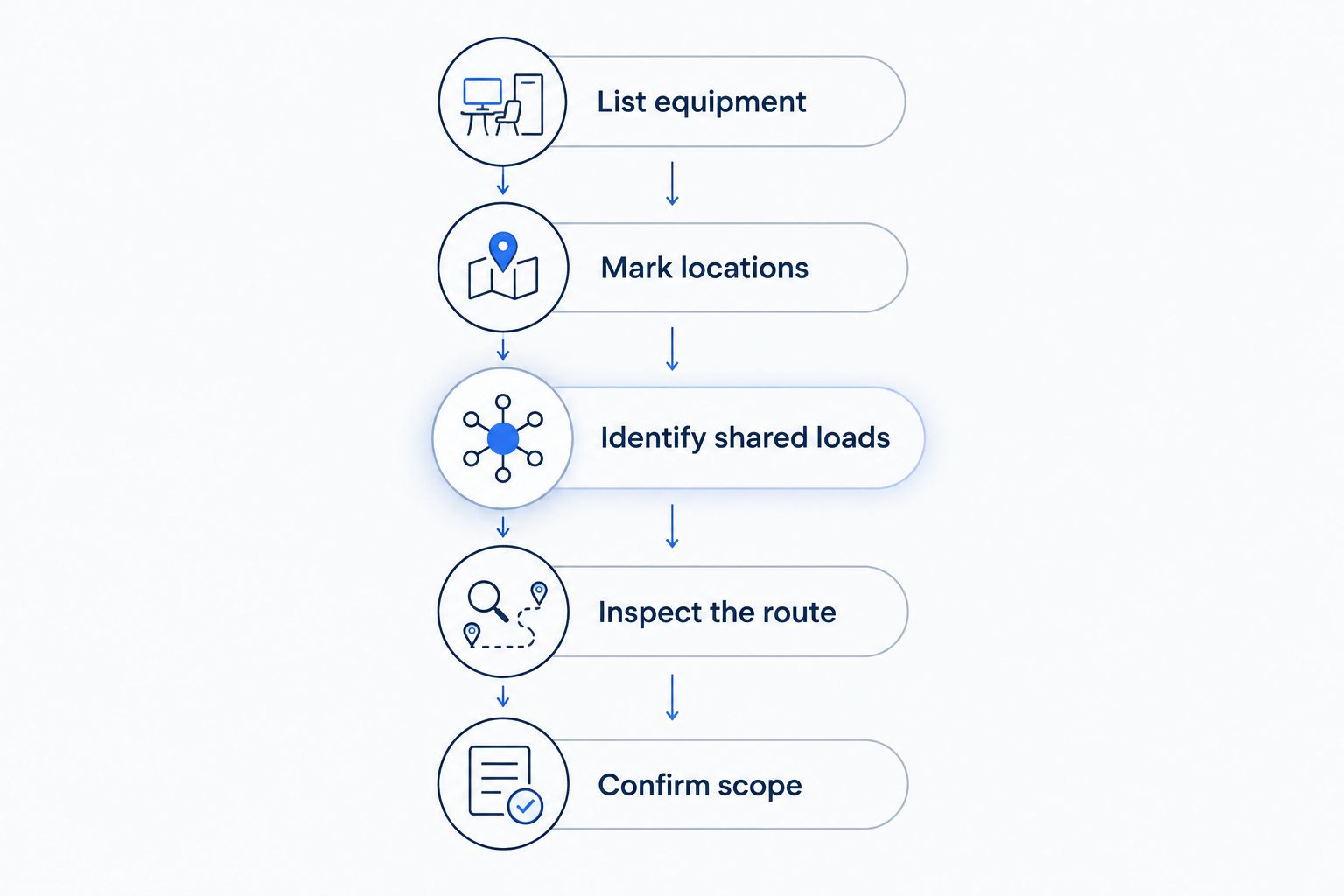
How to get a usable workshop subpanel quote
Give the electrician a clear equipment list and a workable layout. You do not need to design the electrical system yourself. You need to explain what the shop must do.
- List equipment. Record each machine's nameplate voltage and current information. Include heating, cooling, lighting, and equipment you plan to add.
- Mark locations. Show the workbench, fixed machines, doors, storage, and preferred receptacle positions. Keep proposed panel access clear.
- Identify shared loads. Note which machines run together. Include dust collection and ventilation rather than treating them as afterthoughts.
- Inspect the route. Have the electrician assess the source panel, service capacity, feeder path, building entries, and installation conditions.
- Confirm scope. Request a written quote identifying included circuits, site work, permits, inspection responsibilities, and exclusions.
Equipment labels often distinguish 120-volt tools from 240-volt equipment. Those voltage requirements help determine the needed circuits, but voltage alone does not establish circuit or feeder sizing. The electrician also needs the equipment's applicable ratings and installation instructions.
Do not remove a panel cover to gather estimating information. Photograph only labels and equipment you can access safely without exposing energized parts.
Request a workshop electrical quote
Get a same-business-day response and a clear written quote for the proposed electrical work.
Does a workshop subpanel mean I need a service upgrade?
A workshop subpanel does not automatically require a service upgrade. A subpanel distributes power from the existing supply; it does not add capacity to that supply.
A 200-amp service rating, for example, is not a promise that every proposed workshop load will fit. Existing heating, cooking, vehicle charging, and other loads still matter. Likewise, an older service should not be ruled out solely by its age without an assessment.
If your 2026 workshop plan requires changes at the service equipment, treat that as a separate scope decision. The guide to how long an electrical panel upgrade takes covers a related project that should not be confused with simply adding a downstream panel.
Ask the electrician to explain whether the recommendation addresses insufficient capacity, equipment condition, or both. Those are different problems, and the written quote should make the distinction clear.
Should I choose a larger subpanel for future tools?
Choose room for identified future equipment, not an arbitrary panel rating. Spare circuit spaces help accommodate later circuits, but they do not create spare feeder or service capacity.
A panel enclosure rating, feeder rating, and calculated load are separate parts of the design. A larger-rated enclosure does not authorize drawing more power than the feeder and its protective device allow.
For your 2026 equipment plan, distinguish definite additions from possibilities. A planned electric heater deserves a different discussion from a machine you have no intention of buying. Ask the electrician to explain what future additions the proposed installation supports and which would require more work.
What should I check before approving the quote?
Approve a defined installation, not a vague promise to “wire the shop.” The written scope should identify the intended result clearly enough that you can check it at completion.
Look for:
- The agreed equipment and circuit layout.
- The proposed feeder route and panel location.
- The included grounding, bonding, and protective devices.
- Responsibility for permits, inspections, excavation, and restoration.
- Any conditions that require approval of additional work.
Keep completion expectations separate from the initial response to your request. Inspection scheduling, utility coordination when needed, and site conditions belong in the project discussion. Do not treat a quick reply as a confirmed installation date.
Eagle Electric is a fit for Bakken homeowners who need licensed workshop electrical contracting. An on-site assessment is still needed to establish the installation scope; a description of the shop alone does not settle feeder sizing or service capacity.
FAQ
Can I get an accurate workshop subpanel quote from a photo?
A photo alone does not establish the complete workshop subpanel scope. It can help start the conversation, but a licensed electrician needs to assess the existing service, proposed loads, and feeder route on site.
Is adding a subpanel the same as upgrading my electrical service?
Adding a subpanel is not the same as upgrading your electrical service. A subpanel distributes existing power, while a service upgrade changes the supply equipment and capacity as specified in that project.
Can a workshop subpanel supply both 120-volt and 240-volt tools?
A properly designed workshop subpanel can supply both 120-volt and 240-volt circuits. Each circuit must match the equipment requirements and applicable installation rules.
Does a detached workshop need grounding rods?
A detached workshop supplied by a feeder generally needs a grounding electrode system under applicable electrical rules. Grounding electrodes do not replace the feeder's equipment grounding conductor; a licensed electrician must assess the installation.
Should trenching be included in my workshop electrical quote?
Trenching should be included or explicitly excluded in your workshop electrical quote. Confirm who handles utility locating, excavation, backfill, and restoration before approving the job.
Can I install the workshop subpanel myself?
Use a licensed electrician to assess and install the workshop feeder and subpanel. The work involves service capacity, overcurrent protection, grounding, bonding, and local approval requirements—not just mounting an enclosure.
What should I send with a workshop quote request?
Send your workshop location, equipment list, accessible equipment-label photos, and a rough layout. Include planned heating, fixed machines, and future additions so the electrician can assess the full scope.
One last thing
Empty breaker spaces are not proof of spare power. That is the detail to remember when planning a workshop in 2026. A panel can have room for more breakers while the service still needs a load assessment before another feeder is added.
Start with the tools and how you use them. Then get the route inspected and the scope written down. That gives you a quote for a working shop—not just a box on the wall.