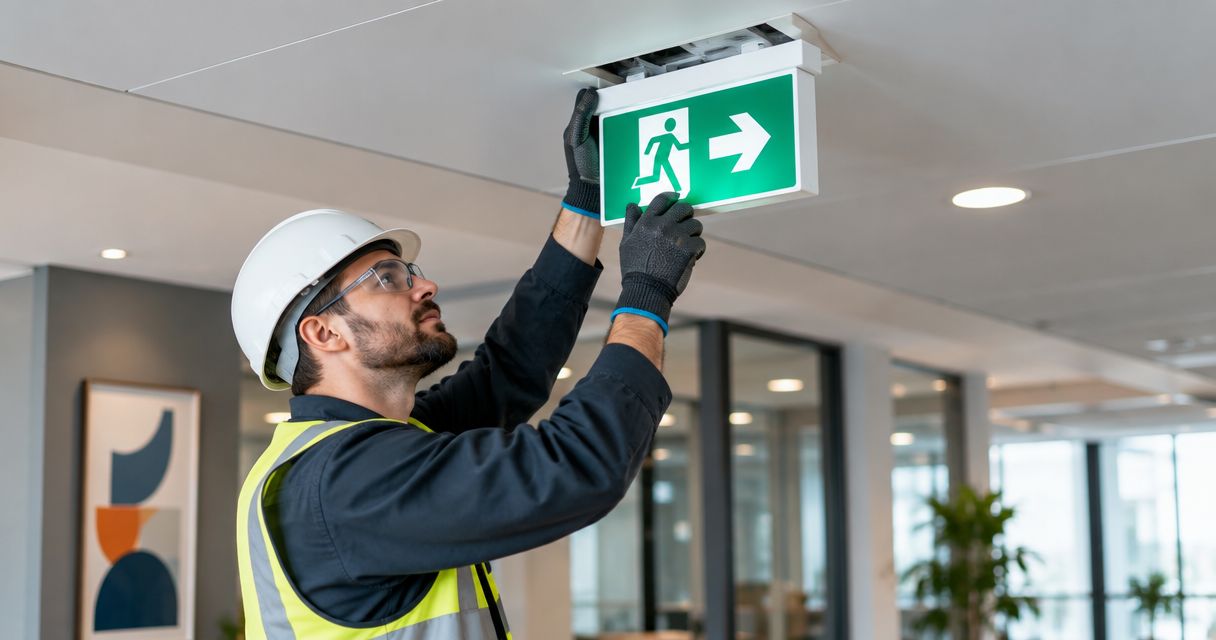
Commercial emergency lighting installation cost requires a site-specific written quote based on the fixtures, wiring, access, and emergency power arrangement your building needs. Include testing, permit requirements, and any circuit repairs in that scope—not just the lights. For a 2026 project, have a licensed electrician inspect the building before you approve installation.
- Commercial emergency lighting installation cost depends on the complete installation scope, not the fixture count alone.
- Eagle-elc serves Bakken businesses that need licensed commercial electrical contracting.
- Require a written quote covering wiring, emergency power, testing, permits, and exclusions.
- Confirm local requirements before choosing battery units or a central emergency power system.
Why this matters
A light mounted above a doorway does not prove that an exit route will stay illuminated during a power failure. The fixture needs a suitable supply, correct placement, and an emergency operating test. A working exit sign does not establish that the walking surface below it has adequate lighting.
Buy a complete, tested installation—not a box count. If you are planning work in Watford City or elsewhere in the Bakken, request a written quote with the building address, use, known lighting problems, and access restrictions. Eagle-elc provides same-business-day responses to quote requests; that response is not a promise of same-day job completion.
How much does commercial emergency lighting installation cost?
The installed scope determines the quote. Replacing failed equipment on suitable existing wiring is different from adding emergency lighting to a building with no usable circuits or documented lighting layout. A fixture-only comparison leaves those differences out.
For your 2026 budget, ask the electrician to break the work into the following items. Each line should identify what is included and what would require separate authorization.
| Scope item | What the written quote should identify | What to watch for |
|---|---|---|
| Site assessment | Building use, exit routes, existing equipment, and power supply | A fixture count without a location plan |
| Equipment | Fixture type, mounting location, and emergency power arrangement | Unspecified equipment or unsuitable environmental ratings |
| Wiring | Circuit connections, cable or conduit routes, and repairs | An assumption that existing wiring is reusable |
| Access | Ceiling access, lift needs, and occupied work areas | Access equipment or restricted work periods left out |
| Permits and inspection | Required applications, inspections, and responsibility | No clear owner for arranging inspection |
| Testing and handover | Functional tests, operating instructions, and records | Installation described without acceptance testing |
| Restoration | Ceiling, wall, and finish repair responsibilities | Openings or patching excluded without explanation |
A clear quote also separates confirmed work from allowances. If concealed wiring cannot be assessed until access is opened, the quote should explain how the electrician will document additional work and obtain your approval.
Do not treat an allowance as a completed investigation. Ask what remains unknown before signing.
Existing-fixture replacement: confirm the circuit first
Best for: Buildings with an established emergency lighting layout where the electrician confirms that replacement equipment and existing wiring are suitable.
Replacing a failed unit avoids redesigning the whole system only when the existing arrangement meets the building's needs. The electrician still needs to check the supply, mounting, coverage, and emergency operation. A new fixture does not repair a damaged circuit or correct a poorly placed light.
The advantage is a narrower scope when the existing installation checks out. The limitation is that a simple replacement does not automatically resolve missing coverage, undocumented alterations, or other failed units nearby.
Ask whether the quote covers only the named fixture or also checks the affected exit route. Those are different scopes. Put the answer in writing.
New emergency lighting: plan coverage before buying fixtures
Best for: Buildings adding emergency lighting, changing their layout, or correcting gaps identified during an inspection.
New installation starts with the route people must use to leave the building. Doors, stairs, corridors, changes in direction, and the exit discharge affect the assessment. The electrician or qualified designer must establish which locations require illumination under the applicable rules.
The advantage is that equipment placement follows the actual building layout. The limitation is a broader installation scope: new wiring, mounting provisions, access work, and inspection requirements need attention before equipment goes up.
For a 2026 renovation, provide the proposed layout as well as the current floor plan. A partition added after the lighting plan is prepared can change what the fixtures illuminate. Coordinate the work before walls and ceilings close.
Battery units or central emergency power: compare the full system
Emergency lighting can use individual battery-backed units or a suitable central emergency power arrangement. The correct choice depends on the building and applicable requirements—not simply whether a generator is already outside.
| Approach | Best for | Practical advantage | Limitation to address |
|---|---|---|---|
| Individual battery-backed units | Locations where distributed equipment fits the approved design | Emergency power is contained at individual units | Batteries and individual units need inspection and maintenance |
| Central emergency power | Buildings designed around a suitable central supply | Multiple emergency lighting loads can use a coordinated source | Distribution, controls, transfer operation, and maintenance need coordinated design |
Neither approach removes the need for testing. A building generator that keeps business equipment running does not, by itself, establish that emergency lighting meets the applicable requirements.
Have a licensed electrician verify the entire emergency power path. That includes how the lights respond to loss of their normal supply, not just whether the backup source starts.
Avoid buying fixtures before that decision is settled. Equipment compatibility and the approved power arrangement belong in the same scope.
Why commercial emergency lighting installation cost varies
The main drivers are physical conditions and the work needed to produce a functioning system. Use these factors to understand differences between written quotes.
- Existing wiring condition. Damaged conductors, unsuitable connections, or undocumented alterations add investigation and repair work. Reuse must follow inspection, not assumption.
- Building layout. Corridors, stairs, partitions, and exit discharge areas affect fixture placement. Floor area alone does not describe those conditions.
- Access. High ceilings, enclosed ceiling spaces, and equipment blocking work areas change how the electrician reaches the installation points.
- Environment. Exterior exposure, damp areas, and classified locations require equipment appropriate to the conditions. Ordinary indoor equipment is not interchangeable with equipment selected for those locations.
- Power arrangement. Individual battery units and central emergency power require different equipment, connections, and maintenance planning.
- Testing and approvals. The scope must address required verification, documentation, and inspection. Confirm responsibilities rather than assuming they are included.
For a Bakken facility with both office space and industrial areas, describe each area separately. Do not apply an office fixture selection across an entire site without checking the conditions where each fixture will operate.
How do you get a quote that covers the whole job?
Give the electrician enough information to inspect the right areas and define the work. You do not need to diagnose the fault yourself. You do need to explain what happens, where it happens, and when the space is accessible.
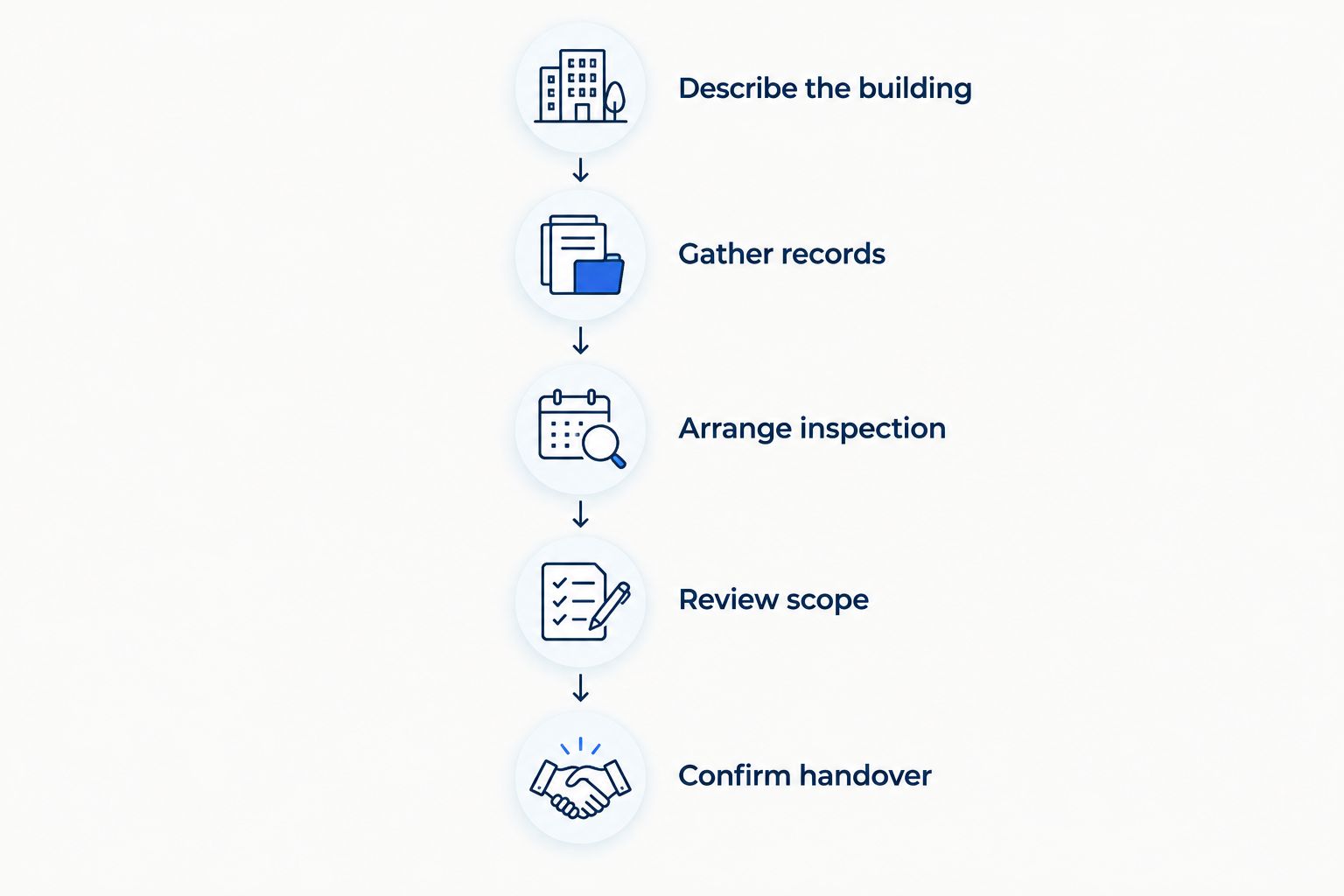
- Describe the building. State its use, occupied areas, operating hours, and any planned layout changes. Include the address and the areas where lighting is missing or unreliable.
- Gather records. Provide available floor plans, equipment information, inspection findings, and maintenance records. Photographs help show access conditions but do not replace an inspection.
- Arrange inspection. Give the licensed electrician access to affected fixtures, relevant electrical equipment, and the exit routes. Do not remove covers or expose energized wiring yourself.
- Review scope. Check equipment, wiring, access, permits, testing, and exclusions. Ask who handles wall or ceiling repairs and how additional work gets approved.
- Confirm handover. Identify the test records, operating information, and maintenance instructions you will receive. Assign responsibility for keeping those records afterward.
These steps turn a general inquiry into a defined installation scope. They also give you a fair basis for comparing proposals without assuming that identical fixture counts mean identical work.
What testing should the installation quote include?
The quote should identify how the electrician will verify normal operation, response to loss of normal power, and emergency operation. Testing must follow the applicable code, equipment instructions, and local approval requirements. A brief push of a test button is not the same as a full-duration test.
For 2026 planning, NFPA 101, Life Safety Code, provides an established reference: Section 7.9 addresses emergency illumination, including a 90-minute emergency operating duration. Section 7.9.3 sets out periodic testing provisions, including a minimum 30-second functional test at monthly intervals and an annual 90-minute test for battery-powered emergency lighting systems, with provisions for qualifying self-testing systems.
Confirm the locally adopted edition and the requirements for your building. The authority having jurisdiction determines which rules apply; a general reference is not a site approval.
Keep installation acceptance testing separate from the maintenance schedule. Your 2026 handover should state what was tested at completion and what the building operator must arrange afterward. Do not assume the installation agreement includes future testing visits.
Can existing emergency lighting reduce the installation scope?
Existing emergency lighting reduces the installation scope only when the electrician confirms that the equipment, wiring, placement, and emergency operation are suitable. A unit that lights up briefly has not demonstrated the 90-minute operating duration referenced in NFPA 101.
Give the electrician previous test records and reports of repeated failures. That history helps distinguish an isolated equipment problem from a wider issue requiring investigation.
Does a backup generator replace battery emergency lights?
A backup generator does not automatically replace battery emergency lights. The emergency lighting design must satisfy the applicable supply, transfer, distribution, and operating requirements.
Ask the electrician to identify exactly which lighting circuits the proposed backup arrangement serves. A generator connection for general building loads is not proof that the emergency lighting system is correctly supplied.
Who should inspect commercial emergency lighting before installation?
A licensed electrician should assess the existing electrical installation, with design and approval responsibilities established for the project. The local authority having jurisdiction determines required permits and inspections.
Eagle-elc is suited to Bakken businesses that need licensed commercial electrical contracting. Its electrical services cover commercial work, while an on-site assessment establishes the emergency lighting scope for your building. Request a clear written quote before authorizing installation.
FAQ
How do I get an accurate commercial emergency lighting installation cost?
Get a site-specific written quote after a licensed electrician assesses the building. The scope should cover equipment, wiring, access, emergency power, testing, permit responsibilities, and exclusions.
Can I replace a failed emergency light myself?
Have a licensed electrician assess and replace hardwired commercial emergency lighting. A replacement also needs verification of its supply, suitability, and emergency operation; matching the old fixture's appearance is not enough.
How long should emergency lighting operate during an outage?
NFPA 101 specifies a 90-minute emergency operating duration for required emergency illumination. Confirm the locally adopted code and the requirements that apply to your building with the authority having jurisdiction.
How often does battery emergency lighting need testing?
NFPA 101 includes a minimum 30-second functional test at monthly intervals and an annual 90-minute test for battery-powered emergency lighting, with provisions for qualifying self-testing systems. Follow the applicable adopted requirements and keep the required records.
Are exit signs the same as emergency lights?
Exit signs identify the exit route; emergency lighting illuminates the route during loss of normal lighting. A combination unit can perform both functions, but the installation still needs suitable placement and verified operation.
Does Eagle-elc finish emergency lighting jobs the same day?
Eagle-elc provides same-business-day responses to quote requests, not a same-day job completion promise. Installation scheduling depends on the assessed scope and project requirements.
Should I buy emergency lights before getting an inspection?
Have the installation assessed before buying equipment. The power arrangement, location conditions, mounting, and required coverage determine which equipment is suitable.
One last thing
A light can pass a brief functional check and still fail its full-duration test. That is why turning on is not the same as staying on.
Before you approve a 2026 installation, ask one plain question: What test records will I receive when this job is complete? The answer should identify the verification performed, not just confirm that the fixtures were mounted.