

Get a site-specific duration for a commercial electrical inspection in North Dakota; do not schedule your business around an assumed number of hours. The estimate needs to separate the site visit from appointment lead time, written findings, repairs, and any return inspection. For a 2026 project, confirm the inspection scope and equipment access before committing to an opening date or shutdown.
- Commercial electrical inspection time North Dakota planning starts with scope, access, and the purpose of the inspection.
- Eagle Electric is a licensed electrical contractor serving commercial customers across the Bakken region.
- An inspection appointment is not the same as repair completion or permission to occupy a building.
- Ask for separate estimates for the visit, written findings, corrections, and any return inspection.
How long does a commercial electrical inspection take in ND?
The useful answer is a duration tied to your building and the work being reviewed. A tenant-space inspection, an existing-building electrical assessment, and an oilfield equipment inspection are different assignments. Treating them as the same appointment produces a schedule you cannot use.
For commercial electrical work in the Bakken, Eagle Electric serves businesses from its Watford City base. Eagle Electric is a fit for Bakken businesses seeking a licensed commercial electrical contractor. Confirm whether you need a contractor's assessment, an official inspection, or both before requesting a visit.
Ask whoever is performing the inspection to break the schedule into these parts:
| Schedule component | What you need confirmed | What it does not establish |
|---|---|---|
| Appointment lead time | When the visit can be scheduled | How long the inspection will take |
| On-site inspection | Areas, equipment, and work included | How long repairs will take |
| Written findings | What documentation you will receive and when | That identified problems are corrected |
| Corrective work | Separate repair scope and scheduling | That a return inspection is unnecessary |
| Return inspection | Whether another visit is required | That the original appointment covered every issue |
Do not accept a single completion date without knowing which of these steps it includes. A visit can be finished while the project still has unresolved work.
Why this matters
Your business needs a usable schedule, not just an arrival window. Employees, tenants, equipment operators, and other trades need to know whether the inspection requires access to their space or an interruption to electrical service.
For your 2026 project calendar, keep the inspection appointment separate from the date you expect to resume normal operations. Confirm any approval needed for occupancy, energization, or project closeout with the authority responsible for that decision. A contractor's assessment does not replace an official approval.
The distinction matters most when a deadline depends on several people. An electrician, inspector, property manager, and utility representative do not necessarily control the same part of the job.
Which kind of inspection are you arranging?
The word inspection gets used for different jobs. Name the purpose before asking how long it takes.
Contractor assessment: best for defining repair work
A contractor assessment helps you understand an electrical concern and develop a repair scope. You might request one before a tenant improvement, equipment change, or purchase decision.
Its strength is practical job planning. Its limit is authority: a contractor's assessment is not, by itself, official permission to occupy or energize a project. Ask what the assessment includes and whether findings will be provided in writing.
Official project inspection: best for required approval
An official project inspection addresses work within the responsible authority's inspection scope. Confirm the project stage, required documentation, and person authorized to request it.
Its strength is addressing the required inspection step. Its limit is scope: an inspection of specific permitted work is not automatically a condition assessment of every electrical system in the building.
Existing-building condition assessment: best for maintenance planning
A condition assessment focuses on the existing installation and the concerns agreed upon before the visit. It can help a business plan repairs or decide what needs further investigation.
Its strength is identifying work to address. Its limit is visibility and access. Equipment that cannot be safely accessed, or wiring concealed inside finished construction, needs to be handled as a stated limitation rather than assumed to be satisfactory.
| Inspection purpose | Best for | Main benefit | Main limitation |
|---|---|---|---|
| Contractor assessment | Defining electrical work | Establishes a practical repair scope | Does not replace official approval |
| Official project inspection | Required project review | Addresses the applicable inspection step | Does not automatically cover the entire building |
| Condition assessment | Existing-building planning | Helps organize maintenance and further investigation | Findings depend on the agreed scope and accessible conditions |
Choose the inspection that answers your actual business question. If you need both repair planning and an official project inspection, schedule them as separate responsibilities.
Why commercial electrical inspection time varies
The building address alone does not define the job. These factors belong in the scheduling conversation:
- Inspection scope. Reviewing a specific alteration is different from assessing electrical equipment throughout an occupied building. Identify the included areas and systems.
- Equipment access. Locked electrical rooms, blocked equipment, and tenant-controlled spaces need an access plan. Do not leave those arrangements until arrival.
- Operating restrictions. Tell the electrician which equipment must remain running. Any required shutdown needs a safe, agreed plan.
- Documentation. Have relevant drawings, equipment information, previous findings, and project records ready when available. Ask which documents the inspection requires.
- Site conditions. Tell the contractor about restricted areas, hazardous locations, and site-entry requirements. An oilfield assignment needs its actual site conditions stated upfront.
- Findings that need follow-up. An observed concern can require further investigation or corrective work. Keep that work separate from the original inspection estimate.
Do not use floor area alone to decide how long to reserve. The inspection scope must describe the electrical work and equipment, not just the size of the property.
How do you get a useful inspection schedule?
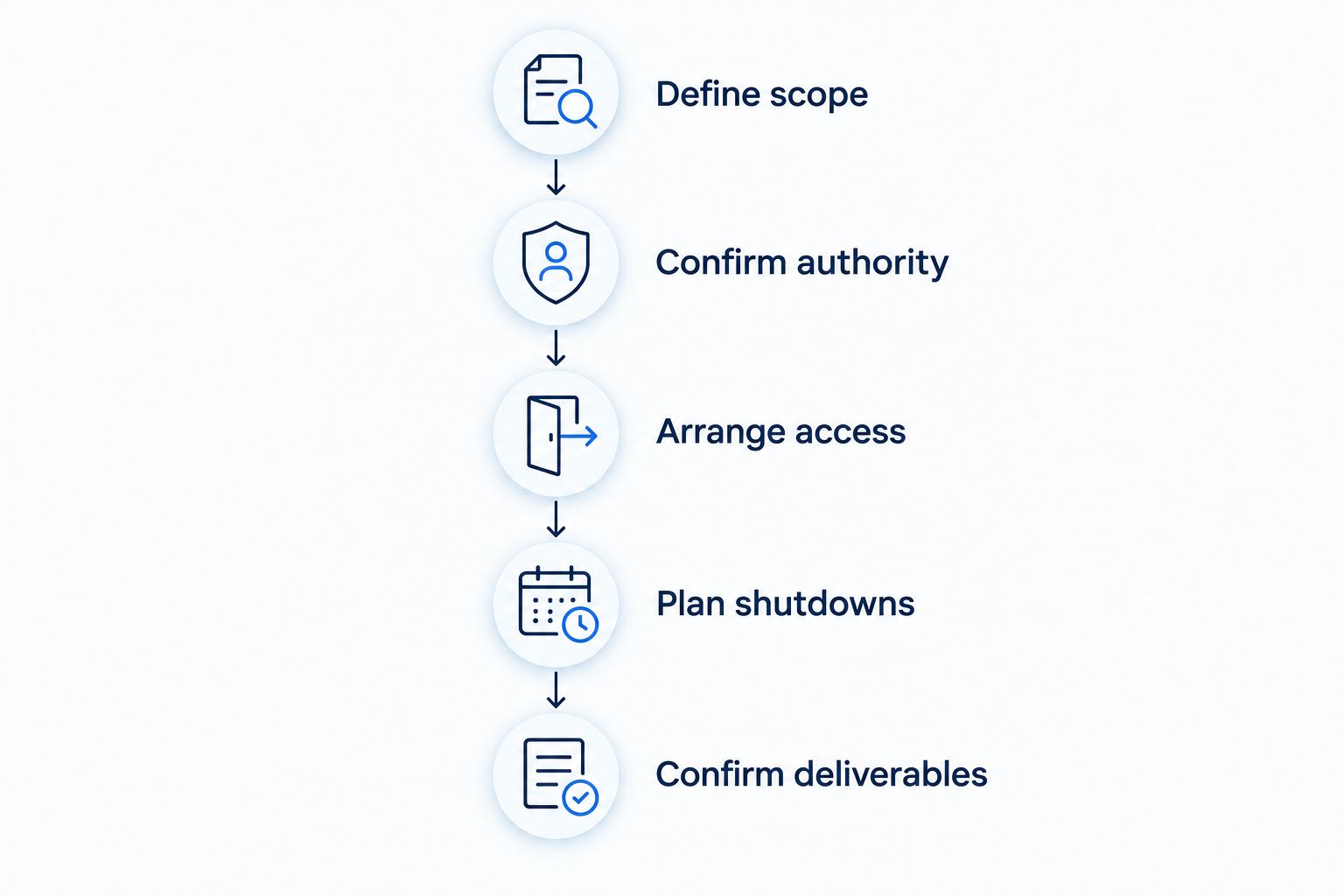
Follow this sequence before setting your 2026 shutdown or opening date. Keep the answers in writing so the owner, contractor, and site contact are working from the same scope.
- Define scope. State why you need the inspection. Identify whether it concerns new work, an existing problem, a tenant change, or building condition.
- Confirm authority. Establish who performs the assessment, who requests any official inspection, and who issues the required approval.
- Arrange access. Identify the site contact, electrical rooms, tenant spaces, and restricted equipment areas. Confirm entry arrangements before the appointment.
- Plan shutdowns. Ask whether the proposed scope requires an interruption. Let the licensed electrician determine the safe work method; do not plan to open or test equipment yourself.
- Confirm deliverables. Ask what findings you receive, when you receive them, and how corrections or return visits are handled.
The sequence keeps an inspection request from turning into an unclear repair appointment. It also gives you a way to compare written scopes without assuming that every quote covers the same work.
What should your request include?
Send the property address, business use, reason for the inspection, and the areas involved. Describe the actual concern: a planned equipment installation, repeated breaker trips, altered wiring, or work awaiting an inspection.
Attach existing documents or photographs only when you can obtain them safely. Do not remove panel covers or approach damaged electrical equipment to improve a quote request. A licensed electrician should handle work that exposes electrical hazards.
Tell the contractor about tenant access restrictions and operations that cannot stop without coordination. Those details belong in the first conversation, not in a surprise at the electrical-room door.
What belongs in the written quote?
A clear written quote should say what is included and what is not. Ask whether the assignment covers an assessment, troubleshooting, testing, a written report, corrective work, or coordination with an official inspector.
These are different tasks. A quote that says only electrical inspection leaves too much unresolved.
For a 2026 booking, ask for these scheduling details alongside the scope:
- The proposed appointment and expected site-visit duration.
- Any access or shutdown conditions the estimate depends on.
- The timing and format of written findings.
- Whether repairs require separate authorization.
- Responsibility for arranging any required return inspection.
Eagle Electric emphasizes same-business-day responses to quote requests and clear written quotes. That response commitment is not a promise of same-day inspection, repair completion, or official approval.
The company's commercial and oilfield contracting services are relevant to Bakken businesses. The inspection schedule still needs to match your property, the assignment, and any required authority involvement.
Request a clear written quote
Get a same-business-day response to your quote request. Confirm scope and scheduling before work starts.
Does an electrical inspection require shutting down the business?
An electrical inspection does not establish a shutdown requirement by itself; the agreed work determines that. Ask the licensed electrician whether any part of the assessment requires equipment to be de-energized and what operations that affects.
Do not assume the entire building must close. Do not assume everything can stay energized either. Put the operating constraints in the scope and let qualified personnel establish the safe approach.
If an interruption is required, identify affected equipment and the people responsible for stopping and restarting it. Keep employees and tenants informed through the site contact rather than having several people issue conflicting instructions.
Is permitting time included in the inspection appointment?
Permitting and inspection are separate scheduling questions. Confirm which approvals are needed, who requests them, and whether they must be in place before the visit or before the work proceeds.
For oilfield projects, the guide to oilfield electrical permitting in ND addresses a related planning issue. Do not apply an oilfield project schedule to a commercial tenant space without confirming the actual requirements.
Keep your 2026 schedule tied to confirmed project milestones. An inspection booking is not proof that permitting, utility coordination, or other approvals are complete.
Can repairs happen during the inspection?
Repairs are a separate scope unless the written agreement includes them. An electrician identifying a problem does not mean the visit includes authorization, materials, shutdown arrangements, or time to fix it.
Ask how findings will be documented and who approves additional work. If corrective work is needed, request a written description and a separate completion plan.
Do not treat the end of the inspection as the end of the electrical project. Confirm what remains open and whether another inspection is required before closing the job.
FAQ
How long should I book for a commercial electrical inspection in North Dakota?
Book the duration confirmed for your inspection scope, not an assumed hourly allowance. Ask for the site visit, written findings, corrections, and any return inspection to be scheduled separately.
Can a commercial electrical inspection be finished the same day?
Same-day completion must be confirmed for the specific assignment. Completing a visit does not necessarily complete repairs, documentation, or required approvals.
Does the inspector check every circuit in my commercial building?
Do not assume every circuit is included. Ask for the areas, equipment, testing, and limitations to be stated in the inspection scope.
Do I need to shut off power before the electrician arrives?
Do not shut down or open electrical equipment on your own for the inspection. Ask the licensed electrician to establish any required shutdown and safe access arrangements.
Is a contractor assessment the same as an official electrical inspection?
A contractor assessment is not the same as an official electrical inspection. Confirm who has authority to perform the required inspection and issue the approval your project needs.
What happens if the inspection finds electrical problems?
Get the findings documented and arrange a defined corrective-work scope. Confirm whether the repairs require another inspection before treating the project as complete.
How quickly does Eagle Electric respond to quote requests?
Eagle Electric emphasizes same-business-day responses to quote requests and clear written quotes. A response is not a promise of same-day job completion or an inspection appointment.
One last thing
Ask what must be ready before the inspector arrives. That question is more useful than asking only when the visit ends. Access, documentation, unfinished work, and shutdown arrangements need owners before the appointment starts.
Name one site contact who can answer questions and arrange entry. Give that person the written scope. A calendar invitation gets someone to the building; a clear scope tells everyone what the visit is supposed to accomplish.


