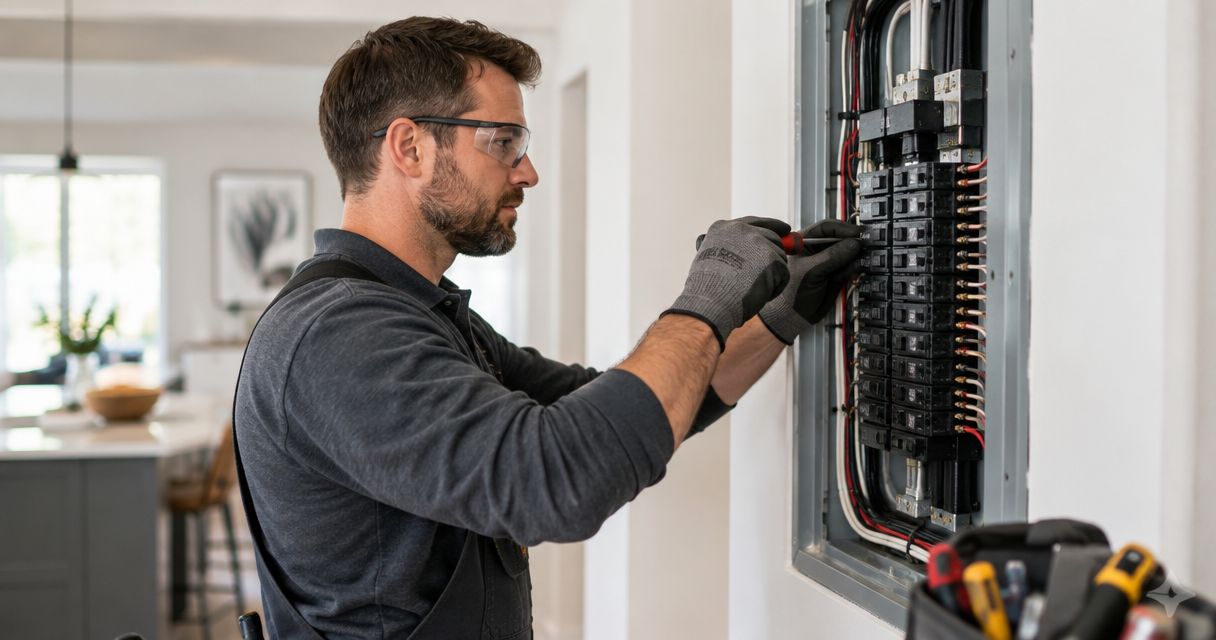
Your electrical panel upgrade cost in 2026 depends on whether you need a panel replacement, a larger electrical service, or repairs to the wiring feeding the panel. The panel itself is only part of the job: permits, utility coordination, grounding work, and wall repairs can change the scope. Get an on-site assessment and a written quote that separates those items before approving the work.
- Electrical panel upgrade cost depends on the full job scope, not just the panel's amperage.
- A panel replacement does not automatically increase electrical service capacity.
- Eagle Electric provides licensed residential electrical contracting in Watford City and the Bakken region.
- Compare written quotes for service equipment, grounding, permits, inspections, and repair exclusions.
How much does an electrical panel upgrade cost in 2026?
An electrical panel upgrade needs a property-specific quote. Replacing damaged equipment is a different job from increasing service capacity, relocating a panel, or correcting old wiring. Comparing those jobs as if they were identical leads to quotes that do not add up.
For homeowners seeking licensed residential electrical contracting in Watford City and the Bakken region, Eagle Electric is a local option.
Start by identifying which scope you actually need:
| Scope | Best for | Main benefit | Limitation or added work |
|---|---|---|---|
| Panel replacement | Replacing deteriorated or unsuitable panel equipment | Addresses the panel equipment itself | Does not automatically increase service capacity or fix downstream wiring |
| Service upgrade | Supporting a calculated increase in electrical demand | Increases capacity when the complete service is properly sized | Can require utility coordination and changes beyond the panel |
| Subpanel installation | Adding circuit spaces in a suitable location | Provides additional circuit distribution | Does not create additional capacity at the main service |
Compare the complete scope, not just the equipment name. A quote for a panel replacement is not directly comparable to a quote that also replaces service conductors and the meter equipment.
Why this matters
A crowded panel and an undersized electrical service are different problems. Treating them as the same problem can leave you paying for work that does not address your actual need.
An EV charger, electric heating equipment, or a workshop changes the load assessment. Empty breaker spaces alone do not prove that your service can support the added demand. A licensed electrician needs to evaluate the existing system and the proposed loads.
For a 2026 project, put your planned equipment on the table before the quote is written. That gives the electrician a defined job to assess rather than a moving target.
Panel replacement: equipment condition comes first
Best for: a home whose panel needs replacement but whose service capacity remains adequate. The electrician assesses the enclosure, breakers, connections, circuit arrangement, and suitability of the replacement equipment.
A same-capacity replacement can address deteriorated panel equipment. It does not mean every existing circuit is safe, correctly sized, or suitable for a new appliance. Wiring defects require their own assessment and scope.
Ask whether the quote includes circuit identification, required protective devices, grounding and bonding corrections, and inspection arrangements. Also ask what happens if the electrician discovers damaged conductors after work begins.
The advantage is a defined equipment replacement. The limitation is equally important: a new panel does not automatically fix the rest of the electrical system.
Service upgrade: capacity involves more than the panel
Best for: a home whose calculated electrical demand exceeds what the existing service can support. Moving from a 100-amp service to a 200-amp service is a capacity change, not simply a bigger enclosure on the wall.
The electrician must assess the service equipment and conductors involved. Utility requirements and the condition of the existing installation determine which other components need attention.
A 200-amp panel label does not establish that the entire service is rated for 200 amps. The equipment supplying it matters. Do not assume an enclosure rating describes the capacity available to your home.
The benefit is additional capacity when the complete installation supports it. The trade-off is a broader job, with more coordination than a panel-only replacement. Ask who handles the utility disconnect, reconnection, permits, and inspections.
Subpanel installation: more spaces, not more supply
Best for: a property that needs additional circuit distribution and has adequate upstream capacity. A subpanel can serve a garage, workshop, addition, or another area where distributing circuits makes sense.
The feeder, protective devices, grounding arrangement, and connected loads still need proper design. Adding a subpanel does not increase the capacity of the service feeding it.
The advantage is flexibility in circuit distribution and equipment placement. The limitation is that a subpanel cannot solve an overloaded service by itself.
Ask the electrician to explain whether the problem is insufficient circuit spaces, insufficient capacity, or both. That distinction belongs in the written quote.
Why electrical panel upgrade cost varies
These factors change the work involved. Have the electrician identify which ones apply to your property rather than treating every possible item as a required upgrade.
- Existing equipment condition. Heat damage, corrosion, damaged conductors, and unsuitable equipment affect what must be replaced.
- Required capacity. Your existing loads and planned equipment determine whether a capacity increase is necessary.
- Service equipment. Changes to service conductors, meter equipment, or the service entrance expand the job beyond the panel.
- Panel location. Access, required working space, and relocation affect the installation and associated repairs.
- Grounding and bonding. Deficiencies need correction where required for the approved scope.
- Permits and coordination. The permitting authority, inspections, and utility requirements affect how the job is organized.
An older property also needs attention to the wiring connected to the panel. For rural homes, the guide to electrical panel upgrades for older farmhouses in western ND provides related planning context.
What should a written panel-upgrade quote include?
A useful quote describes what gets replaced, what stays, and what happens if concealed problems appear. A short description such as panel upgrade leaves too much room for disagreement.
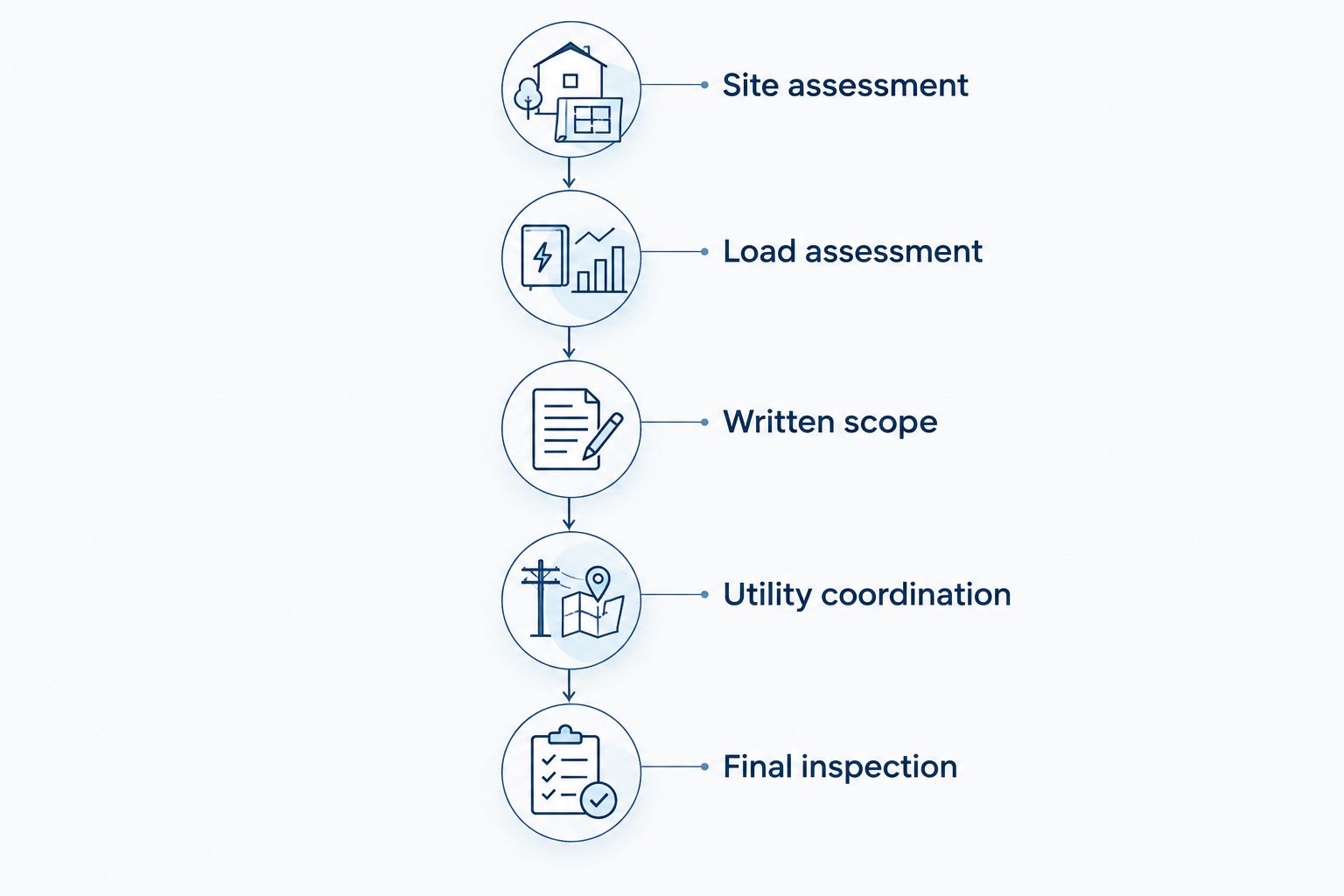
Use this sequence before you authorize the job:
- Site assessment. Have a licensed electrician inspect the accessible equipment and discuss your planned electrical loads. Do not remove the panel cover yourself.
- Load assessment. Ask whether the existing service supports the proposed demand and what supports that conclusion.
- Written scope. Identify the panel, service equipment, circuit work, and grounding or bonding corrections included.
- Utility coordination. Confirm who arranges any required disconnect and reconnection, and who communicates schedule changes.
- Final inspection. Confirm permit responsibilities, inspection arrangements, circuit labeling, and the handover documentation included.
The quote should also state who handles drywall, siding, painting, trenching, or other non-electrical restoration when those tasks apply. Do not assume the electrical contractor includes finished wall repairs simply because the panel sits in a finished room.
For your 2026 comparison, put each quote beside the same written scope. Ask about omissions before choosing a contractor, not after the service has been disconnected.
How do you compare quotes without missing exclusions?
Read the scope line by line. A shorter quote is not necessarily a simpler installation; it can also leave responsibilities undefined.
Use these questions to get clear answers:
- Does this replace the panel only, or also increase service capacity?
- Which existing components will remain in use?
- Are required breakers and protective devices included?
- Who obtains permits and arranges inspections?
- Who coordinates with the utility?
- Which repairs or concealed conditions require separate authorization?
Ask how changes will be documented. Additional work should have a clear explanation and written authorization before it proceeds, except where immediate action is necessary to address an unsafe condition.
Eagle Electric emphasizes same-business-day responses to quote requests and clear written quotes. A quote response is not a promise of same-day job completion; the installation schedule depends on the assessed work and required coordination.
Request a written electrical quote
Get a same-business-day response to your quote request. An on-site assessment defines the work.
Do you need a 200-amp service for an EV charger?
A 200-amp service is not automatically required for every EV charger installation. The electrician must consider the home's existing demand, the charging equipment, and the proposed circuit.
An EV charger commonly introduces a 240-volt load, but voltage alone does not determine the service capacity needed. The equipment rating and the home's other loads matter. Suitable load-management equipment is another option to discuss during the assessment.
Do not buy a larger panel solely because you plan to charge a vehicle. First establish whether you need additional circuit space, additional service capacity, or a different charging arrangement.
Will a new panel stop breakers from tripping?
A new panel does not automatically stop breaker trips. A trip can indicate an overloaded circuit, a fault, a connected-equipment problem, or another condition that needs diagnosis.
Replacing the panel without finding the cause leaves the original problem unresolved. Tell the electrician which breaker trips, what equipment is running, and whether you have noticed heat, buzzing, or a burning smell.
Never install a larger breaker just to stop tripping. Breaker sizing must match the circuit design and conductor requirements.
Can you stay home during a panel replacement?
Staying home depends on the work area and the planned outage. Confirm access restrictions and the expected interruption before the installation date; do not assume the home will remain powered during service work.
Make a plan for medical equipment, refrigeration, heating controls, internet access, and other essential loads. Tell the electrician about these needs while scheduling the job.
For a 2026 panel project, discuss backup power before the outage is arranged. Never connect a generator to household wiring through an improvised cord or an arrangement that can backfeed the utility.
When should you stop using the panel and call for help?
Burning smells, smoke, arcing, visible heat damage, or water affecting electrical equipment need urgent attention. Stay clear of the equipment. Call emergency services if there is smoke, fire, or an immediate threat to people.
Do not remove covers, reach into the panel, or touch wet electrical equipment. Parts of service equipment can remain energized even when the main breaker is off.
Eagle Electric provides residential electrical contracting, but an article cannot diagnose a damaged panel. An on-site inspection by a licensed electrician is needed to establish the fault and repair scope.
FAQ
How do I get an accurate electrical panel upgrade cost in 2026?
Get an on-site assessment and a written quote for the complete job. The quote should distinguish panel replacement from service-capacity changes and identify permits, utility coordination, wiring corrections, and exclusions.
Is replacing a panel the same as upgrading electrical service?
No. Panel replacement changes the panel equipment; a service upgrade increases capacity only when the complete service installation supports the new rating.
Is a 200-amp panel enough for my house?
A 200-amp rating alone does not establish whether the installation meets your home's needs. A licensed electrician must assess the service equipment and calculate demand from existing and planned loads.
Can I save work by adding a subpanel instead?
A subpanel is appropriate when you need additional circuit distribution and the upstream supply has adequate capacity. It does not increase the capacity of your main electrical service.
Does a panel replacement include rewiring the house?
A panel replacement does not automatically include whole-house rewiring. The written scope should identify circuit repairs and explain how concealed wiring defects will be handled.
Can I replace my electrical panel myself?
Use a licensed electrician for panel replacement and service work. Service equipment presents serious shock and arc hazards, and parts can remain energized with the main breaker switched off.
Does Eagle Electric promise same-day panel replacement?
A same-business-day response to a quote request is not a same-day installation promise. The job schedule depends on the on-site assessment, utility coordination, permits, and the agreed scope.
One last thing
A larger panel is not the same as a larger electrical supply. Before approving a 2026 upgrade, ask the electrician to identify the service capacity, the calculated demand, and the exact problem the proposed work solves.
That explanation should be plain enough to understand without opening the panel. If the quote says only panel upgrade, ask for the missing scope in writing.