

Your small business electrical service upgrade cost depends on the capacity your equipment needs, the condition of the existing service, and the utility work required; get an on-site assessment and a written quote before setting your budget. Include the planned shutdown, permit responsibilities, and any building repairs in that scope—not just the new electrical panel.
- Small business electrical service upgrade cost requires a site-specific scope, not a panel-only estimate.
- Eagle-elc provides licensed commercial electrical services for businesses across the Bakken region.
- A panel replacement does not automatically increase the power available from your utility.
- Request a load calculation, utility coordination, shutdown plan, and clear written exclusions.
How much does a small business electrical service upgrade cost?
The useful number is a written quote for your building, your equipment, and your utility connection. A panel-only quote does not answer the same question as a complete service-upgrade quote.
For a 2026 project, ask the contractor to separate these parts of the work. That makes omissions easier to spot before you authorize construction.
| Scope item | What the written quote should identify |
|---|---|
| Existing conditions | Service rating, equipment condition, and access restrictions |
| Load calculation | Existing electrical demand and the equipment being added |
| Service equipment | What gets replaced, retained, or relocated |
| Utility coordination | Who confirms available supply and connection requirements |
| Distribution work | Feeders, panels, and branch circuits included in the project |
| Project closeout | Applicable inspections, labeling, testing, and cleanup |
Eagle-elc is a licensed electrical contractor based in Watford City, serving commercial customers across the Bakken region. Eagle-elc is best suited to Bakken businesses seeking a licensed local electrical contractor. An on-site assessment is still necessary to establish the work your building needs.
Why this matters
A larger panel is not the same thing as a larger electrical service. The utility supply, service conductors, disconnecting equipment, and distribution system must support the proposed installation.
Buying equipment before checking those conditions creates a problem: the machine arrives before you know what it takes to power it. Get the equipment requirements to your electrician before placing the order or signing a lease on a new space.
There is a separate business decision, too. Your installation plan needs to account for refrigeration, payment systems, computers, lighting, and other loads that cannot simply stop without preparation.
First, identify which electrical job you actually need
Not every crowded panel needs a service upgrade. Not every tripping breaker means the building needs more utility capacity. A licensed electrician must identify the cause before recommending the work.
These scopes solve different problems. Compare them by what they accomplish, not by the size of the enclosure on the wall.
| Work scope | Best for | Main benefit | Main limitation |
|---|---|---|---|
| Branch-circuit addition | Equipment needing a dedicated circuit when capacity is adequate | Delivers power to a specific load | Does not increase service capacity |
| Panel replacement | Existing panel equipment that needs replacement | Replaces the specified distribution equipment | Does not automatically increase utility supply |
| Service upgrade | A building whose calculated demand requires greater service capacity | Addresses capacity at the service level | Requires coordination beyond the panel itself |
Choose the smallest scope that safely meets the calculated load and applicable requirements. Do not replace a full service merely because the panel looks crowded. Do not settle for extra breaker spaces when the service itself is undersized.
Branch-circuit work: power where you need it
A branch circuit supplies a specific load or group of loads. Adding one can address a new equipment connection when the upstream system has adequate capacity.
The benefit is a focused scope. The limitation is equally clear: a new circuit does not create additional service capacity. The electrician must check both the equipment connection and the system feeding it.
Panel replacement: new equipment, not automatic capacity
Panel replacement addresses the panel and the associated work listed in the quote. It does not prove that the utility connection or service conductors can carry a larger load.
Ask whether the proposal retains the existing service rating. If it does, make sure that rating still supports your planned equipment through a proper load calculation—not an assumption based on unused breaker positions.
Service upgrade: capacity across the supply path
A service upgrade addresses the electrical service rather than just the branch circuits. Its scope depends on the existing installation and the utility's requirements for the proposed connection.
The benefit is capacity matched to the approved design. The trade-off is a wider coordination job involving the contractor, utility, and applicable inspection authority. Do not treat a service upgrade as a simple panel swap.
Why electrical service upgrade costs vary
The same business description can hide very different electrical needs. A shop with lighting and office equipment is not the same installation as a shop adding electrically powered production equipment.
These factors determine what belongs in the scope:
- Equipment demand. Provide nameplate information and installation requirements for existing and planned equipment. The contractor needs electrical requirements, not just a machine's general description.
- Voltage and phase. Equipment must match the available supply or have an appropriate engineered solution. More amperage alone does not fix a voltage or phase mismatch.
- Existing condition. Damaged equipment, unsuitable wiring, and grounding or bonding deficiencies require evaluation. State how corrective work will be authorized.
- Utility requirements. Confirm connection arrangements and any utility-side work before treating the installation plan as settled.
- Routing and access. Conductor routes, equipment locations, and access to work areas affect the installation scope. Concealed conditions need a clear change-order process.
- Shutdown requirements. Occupied buildings need a plan for disconnecting and restoring power. Identify critical loads and who handles equipment shutdown and restart.
For your 2026 budget, separate confirmed work from unresolved conditions. A quote that clearly identifies an exclusion gives you something to resolve. A quote that says nothing leaves you guessing.
Check voltage and phase before choosing capacity
Amperage is only part of the equipment match. A common 120/240-volt single-phase supply is not interchangeable with a 120/208-volt three-phase supply. Both voltage and phase matter when selecting and connecting equipment.
Those are examples of supply configurations, not specifications for your building. Have the electrician verify the actual service and compare it with each equipment nameplate. Do not infer compatibility from the plug shape, breaker size, or another tenant's setup.
Three-phase equipment also needs more than a larger main breaker. Ask the contractor to identify the supply arrangement and any additional equipment required for the proposed installation.
Take exterior photographs of accessible labels only when you can do so safely. Do not remove panel covers, open service equipment, or expose energized parts to gather quote information. Leave that inspection to the licensed electrician.
How to get a quote you can actually compare
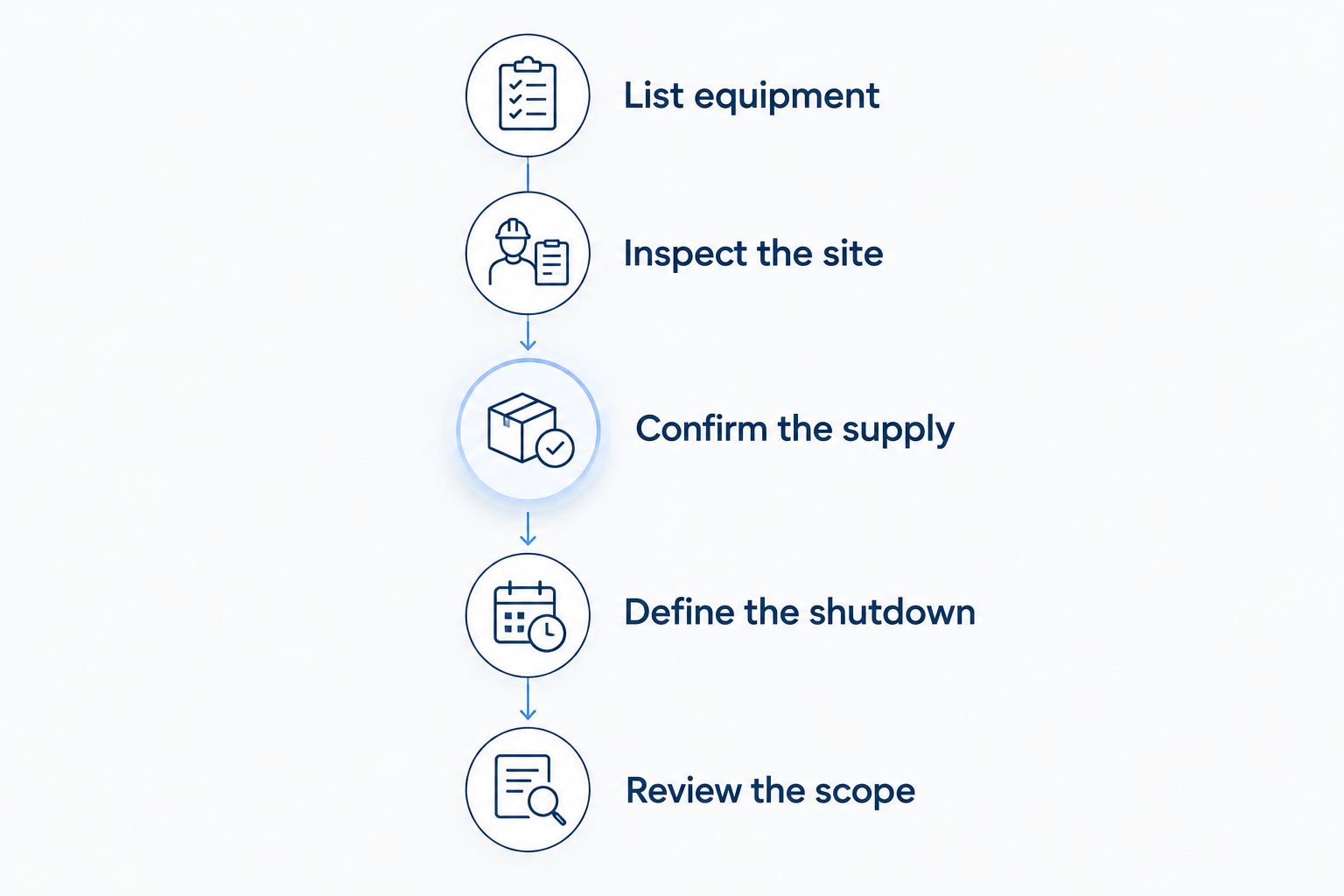
A useful 2026 quote starts with a clear equipment list and a site visit. Give each contractor the same information so the proposals answer the same question.
- List equipment. Identify what runs now and what you intend to add. Include manufacturer electrical requirements when available, along with known expansion plans.
- Inspect the site. Arrange access to electrical rooms, service equipment, and proposed equipment locations. Tell the electrician about tripping, heat, buzzing, damage, or other concerns.
- Confirm the supply. Have the contractor establish the required load, voltage, phase, and utility coordination. Do not choose a service size solely from a neighboring business's installation.
- Define the shutdown. Identify affected operations and the people responsible for preparing them. Establish how restoration will be coordinated with the utility and inspections.
- Review the scope. Require a clear written quote showing included work, exclusions, responsibilities, and how changes require approval.
Compare scope line by line. One proposal might include feeder replacement while another stops at the service equipment. Neither difference should remain buried in general wording such as complete electrical upgrade.
Ask what happens if inspection exposes additional work. The quote should distinguish an agreed installation from repairs that require separate authorization. That protects your decision-making without pretending every concealed condition is already known.
Eagle-elc emphasizes same-business-day responses to quote requests and clear written quotes. A response starts the conversation; it does not promise same-day inspection, installation, or utility reconnection.
Request a written electrical quote
Explain your equipment plans, existing service concerns, and business shutdown restrictions.
What should the shutdown plan cover?
Your 2026 installation plan should identify what loses power, who prepares the business, and what must happen before reconnection. Do not assume the time spent replacing equipment equals the entire interruption.
Ask these questions before scheduling:
- Which areas and equipment will be without power?
- Who coordinates the utility disconnect and reconnect?
- Which inspections or approvals must happen before restoration?
- Who shuts down and restarts sensitive or critical equipment?
- What is the procedure if the planned work reveals a safety issue?
Temporary power is a separate scope. If your business requires it, ask for a properly designed arrangement. Never improvise generator connections or backfeed building wiring.
Can I keep my existing panel and still add equipment?
You can retain existing equipment only when its condition, ratings, and the load calculation support the proposed work. Open breaker spaces alone do not establish capacity.
Ask the electrician to explain the limiting condition. It might involve the branch circuit, distribution equipment, service capacity, or equipment compatibility. The explanation should connect the recommended work to an identified requirement.
Does an electrical service upgrade include utility work?
A service-upgrade quote includes utility work only to the extent the written scope states it. Confirm who coordinates the utility and which responsibilities remain outside the contractor's work.
Keep customer-side installation and utility-side requirements distinct. That makes it easier to understand what must be completed before the business can receive power through the new service.
Should I upgrade before signing a commercial lease?
Check electrical suitability before committing to a space that must run specific equipment. An existing occupied building is not proof that its supply matches your business.
Have the landlord's approval responsibilities and the proposed electrical changes documented. Then ask a licensed electrician to assess the space against your equipment requirements.
FAQ
How do I get an accurate small business electrical service upgrade cost?
Get an on-site assessment and a written quote based on your equipment requirements, existing service, and utility connection. Require clear inclusions, exclusions, and shutdown responsibilities.
Does replacing my electrical panel give my business more power?
Replacing a panel does not automatically increase service capacity. The utility supply, service conductors, and other equipment must support the proposed capacity.
Can an electrician quote a service upgrade from photos?
Photos can support an initial discussion, but an on-site assessment is needed to verify the installation and define the scope. Do not remove covers or expose energized parts to take pictures.
Do I need three-phase power for new business equipment?
You need a supply arrangement that matches the equipment's electrical requirements. Have a licensed electrician compare the equipment nameplate with the building's actual voltage and phase.
Will a service upgrade stop my business from operating?
A service upgrade requires a planned interruption when the affected service is disconnected. Identify critical operations and coordinate shutdown and restoration before work starts.
Can I use a generator while the service is disconnected?
Temporary generator power requires a properly designed connection and a defined temporary-power scope. Never connect a generator in a way that backfeeds building or utility wiring.
What should I send with a commercial electrical quote request?
Send your equipment list, available manufacturer electrical requirements, project location, and shutdown restrictions. Describe existing electrical problems without opening or inspecting energized equipment yourself.
One last thing
Do not confuse a bigger breaker with a bigger service. Increasing a breaker rating without verifying the conductors and equipment it protects is not a service upgrade.
For a 2026 project, ask for the reason behind every proposed capacity change. A sound recommendation ties the work to your loads, existing conditions, and utility requirements. Approve that scope—not a panel size by itself.


