

There is no fixed time to restore power after an oilfield electrical outage: the schedule depends on where the fault is, what needs repair, and whether the site can restart safely. A utility interruption, a damaged feeder, and a motor-control fault require different work. Power returning to the service entrance does not mean production equipment is ready to run.
- To restore power after oilfield electrical outage, separate utility restoration, site electrical repairs, and production restart.
- Eagle Electric provides licensed oilfield electrical contracting for Bakken operators needing on-site electrical assessment.
- Do not repeatedly reset tripped breakers or bypass protective devices to restart equipment.
- Ask for a repair scope, remaining dependencies, and a separate restart plan—not an unsupported completion promise.
How long does it take to restore power after an oilfield outage?
A useful restoration estimate starts with the fault location, not the outage start time. A licensed electrician needs to establish whether the interruption is upstream of the site, inside the site's distribution system, or limited to connected equipment. Each condition has a different repair scope and different parties controlling the schedule.
For a Bakken site seeking help in 2026, Eagle Electric's electrical services include oilfield electrical contracting. Request an on-site assessment rather than treating a remote guess as a production commitment.
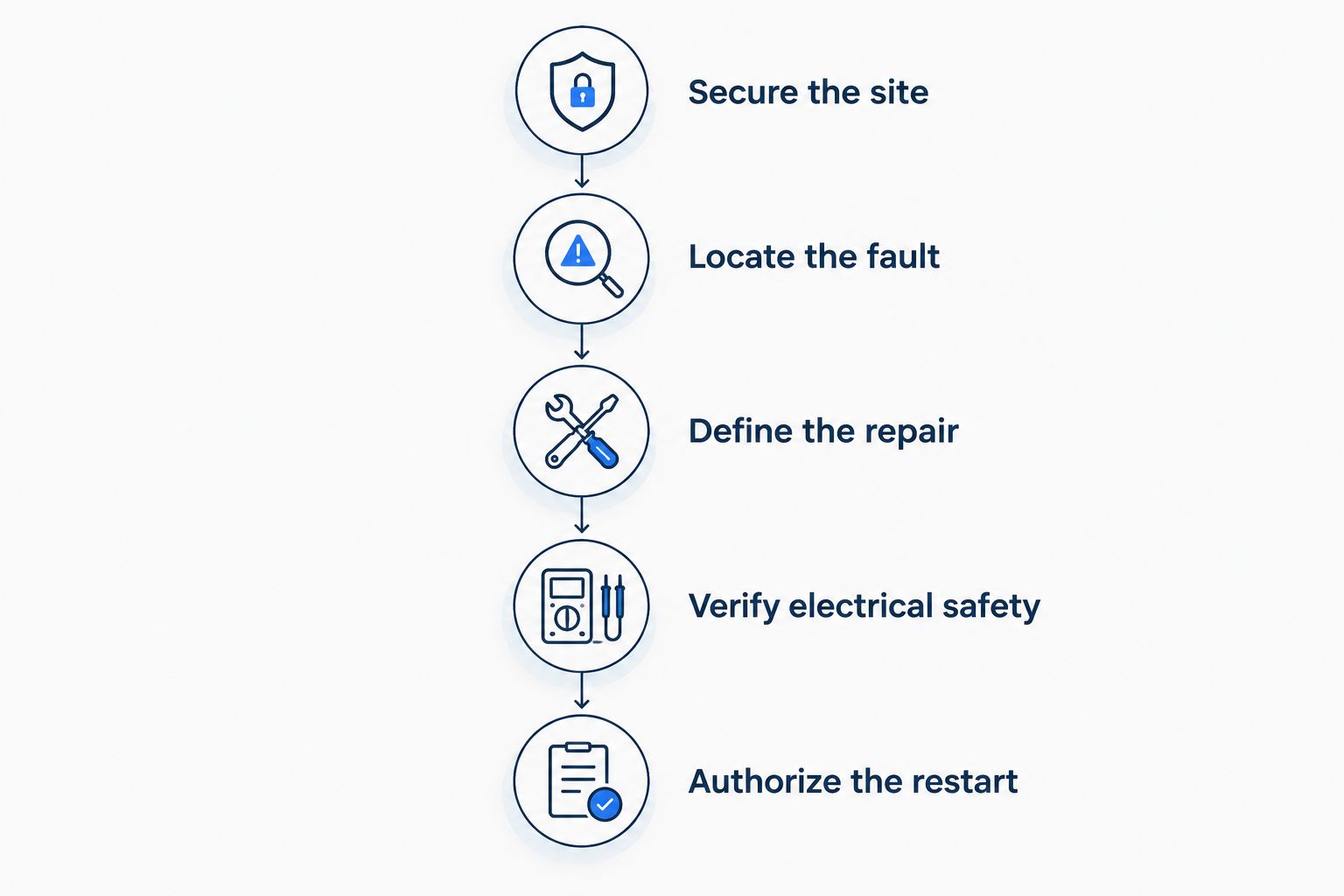
The restoration process has separate checkpoints:
- Secure the site. Keep personnel away from damaged equipment, exposed conductors, downed lines, and suspected electrical hazards. Follow the site's emergency procedures and involve emergency responders when conditions require them.
- Locate the fault. Qualified personnel determine whether the problem involves the utility supply, site distribution, controls, or individual equipment. Operators should report what stopped, not open enclosures to investigate.
- Define the repair. The electrician identifies damaged components, required replacement equipment, access restrictions, and coordination needs. This is where a repair estimate becomes useful.
- Verify electrical safety. Repairs require appropriate inspection and testing before authorized re-energization. A breaker staying closed does not establish that the entire installation is safe.
- Authorize the restart. Site operations checks the process conditions, controls, alarms, and equipment readiness before restarting production. Electrical clearance and operational clearance are different decisions.
Why this matters
An outage has an electrical endpoint and an operating endpoint. Confusing them puts pressure on crews to restart before the equipment and process are ready.
Your 2026 outage plan should track both. Record when power becomes available, then separately record when the responsible personnel release equipment for operation. That distinction gives dispatch, maintenance, and production staff a clearer picture of what remains.
Ask what is blocking the next safe step. That question produces a more useful update than repeatedly asking when the whole site will be back online.
What the fault location means for restoration
Use the table below to understand the repair path. It is not a troubleshooting guide for opening energized equipment.
| Outage condition | Main restoration dependency | What electrical restoration does not settle |
|---|---|---|
| Utility supply interruption | Utility work and confirmation that supply is available | Whether site equipment was damaged or is ready to restart |
| Damaged site feeder or distribution equipment | Isolation, assessment, compatible replacement components, and testing | Whether unaffected loads can safely operate separately |
| Fault limited to one equipment circuit | Inspection of the circuit, protection, controls, and connected equipment | Whether the process can operate without that equipment |
| Control or protective-device shutdown | Identifying the shutdown cause and verifying required conditions | Whether clearing an alarm also resolves the underlying problem |
| Damage involving a hazardous location | Electrical assessment consistent with the area's classification | Whether ordinary replacement equipment is suitable |
A utility outage and a site fault can exist together. Confirmation that neighboring facilities have power is useful information, but it does not prove your incoming service or equipment is sound.
Record the actual fault identified by qualified personnel. Avoid closing an incident report with only “power outage” when the inspection establishes a more specific cause.
Why oilfield power-restoration time varies
These factors control the work sequence. None supports a blanket completion promise before assessment.
- Fault location. Utility equipment, site distribution, and individual machines have different repair responsibilities. The responsible party must be identified before the schedule is clear.
- Damage extent. An isolated component failure and damage affecting several connected assemblies require different repair scopes. Testing establishes the boundaries.
- Replacement requirements. Electrical ratings, equipment compatibility, and hazardous-location suitability restrict what can replace a damaged component. A physically similar part is not enough.
- Safe access. Road conditions, equipment access, site hazards, and required work controls affect when personnel can assess and repair the installation.
- Coordination requirements. Utility switching, site isolation, inspections where required, and operator authorization can depend on different people. Their work must follow the correct sequence.
- Restart conditions. Controls, interlocks, alarms, and the connected process need appropriate checks. Electrical repair alone does not authorize production.
For 2026 maintenance planning, assign responsibility for each dependency before an outage occurs. Keep current site drawings and equipment records accessible to the people authorized to use them.
What should you report when requesting electrical help?
A clear report helps the electrician understand the site before arriving. Collect information from normal operator displays, existing records, and safe observation points—not by removing covers or entering restricted areas.
Include:
- The site name, location, access instructions, and responsible on-site contact.
- When the outage began and whether the whole site or selected equipment stopped.
- Any utility outage notice or confirmed utility information.
- Alarms, trip indications, or displayed fault codes, copied exactly.
- Smoke, unusual odors, arcing, visible damage, water exposure, or downed lines observed from a safe distance.
- Any work, switching, weather event, or equipment change immediately preceding the outage.
- Existing backup-power arrangements and known isolation status.
Report observations separately from assumptions. “The pump stopped and the control display is dark” is useful. “The breaker just needs resetting” is a diagnosis that still needs verification.
Do not approach damaged equipment to get a better photograph. If a safe photo already exists, provide it with the report, but leave enclosure access and electrical testing to qualified personnel.
What should the restoration estimate include?
A useful estimate identifies the current condition, proposed work, and unresolved dependencies. Ask for clear written scope rather than a single finish time detached from the repair findings.
The update should separate:
- What the electrician has confirmed.
- What still requires inspection or testing.
- Which repairs are proposed.
- Which equipment or outside approvals the work depends on.
- What will be checked before re-energization.
- Who authorizes the operational restart.
Ask when the next status update will occur. That commitment is different from promising that an unknown fault will be repaired by a particular deadline.
Eagle Electric emphasizes same-business-day responses to quote requests and clear written quotes. A quote response is not a promise of same-day job completion. State the outage conditions plainly so the request is not mistaken for routine scheduled work.
Request a written electrical quote
Provide the site location, outage symptoms, and known damage. Request a clear scope and next steps.
Can backup power restore production before permanent repairs?
Backup power is a possible temporary supply, not a substitute for fixing damaged wiring or equipment. A licensed electrician must assess the connection, isolation, load requirements, grounding and bonding, and equipment suitability before a temporary arrangement is used.
The choice depends on what must run and what can safely remain isolated.
| Restoration option | Best for | Main benefit | Main limitation |
|---|---|---|---|
| Repairing the normal supply | Sites that need their regular electrical system returned to service | Addresses the failed supply path | Depends on the identified repair and any outside coordination |
| Supplying selected loads temporarily | Sites with defined essential loads and an approved temporary connection | Separates essential operation from full-site restoration | Does not repair damaged downstream equipment or establish full production readiness |
| Keeping affected equipment isolated | Sites where operations confirms an unaffected area can run independently | Avoids treating every load as one restart decision | Requires verified separation and operational approval |
Do not connect a generator to damaged distribution equipment or improvise a backfeed connection. Temporary power needs its own safe design and work controls.
Your 2026 backup plan should identify essential loads before the outage, not during a rushed restart. Keep the electrical supply decision separate from the decision to resume the process.
Can you reset a breaker to get an oilfield site running again?
A tripped breaker needs assessment under the site's approved procedures; repeated resetting is not an outage-repair strategy. A protective device can be responding to a condition that remains dangerous.
Do not bypass an interlock, increase a protective-device rating, or hold a device closed to keep equipment operating. Only authorized, qualified personnel should assess the cause and determine the safe next step.
Does utility power returning mean the site is safe to restart?
Utility power returning means supply is available, not that the site's installation and process are cleared for operation. Follow the site's restart procedures and obtain the required electrical and operational releases.
Check the recorded outage conditions before restarting. Visible damage, protective-device trips, or abnormal equipment behavior require assessment rather than an assumption that the interruption was harmless.
What should a 2026 oilfield outage plan contain?
Keep the plan usable under pressure. Put the site location, emergency contacts, utility reporting details, isolation responsibilities, and restart authority where authorized personnel can find them.
Include current electrical drawings, equipment identification, essential-load priorities, and the rules for temporary power. Mark the information that operators can gather safely and the tasks reserved for qualified electrical personnel.
After the incident, record the confirmed cause, repair performed, test documentation, and remaining corrective work. Do not let temporary restoration become an undocumented permanent arrangement. Assign an owner to close the remaining work.
FAQ
How long will my oilfield site be without power?
The restoration time depends on the fault location, damage, repair requirements, and safe restart conditions. Ask for an estimate after assessment, with utility work and production restart identified separately.
Can an electrician promise restoration before visiting the site?
A completion promise made before the fault is assessed does not establish the repair scope. An on-site inspection is needed to identify the work and dependencies controlling the schedule.
What should I do first during an oilfield electrical outage?
Follow the site's emergency procedures and keep personnel away from suspected electrical hazards. Report the outage to the responsible site contact and involve emergency responders when conditions require them.
Can a generator get the entire oilfield site running?
A generator cannot be assumed to support the entire site. A licensed electrician needs to assess loads, starting requirements, connections, isolation, and the condition of the equipment being supplied.
Should operators open electrical panels to look for the problem?
Operators should not open electrical panels unless they are qualified and authorized for that work under the site's procedures. Report accessible display information and observations from safe locations instead.
Does Eagle Electric provide oilfield electrical services in the Bakken?
Eagle Electric provides licensed oilfield electrical contracting across the Bakken region from Watford City, North Dakota. Quote requests receive same-business-day responses; that is not a same-day repair guarantee.
What is the difference between restored power and restored production?
Restored power means an electrical supply is available; restored production requires the equipment and process to be cleared for operation. Electrical testing and the site's restart procedures address different parts of that decision.
One last thing
Record “power available” and “production released” as separate milestones. That simple distinction keeps a utility restoration notice from becoming an accidental instruction to restart equipment.
Before closing the incident, confirm who owns any temporary wiring, isolated equipment, and unfinished repairs. The outage report should leave the next crew with facts, not assumptions.


